

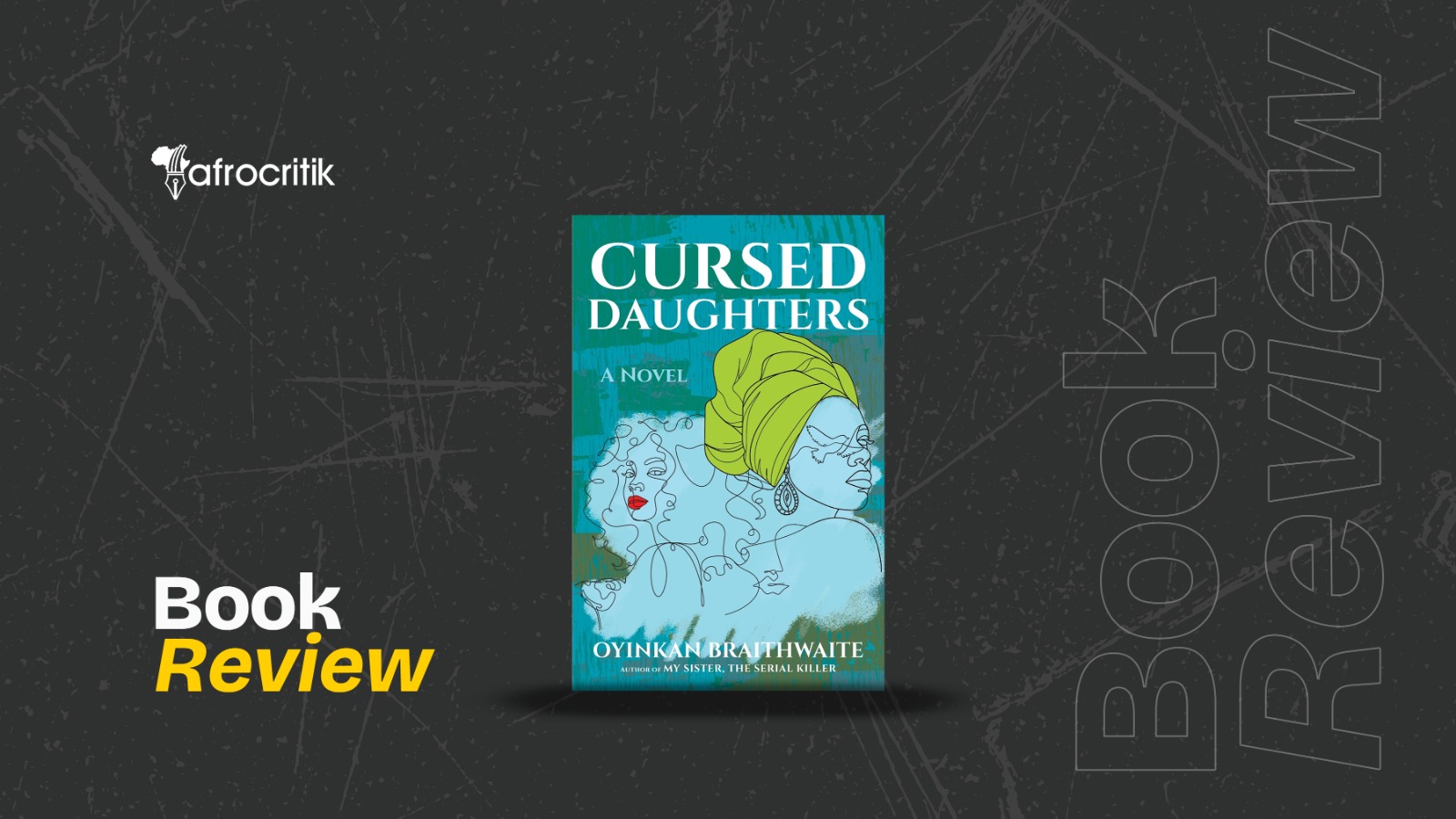

At the centre of Cursed Daughters lies a question that Braithwaite intentionally refuses to resolve: Is the curse real, or is belief and fear the true architect of the Falodun women’s misfortune?
By Evidence Egwuono Adjarho
British-Nigerian writer, Oyinkan Braithwaite, has, from the beginning of her career, shown a fascination with the grotesque, the uncanny, and the slyly humorous. Her 2019 debut, My Sister, the Serial Killer, ushered readers into a slippery world where moral boundaries warp and domestic life bristles with menace.
The novel’s central mystery—why Ayoola keeps murdering her boyfriends—remains deliberately unresolved. Braithwaite offers just enough evidence for readers to pursue any interpretive line they please: psychological trauma, supernatural influence, or sheer sociopathic impulse. The ambiguity animates the novel with a sense that the truth is complex and could be both within and out of reach.
Six years later, Braithwaite returns with Cursed Daughters, a work that reasserts her talent for the grotesque. While her debut explored sisterhood through the lens of crime, this sophomore novel delves into matrilineage, superstition, and the inheritance of intergenerational trauma. The title, Cursed Daughters, then becomes both literal and metaphorical: these are daughters who believe they are cursed, but they are also cursed by belief itself.

The supposed curse originates with Feranmi Falodun, the family’s mythic ancestress, who once slipped into the room of a man who enchanted her, overwhelmed him “body, mind and soul”, and vanished by dawn. The result, as she intended, is a hasty marriage to this stranger—provoking a confrontation with his first wife. It is the latter who utters the damning words that become the curse, seeping through generations: “Your daughters are cursed—they will pursue men, but the men will be like water in their palms.”
Cursed Daughters opens with a tragedy that shapes its emotional terrain. Monife, one of the Falodun daughters, stands alone on Elegushi Beach at night and prepares to drown herself. The name she calls to mind is “Golden Boy”, a presumed lover whose absence or betrayal has driven her to despair.
In the chapters that follow, Braithwaite alternates between past and present, tracing the childhood bond between Monife and her cousin Ebun, and the contemporary life of Eniiyi, Ebun’s daughter, who grows up in the shadow of Monife’s death.
The Falodun house, where much of the plot unfolds, functions as an archive of matrilineal trauma—a place the women return to not by choice but by necessity. After Monife’s father abandons her mother, Bunmi, for a woman in London, Bunmi returns with her children to this ancestral compound. There she reunites with her sister, Kemi (Ebun’s mother), who has fled the ruins of her own marriage.

Ebun and Monife grow up nearly inseparable, united in their scepticism about the so-called curse that obsesses their mothers. Yet, when Monife falls in love, the first fracture appears. Her affection deepens, and so does her anxiety that the curse may be stirring to life within her. The tension between her desire for autonomy and her dread of inherited fate becomes one of the novel’s most compelling threads.
Years later, Eniiyi is born on the day Monife is buried. The older Falodun women read this coincidence as reincarnation, especially because of the immediate facial resemblance. Their conviction only intensifies as Eniiyi grows into a near-perfect physical replica of her aunt.
What might have been an ordinary resemblance becomes, in the psychological pressure cooker of the Falodun household, a burden heavy enough to bend identity itself. Eniiyi spends her adolescence and early adulthood wrestling with a constant inquisition into her identity. Later, this develops into a disorienting fear that she is destined to repeat Monife’s story.
At the centre of Cursed Daughters lies a question that Braithwaite intentionally refuses to resolve: Is the curse real, or is belief and fear the true architect of the Falodun women’s misfortune? Viewed through one lens, the curse becomes a convenient repository for the failures of men. Bunmi, for instance, endures her husband’s infidelity with dutiful stoicism—“she smelt the perfume, spotted the lipstick stains, found the odd condom”—but consoles herself so long as her position as wife remains nominally intact. When he finally abandons her, she attributes the collapse of the marriage to the curse rather than to her husband’s longstanding indifference. Without the curse as an interpretive crutch, Bunmi might have sought legal redress instead of accepting defeat.


But Cursed Daughters also refuses to let rationalism settle the matter entirely. Eniiyi’s resemblance to Monife extends beyond appearance into habit and instinct. Monife once buried keepsakes from her lover beneath the tree in the Falodun compound; Eniiyi, without knowing this, begins to do the same. These uncanny actions complicate any attempt to interpret the novel strictly through rationalism. Braithwaite’s prose, therefore, occupies a liminal space where superstition and reason bleed into each other, and readers are encouraged to oscillate between explanations just as the characters in the novel do.
Cursed Daughter’s ambiguity is not merely thematic but also structural. The novel is built around gaps. There are deliberate omissions in the recount of the history of the Falodun women (the names of the men are left anonymous), and silences from mothers in place of full-blown explanations.

In this sense, Cursed Daughters resembles Braithwaite’s earlier work in the way it destabilises certainty. But where My Sister, the Serial Killer was brisk and wickedly funny, Cursed Daughters is more meditative, shot through with melancholy and a near-ritualistic sense of inevitability.
Braithwaite’s skill lies in her ability to fuse the supernatural with the mundane. Her Lagos is not a place of spectacle but one where the most haunting thing is not the curse itself but the ways women internalise the stories told about them. The Falodun women are shaped, and/or doomed, by narratives passed down through generations, and Braithwaite dramatises how such can become self-fulfilling prophecies.
Whether Cursed Daughters ultimately lands on the side of the supernatural or the psychological is beside the point. The novel allows the believer and the sceptic to coexist within the same space, offering each reader their own point of entry. For some, this is a story about the persistence of ancestral curses; for others, it is a study in how trauma calcifies across generations.
Evidence Egwuono Adjarho is an evolving critic and writer.