

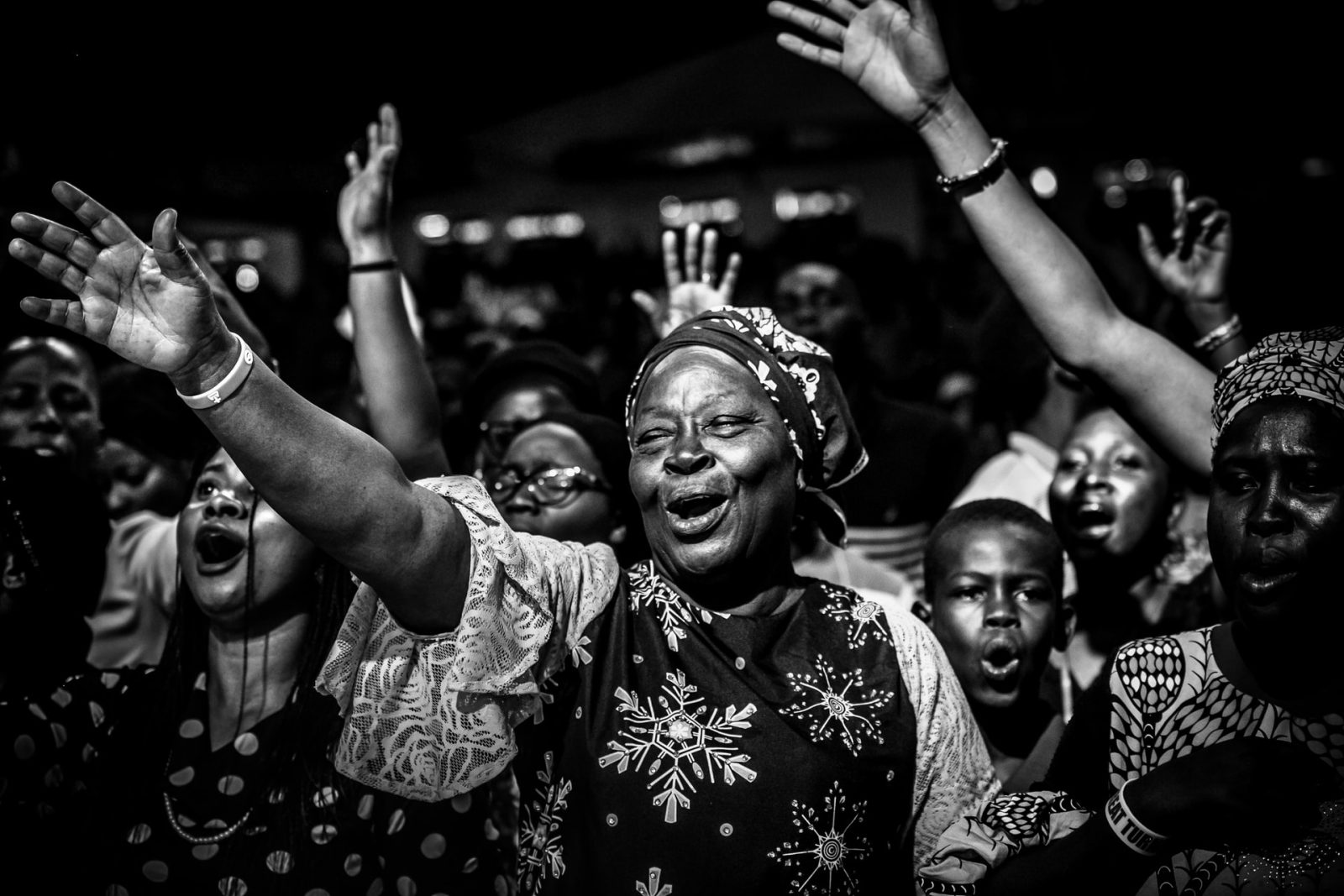


The spiritualisation of hustle functions, in part, as a theodicy: a way to explain suffering without blaming the state because now, the supernatural offers both meaning and mobility.
By Felicitas Offorjamah
In 2022, in a viral clip that circulated on the Nigerian side of Instagram, the Founder of the Living Faith Church Worldwide, Bishop David Oyedepo, paced the pulpit with the fire of a general. “You sleep eight hours?” he bellows. “How do you sleep eight hours in a 24-hour day? That means you are sleeping for one-third of your life. And you call that rest?”
Laughter erupts from the congregation in Oyedepo’s church, also known as Winners’ Chapel International. The pastor does not laugh. “Sleep is for people without destiny”. A louder cheer is heard from the congregation.
The rebuke from the Bishop may seem extreme, but within the moral economy of prosperity preaching, it makes perfect sense. For the bible doctors who prescribe less sleep to an audience hungry for prosperity and a sane life, their pulpit is the body of a rumbling stomach that vomits the teaching that sleep is a luxury for losers. The applause from Oyedepo’s listeners echoes the wider applause of Nigerian citizens to the restless gospel – sleep less to make it.
Another supporter of the anti-sleep sermon, Nigerian Christian Author, Bishop David Abioye, articulated in a viral video that, “too much sleep is a destiny destroyer. Sleep is a practice of death… your destiny dies when you sleep”. Reframing sleep as a moral threat to holy purpose, the audience is not silent but responding with affirmations, which underscores how deeply rest shaming has been normalised in prosperity culture.
The doctrine of sleeplessness has also found new terrain in the digital sphere. Founder of the massively popular online prayer platform, New Season Prophetic Prayers and Declarations (NSPPD), Pastor Jerry Eze, routinely exhorts his followers with the words, “You can’t be sleeping when destinies are being decided. Wake up and pray!” His livestreams begin promptly at 7 a.m., drawing hundreds of thousands of viewers who forgo rest in order to “tap into” divine favour in real time.

In this iteration, being spiritually alert is not a matter of faith but of rhythmic discipline as the followers are expected to be watchful in spirit and across media platforms. This virtual war on rest by NSPPD perpetuates a spiritual urgency fused with digital immediacy. Prayer titles are framed with headlines: “Today is your day of turnaround!”, “Let the affliction expire!” — designed to generate clicks and cultivate spiritual fear of missing out (FOMO). Additionally, testimonies scroll rapidly in the chat: healed bodies, visa approvals, financial breakthroughs; portrayed as a reward for showing up, staying awake, and having an unshakeable faith. It is not obvious that missing a livestream isn’t just missing a prayer, but a window into divine opportunity.
Apart from being an audience, the believer becomes an algorithmic labourer. Two years ago, Rudolf Okonkwo had written in Premium Times of his friend’s lament of how the platform beguiled his wife to his detriment. According to Okonkwo, his friend’s wife wakes up in New Jersey at 2.00 a.m., “what in the past we called ungodly hours, to tune into Pastor Jerry Eze’s live prayer and declaration show on YouTube. That means she sleeps early so she can wake up at 2.00 a.m. And most nights, she wants to keep her body and soul clean in readiness for hours of prayers, so no action for my friend”.
Adding another line of stitch to the insomnia gospel, Apostle Joshua Selman, in a widely circulated message titled, “This Message Will Not Let You Sleep On Your Destiny”, urged believers to reject comfort in favour of consecration, warning that excessive rest can derail divine timelines. “Many of you are sleeping through kairos moments”, he says, referencing the Greek concept of God-ordained time. His sermons demolish the boundary between the entrepreneurial and the spiritual, casting prayer as preparation and night watches as a competitive advantage in a divine marketplace.
Selman’s hustle gospel proclaims that rest is costly because to sleep through a prophetic hour is to risk exclusion from God’s unfolding script. This televangelist’s hustle culture is different from the secular one, which awards productivity with prestige, but it offers something greater: favour, relevance and divine acceleration. In his theology, weariness is a mark of maturity and a proof that one is contending for a purpose.
This isn’t unusual. Pentecostal pastors who preach the prosperity gospel—a theological framework that blends biblical faith with capitalist self-improvement—have made anti-rest propaganda a common refrain in Nigeria.
Prosperity preaching, which has its roots in the idea that worldly success is a sign of divine favour, views the body as a vessel and a validator, requiring ongoing output, discipline, and sacrifice. Because it interferes with the fulfilment of the purpose, rest becomes suspicious, and the prosperity preachers caution that sleep can be a spiritual opening for demonic influence and poverty. Metaphors of battle and enterprise abound in sermons: the devil strikes at midnight, fates are decided in the wee hours of the morning, and heroes awake before the sun.
In this space, fatigue is not only accepted but celebrated. Exhaustion becomes a sign of moral greatness, insomnia becomes evidence of faith and suffering is turned into a sacrament by this spiritualisation of exhaustion. One’s perceived level of spiritual seriousness increases with the amount of hardship they undergo, such as long commutes, night vigils, working several jobs, and fasting while working a full-time job.
This theology views burnout as a rite of passage rather than a symptom of bodily wearout, giving believers a moral advantage and a means of surpassing their peers in perceived spiritual depth as well as worldly prosperity.
The phrases, “violent faith” and “possessing your possession”, enrapture the lips of Pentecostal leaders as they rebrand tiredness as actively contending for destiny turning believers into martyrs for success. It leaks into national discourse, where political leaders deepen the insomnia and inflict suffering on the masses.
However, it seems to land the hardest on underpaid teachers moonlighting as ride-hailing drivers; the single mother whose persistent hustle is framed as evidence of grace, and the unemployed graduate attending dawn prayer challenges. The opium of sleeplessness is packaged as both a coping mechanism and control strategy, as it excuses the state from providing structural support and subjects the poor to ceaseless striving.
This theology interprets poverty as the result of spiritual and personal failure, packaging prosperity as divine reward. It also portrays rest as a quiet refusal to participate in the redemptive logic of suffering — a political transgression. And it becomes that there is no rest for the weary, but offers more prayer points, more vigils, more motivational mantras, as deliverance is found in doubling up, not in slowing down.
At the crux of this deceitful sedative lies a deeper crisis that is systemic. In a country that is characterised by crumbling infrastructure, epileptic electricity, limited access to healthcare and quality education, Nigerians have long been forced to self-organise their survival. The state, hollowed out by decades of corruption and policy failure, has largely abdicated its role as provider. To fill this vacuum, spiritual sanctuaries have stepped in as providers of motivation, meaning and in some cases, material aid.
The Gospel of “less sleep to succeed” thrives because for Nigerian citizens, rest has never been a viable option. When the only way to eat, send a child to school, or pay rent is to hustle without pause, and validate the sermon that says “God rewards the tireless”, making hustle holy because it is necessary.
Governmental neglect is a silent collaborator, not just a backdrop, especially in the absence of justice, which makes divine compensation all that remains. The burden of survival has shifted squarely onto the shoulders of citizens as public systems have largely failed.
The World Bank states that over 139 million Nigerians, that is more than half of the population, live in poverty as of 2024/2025, up from 83 million in 2019. The situation is more difficult in rural areas, as 75.5 percent of its dwellers live below the poverty line compared to about 41 per cent who live in the urban centres.

As contained in the National Bureau of Statistics, nearly 63 per cent of Nigerians are classified as multidimensionally poor, as they lack access to essential services like clean water, sanitation, education and healthcare. Moreover, only about 45 per cent of Nigerians are connected to the national grid, which provides electricity for an average of just four hours per day.
Apart from quantifying hardship, these figures reflect a broader reality in which the state has effectively relinquished its responsibility to care. So, the churches have filled up this void and have become moral and social architects that spiritualise survival and glorify exhaustion. When rest feels like a luxury you cannot afford, a doctrine that exalts sleeplessness begins to sound like wisdom, even necessity.
Glancing at the past, Pentecostalism didn’t just offload with spiritual fervour but arrived with televised crusades, cassette ministries, and prosperity promises. From the late 1980s through the 2000s, figures like Bishop David Oyedepo, Pastor Chris Oyakhilome, and Dr. D.K. Olukoya built empires preaching a gospel of supernatural success and central to this was the rebranding of personal hardship, for suffering was no longer senseless — it was sacrificial.
Lack became a test, and delay became divine preparation; embedded in these teachings were spiritualised messages of toil that valorised toil while demonising ease. Pastor Paul Enenche of Dunamis International Gospel Centre has repeatedly warned against “slothfulness of spirit”, equating sleep with stagnation, while Dr. Olukoya’s Mountain of Fire Ministries has long preached that the “enemy of your destiny is your bed”.
Motivational aphorisms like “No food for a lazy man”, “Sleep is the brother of death”, leapt from pulpits into WhatsApp broadcasts and Instagram reels. What began as spiritual advice calcified into doctrine: successful Christians don’t rest.
Churches weren’t just filled with this media-savvy Pentecostalism; it reprogrammed the national psyche, especially since these pastors weren’t just preachers; they were broadcasters, brand-builders, architects of a new moral economy where godliness was indexed through grit.
The language of destiny, breakthrough, and divine promotion seeped into everyday life, turning hustle into holiness, shaping not only how Nigerians prayed, but how they worked, waited, and worried. It extended beyond Sunday services into radio shows, night vigils, best-selling prayer manuals, and satellite TV channels and embedded it in the daily rhythm of national life.
Silence and stillness came to seem suspicious, and as digital platforms emerged, these messages migrated easily; now stylised as memes, sermon clips, or prayer reels, optimised for virality. Pentecostalism’s promises of reward through restlessness dovetailed with the pressures of a neoliberal society increasingly organised around personal branding and productivity.
Spiritual-industrial complex is the outcome where faith is performance, and the tired body is proof of devotion. In such a system, to rest is to risk being left behind — by God, by the algorithm, by the economy.
This manufactured faith did not emerge in a vacuum but was forged in the economic turmoil of the 1980s. When Nigeria adopted IMF- and World Bank–prescribed Structural Adjustment Programs (SAPs) in 1986, the policies slashed public spending (from approximately 44 % of GDP in 1979 to 17 % by 1988), devalued the naira by over 1,300 %, and privatised dozens of state-owned enterprises.
So immediate and stark was the output that by 1987–88, Nigeria’s per capita GDP had dropped ~4.8 % annually, erasing gains from the previous decade. By the early 1990s, real per‑capita national income had fallen roughly 45 % from 1980 levels.
Additionally, public sector layoffs were rampant: estimates show the civil service shrank by more than 50 %, while overall formal‐sector employment fell below 14 % of the workforce. Between 3 million and 5 million industrial-sector workers lost jobs, fueling mass unrest and incursions into poverty and by the mid‑1990s, an estimated 65 % of Nigerians were living below the poverty line. With basic services collapsing—schools, hospitals, public utilities—the state no longer offered meaningful security.
To occupy this emptiness, mega‑churches supplied a different kind of structure, one that preached hustle as grace and toil as testimony. Where the government had defunded education and hollowed civil service, churches offered prayer manuals, vocational seminars, and micro-finance networks—not as charity, but as spiritual strategy. In that context, the prosperity gospel didn’t feel exploitative; it felt like survival and an existential necessity, one that carried within it not only hope but also a subtle moral imperative.

The spiritualisation of hustle functions, in part, as a theodicy: a way to explain suffering without blaming the state because now, the supernatural offers both meaning and mobility. This helped explain why Nigerian youths, facing sky-high unemployment and a decaying public sector, embrace spiritual productivity with zeal. If the odds are stacked against you economically, belief becomes a kind of capital, positing prayer as productivity, tithe as investment, and faith as CV.
This theological framework doesn’t just soothe anxiety, but imposes a perceived discipline where to take a break is to flirt with backsliding and vigil services — all-night prayer marathons — are praised for their intensity.
Believers recount testimonies of working two jobs, praying from midnight to 5 a.m., and still attending morning service. “I have not slept in three days, and God is still strengthening me”, a young woman testified on a livestream of the NSPPD. The chat explodes in praise hands. This is the economy of performative exhaustion where your badge of faith is burnout and eye bags.

It is not oblivious that gender plays a deep role in enhancing the multitude of sleep-deficient humans. Men dominate the pulpit, and women bear the brunt of the hustle theology in practice. They are seen juggling precarious jobs, raising children and attending multiple weekly church programs.
Adding more firewood to their tireless heat, they are told that their labour is sacred, their suffering sanctified and rarely told to rest. My colleague at work had shared a dream where she saw herself sleeping in the middle of a market. She woke up and began fasting for seven days. “It was a warning from God”, she said. “I must never relax”.
What’s striking about Nigeria’s hustle gospel is how seamlessly it aligns with global neoliberal logics. In the United States and the UK, workism, the ideology that work is the centrepiece of life’s purpose, is often presented as secular. But in Nigeria, workism wears a cassock. The language of self-discipline, optimisation, and personal branding is suffused with divine authority. “God rewards diligence”, pastors say. “Your gift will make room for you, but you must stay awake”.
This ideology, however, is not merely imported but locally curated and culturally encoded. In Nigeria, capitalist values were not imposed by multinationals alone; they were baptised in sermons, sung in gospel choruses, and preached on YouTube by pastors with million-view followings. The message, “You don’t need the government. You need grace and grind”, is the real anthem of the masses, not the officially composed, “Arise, O Compatriot”.
The recent removal of the fuel subsidy by President Bola Tinubu provides a realistic portrayal. Overnight, the cost of transportation doubled. Inflation soared. Protests erupted. But from some pulpits, the suffering was reframed as seasonal. “God is using this hardship to prepare you for elevation”, one pastor declared. “Don’t complain, press in”.
But across scripture, rest is framed as divine design, a necessity as GOD himself, who never grows weary or tired, rested on the seventh day after creation.
Psalm 127:2 reminds us: “It is vain for you to rise up early and dwell late, to eat the bread of anxious toil; for he gives sleep to his beloved”. Proverbs offers reassurance: “When you lie down, you will not be afraid; when you rest, your sleep will be sweet” (3:24). And Jesus himself extends an invitation: “Come to me, all who labour and are heavy laden, and I will give you rest” (Matthew 11:28).
Despite clear scriptural mandates to rest, the Pentecostal hustle gospel in Nigeria flips the script: to rest is to risk missing God. In reality, we miss life and die in haste because sleep deprivation has become a public health crisis. It has been proven over time that chronic lack of sleep is linked to impaired memory, reduced immune function, high blood pressure, heart disease, weight gain, and increased risk of stroke. Worse still, it aggravates mood disorders like depression and anxiety, and in extreme cases, contributes to suicidality.
The World Health Organisation warns that sleep deprivation is as dangerous as driving under the influence of alcohol, significantly increasing the risk of accidents and poor judgment. In Nigeria’s overcrowded hospitals and poorly regulated transit systems, such lapses are often deadly. This is no abstraction for struggling Nigerians. Bitter still is when the country’s youths are called lazy despite the crumbling situations they find their ambitious young selves.
Moreover, a 2021 study of pharmacy students in Enugu found that 68 percent reported poor sleep quality; nearly 49 percent screened positive for anxiety, and 47 percent for depression. Among medical students across 25 Nigerian universities, 84.6 percent exhibited signs of burnout-related disengagement, while 77 percent reported physical and emotional exhaustion.
Even the caregivers themselves—doctors—aren’t exempt. Burnout among Nigerian physicians has been reported to range between 23.6 and 51.7 percent, with some studies estimating rates as high as 75 percent. Files in police custody have also divulged accidents and deaths caused by drivers who are in need of sleep or a passerby who has lost concentration or balance due to lack of rest. Even the quality of productivity is reduced, because what can a sleeping hand do? Nothing.
Despite the fast-growing population rate of Nigeria, its productivity per person is subliminal compared to countries in Africa that possess a smaller population. Its per capita output trails significantly behind peers: while Nigeria manages 1,110 per person, countries like South Africa reach 5,975 dollars; Ghana, 2,230 dollars; and Kenya, 1,983 dollars. In fact, last year, Nigeria’s GDP per capita fell 710 dollars below the Sub-Saharan African average — its widest gap in 25 years.

Also, the beginning of this year saw Nigeria having a GDP per capita of just 807 dollars, placing it near the bottom of global rankings and among the 12 poorest nations worldwide.
Sleep-deprived citizens are a major contributor to this continual decline in productivity, yet the spiritualisation of sleeplessness persists. In many Pentecostal circles, staying awake to “tarry with God” during night vigils or fasting marathons is evidence of divine seriousness.
The logic is cruelly recursive: if you’re tired, you haven’t prayed enough; if you’re burned out, you must press on. The social costs are immense. According to the Association of Psychiatrists in Nigeria, nearly 25 to 30 percent of Nigerians live with some form of mental illness, yet less than 10 percent have access to effective care.
Some empirical observers believe that citizens with mental health problems are more than the percentage presented by the Association, especially due to the experiences recounted by citizens in the daily hustle: “It’s like you meet one bitter, angry, restless yet weak-from-less-sleep human every day.” Unfortunately, mental health receives just 3 percent of the national health budget. The result is a generation overworked and undercared for, clinging to faith not only for salvation, but for permission to rest.
It should become necessary that sleep be an act of rebellion, survival and healing. To rest in this critical moment is to begin unlearning the ritual self-punishment passed off as piety. It is to reject the sleep-shaming, the destiny-fearing, the grind-glorifying gospel that equates stillness with sin. It is a statement that the world will not crumble if we pause; that in the act of resting, we might remember how to begin again—not as hustlers, but as humans.
Ogonna Felicitas Offorjamah is a creative writer who holds a bachelor’s degree in Mass Communication from the University of Ilorin, Kwara State. She has been published in various outlets including The Guardian, Afrocritik, Edge of Humanity Magazine, and The Lens Magazine. She was listed as one of the top ten winners of the fifth edition of Samson Abanni’s poetry contest. See her on Instagram.