


Lady confronts its subjects from the angle of dreams, trauma, and survival within the context of the country’s systemic dysfunction, specifically set in the commercial and cultural capital, Lagos.
By Vivian Nneka Nwajiaku
Nigeria’s return to Sundance after C.J. Obasi’s 2023 Mami Wata triumph arrives in the form of the striking, if occasionally shaky, UK-co-produced Lady, the debut feature from Lagos-born, London-based Nigerian filmmaker Olive Nwosu. As women-focused as its Sundance predecessor, and as political, Lady similarly grapples with governmental failure, colonial legacy, and the idea of revolution, though from a starkly different cinematic lens.
Where Mami Wata sets up a matriarchal fantasy world as an allegory through which Obasi deals with his themes, Lady confronts its subjects from the angle of dreams, trauma, and survival within the context of the country’s systemic dysfunction, specifically set in the commercial and cultural capital, Lagos.
In that sense, Lady recalls Arie and Chuko Esiri’s Eyimofe: This Is My Desire (2020), the Nigerian indie darling that introduced the Berlin International Film Festival to Nigerian cinema, at least as far as features are concerned. As such, it is not too much of a surprise, though it is impressive, that following its Sundance premiere, Lady is set to put Lagos survival back on the Berlinale screen this February.
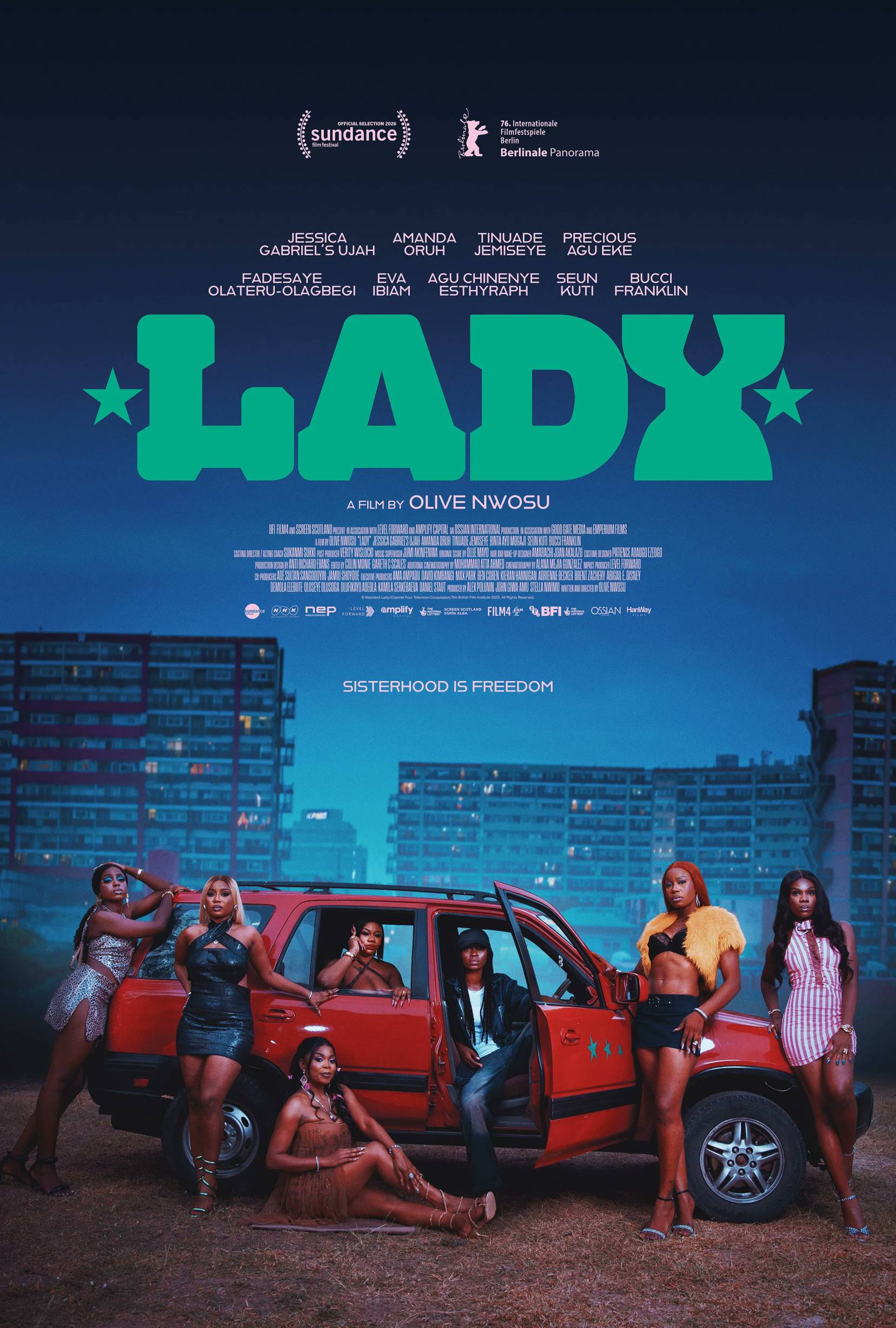
The film follows the eponymous Lady (Jessica Gabriel’s Ujah), a ferocious, intensely independent young woman navigating the hectic but zesty metropolitan city of Lagos as a rare female taxi driver. Revolution is springing up across the country in response to fuel scarcity and the removal of fuel subsidies across the oil-rich nation. Amid this political instability, Lady’s childhood friend, Pinky (Amanda Oruh), now a sex worker, reappears with an offer: Lady can earn good money if she moonlights as a driver ferrying her and other women to their night job.
Lady has judgment for their profession and a traumatic history with sex. She also has a dream that requires considerable funding. When she takes the job, she is both thrust into their dangerous world and bound to the women in a sacred sisterhood. It’s in those intimate scenes focused on the women, marked by uncomfortable banter and spirited conversations, and mostly set against nocturnal Lagos, that Lady feels most alive, insightful and even entertaining.
Nwosu’s deftness at capturing intimate moments is not surprising. She has quite the experience in that regard, considering her earlier work, the remarkable Sundance-selected short film, Egungun (Masquerade) (2021). They’re both very different films—one is about sexuality and the other is interested in sex. But they share a preoccupation with the friction that develops when two bonded women grow apart, when one leaves, and the other stays back. In Lady, Nwosu does not dig as deeply into that background, leaving the weight of betrayal that Lady feels to play like an overreaction, and the extent of her trauma is sketchily drawn.
And that trauma is fundamental to the film. From the first frame, Nwosu emphasises it. Lady opens with an upended view of a shanty town by the Lagos Lagoon, soon revealed to be the point of view of young Lady (Petra Effiong) and Pinky (Mitchelle Oluwafemi), just before Lady’s search for her mother leads her to a bewildering encounter that would forever shape her relationship with sex.
As the adult Lady drives through the glistening, swirling streets of Lagos with her daytime and nighttime passengers, and as she walks through the rooms where her nighttime passengers work, her trauma reflects back at her in mirrors, and her memory seeps through window bars and door frames, capably photographed by Alana Mejia Gonzalez.
Yes, so much about Lady is about sex, even in its religious symbolisms. But it is mostly about sex as seen by a woman who only sees it through the lens of power dynamics, both gendered and economic. It is a fair assessment, especially considering that the sex workers Lady now has to drive for a living are themselves at the mercy of a dangerous man, a pimp simply known as Fine Boy (Bucci Franklin, in an expectedly memorable performance despite such brief screentime).
But in her case, it’s a perspective backed by trauma. The nature of the sexual dynamics she was prematurely exposed to, coupled with the violence of the gendered and economically unequal world in which she has had to fend for herself, especially as the sole female driver in her taxi park, creates a potent mix of control and defensiveness that makes Lady’s proximity to sex work, albeit as a mere driver, even more volatile for her and the other women.
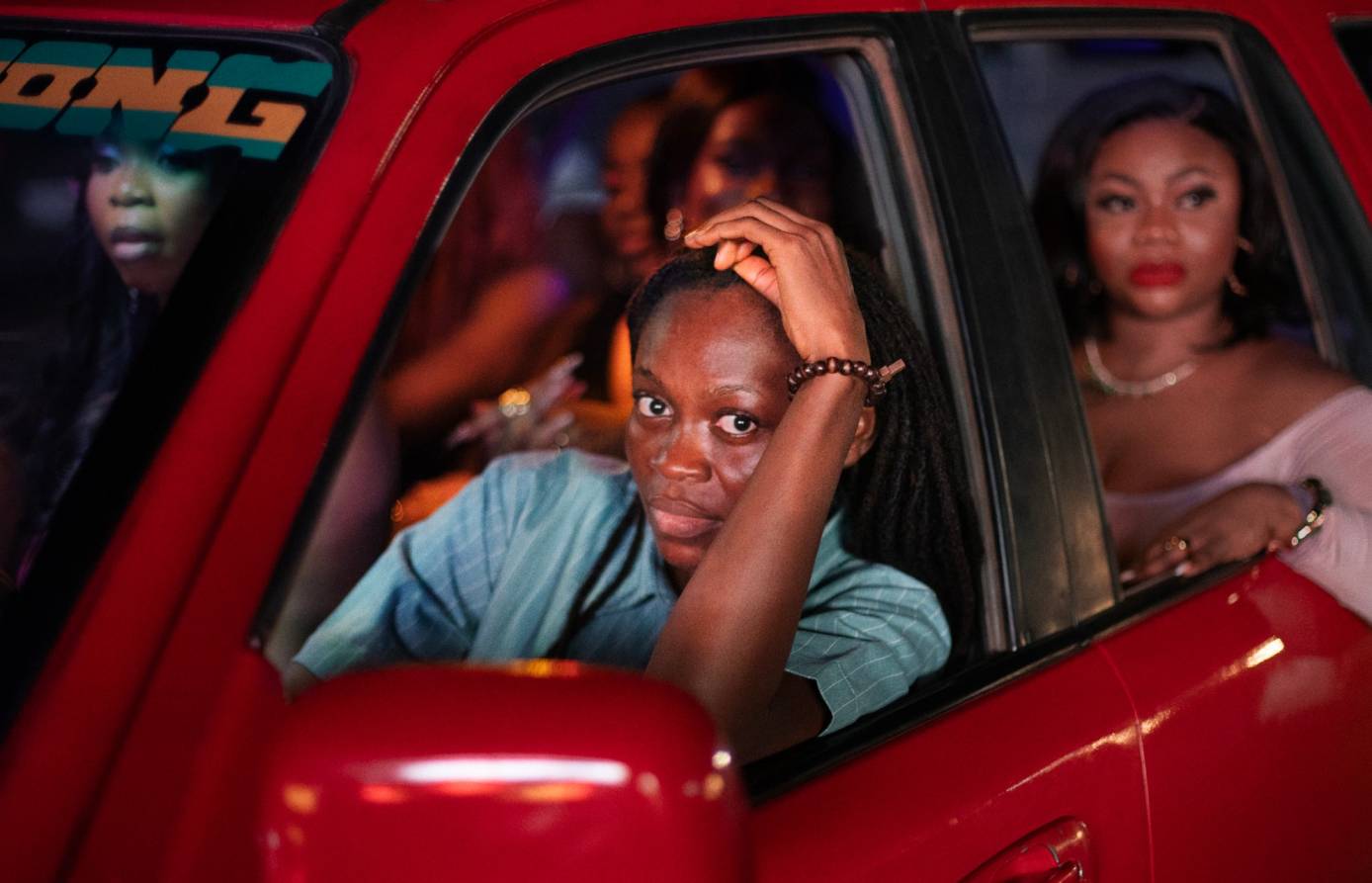
Lady is a woman who is quite literally driving the wheel of her life. In some sense, she calls to mind the subject of Fela Anikulapo-Kuti’s anti-feminist hit of the same title. The name “Lady” is pronounced in the same Pidgin cadence Fela Kuti used, despite the film’s obvious non-fluent Pidgin English, and his influence is even apparent in the film’s music. Like Fela Kuti’s “Lady”, Nwosu’s “Lady” is acutely aware of gendered inequalities, especially in relation to sex (thoughts on Fela’s Lady and his treatment of women, especially with respect to sex, are detailed here) and simply refuses to—or, more accurately, cannot—participate.
If Lady shares anything with Fela Kuti, it is their anti-colonial and emancipatory ideals, which surface in a tenuous mid-film monologue where the women ask Lady where she would go if she could go anywhere. For the other women, freedom means Sweden, America or France.
For Lady, true freedom is not to be found in the countries that have historically colonised and enslaved black people, which is, of course, ironic for a UK co-produced film. No, her dreams have always been located in Sierra Leone’s Freetown, not necessarily because she expects it to be economically better than Lagos, but because of what it represents: both historically and personally.
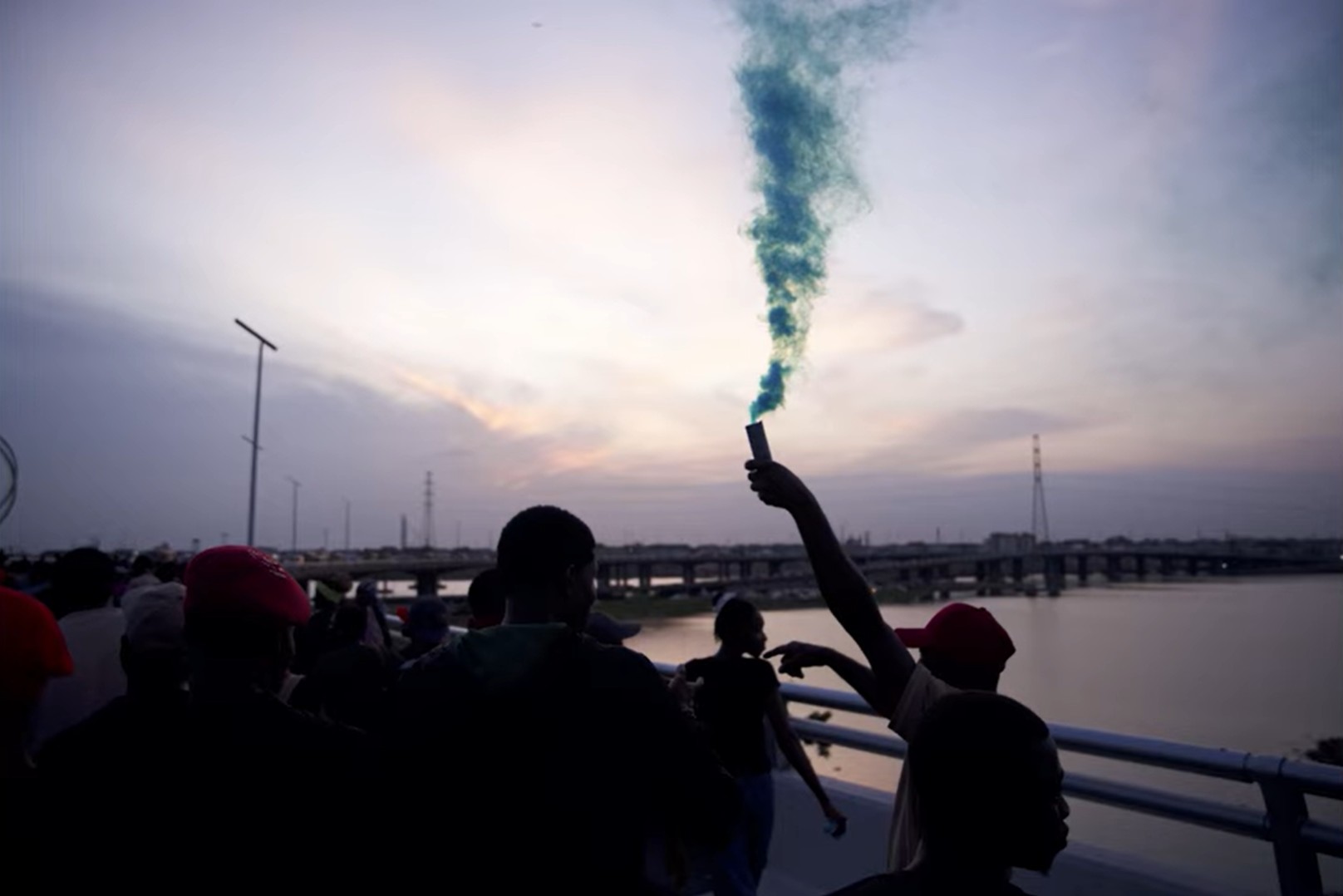
Still, she is far from an idealist. Migration to Freetown is a dream she believes she can control. She just has to save enough money, even if she has to drive sex workers around Lagos to achieve that. To be bogged down by fuel scarcity and the country-wide economic turmoil would mean admitting to a lack of control. And so, as the country rages on, with protests filling the gridlocked Lagos roads and bridges, fuelled by an on-air activist known as DJ Revolution (interestingly voiced by Fela Kuti’s son, Seun Kuti, who also appears in a brief protest clip), Lady forges on seemingly unconcerned, much like the protest footage and the DJ Revolution speeches that unfortunately come off as detached and out of place in the film.


Gabriel’s Ujah carries Lady with ruggedness and doggedness that demand focus, even if her deliberately combative demeanour is occasionally laid on too thick. Oruh, as Pinky, strikes a sharp contrast, a gentle and soft-spoken young woman in a dangerous world, but with a much stronger will than she realises—strong enough to leave unsatisfying situations more than once. Then, there’s the delightful Sugar, played by the easily likeable newcomer Tinuade Jemiseye, through whom Nwosu attempts to present an argument around sex work that includes but is a tad more complex than economic desperation.
These women are underwritten, although less so than the rest of the crew (played by Eva Ibiam, Precious Agu Eke, Fadesaye Olateru-Olagbegi, and Agu Chinenye Esthyraph), who mostly just exist as filler in Lady’s story. But Pinky and Sugar serve a decisive purpose in Lady’s transformation. Pinky forces her to confront both her past and present. And Sugar ultimately becomes the catalyst for a charged and sudden climax where Lady’s trauma clashes with the inherent danger of sex work.
The fatal consequences force her to reconsider not only the motivations behind other people’s choices, but also her own illusion of control, especially in a rigged and unequal system. The juxtaposition of her circumstances and the country’s chaos and dysfunction does feel indiscriminate, if not jumbled. But Lady, herself, cynical, self-reliant, and comfortable with personal exceptionalism, represents the familiar apathetic Nigerian.
As uninterested as one might be in the country’s political shenanigans, as well-adapted to its survival tactics as they might be, it often gets to a point where survival and those political shenanigans become inextricably linked, at least more desperately so. Lady’s ninety minutes are spent directing the protagonist toward that reckoning. The ride is bumpy, but there is no denying that the journey is worth it.
Rating: 4.1/5
*Lady premiered in the World Cinema Dramatic Competition at the Sundance Film Festival in January 2026 and will screen in the Panorama section at the Berlin International Film Festival in February. HanWay Films handles worldwide sales and distribution.
Vivian Nneka Nwajiaku is a writer, film critic, TV lover, and occasional storyteller writing from Lagos. She has a master’s degree in law but spends most of her time watching, reading about and discussing films and TV shows. She’s particularly concerned about what art has to say about society’s relationship with women. Connect with her on X @Nneka_Viv