

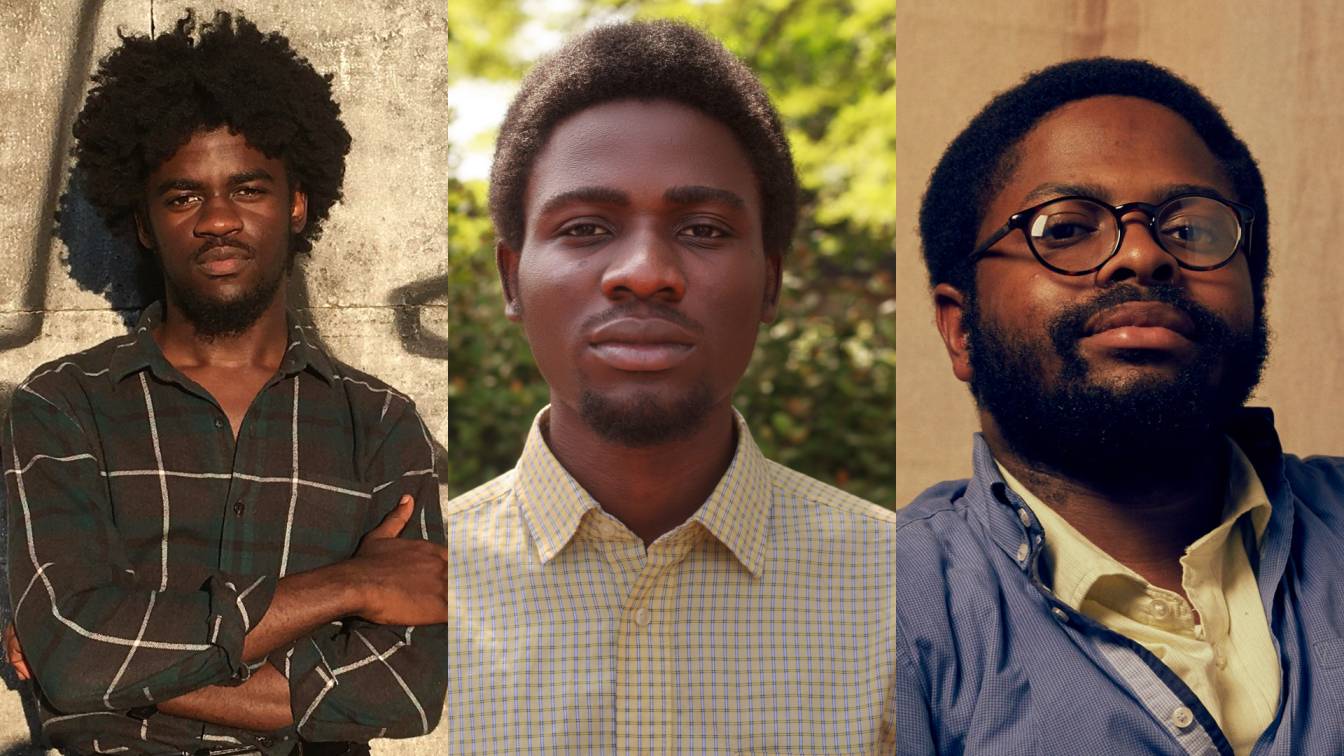

Onyekachi Iloh’s “It Is Once Again the Season of Corn”, Yomi Folaranmi’s “Reverie on Milliken Hill”, and the late Gboyega Odubanjo’s “Makoko Adam” are songs of praise in which the poets take into cognisance the difficulty of praising.
By Ernest Jésùyẹmí
I call the poems I look into in this piece “hymns”, though they are not songs of praise to God. The term does have a larger connotation outside Christian usage. Its Greek root (hymnus, and possibly hymenaios) refers to an ode, a song of adoration to gods, heroes, and in commemoration of a wedding ceremony. A good example is The Hymns of the poet Callimachus (310 BC—240 BC). A closer example is A. R. Ammons’s “Hymn” (published in the sixties). I use the word here in the odal sense.
Onyekachi Iloh’s “It Is Once Again the Season of Corn”, Yomi Folaranmi’s “Reverie on Milliken Hill”, and the late Gboyega Odubanjo’s “Makoko Adam” are songs of praise in which the poets take into cognisance the difficulty of praising. I say “difficulty”, but “difficulties” may be more accurate. The difficulties overlap but they belong to separate classes. However, all three poems praise what the eyes can see and seek what only the mind’s eye can. Folaranmi dreams as much as Iloh does; Odubanjo cannot, but wants to.
For Iloh, the question is how to praise a rusty country hanging on the brink. His poem takes on a political challenge through metaphor. It turns on the idea of “change” and the “unchanging”. “Change” is, of course, a word that tolls for every Nigerian (“APC—Change”; “When will things change?”), It has sociopolitical impetus. Being a Nigerian himself, Iloh is as hungry to “see change” as the guy on the street. But what kind of “change” can we see in a poem? Or what kind of “change” can we see through the transportive and transformative power of metaphor (the Greek for metaphor means “to transfer, carry over, transport”)?

Power—the word calls to mind aggression. And tension. There is much tension, an aggression arrested in the moment (by corn, hands are too busy to punch down), in “It Is Once Again.” Early in the poem, we are introduced to a triangle of metallic men: “the bus drivers, the policemen with rusting rifles, / and the iron-benders with biceps like seas / not fully awake”. The drivers, if they are so inclined, would do their rituals at the shrine of Ogun, the god of iron; the rifles are metallic; and, at the head of the triangle, in its culmination, are “the iron-benders” who carry raging energy that has not become fully conscious. A volatile triangle; a nation on the edge.
But the change Iloh wants to see is not going to be brought about by rage. Moreover, a poem is not a program. Practical (or political) change is not its province. So when he writes that “the policemen’s black and fading / uniforms remain unchanged”—he is not asking for a replacement with new ones; he is expecting that the costume that “enables” violence would be transformed into . . . what?
Choir robes, maybe.
The verbs he uses make clear the kind of change he has in mind: “morph”, “become”, “pray into”. The poet has been gesturing towards this from the first line. When we meet “the women in clothes the colours of flame”, we almost see them in skirts of fire. The rifles that are “rusting”, for Iloh, rust literally and metaphorically. He proceeds by using similes, trying to see if he would be able to complete the corrosion of the status quo that way: the biceps like seas, the trucks like sleeping millipedes, etc.; but the metaphorical pitch of those similes cannot do the job.
In the second part of the poem, as he prays, in a new pitch, miraculously we see the change that we have been made to expect. The cobs held to mouths and been turned “this way and that” were already harmonicas; the musical impression was latent in “turning . . . the turnings”—the latter so close to “tuning”. When they become harmonicas, it is so right it seems a match made in heaven. And the women: it feels just as right that they are “cherubs” and “their adire scarves morph into flaming halos” (“the colours of flame” have become the radiance of flame).
And it is right, again, that “iron grilles” should morph “into aeolian lyres”. The pitch of this final transport is perfect and achieves the poem. The optative “let” is substantially muted: “and their iron grilles into aeolian lyres”. The cooking things enter into a new reality at once. The prayer is fulfilled just as it is uttered. The effect is more profound because, as we have seen, metal is so conspicuous in this poem—it is the ruling symbol; and the desire is for the reigning order of power and repression (signified by the metal) to come to an end, to be transposed into a lyrical order. (The word “lyre”, as you know, comes from Greek and gives us the word “lyrical”. The adjective “aeolian” is meant to ensure we don’t miss that simple fact.)
The change is not only seen, as in all good poems, it is heard, too. (To hear it well is to see it.) I am talking about the fluency (which I envy) of “iron grilles into aeolian lyres”. In “Iron”, the “r” makes no impact. In “grilles” it takes revenge for its muteness in the preceding word: the letter acts the verbal part of the noun it sits inside of—it grills against the soft consonants. It is a tyranny of sound. But say “iron grilles into aeolian lyres” and you find that after “into” the soft consonants play their part in a new order, and “r” (sitting after “l”) itself is made happy.
What I have tried to say is that the morphing is audible. The change takes place in our ear, too.
Yomi Folaranmi’s “Reverie on Milliken Hill” begins with what is heard: “Mispronounced, surely”. What has not been said right is the name of the hill, a hill named for “the colonial holdover who dynamite-blasted the rock / to carve out the lean road” that the poet visited in Enugu. Those who fail to call it right, who call it “Milking Hill”, are the people of the city. The poet writes, “The languid Enugu / tongue had played fast and loose, as usual, with the syllables”.
You could read this poem, as I did, many, many times and not detect the difficulty that is playing out in it. It is a very jocular piece, written tongue-in-cheek, but what the poet jokes about is quite risky.
For instance, the words I italicised in the excerpt have a negative connotation. These are the listed meanings for “languid” in Merriam-Webster: “sluggish in character or disposition”, “drooping or flagging from or as if from exhaustion”, “lacking force or quickness of movement”. And “to play fast and loose” suggests immorality or irresponsibility. The question to ask is: Do the people of Enugu owe it to the oyibo man to say his name right? Does the poet suggest that they do?
The difficulty for Folaranmi, who himself is Igbo, is how to honour “a whiteman’s memorial”. Any homage of the kind raises questions like the ones I have raised and a poet of precise speech (“languid” and “fast and loose” are precisely used in their context) cannot be naive. He has to be conscious of tensions crying under the point of his pen. Folaranmi is conscious, and very cautious. He steps and side-steps. It is to so as not to run a costly risk that he handles the whole thing in a light tone.
So the first three lines, loaded as they are with prejudice (which cannot be helped: the guilt of language is inescapable), are rerouted humourously. (Looked at another way, the prejudice is meant to increase the delight of the punchline.) With the way the word is pronounced, the poet says, he thought the hill was “dedicated simply to the fetching of milk from cows”.
A short relief.
But a few lines down, he is back in the face of history, because it is unavoidable. But now honour has shifted into another point—preservation, maintenance: “Seventy years later, warranty expired, as these things do, the old road don give out, / the damp sand underneath crumbling and taking the coal tar with it.” (There is a joke in “taking the coal tar with it”, Enugu being the Coal City.)
There are people in power “playing fast and loose” with the money necessary for the preservation of roads, for the building of railings around the edge to prevent drivers and passengers from falling to their death (the poem was published in 2020; from a YouTube video I saw, it seems a railing was just installed around the snaky road four years ago). But pointing fingers has never helped—and should politicians preserve roads named for British colonialists?
Folaranmi’s use of phrases that are intended to cancel out any element of surprise point to this attitude of reluctance to judge: “as usual”, “as these things do”, nothing to see here. Something to see, however. As he looks over the cliff in “my wandering/mind’s eye”, he sees “the burnt-out frames of commercial passenger buses, fallen off the brink / with so many nameless bones”.
Fewer, though, than you would think;
my conveyor, old-reliable Coal City Cab, is righted just in time, having
digressed abruptly to avoid headlong death; screeching out of nowhere
at two hundred and twenty kilometres an hour, tumbling along
like these lines, the would-be manslaughterer with failing brakes.
The joke is made on the edge of death. Like the drive, “Reverie on Milliken Hill” is a dangerous enterprise. The good thing is to have your brakes and know when and how to apply them. Folaranmi risks more than a few things and takes almost no casualties.
To retrace my steps: Onyekachi Iloh knows too much and wants to move the reality in front of his face; Folaranmi does not know as much but knows enough to beware how he writes. Gboyega Odubanjo differs from the two in that he is not convinced of his knowing. He feels inadequate in the face of a fact.
like a tourist i navigate you no baseline data no big man
to bless my coming just a bottle of gin and a prayer
your insults so fitting my city smell my gerrymandering
all barracuda through your floating settlement you so non
communicable me so dredging your lagoon waiting
for the high tide to tell me what will last what won’t
can’t you translate for me talk back just this once
“Makoko Adam”, which I just quoted in full, is the only poem of its kind in Adam (Odubanjo’s debut, published in 2024, and one of the most important poetry books any Nigerian ever published, as important as any by Okigbo and J. P. Clark-Bekederemo, a book I hope will be given the NLNG posthumously). It is the one poem in the book where his drunk (inspiriting) off-speaking is kept at a minimum and the geography of the poem is very real, and you can be sure that it is Odubanjo himself who is talking and not “the lyric Adam”. The water here, the lagoon that the poet “dredges”, is the only in the book that is not mythologised.
In the final line, we also hear a forlorn cry that I am sure I did not hear anywhere else in Adam. The reason is that, here, only here, does Odubanjo experience something that proved “untranslatable”.


Look: “you so non/communicable”; “can’t you translate for me talk back just this once”.
To be “communicable” is to be “transmittable” as a disease but also through language. The word must have been suggested to his mind by his eyes: looking at “the floating settlement” on piles of dirt in grey water, one thinks of diseases. But this marvellous poet, this original genius, this most democratic of Nigerian poets, aware of the image that proliferates everywhere, would not judge by what his eyes see that he has it better than those who live there. He makes positive the very word that his cultural education (gotten, partly, out of the media) offers to him as a way to contain the reality (as if any reality can be so contained). If Makoko is a disease, it is a “non/communicable” one; but it is the kind of disease he would like to carry in his blood.
But the real level on which he uses the word is in the sense of speech. I can see you, alright, but you are more than what I can see: there is much here that I who have come “like a tourist” cannot know. (This poem should be required reading for tourists everywhere.) Translate for me. Translate seeing to knowing, because they are not the same. And you start to hear, low behind these words, Christopher Okigbo’s “The Passage”:
Before you, mother Idoto,
naked I stand:
before your water presence,
a prodigal . . .
Under your power wait I
on barefoot,
watchman for the watchword
at Heavensgate;
out of the depths my cry:
give ear and hearken . . .
Romanticism is a kind of spirituality. It is a search for something to believe in in a world that has lost the idea of faith. Odubanjo, unlike Okigbo, cannot call Makoko “Mother Idoto”. But he, too, returns as “a prodigal” and cries out of an icy depth. But, unlike Okigbo again, he cries not so that Makoko would give ear and hearken, but so that it would speak, that he may hearken. Has he not come with “a bottle of gin and a prayer?”
Still, he managed to make an ode to Makoko that is free of sentiment, that does not paint boats or houses made of stilts; he wanted to inscribe something more true. His cry for utterance is true enough. It is true because it expresses a faith—“Homo sum, humani nihil a me alienum puto”. Nothing human is alien to me. Its alienity, if it is perceived that way, is merely a refusal on its part to talk to me, or deafness on my part. I must be a fool—or it must be a god.
Blessed be the poets and their faith.
Ernest Jésùyẹmí is the author of A Pocket of Genesis (Variant Lit, 2023). His work has appeared in AGNI, The Sun, Poetry London, The Republic, and Mooncalves: An Anthology of Weird Fiction. He holds a BA in history and international studies from Lagos State University, Nigeria, and is the poetry editor of EfikoMag.