



The Termite Colony does not restrict itself to the Nigerian problem; Ike Okonta casts his net wide, offering remarkable insights and analysis on how the forces of (neo)colonialism continue to hamper the efforts of the ordinary man.
By Azubuike Obi
In recent memory, there has not been a novel more encompassing in its examination of the Nigerian problem than what we encounter in Ike Okonta’s The Termite Colony. The title itself is a metaphor for Nigeria and the leaders who persistently fester on her.
Set in Nigeria’s capital city twenty years after the end of military rule, The Termite Colony follows three idealistic friends—Uche Okonji, a staunch democrat; Itohan Osagie, an impassioned Marxist; and Kanayo Uzondu, a brave Pan-African—in their attempts to save a nation from its leaders.
The novel opens thus: “He had always believed Ebuka Amanze was indestructible.” One wonders who “he” is, and if one is not careful, it is quite easy to miss— the chief character’s name is mentioned just once in the first chapter. This is not merely a quirk or an ordinary stylistic choice, but a tool Okonta employs in order to put the reader at the forefront. So that it is as though the narrator, Uche, from whose eyes the events of the story are observed, is made to move aside, rendered a witness— and by implication, the reader, too.
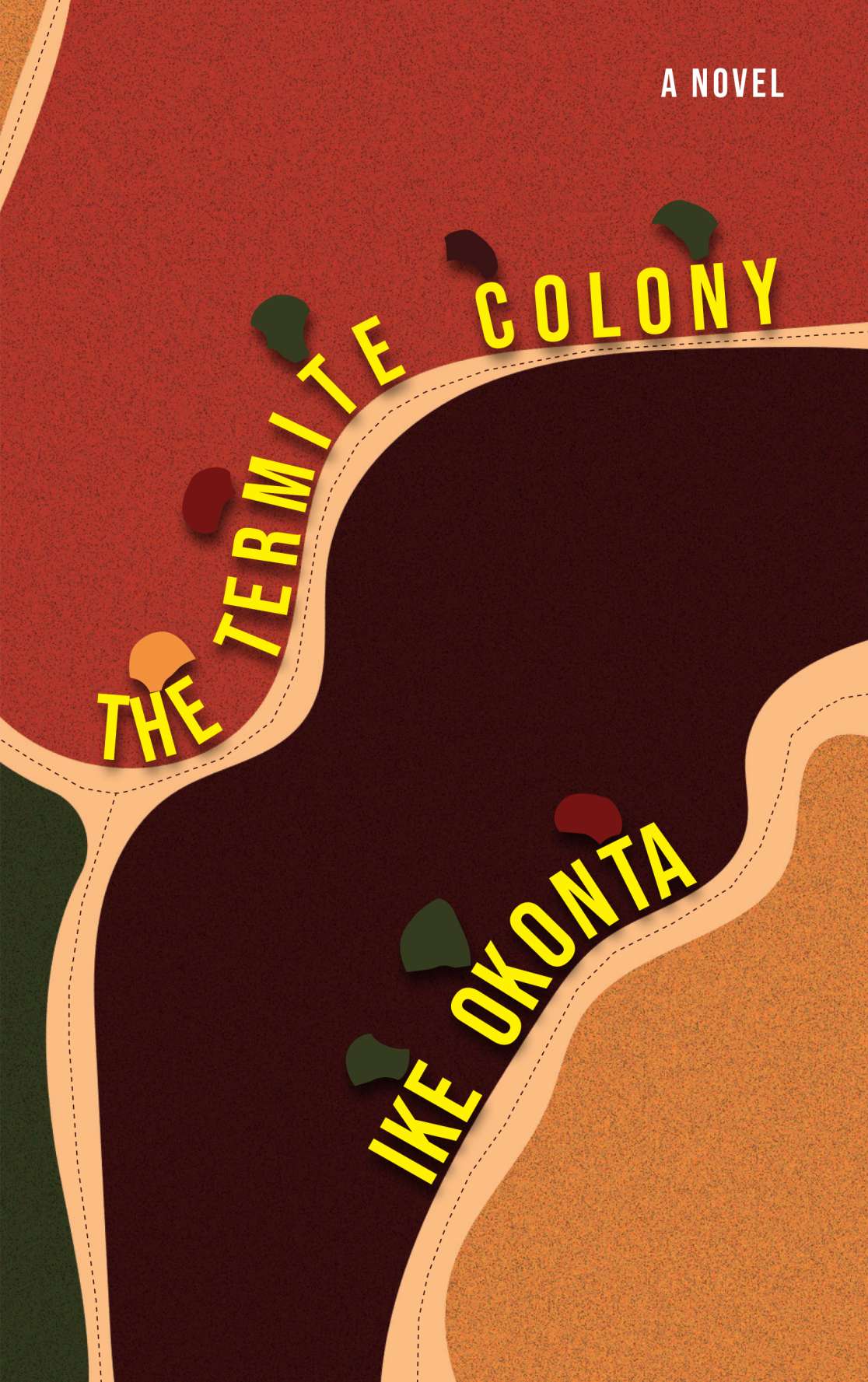
We find that Uche is not exactly the novel’s principal character— but a conduit through which the stories of Africa’s myriad problems are chronicled: the novel is more or less a series of conversations, each one adding to a collective whole, all of them thematically aligned in the unflinching gaze it fixes on Nigeria and Africa.
Hence, each new character is representative of a particular problem: through Senator Mac Phillips we see corrupt politicians feeding off the nation’s coffers, and the disillusionment of the few good men in Nigeria’s political class as they come to terms with the dividends of Nigeria’s version of democracy; from Ishaya, we witness the brutal hands of capitalism, and the indignities poor people bear in the face of impossible odds; Emmanuel, Uche’s neighbour’s vantage point offers us the early burgeoning of the Japa phenomenon and what a failed government turns her brightest minds into; with Victory, Uche’s housekeeper, we get first class seats at the mechanics of vote buying; Itohan brings insight into the “pervasive” rot in Nigerian academia; and, with Kofo, a young female banker, the insidious brutality of Nigeria’s banking system on female bodies is made manifest. The list is exhaustive. Okonta is unsparing.
This can, however, become overwhelming, given that in Okonta’s investigation of the Nigerian problem, he offers virtually zero solutions, nor is the narrative couched in satire. But what is bearing witness if not being overwhelmed in the face of another’s suffering?
The narrative fully sets off after the three friends inspect a cholera outbreak in Araba, a small community a short distance away from Abuja, where Golden Valley, a sugar plantation, is chiefly committed not only to diminishing the quality of life, but also to the extinguishing of lives. Amidst increasing difficulties, Uche and his friends try to save the community. They must, however, suffer the consequences of playing saviour.
The Termite Colony does not restrict itself to the Nigerian problem; Okonta casts his net wide, ranging from The Congo to Rwanda to Ghana to Lebanon, and then to South Sudan, offering remarkable insights and analysis on how the forces of (neo)colonialism continue to hamper the efforts of the ordinary man, further plunging African nations into a perpetual state of chaos and despair.
This passage on South Sudan is instructive:
“South Sudan had just won its independence from Sudan. There was a small UN Mission in the country. Everything was new and fresh, including its political and economic institutions… Suddenly, civil war broke out. The President, from the Dinka ethnic group, had been bickering with his Vice, a Neur. I thought these were the usual teething problems one should expect in a young country, whose institutions were still taking shape…There was much to do. The government of Khartoum had disgracefully neglected the southern part of the country. There were no roads or infrastructure when the south became independent. Juba, the capital, was just a handful of cement buildings… Then war broke out between the Dinka and the Neur… The announcer’s casual tone and formal language stung me. This was war! The people of South Sudan were starving and their leaders were shooting at each other.”


While much of The Termite Colony is devoted to the investigation of Nigeria’s—and Africa’s—problem, a human story exists at the centre of the narrative: Itohan suffers a betrayal and must make a difficult decision. Kanayo battles depression following an assignment in South Sudan. And Uche must redirect his policy think tank if he is to survive the monotonous crusade his life has become.

Like Uche Okonji’s home and surroundings, Okonta’s prose is spare and refined, with an assuredness that can only come with age. The novel is reminiscent of Chinụa Achebe’s Anthills of the Savannah (1987) in its thematic preoccupation, and redolent of Nnamdi Ehirim’s Prince of Monkeys (2019) in its atmospheric situation, with all of its central characters bursting with idealism (a characteristic Anthills of the Savannah also shares).
But in telling the stories of Nigeria’s many problems, the principal characters of The Termite Colony suffer the burden of saintliness; they are one-dimensional and allegorical in presentation— characters who do everything for all the right reasons, stark in their pursuit for truth, “shining examples”, as one interlocutor hails them.
This allegorical characterisation extends to other minor characters who populate the pages of The Termite Colony: Archbishop Opini is the poster boy for religious leaders; Uche’s housekeeper represents the suffering masses; Uche’s neighbour, Emmanuel, stands in for the quickly diminishing middle-class, all of them caught against the tide of Nigeria’s “corrupt, incompetent and capricious” leaders.
The Termite Colony is the first in a “projected trilogy”, and here, Okonta has delivered, with unflagging candour, what it means to live through Nigeria’s pervasive rot, and how much hope it takes to not only thrive within, but to continually seek out better. So, by the end, we find ourselves asking if truly hope is enough, and why we have to give up so much in the making of a nation that has only but taken from us.
Azubuike Obi is an Igbo storyteller who believes in the transformative power of language. His fiction and nonfiction have appeared online and in print in The Republic, Efiko Magazine, Afapinen, Afrocritik, Naira Stories, and elsewhere. He was nominated for Chika Unigwe’s Awele Creative Trust Award and H.G Wells Short Story Competition in 2024, and is currently pursuing a Bachelor’s degree in English Language and Literature.