


The NNAF+Parrot Analytics deal joins other existing strategic efforts towards African screen development. While Africa boasts a sizable film and content market, development and audience commitment are uneven across different regions.
By Adedamola Jones Adedayo
Next Narrative Africa Fund (NNAF), in partnership with Parrot Analytics, has revealed a 13-member Advisory Board constituting experts and leaders across production, technology, finance and management, which follows a $50 million in total capital that will go into developing audiovisual Afrocentric projects made by both Africans on the continent and diasporan storytellers.
NNAF is founded and led by the U.S. Deputy Assistant Secretary of State for Africa, Akunna Cook. Its Advisory Board includes Moroccan producer, Khadija Alami; MTV Staying Alive Foundation founder and MTV Shuga franchise creator Georgia Arnold; producer and CEO of Gamechanger Films, Effie T. Brown; A54 co-founder, Nitin Gajria; senior film executive and cultural strategist, Darcy Heusel; Emmy-winning writer and Principal CEO of independent company Tom Lynch Co., Tom Lynch; literary film and television agent and founder of CAA Africa, Ozi Menakaya; senior entertainment executive and creative technologist, Bianca Nepales; Emmy- and Sundance-winning filmmaker, Tommy Oliver; global investment and project finance executive, Tunde Onitiri; Co-Founder and President of ColorCreative Management & Productions, Talitha Watkins; Founder and Managing Partner of Lions Range Group, Victor Williams; and private equity film financing executive and producer, Sahar Yousefi.
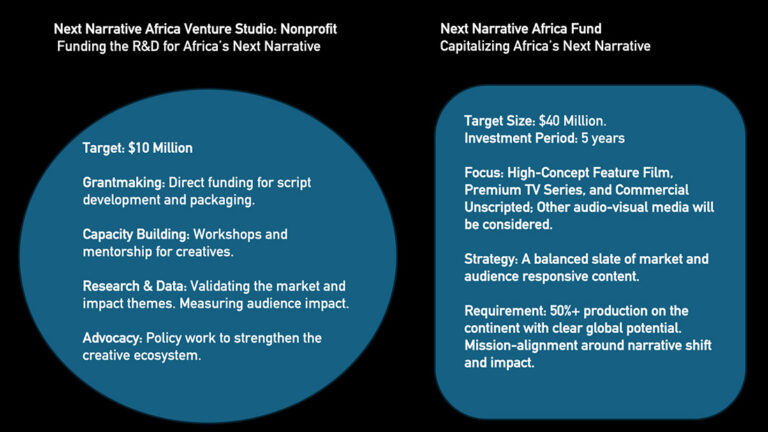
While NNAF’s full playbook is yet to be disclosed, its seed funding has a hybrid structure: $40 million in commercial equity financing for projects with global potential and a $10 million grant-making venture studio for formative content development and ecosystem engineering. NNAF’s strategy caters to both developing and established Afrocentric audiovisual creators, as it aims to “de-risk the export of high-value intellectual property” while leveraging verifiable data and purposeful partnerships, such as that of Parrot Analytics, a global data-driven analytics outfit that gauges and interprets audience relationships with media content.
Antecedents & Comparable Initiatives
The NNAF+Parrot Analytics deal joins other existing strategic efforts towards African screen development. While Africa boasts a sizable film and content market, development and audience commitment are uneven across different regions.
South Africa, Nigeria and Kenya lead the continent’s entertainment ecosystem, with trackable consumer behaviour in cinema, internet advertising, OTT video, traditional television, music, radio and podcasts, video games and other media forms. As of 2024, according to a PwC report, digital engagement statistics showed growth rates of 11.2%, 7.1% and 6.2% for Nigeria, Kenya and South Africa, respectively, with emerging markets like Mauritius projected to evolve at a 2.2% CAGR through 2029 and reach a $508 million market value.
South Africa enjoys a decently structured content environment backed by institutional support. The National Film and Video Foundation (NFVF), an agency of the South African Department of Sports, Arts and Culture, provides funding for content development, marketing and distribution to the country’s creatives. For works in development, each feature film or TV content may receive up to R200,000 (roughly estimated at $12,540) while each documentary or short film gets R100,000 ($6,270). Similarly, for films in production, feature films lead with a possible R1,200,000 ($75,240 USD) funding, whereas documentaries, short films and TV pilots may get up to R200,000 each.
Another similar initiative is the French media and television network Canal+’s acquisition of MultiChoice Group, a leading African television giant, in 2025. This merger, considered “transformative”, looks to deliver synergised content that bridges Africa and Europe, with the Canal+ app already available to at least 30 countries in Africa. The goal is to expand the MCG’s content production and distribution network, with a mixed slate of local and globally admissible content. Implementation costs are expected to grow from an estimated €35 million in 2026 to €40 million in 2028 and €20 million in 2030.
Netflix remains one of the outstanding investors in African screen lately. Entering into the market in 2016, the global streaming committed an initial $175 million fund in South Africa, Nigeria and Kenya from 2016 to 2022, before increasing investment in South Africa with $250 million between 2021 and 2024—all with a focus on indigenous African content.
Other international streamers, such as Prime Video, which stopped greenlighting original content in 2024 and Disney+, with presence in six African countries as of 2022, may have enjoyed limited success so far but advanced African cinema nonetheless.
Beyond the three major hotspots in Africa, more African governments now seem to be showing up for local creatives. In January, the Zimbabwean government revealed a $10 million commitment targeted at growing the local television and radio services, with further plans to establish content hubs across ten provinces in the country.


In addition, co-production treaties such as the 2022 Kenya-South Africa Audiovisual co-production agreement, the 2025 Côte d’Ivoire-Belgium agreement and the 2026 Canada-South Africa Audiovisual co-production agreement are also shaping activities in film and television across Africa.
Data Meets Creativity: Implications for Africa’s Screen Industry
The NNAF+ Parrot Analytics deal presents a unique situation where data meets creativity.
Parrot Analytics is known for its seasoned insights and data-driven reports that connect content creators with consumers globally and make it possible for content stakeholders to make artistic and business decisions. Its scope covers audience demand measurement, streaming economics and financial insights, and content valuation and predictive analytics. With a proven global trajectory, these analytics are embraced by studio and streaming platforms, networks and broadcasters, advertising and marketing agencies, sports leagues and talent agencies, and investment outfits and government agencies.
This formally declared partnership with NNAF creates an atmosphere for Parrot Analytics’ proper inquiry into the African screen market. While agreement terms remain unknown, there’s a need to analyse and cater to the content demands of specific countries and regions that are often underrated or overlooked in most reports.
While initiatives such as Africa Film Press have started to provide data-based intelligence reports, forensically tracking engagements across Africa’s dynamic screen industries, this NNAF+ Parrot Analytics gesture towards a refreshing perspective: the global community’s quantitative engagement with African screen. This requires a careful, appreciative attention to the African creative landscape. With the partners based in the US, the collaboration feels like an aspiration for a Pan-African screen network, an attempt to measure how African stories are created, received and optimised for audiences across Europe, the Americas and Asia.