


BEAST OF NO NATION
On 6th February 2025, the United Nations Secretary-General appealed for peace in the Democratic Republic of Congo, where a recent escalation of fighting between rebels and the national army has killed at least 2,900 people and displaced tens of thousands. — The Nation.
1. Today, I cannot say when, in the Democratic Republic of Congo—somewhere not more than a broken cry away, in the phantom shoeprint of a Third World village street—a Congolese crisis-displaced boy is being silently plucked from the secret seedbed of living. As we speak, the final rites of a bullet are being canonised in the hollow casket of his skull. His budding penis peers out from rugged trousers. Red broils out of his lantern-eyes, & then— silence.
2. A bullet becomes a boy. A boy becomes a bullet. Both are bound in holy matrimony.
Silence.
If the earth rotates, why am I still in Africa?
Silence!
Are you surly yet? Uncomfortable? Are you restless? A bullet is a coppery beast, grazing at anything: leaves, trees, houses, bones, bodies, bones. A bullet is a beast of no nation.
3. To the boy’s left, a woman—whom I assume to be his mother (or loved one, or perhaps a good Samaritan)—thrashes on the bare sand like a beheaded snake. Sprawling & hollering. Tears snail down her dust-fogged face as she screams into the gun-powered air:
“No, Mowéli!”
Both hands capsized on her head. Then, as if gasping for breath, she lets out a shrill, muffled yell:
“Noooo! Not my Mowéli. . . Ah!. . . Okay, okay. Hmmm. . . Mowéli”
Her dim eyes bulge with gash-unfinished weeping. The tiny black bullets of her pupils smart & ricochet off his forehead, tracing the seven-headed scale of his frozen body.
4. The sky is blue—just blue—as afternoon skies are supposed to be. & nothing more. The upland sun dwarfs itself, reducing into the shape-shifting disc of evening.
5. In a sun-mined region like this, know that a newspaper photograph of your fading fate is an immortalised gift. Even this, I ought to think to churn on otherwise—just beside the tiny swell of hillocks & corrugated sand, a baobab away, an international pressman unskins a pack of cigarettes &, in a single sustained drag, sucks his way into its glowing tobacco bead. A tarpaulin umbrella billows over his moving form, barring the fierce sun barking at him. He hobbles, crumples onto a knee, & squints precariously under black, heavy-duty Canon lenses, listlessly swatting flies from his machine toy. Pottering about in uncomplaining silence, he readies the aperture for a light spruce, which—by a trick of perspective—duplicates a 9mm shotgun’s shadow on the ground splayed before him.
6. Because in these little gardens of bullets, in this Congo of thimbled grief, you need proof for the planet to mourn with you: coloured photographs of your screaming before faying with your ancestors—for USAID to send you first aid.
But then—can the cockroach be innocent in a gathering of fowls?

7. I slow down in my staggering gait, for a moment too brief to matter, turn back, & watch their three molten forms dissolve like fog into the expanding ghetto.
Silence. . .
Silence!
8. Silence?
ALMAJIRI GIRL
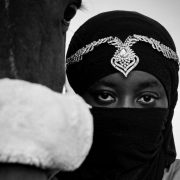
She’s not unattractive. / She’s only slightly rough / to the eyes that are smoke-blind / to see, / & see, & see. / Though, / more often than not, / her sandals are tattered; / we may even say, / crippled. / She rubs her cold fingers, / cursively slim—perhaps / like her mother’s—briskly, / to singe the same way / a housefly squats / to wash its hands with air, / to perch. / Her tribal marks knifed / beneath her cheeks: / four impossible quotation marks / enclosing the other half / of her wrinkled skin, / indolently flagged / from a soft cluster / of six-year-old bones. / A purple hijab, / like a comma, / pinches across / her black phrase of a face, / glassed with sweat / & soot. / Her pelt lips—as if / an indigoed stitch / in a shirt— / sigh & hunger / for saliva, / or Nigerian Kobo. / An orange rubber bowl / for daily offertory / suspends upwards / to the street on one hand. / Her eyeshadowed eyes: / two black coins / in a saving box / hidden in a poem, / as of a girl / whose only metaphor / is to be born / on the very same day / when Adam fell, / & was bloated out / into a forbidden miracle— / like being / a tiny northern sunflower, / & yet Nigerian.
Paul Chibuike Emenike is a Nigerian multiple award–winning visual artist and poet whose work explores Afro-cultural themes, urban life, and the shifting landscapes of contemporary Nigeria. His writing has appeared in and is forthcoming from The Illumination Magazine, The Shallow Tales Review, Brittle Paper, Centaur, African Writers Magazine, The Weganda Review, Palette Poetry, and elsewhere. He lives and works in Jos and is currently developing his debut collection of prose poems. Instagram: @paul_chibuike_emenike