
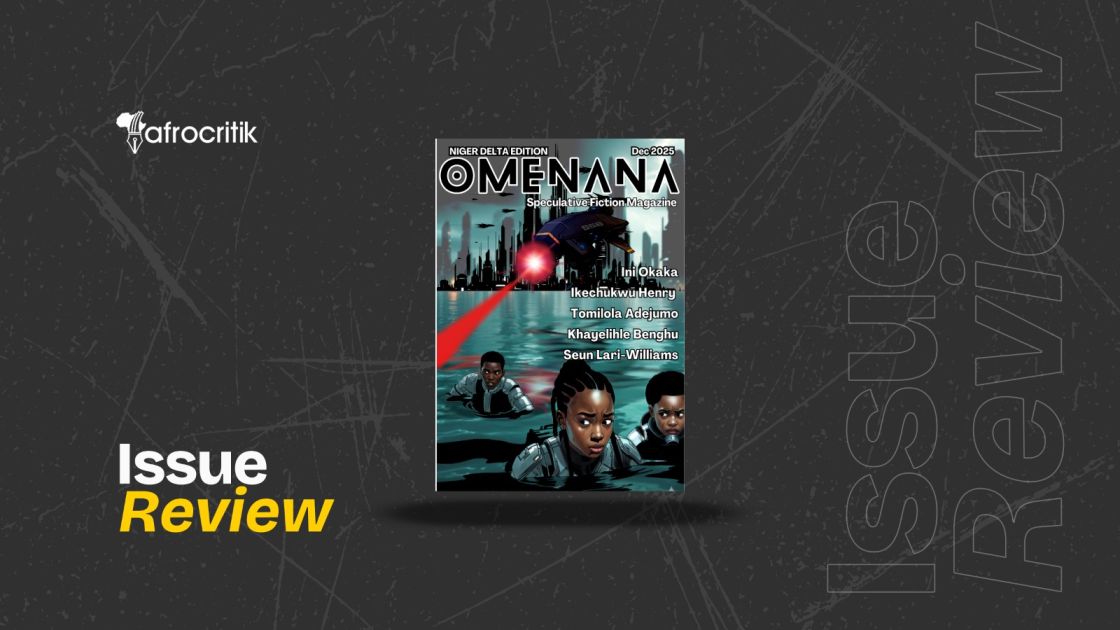

What Omenana has essentially done with this Niger Delta Issue is to ask fiction writers to do what journalism and policy reports have struggled to do: make the crisis felt rather than merely known.
By Folakoyejo Olowofoyeku
Omenana, a speculative fiction magazine, in its December 2025 issue, called on writers to create worlds that explore possibilities surrounding the Niger Delta region. Five writers answered the call, building unique, alternate worlds that shine a light on the plight of the region. Interestingly, their primary focus was the issue of oil pollution. Even the call for submissions prioritised “oil spills and their attendant environmental devastation”. The rationale behind this attention is not difficult to understand.
The Niger Delta, once rich with plant and animal life, has been poisoned for decades—intoxicated by one of its most valuable resources, now turned into one of its worst enemies: crude oil. Ken Saro-Wiwa was executed in 1995 for his activism against the political abandonment of the region. He famously said, “The environment is man’s first right. Without a safe environment, man cannot exist to claim other rights.” Yet, today, the region remains subject to extreme exploitation and political neglect.
What Omenana has essentially done with this Niger Delta Issue is to ask fiction writers to do what journalism and policy reports have struggled to do: make the crisis felt rather than merely known. In response, the five published stories take readers on journeys exploring solutions originating from revolution, rebellion, faith, science and determination.
Together, they produce an uneven but ambitious collection of stories—ambitious in their literary choices and in their advocacy for our planet—that demonstrates both the power of African speculative fiction and the difficulty of translating one of the continent’s most devastating environmental catastrophes into narrative form.
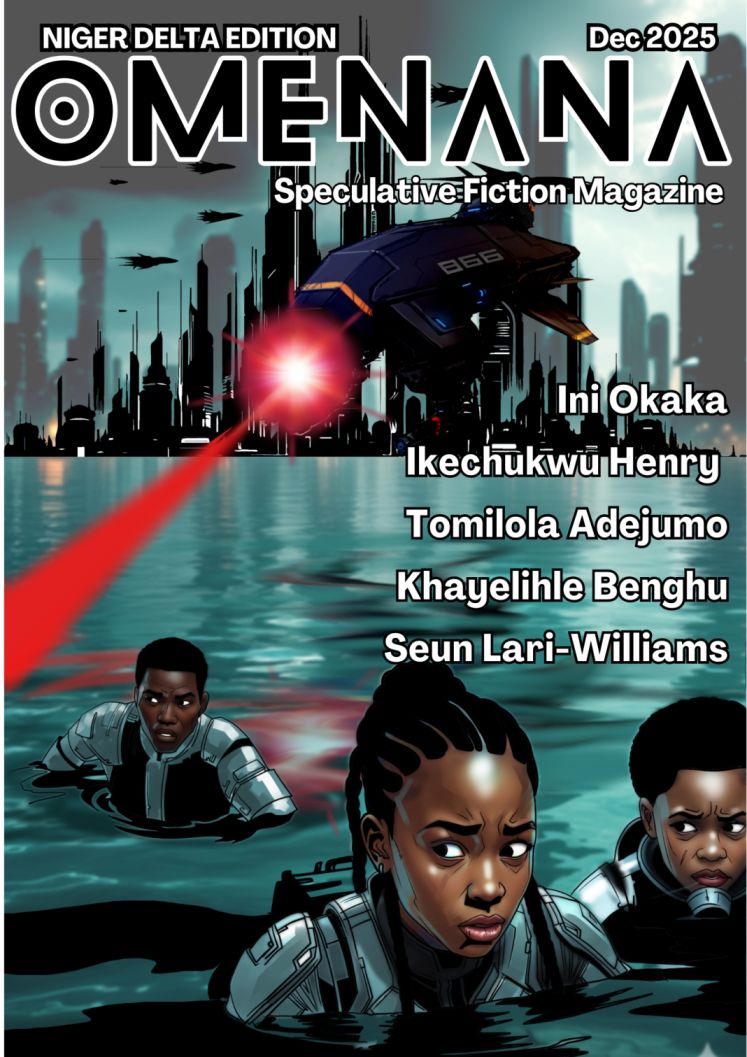
The Issue opens with “Waterbringer” by Ikechukwu Henry, a story centred in a futuristic Africa, where a village is forced to buy usable water, as its natural supplies have been choked by oil. To get clean water, Amina, the protagonist, needs to trade with an entity called The Authority, a scientific organisation that serves as a government. The trade is not for standard currency, but for something worth much more: her memories. Amina soon discovers that The Authority is using the access to memories to alter their perception, a violation that leads her to expose the crimes of The Authority.
By putting a face to the crisis, in the form of an exploitative organisation, “Waterbringer” gives a seemingly helpless situation an identity that the reader can root against, inspiring courage rather than apathy. Amina’s resolve to expose the crimes of The Authority doesn’t necessarily solve the crisis, but it does leave the choice in the hands of exactly those it should be: the people. The lack of a clear resolution could be seen as a flaw in the storytelling, but in this case, it makes one thing clear: the presence of choice. The fact that a violation has been exposed to the public does not automatically mean the violators will be held accountable, especially when they are the government. The choice to act lies in the hands of the people, where it will always lie. This type of choice is nigh on impossible to force in any direction, and may be the reason whistleblowing is typically done to the authorities or the press and not to the victims, to whom, at that point, the violation has simply become a way of life, one they may not be keen to see change.
Khayelihle Benghu explores the same solution of revolution in her cyber-punk story, “The Smuggler of Wet Gene”, except that the revolution is constant and hidden as opposed to the spontaneous and visible revolution in “Waterbringer”. Both stories, though, share the same key element: the choice to fight for the people’s rights. In Benghu’s story, the region has turned to cyborgs and artificial intelligence for administration to avoid the human mistakes that lead to environmental crises. With this administration lacking the emotions necessary to sustain citizens’ welfare and culture, the protagonist, Orire, takes up the mantle of revolution, providing prohibited resources to the people.
The stakes are kept at a constant high, with Orire skating arrest by the skin of her teeth, a testament to the strength of her moral code. Just like Amina in “Waterbringer”, she chooses to fight for the rights of the people in her community. Her fight is vastly different. Where Amina chose to blow the whistle, Orire’s choice is more physical, putting herself at great risk every night to meet the needs of her people, but it is still, ultimately, a choice.
One attribute that totters between skill and flaw would be the emphasis on cyborgs and AI being the governing body. While a good device to show that heavy reliance on technology for administration–eliminating human emotions like compassion and empathy–can leave individuals with needs unmet, the repeated references can feel a bit overdone, almost like a heavy-handed attempt to situate the story within the realm of “science fiction.” It does make one thing clear, however, in this world of ours that is beginning to rely more heavily on technology, especially AI, an apparent violation of human rights may be inevitable. This is a reality facing many industries today, with losses of jobs becoming a more common occurrence with the increased innovation in automation and AI use.
Ini Okaka’s political sci-fi, “A Time Like This”, follows a different path from “Waterbringer” and “The Smuggler of Wet Gene”, exploring, instead, an internal battle in a world where the hero and villain are intangible, amorphous mindsets battling for dominance in the heads of the characters. This internal conflict calls to mind the comedy trope popular in animated media: the angel and demon on the shoulders.
Madam Ivy, a local lab assistant working with foreign scientists in the region, discovers a solution to the environmental crisis and relates her discovery to the President of the country, President Koko, and to her husband, Dr. Tari. The President and her husband are then faced with a moral dilemma, weighing the risks of utilising the solution and losing it to external exploitation, on one hand, or keeping it to themselves and inadvertently becoming a part of the problem, on the other hand.
The story is left open-ended, concluding with no clear idea which choice President Koko makes–which risk she decides to stomach. This hits home a common truth of human life: sometimes, the answer to a morality question is not immediately clear. Often, the answer does not come easily, and sometimes it never comes.
Seun Lari-Williams flips the script in “GbeneBeka: The Gospel According to Wiayor”. In Lari-Williams’ alternate history, religion and culture have taken a back seat in a community now driven by refinement and poise. There is one man, however, who holds on to the old ways: faith in the gods. In defiance of an unappreciative community poisoned by pollution but blinded by the gift of “advancement” by foreign organisations that exploit the land, Wiayor goes searching for a saviour of a divine nature.
This narrative of holding on to faith against the grain is one most readers can relate to. Swimming against the tide of submission to greed under the guise of “progress”, Wiayor does more than hold on to his faith; he protects its object against people he has known his entire life, showing incredible bravery.
The narrative is rich with hope and faith, and the flow of the story is gripping, but the narrative language is often jarring as it conflicts with the language presented in the dialogue of the main character, Wiayor, especially as the tale is narrated in the first person. The beauty of first-person narration is the sense that the protagonist is speaking directly to the reader in their own language–their own thoughts straight to the reader’s ears, creating an optimised state of immersion into the events of the story. When the narrative language and the language in the dialogue are different, it can create a conflict where the narrator and the character making the speeches present as completely different characters despite having the same identity within the story. This conflict breaks the feeling of being in direct–albeit one-sided–conversation with the main character, breaking the immersion and, in some cases, distracting from the value of the story.


The closing story, Tomilola Adejumo’s “The Last Fisher of Oporoza”, breaks the mould set by the earlier stories—it creates no villain and offers no clear solution to the violation of the environment. In this time-travel story, the polluter is not an enemy but an entity that takes accountability for the disaster they have caused. The solution itself becomes the problem, trapping the villagers in a day-long time loop while the polluter studies the oil spill to prevent future disasters.
By chance, the protagonist becomes the only villager to be aware of the time loop. Against all reason, he begins to warn the people in the hopes that behavioural changes would avoid the disaster, much like is done in the real world as governments and activists hope to abate climate change with recommendations around the use of plastics and the consumption of fossil fuels.
However, the stakes in “The Last Fisher of Oporoza” are somewhat reversed–there seems to be no gain as his crusade appears to yield no positive results. It almost begs the question, “What is the point?” Yet, his fervent determination, despite setbacks and perceived failures, inspires great admiration in the reader.
At its best, speculative fiction uses imagined worlds to illuminate the anxieties and possibilities of our own, and this collection does precisely that through its diverse array of narratives. Each author confronts the crisis of oil pollution in the Niger Delta by envisioning solutions born of sacrifice, science, anarchy, faith, and unwavering determination. The result is a series of stories steeped in fear and uncertainty, yet never devoid of hope—stories that serve as a reminder that speculative fiction is not merely an escape from reality, but a means of reimagining it. By projecting today’s environmental wounds into inventive and unsettling futures, these authors transform fiction into an act of inquiry, resistance, and possibility.
However, it is worth noting the wording of Omenana’s call for submissions for the Niger Delta issue, which requested stories in any of science fiction’s many forms—cyberpunk, climate fiction, African futurism, solarpunk, biopunk, eco-scifi, political sci-fi, alternate history, time travel, space exploration, AI and robotics—so long as they meaningfully engage with the region”. Although the writers explored different forms of sci-fi, they all restricted their focus to environmental concerns.
While the state of the environment is one of the most glaringly important facets of life in the region, the Niger Delta is a multifaceted gem of deep-rooted culture, religion, and traditions, which were notably unexplored in the Issue, except in “GbeneBeka: The Gospel According to Wiayor”, which reflected how traditions and culture adapt to the changing times. The possibilities around the Niger Delta are endless, and the Issue could have benefited from shedding light on the unique customs and practices of the region without ignoring the darkness that is the environmental crisis.
Nevertheless, the value of Omenana’s December 2025 Niger Delta Issue lies in the vibrancy of the worlds in the minds of its writers. Five writers, one environmental conundrum, one region, five unique answers, each exploring worlds requiring a different set of heroes: a whistle-blower, a scientist, a deity and her priest, an anarchist, and a man with absolutely nothing to lose. But these worlds reveal a hard truth: there is not just one single solution to the crisis in the Niger Delta. Same as in the real world, there are a myriad of solutions.
Folakoyejo Olowofoyeku is a novelist and environmental protection advocate. He is a graduate of Environment Science and has written two wildlife fiction novels: Timber and P2-Peregrine. He can be found on TikTok @the_writing_foyeh, on Instagram @fola_ko and on LinkedIn: Folakoyejo Solomon Olowofoyeku