



With 82nd Division, Aderibigbe brings the reader to poems that are simultaneously historical and modern; adherent to the stipulations of traditional poetry and the radical freedom of the contemporary one.
By Daniel Echezonachi
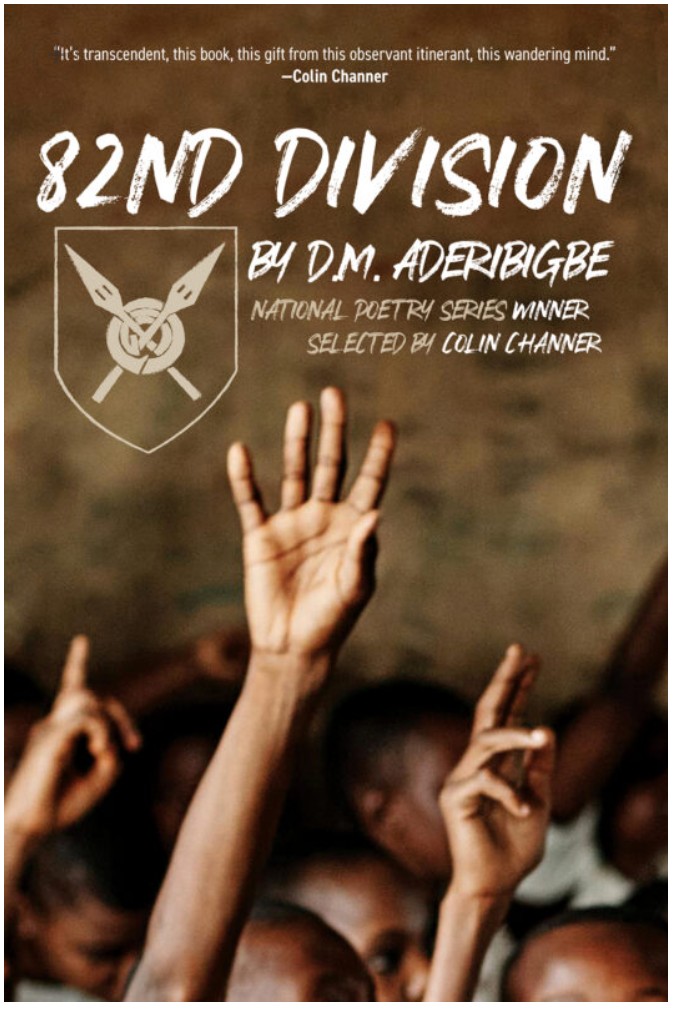
D. M. Aderibigbe’s 82nd Division—which won the 2024 National Poetry Series competition (selected by Colin Channer)—sets out to manifest scars of thrust and counter-thrust in a specific historical context. It achieves this, arguably placing the poet within a long lineage of poets-as-historians, through its concise language; distilled but not stripped-down, imaginative but not indulgent. Colin Channer, in his introduction to the book, describes Aderibigbe’s work as a ‘transcendent gift from an observant itinerant [and a] wandering mind.’
The book’s title, drawn from the 82nd (West African) Division—an army regiment composed of forcibly conscripted Nigerian men, is also the title of a sequence in the book. The sequence, set during World War II, recounts the horrors of war from the perspective of the colonised. It begins with the persona’s narration of his conscription into the army:
“three men, British, barged into my view,
two grabbed me by my underpants. The third—
the man who owned the garden—stood beside them.
At every turn of thought, I hear his words:
He’ll be useful. He knows English.” (82nd Division: September 1943)
From this point follows a long sequence detailing how ‘every Black man’s dusk and daybreak/ were born from the mouth of the general’, how the Black man was bound to end every sentence with Sir, how they were forbidden from calling the lies of a White man a lie. In the spartan circumstances of fighting the war as a Black man at the mercy of British Soldiers, the persona still finds time to write, because ‘it is only fair/ that history remembers the sound of our voice’, the same voice which should not be raised on the battlefield. The end of this long poem falls on the end of the war and the neglect suffered by the Black men who had been made to fight with their lives.
‘‘In his speech, he extends his gratitude
to all the British soldiers who made
this victory a reality.
In his speech, he extends his gratitude
to British people everywhere.
In his speech, he extends no further gratitude.” (82nd Division, April 1945)
By the end of the titular sequence, it becomes obvious that the governing subjects of the collection are colonialism and the Second World War; a quick dot-tracing would reveal that the book’s ultimate goal might be to give voices to the Nigerians whose lives dangled on the thin ropes of the coloniser’s whims. To arrive at this conclusion is to follow the voice in the sequence, or the man in “The Porter” who says ‘You see dem marks for my face…I get gem all for Burma when I bin dey fight for the British’; or even the curious boy who asks ‘Sir, sir, is this how the British flooded our history?’
But the collection is not tethered solely to these themes. The elegy—which seems to be Aderibigbe’s surest poetic heft—is most times more personal than it is historical or communal. The voice in poems like “A Brief History of My Grandmother” and “Failed Elegy” rethinks familial love from a place of casual but deep longing— for grandfathers, grandmothers, uncles, and aunts who live ‘on scraps of light and the echoes of [their] own voice.’ (“Rose”). In the second section of the book, he takes an inquisitive eye to the things one might consider markers of familiar bonds and boundaries. For instance, in the poem “Pantoum”, the speaker says ‘My mother had mouthed off a mild protest/ She couldn’t use that mouth for days.’ These lines introduce the reader to a family headed by an authoritarian father ‘whose hands were fluent as a boxer’s’. On the edge of the voice in this poem, we hear the reticence, the fear of living in such a home as this. Here, the family becomes a microcosm for a colonised people; the fluent hand of the Father melding into one with the coloniser’s.
The Mother-Presence in poems often being a motif for protection, we find a thread of Grandmother-Mother-Son relationship running across some of the poems in the collection. In “Ritual” we find a son trying to immortalise the mother: ‘Each morning, I gather what’s left of her. /Call this a son’s ritual for his mother.’ It is similar to what we encounter in “Failed Elegy” where a mother kisses her child while standing on her toes. The canvas is broadened to accommodate uncles, aunts, siblings— all of which make up a family. In a way, the poet shows us through this poem that what assails the family unit, what causes a weathering of its core, is in many ways similar to the maladies of an oppressed nation: death, silence, tyrannical leadership, dwindling of hopes alongside kerosene lamps.
However, one may have to agree that the poet is not his best at surrealism or overblown exaggerations. The shortest poem of this collection— which again features the mother, the grandmother and the “son”— is titled “Essay on Love”. The poet drifts a little from his mild mode of interrogating familial love, and presents in this poem what should be a short, gut-punching snapshot of his experience of maternal love.
He writes:


The last time I stepped out of her
gray hair, the town fell around my
grandmother’s feet. It was the first day of high
school. A month before, we buried my mother.
In three sentences, the poet establishes generational layering, grief and loss. But the poem raises more questions than it provides answers. It is unclear whether the act of ‘stepping out’ connotes growth, inquisitiveness, or just separation. Also, the falling of the town, while it suggests collapse, does not state what emotional register we should take it on. This ambiguity might well be a conscious attempt at opacity by the writer; its adverse effect is equally as obvious. The reader does not understand, because somehow some part of the poem shields itself from meaning. All we get from the poem is: On the first day of high school, a month after [he] buries his mother, something happens with grandma. The second part of the poem goes through, but the first cowers under what might have been an attempt at surrealism.

With 82nd Division, Aderibigbe brings the reader to poems that are simultaneously historical and modern; adherent to the stipulations of traditional poetry and the radical freedom of the contemporary one. Perhaps for the poet, Form (or a subversion of it) holds equal importance as the thematic, spatial and even temporal concerns of the poems. The understanding of the formal implications in each poem covers much ground in the understanding of the poem’s purpose in itself. Across the pages of the book, the reader sees how much personal voice is infused into traditional styles. Nearly half of the collection is built on existing poetic forms— the Japanese Haibun, the Ghazal form made popular by the Arabs, Jericho Brown’s Duplex form, Sonnets and Pantoums.
At his best, Aderibigbe excels with these forms, when one considers what he does with the villanelle form in “Ritual” or the ghazal form in “English”. When he falters, like in “Christening: An Abecedarian”, the poet collapses concepts into mere structuring; tries to bend a grand concept like colonial extraction into the demands of alphabetic order. On a closer look, one begins to think that perhaps the line ‘Grenade. Gun. Gun. Gun. Gun. Gunpowder. Gut.’ serves the purpose of keeping the abecedarian form in line, and not to enhance the poem’s subject.
While, on the whole, Aderibigbe’s book is not a flawless collection, it offers an impressive trifecta of meaning, structure, and imagistic language, which culminates in an undeniably authentic voice. 82nd Division is a book unhesitant to dignify the memories of the Nigerian man in the time of colonialism; unafraid to dare both personal and broad histories. By probing into dark times like World War II, it pays homage to these “men whose songs [bones, eyes] have become ours”. Men who sang resistance to oppression. The poet hands us the songs of these men in all their variants, asking us to see how much these songs are still ours. How we still grieve in similar ways, experience love in the same ways, how—although free—we are still colonised in places.
If one’s definition of poetry is a subtle deification of reality in ways that nothing vital to truth is bleeped out, then 82nd Division exemplifies it.
Daniel Echezonachi is a writer and student of the University of Nigeria, Nsukka.