


In Dawn is an Open Wound’s first section, the poet persona is a tourist, and the poems read like a travel diary.
By Joel Oyeleke
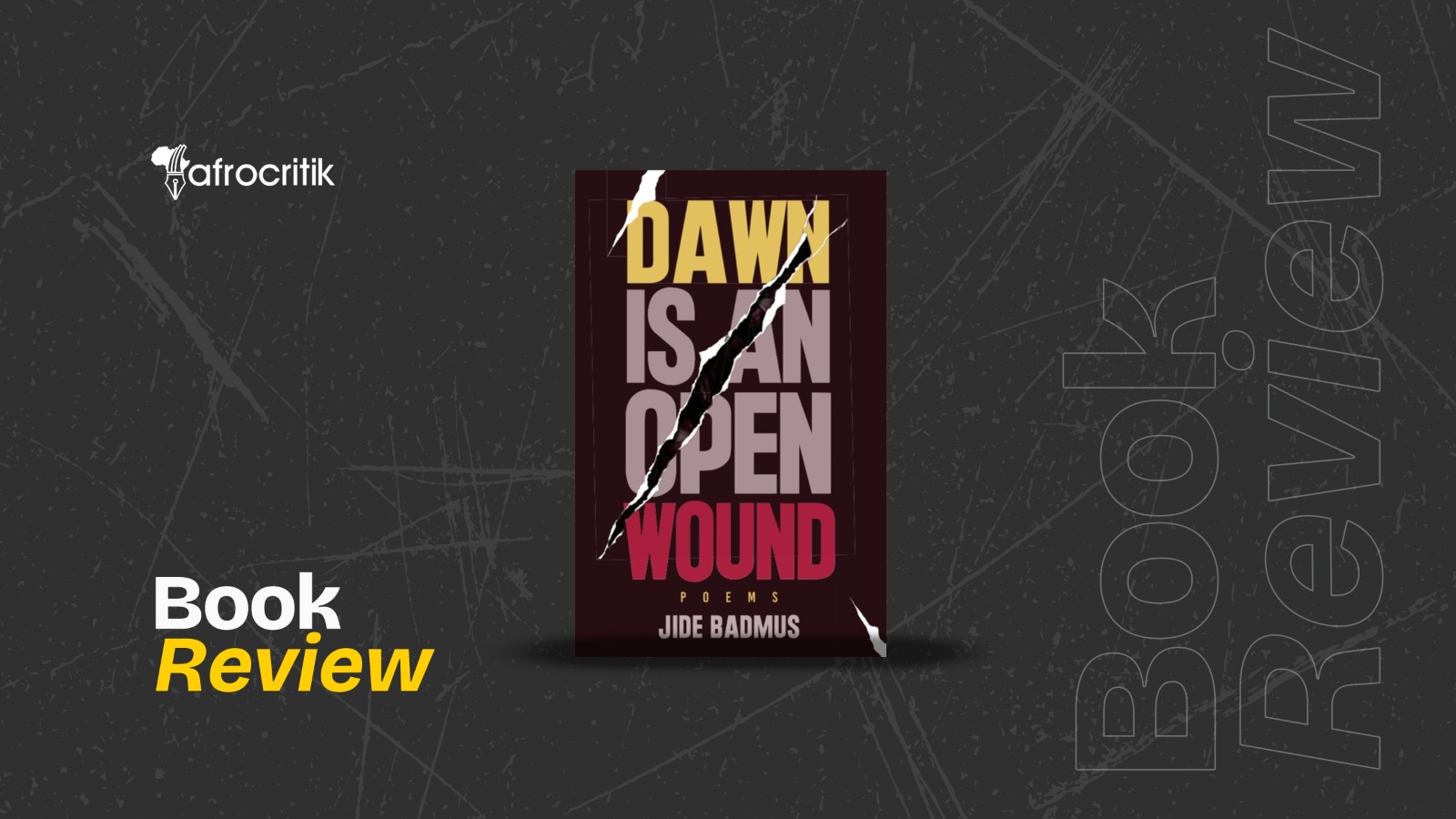
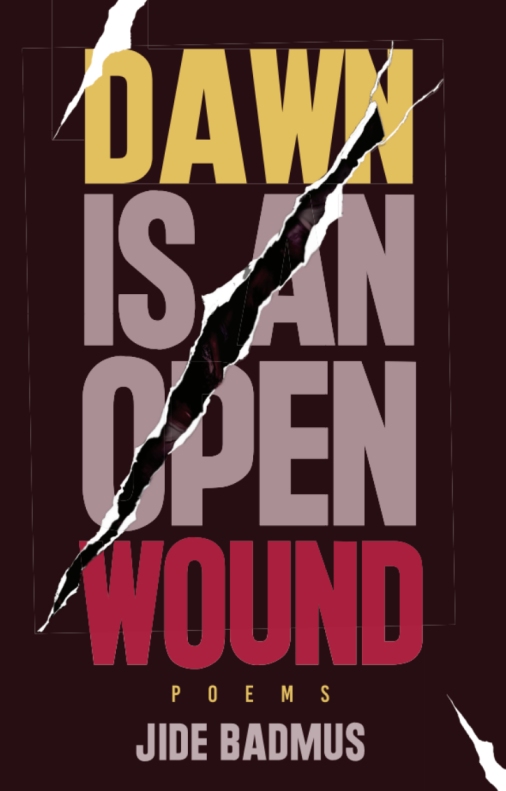
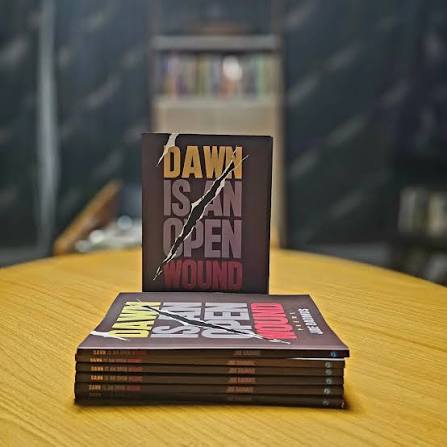
Jide Badmus’ latest collection of poems, Dawn is an Open Wound, is an eighty-page book that explores various dimensions of Nigerianness, especially in the realm of the working or poor class. Most of these new poems are playful, sensual, short, diction-simple, and individually lyrical (that is, readers are forced to share simple moments with the poet persona). Divided into four sections: “I Disappear at Dawn”, “Blood Currency”, “Grief Motel”, and “The Night calls a truce”, the collection captures quotidian realities of different Nigerian spaces in ways that render the book a very easy read.
In Dawn is an Open Wound’s first section, the poet persona is a tourist, and the poems read like a travel diary. The first five poems are in a continuum. From “I started this poem in Lagos traffic” to “The road” to “Danfo” to “Oshodi” and to “Portrait of Lagos as a feast of fury”, Badmus presents separate travelogue poems that could easily be edited into one piece. The tempo of these first five poems carries into the rest of the section as the works move from presenting the hustle and bustle of Lagos to Oraifite of Anambra State, Idi Aba of Ogun State, Ede of Osun State, Abulenla of Kwara State, and Gwarinpa of FCT, Abuja.
Simple events like drinking and eating at a bar, strolling around or meeting new people are the focal point of this section. Place poetry is the framework that holds here. The poems are situated in the everydayness of street culture. Many writers are fond of “paying homage” to their homeland and using their heritage as foreground for stories. Badmus, in Dawn is an Open Wound, is one of them.
It is, however, difficult to understand why the book is titled Dawn is an Open Wound through the I Disappear at Dawn section, as there is hardly any poem that seriously confronts the tension the title suggests. In “Motel on Coca-Cola Road”, Badmus lives up to his acclaim in the thematics of roadside sexuality and desire when he writes:
You are hot
Like Ilorin sun,
Abuja wannabe,
You will burn my heart . . .
Although the poem isn’t very intense in its description of romance and cannot, for instance, compete with the level of craft-work, cultural rootedness and linguistic elegance in Sharon Doubiago’s similarly thematised poem, Crazy Horse, it speaks to the mood of the section as a generally gleeful one.
Blood Currency is a section that changes drastically from the first. It confronts and attempts to tackle the obsession with money and materialism in the streets or in places of power and governance. In “Black Market”, Badmus poeticises against the system – in this case, the medical world of Nigeria. He writes:
In a Lagos hospital,
the blood bank is empty.
Commercial donors,
Poised to milk your misery,
charge thirty thousand per pint . . .
A piece like “& Men shall worship you” is an amplified version of the poem excerpted above. Both poems find their essence in Badmus’ critique of contemporary Nigerian socio-politics that rewards flimsy extravagance. Another poem like “Hard target” works because the poet plays around the issue of religious syncretism in addressing mass obsession with money and success, no matter its source. The first stanza reads: “I’m a hybrid of juju & grace. I wash my head with black soap, & wear a crucifix around my neck”.

However, other poems in the section lead me to the conclusion that “Blood Currency” is the weakest part of Dawn is an Open Wound. They are written in a very unpoetic language and are full of poorly constructed images. They are also full of cliché phrases like “time is a blessing and a gentle curse”. The work of the poet is to wrestle language, to burst open new frontiers, and it is what this section fails to achieve.
Things get a bit better in the third section, “Grief Motel”. Here, Badmus totally abandons any art-for-art’s-sake motif and directly “confesses” several anomalies of contemporary Nigeria. In “The world is a bat” and “Warning: what you are about to see next is graphic”, the leaders and happenings in the nation of the world of the text are “a nightmare, a fortress for distress. no joy in the market, only a glut for tears”.
The section matures from these first two poems into a kind of weeping about specific issues like economic instability, socio-political unrest, corruption, and insecurity. A stanza from “Unusual metaphors” reads very plain but with a tone of urgency:
The land is on fire
The land is ailing
Hospitals hold prayer
vigils before surgery–
Doctors who are not on queue
at foreign embassies
are on strike
The ones not yet in school
are home learning to knit or write poetry.
The poem excerpted above tackles many issues at once: from religious overzealousness to the scramble for migration to poverty and eventually throws shade at poetry (which is sincerely underfunded and hardly lucrative in Nigeria). Poems like “I know your God” and “Asylum” further argue for the complicity of religion and faith in the Nigerian brand of suffering. “Fill in the blanks” – like most of the poems of James Yeku and Jumoke Verissimo’s Sorosoke Anthology (2022) – memorialises the 20-10-20 Lagos toll gate incident, especially as it relates to media misrepresentation of truth. The poems of the Grief Motel section demonstrate tensions and counter-tensions in both the grand and ordinary experiences of everyday Nigerianness.


In the last section, “The Night calls a Truce”, the eponymous poem titled “The night calls a truce” is the heart of the collection. It continues the grief-induced imagery of the third section and extends into a kind of hopelessness in poems like “I’ve run out”, “A stuttering of seasons”, and “After this episode, I shall have shark pepper soup for dinner”.
In “Clay” – which this writer believes is the best poem in the book for its mood of solemnity that forces the poet to use a more disciplined prayer-induced lyricism – Badmus turns to God for a solution to problems of national and personal concern. He writes:
Do not hide
your face . . .
Show me your good eyes . . .
Do not tuck away your wings . . .
I have doused
your altar with water
from my eyes.
Breathe.
Breathe your fire
into this storm . . .
By the time one gets to the end of Dawn is an Open Wound, the poet persona surrenders to the absurd —albeit existential—forces that frustrate living: “I’ll hold on to this emptiness, to this promise of a brimming”, “thankful for light– thankful for warmth, for incandescent rain”.
Although I largely agree with Dami Ajayi that Jide Badmus’s newest poetry collection “transforms communal lament about Nigeria into poems pulsating with intimacy and despair”, Dawn is an Open Wound, published by Noirledge Limited, cannot be his magnum opus. This is because, despite the seriousness of the issues explored in the collection, it (a) over-tells (i.e., most of the poems can be better edited into cleaner versions) and (b) the craft at the level of language, images and freshness is not stellar enough for a mature poet, let alone the Jagunlabi of contemporary Nigerian Poetry.
Joel Oyeleke is a culture curator, poet and essayist. He is currently doing a year-long project on New Nigerian Poetics through profiling, interviews and critical reviews. A 2025 Fellow of Ken Saro Wiwa Int’l. Writers’ Residency, he was shortlisted for the 2026 Evaristo Prize for African Poetry. Find him on Instagram @joel.oyeleke and X @joel_as_poetry.