

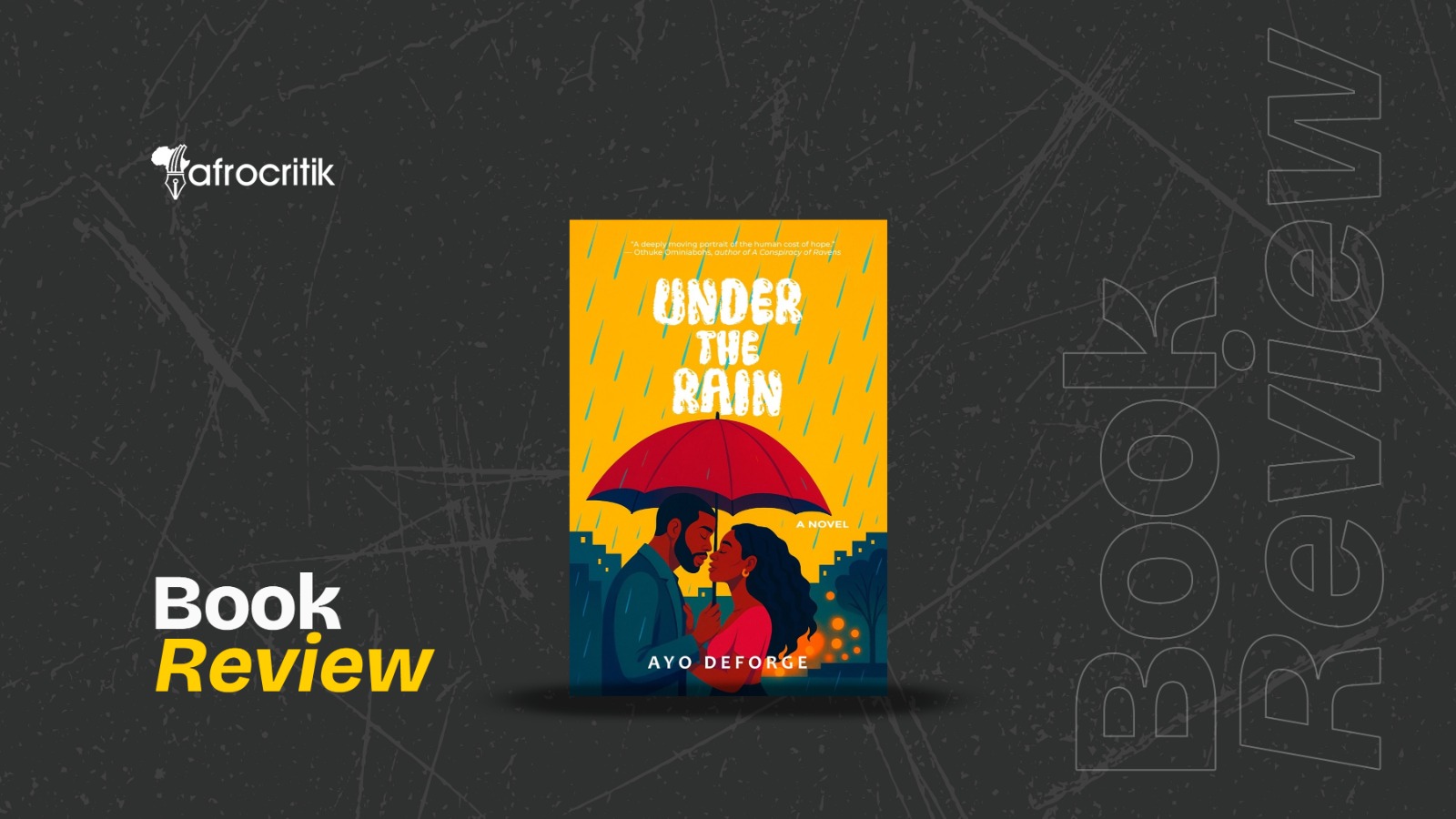


Under the Rain is a sharp exploration of the Nigerian middle-aged male psyche, dissecting the layers of socio-religious duty, personal ambition, and emotional repression.
By Evidence Egwuono Adjarho
Ayo Deforge’s Under The Rain is an immersive and patiently crafted novel that immediately establishes itself as a meditation on the nature of regret, the sting of genetic-engineered separation from loved ones, the haunting pull of the past and the fear of failure.
Deforge narrows the lens of this novel onto the inner life of Dr. Bolaji Akalla, whose outward success as an established medical professional conceals an interior of deep personal, marital, and professional friction. The opening chapters of Under the Rain, in this regard, function as a psychological autopsy of a life carefully constructed on the foundations of unexamined guilt and emotional compromise, which is then fleshed out as the novel progresses.
The novel begins with a literal downpour, which is also symbolic. The rain is utilised as the central, evocative motif that links Bolaji’s stagnant present to his idealised, emotionally alluring past. It is under the sign of the rain that Bolaji’s life is shown to be at a critical impasse, divided between his emotionally barren marriage, his dangerous public activism, and diminished hopes of his first, true love.

The marital disposition of Bolaji and his wife, Yetunde, is perhaps Under the Rain’s most immediate and devastating subject. In the first pages, Deforge establishes a suffocating sexual and emotional disconnect. Following an act of intimacy, Bolaji’s ritualistic inquiry, “Did you like it?” followed by Yetunde’s firm, defensive reply, “Why do you always ask this question?”, immediately sets the tone of their marriage, which largely functions on perfunctory gestures rather than genuine or mutual connection.
Yetunde’s aversion to sex—which she bluntly states she “didn’t like” even before they married—is portrayed as a fundamental block to marital intimacy. Her ‘performance’ in the bedroom is described with brutal honesty: she lies on her back, “closing her eyes and lips tightly, as though mentally preparing for the worst experience of her life”.
This rejection is absolute, leading Bolaji to acts of silent desperation, such as masturbating into his palm when he gives up on finding “the right spot”. That he accepted this condition because she was a virgin speaks volumes about a societal compromise, leaning into the Madonna-Whore complex: sacrificing emotional and physical fulfilment for what is perceived as purity obtained from marrying a Madonna.
Their separation is not only emotional but structural. They inhabit the same house but occupy separate rooms, with Bolaji on the ground floor and Yetunde in the master suite upstairs. This physical division is a sharp metaphor for their isolated lives. While Yetunde escapes the realities of Lagos and her marriage by staying home, glued to “African Magic Yoruba”, Bolaji is left to parent their children and to retreat into his own rooms to process his public and private anxieties.
The title’s imagery, Under the Rain, quickly becomes the story’s most potent extended metaphor. For Bolaji, the sound of raindrops no longer offers comfort; instead, it stirs a “sick feeling of resignation—that his life, as it was, was meant to be just the way it was, whether he liked it or not”. The rain is therefore a conduit to memory, and the memories it unlocks are a blend of joy and profound guilt.
The joy he feels belongs to Shola, his childhood friend and first love. The rain transports him back to being fourteen, “soaked to the skin… watching his neighbour Shola twirl around him”. This memory is painted with laughter, dizziness, and a feeling of “no care in the world”. Shola represents a path not taken for Bolaji, an emotional completeness that his life with Yetunde lacks.
The sudden appearance of a ‘FOR SALE’ sign on Shola’s parents’ house triggers a powerful, existential panic: if Shola’s parents move, his only hope of seeing her again will vanish. This anxiety underscores how much Bolaji has clung to the possibility of the past, using it as a shield against the pain of his present reality.

The profound guilt, however, is reserved for his younger brother, Bamidele, who died of sickle cell anaemia. Bolaji remembers the day before Bamidele died, a day when the rain was “bucketing down from the heavens”. He had refused Bamidele’s request to play outside, wanting to avoid risking his health. This decision, made with good intentions, became Bamidele’s “final opportunity to experience the joy of playing in the rain, and they hadn’t known it”. This guilt is the wound that motivates Bolaji’s life. He silently vowed to become a geneticist and find a cure for sickle cell anaemia.
Deforge brilliantly juxtaposes Bolaji’s private life with a dangerous and intense public life. Dr. Bolaji Akalla is not merely a physician; he is a controversial public health advocate for reproductive rights in a deeply religious and socially conservative Nigerian context. He campaigns for the legalisation of abortion to reduce deaths from unsafe clinics and for making contraceptives accessible to unmarried women. This activism earns him death threats and hate mail accusing him of “encouraging premarital sex and promiscuity”.
The contrast between these two worlds is key to Bolaji’s character analysis. He is a man who shows immense courage and conviction when fighting for the lives of strangers, risking his own safety to challenge societal taboos. Yet, in his own home, he is paralysed and incapable of confronting his wife about their emotional vacancy. His outward passion for reproductive health is, arguably, a displacement of his inner, unfulfilled purpose. His professional life allows him to engage with the grand questions of life and death, with Bamidele’s death as a propeller.
The emotional tension that simmers through the first chapter of Under the Rain reaches a flashpoint in the second with the unexpected reunion of Bolaji and Shola. Bolaji, consumed by his regret and actively seeking Shola’s parents’ contact information, encounters her on the very street she used to live on. The subsequent interaction is charged with the weight of “years of separation” and an “old and unfinished” feeling.

Shola is now a polished, married woman with children, living in the US. Her expensive diamond ring and gold bracelet signal a successful, financially secure life, yet there is a “mysterious look” in her eyes—perhaps sadness or regret—that Bolaji cannot place. When she reaches out to touch his wrist, a “tingling sensation” shoots up his arm, instantly shattering the carefully maintained emotional boundaries he has built.
The memory they awaken through the shawarma they share afterwards is nostalgic and serves as the catalyst for Shola’s request for him to stay. Bolaji, already having convinced himself that he had “lost two of the greatest loves in his life” (Bamidele and Shola), now stands at a precipice. The return of Shola presents an immediate, tangible opportunity to revisit the love he believed was forever vanished.
The author uses this encounter to set up the Under the Rain’s core dilemma: will Bolaji continue his submission to fate and his miserable marital status quo, or will he choose to risk everything—his family, his reputation, and his present life—to grasp at the fleeting chance for the happiness he lost?

Ayo Deforge’s prose is notable for its deep reliance on the protagonist’s internal monologue, creating an intimate, almost confessional tone. The novel also presents many events that are left unfinished. The result is that the reader is forced to make conclusions. For instance, the relationship between Shola and her parents, especially her father, is almost evasive. We only know enough to keep us wondering why their family dynamics play out as such.
In its first movement, Under the Rain is a sharp exploration of the Nigerian middle-aged male psyche, dissecting the layers of socio-religious duty, personal ambition, and emotional repression. But the novel also shines a light on an underexplored area, which is how genetic construction affects individuals.
Under the Rain might be mistaken for a romance novel. However, this would be a lazy generalisation of some sort. While there is no disputing that it is punctuated with elements of eroticism, the book uses these as a backdrop to explore the human psyche and the complexities of emotions.
This is a messy book. The characters are messy. The end is even messier.
Evidence Egwuono Adjarho is a critic and writer.