


Kikuyu Land trusts its audience to sit with complexity, to resist the urge for premature closure.
By Jerry Chiemeke
In Kikuyu Land (2026), directors Bea Wangondu and Andrew H. Brown confront viewers with a stark caveat from the outset: names of interview subjects have been changed, identities concealed, locations undisclosed. It is a sobering preface that announces the uncomfortable nature of the conversation to follow. The documentary’s subject matter, we quickly learn, is so combustible, so entangled in ongoing power structures, that even the act of documentation becomes an exercise in risk management.
What unfolds over 95 minutes is less a conventional documentary than an act of archaeological recovery; digging through years of erasure to exhume the bodies buried beneath Kenya’s tea industry.
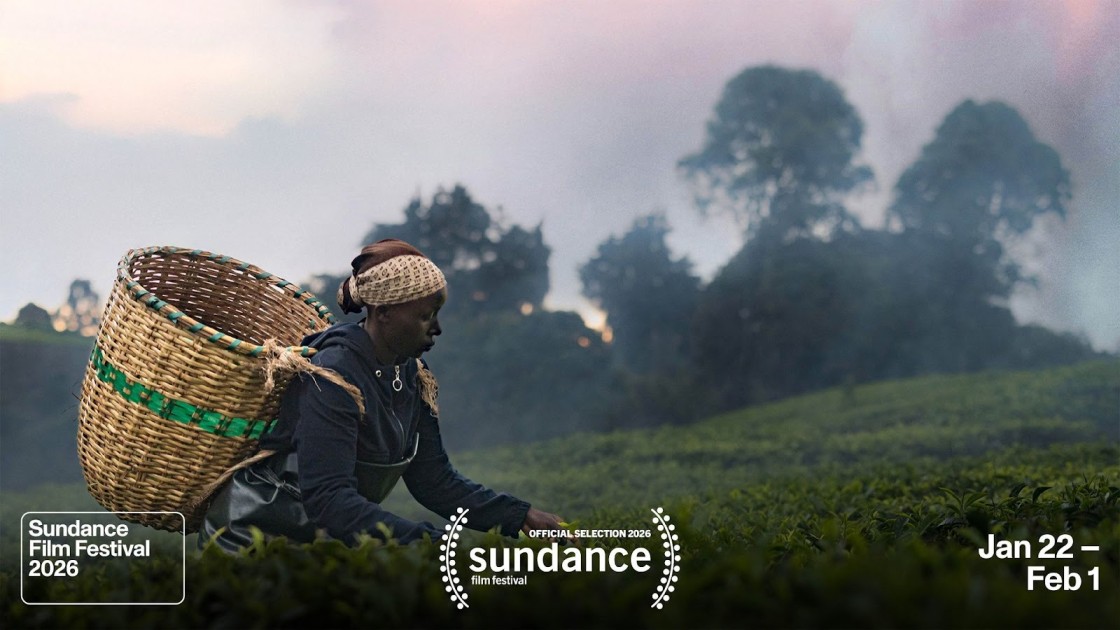
Kikuyu Land opens with bucolic establishment shots—tea leaves swaying in Kikuyu farmland, a young boy’s smiling face as he plays with a frog— then pivots to a jarring black-and-white clip of Sir Evelyn Baring, colonial governor of Kenya in the 1950s. His voice, captured over seventy years ago, lays bare the colonial administration’s blueprint for dispossession with chilling explicitness: exploit the farmlands, evacuate the people, employ the indigenes as low-paid servants in a modern feudal echo. Baring’s condescension reverberates across the decades, his words providing an unquiet through-line to the present-day injustices that Wangondu interrogates.
Several generations later, residents of Kikuyu seek legal redress for historical land injustice, and the Kikuyu Land’s central provocation becomes immediately apparent: why has it taken so long for Kenya’s democratic governments to facilitate restitution? The scene at the National Land Commission is heartbreaking: Ali Ibrahim, a commission representative, tries to placate a sceptical crowd with promises of patience, but a shrill voice cuts through the bureaucratic platitudes, screaming, “Being patient has never worked in life.”
Wangondu positions herself at the intersection of observer and subject, shuttling between both ends of the lens in what becomes as much a personal excavation as a sociopolitical inquiry. She sifts through old photographs of Queen Elizabeth and colonial officers, her voice laced with palpable anguish as she recounts how British colonial governments manipulated their way to power, plundered Kenya’s resources, and created bitter divisions among the Kikuyus that persist to this day. For her, this is an attempt to answer the question of who she really is.
The documentary’s probing lens extends to a cast of resilient subjects, each illuminating facets of systemic dispossession. One of its chief characters is middle-aged musical engineer Mr. Mungai, whose decade-long excavation of colonial archives unearths written evidence of how his people were forcibly ejected from their ancestral lands.
His research is meticulous, almost obsessive, and as he burrows through correspondence from nearly a century ago, the numerical context he provides is staggering: by today’s valuation, the land stolen from his family would be worth more than $967 million USD. Watching old film clips alongside Wangondu, Mungai relives the pillaging and violence meted out to the Kikuyu people.
But Wangondu is not content with theory. She is curious to know the actual names attached to the land titles, the specific individuals and multinational corporations who now own what was stolen. Her investigative efforts meet with cynicism from locals reluctant to answer questions, and the farmlands are heavily-guarded fortresses where cameras are forbidden even at the gates.
Mungai’s son Njenga, raised on the tea plantations, offers crucial insight into why he worked with co-director and cinematographer Andrew H. Brown for about a decade to piece his story together: he deemed the camera more trustworthy than the courts or the land commission.
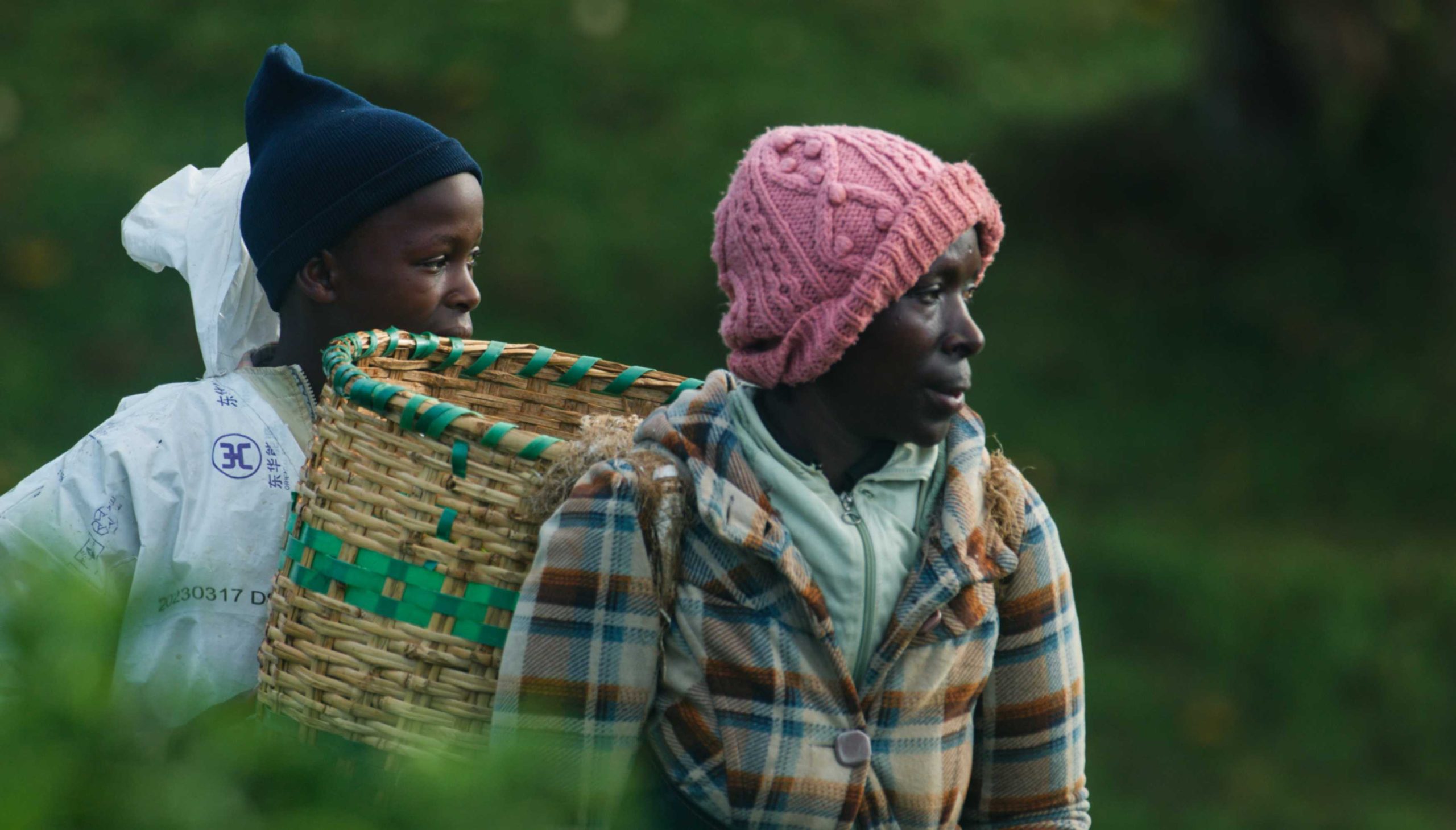
His childhood memories of plantation managers using dogs to patrol the land inadvertently taught him to navigate alternative routes, a knowledge which he brings to bear as Wangondu seeks out the perfect vantage point for filming. His observation that families have worked these lands for generations, not just impoverished but spiritually trapped to the grounds where their ancestors are buried, points to a malaise that transcends economics.
Kikuyu Land’s most haunting sequence arrives around the 30-minute mark. Two women, filmed from a distance to avoid spooking field managers, discuss an acquaintance who ran away from the plantation but left her son behind to “meet up his family’s quota”, forcing him to drop out of school. Their faces are blurred, a visual reminder of how raw and sensitive the situation remains. The juxtaposition of this scene with news reports that Kenya’s tea industry earned $1.2 billion USD between 2021 and 2022 is damning. The wealth flows only in one direction, far away from the people who produce it.
Jecinta Gathoni’s testimony cuts to the bone. In tears, she recalls running away from home in 1968 when her father refused to let her get an education, only to find herself at a tea farm where working conditions were tortuous and field managers played god, assuming control over workers’ time, resources, and bodies. The sexual assault she and other women endured, even in the presence of their children, indicts not only the field managers but corporations like Unilever, which employed them and made no effort to remedy their plight. Gathoni can only speak now because she has managed, after so long, to own some land.
Wangondu’s attempts to contact Unilever are predictably rebuffed. Even when she physically visits the organisation’s global headquarters, she is denied access. A breakthrough comes when she overhears news of a British law firm successfully instituting compensation claims for Kenyans tortured by the colonial administration, opening a pathway to investigate corporate complicity in the sexual abuse spanning decades at Kikuyu tea farms.
But Kikuyu Land’s investigation plunges into even darker terrain. Wangondu’s path is lined by bodies of assassinated journalists, evidence of hit squads, inter-communal clashes orchestrated to divert attention from structural injustice, and politicians with no incentive to disturb the status quo. The spate of abductions and forced disappearances constitutes an urgent human rights concern, but it also reflects the volume of obstructions facing anyone who seeks to uncover the truth in a country where knowledge can be lethal.
In one of Kikuyu Land’s most wrenching revelations, Wangondu learns that her own grandfather was in cahoots with the colonial administration. Her attempt to excavate this history of collaboration almost tears her family apart.
Brown’s editing and cinematography work in tandem with the investigative thrust of the narrative. Amid seamless transitions that blend archival pillage with modern desolation, the cuts are urgent without being distracting, though one senses that a sizeable chunk of story material was left on the threshing floor. The film’s score, provided by Nyokabi Kariuki and Keir Vine, avoids the pitfall of overt sentimentality and instead provides a rhythm that amplifies the film’s mood in a refreshing style without manipulating audiences into any (unearned) emotional response.
Yet Kikuyu Land struggles with a significant limitation: the directors attempt to capture so many stories at once, perhaps too many, making it difficult for each individual narrative to breathe. Wangondu and Brown have compiled an overwhelming volume of footage and testimonies that could each support their own feature-length treatment.
The impulse to include as much as possible is understandable; these are stories that have been suppressed for generations, and the filmmakers may have felt an ethical obligation not to leave anyone out. But the result is a certain dilution of emotional impact. We understand the systemic nature of the injustice, but we don’t always feel the full weight of individual suffering. One can’t help but wish these humans had been given more room to unfold.

There is also an overarching sense of nihilism that pervades the film, a feeling of helplessness that extends from interviewer to subject. We are presented with a world where justice remains perpetually deferred, where the machinery of accountability is either captured by the powerful or deliberately sabotaged. Perhaps this is inevitable in a story of this nature.
Perhaps, there are no miracles or answers, and not every narrative needs to lean towards resolution. Sometimes it may suffice to sit in the tragic order of events, to navigate these conversations in all their discomfort, whether that means unearthing generations’ worth of trauma through diligent journalism, or making peace with the fact that your family’s history has been embellished by white lies to keep things together.
Kikuyu Land joins a recent wave of Kenyan nonfiction that interrogates the long-term, far-reaching effects of colonial violence on contemporary Kenya. Maia Lekow and Christopher King’s How To Build A Library (2025), as well as Daphne Matziaraki and Peter Murimi’s Battle for Laikipia (2024), explore similar terrain, albeit via different premises. The fact that three films addressing variations on this theme have appeared in consecutive years might seem like repetition to some, but making an assertion along those lines would be missing the point entirely.
There is no such thing as “too many documentaries” when the subject is a nation still reeling from trauma, still searching for answers to protracted dysfunction, still waiting for acknowledgement of crimes that shaped its entire political trajectory.
What distinguishes Kikuyu Land is its insistence on naming names, on pursuing the specific rather than the abstract. Mungai, Njenga and Gathoni are not abstract victims of historical injustice; they are people with names, histories, and dreams curtailed by a system that treats them as expendable.
If this documentary has any other “flaw”, it’s that it may essentially be preaching to the converted. Those who already understand the legacy of colonialism will find their understanding deepened and specified; those who prefer to view Kenya’s problems as purely contemporary dysfunction, divorced from historical cause, are unlikely to be persuaded. But perhaps this is an unfair criticism. The documentary is not primarily aimed at sceptics in the Global North; it’s for Kenyans themselves, particularly younger generations who have had this history systematically excised from their education.
Kikuyu Land ultimately succeeds, not because it offers solutions—it doesn’t—but because it refuses to look away. In an era where documentaries often feel compelled to end on notes of hard-won optimism or individual triumph, Wangondu and Brown have made a documentary that is brave in its unvarnished gaze, a defiant piece of work that navigates discomfort without flinching.
They both understand that sometimes the most radical act is simply to tell the truth as completely as possible, even while accepting that resolution may never come. The tea continues to be harvested. The revenue continues to flow elsewhere. The people whose forebears’ bones fertilise the soil remain dispossessed, but at least these facts can no longer be denied with the same ease they once were. In a world bent on forgetting, this is no small achievement.
*Kikuyu Land screened at the 2026 Sundance Film Festival.
Jerry Chiemeke is a Nigerian-born writer, film critic, journalist, and lawyer based in the United Kingdom. His writing has appeared in Die Welt, The I Paper, The Africa Report, The British Blacklist, Berlinale Press, The Johannesburg Review of Books, Culture Custodian, Olongo Africa, and elsewhere. Chiemeke’s work has won or been nominated for the Pushcart Prize, Ken Saro Wiwa Prize, Diana Woods Memorial Award for Creative Nonfiction, Best Small Fictions, and the Quramo Writers Prize. He is the author of the critically-acclaimed short story collection, Dreaming of Ways to Understand You.