

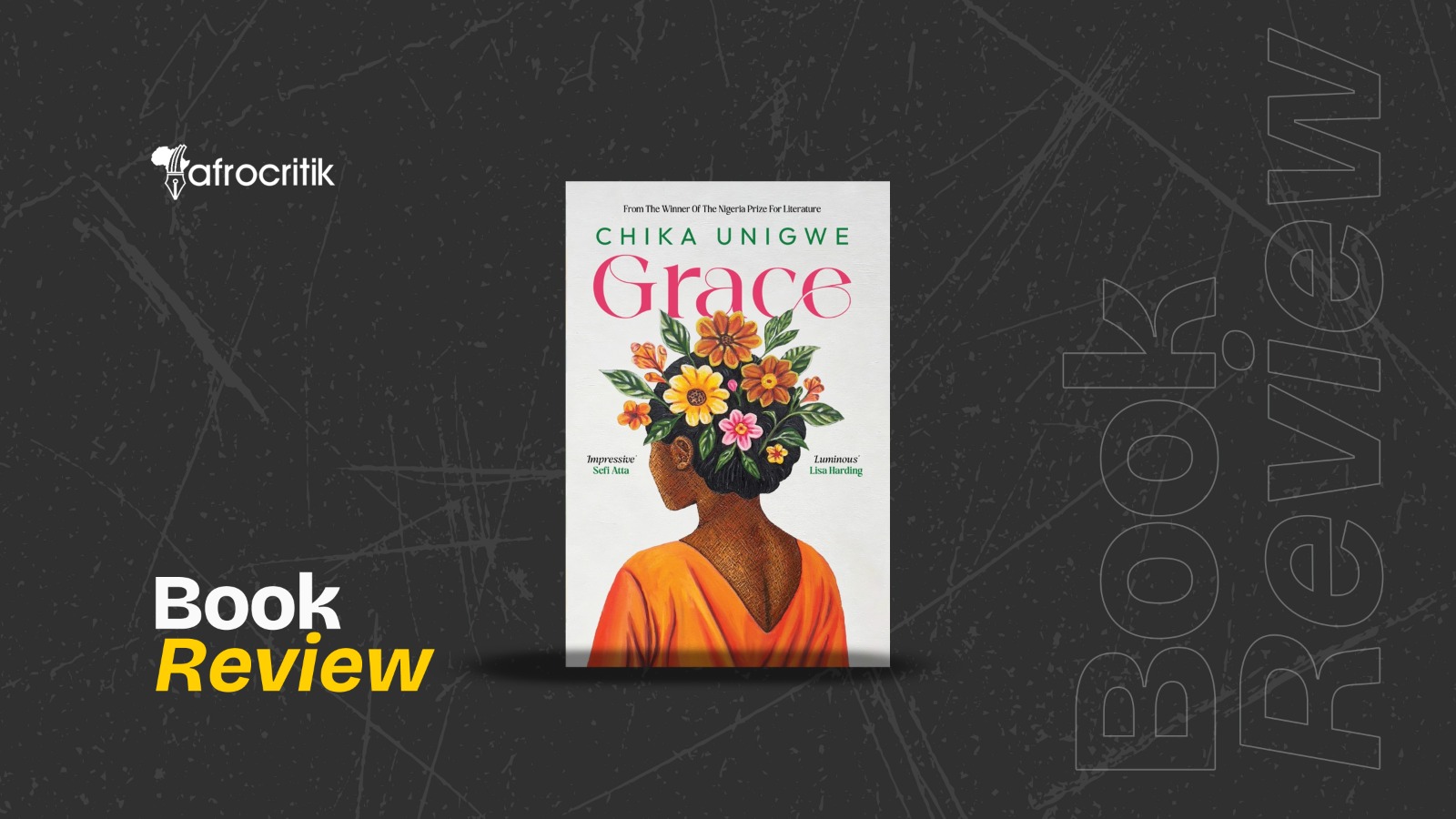

Grace is an immensely provocative story that asks questions about the rightness or wrongness of the ways in which human beings solve the problems of family and society.
By Chimezie Chika
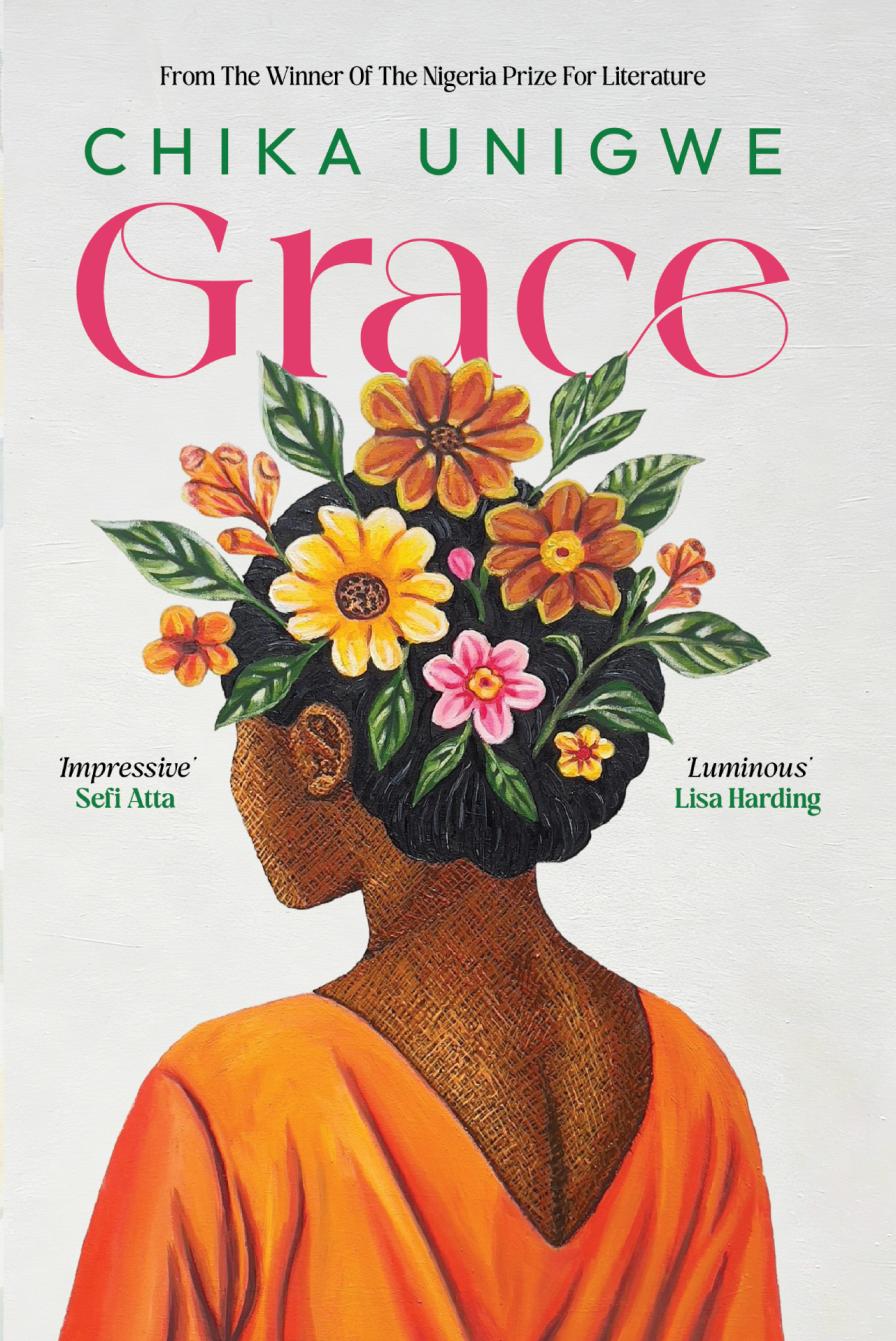
Grace, the latest novel from Chika Unigwe, one of Nigeria’s most prolific novelists, does not stray far from her body of work. Which means that the story it tells is about women surviving unpleasant or less-than-ideal conditions. In many cases, these women are forced to seek seemingly immoral solutions to the strictures of societies determined to humiliate or keep them down. Unigwe’s well-known NLNG Prize-winning novel On Black Sister’s Street (2020) took these feminist concerns to a close masterly control of material and story.
In Grace, some of what won that magnum opus accolades can be seen. It tells the rather familiar story of its eponymous protagonist, alternating non-linearly between the present and the past, between 2020, the COVID-19 pandemic year, and the 1990s. Grace is a young girl born into a lower-middle-class family in Enugu. She falls for a rich, lanky boy in her secondary school, who waylays her, gets her pregnant, and promptly denies her. When Grace’s mother, in a typical act, takes her to confront the boy’s wealthy parents over their son’s misdemeanour, she and Grace are humiliated.
And thus, Grace’s introduction to a harsh world begins. The young Grace can scarcely believe what just happened. She’s pregnant in her mid-teens when she barely knows what it means. Her ‘boyfriend’ now ignores her at school. Her parents regard her with a certain coldness and disbelief. They find a new school for her, where nobody knows her. They goad her into carrying to term and then giving up the baby—all orchestrated by her Grace’s mother.
The scene in which Grace gives up the baby and the clandestine events around it (which was revealed later) is as significant as any in English language literature, including but not limited to George Eliot’s Silas Marner (1861). Grace is distraught; her life spirals psychologically from the point of this loss. Expectedly, she becomes hardened to relationships, her parents, and life generally, until she decides at some point to take a different route to her grievance with society’s treatment of young girls like her.
Upon becoming a maternity nurse as an adult and marrying the most reasonable man she met, Grace sets about building barricades around her life, fortifying it (or so she thinks) against the unsavory influences of her past, including her parents about whom she promptly told her husband and all knows her at this point in life that they were dead (and never having any sort of physical contact with them for years to maintain the specious act).
All these while working towards saving women and girls who, in one way or another, are going through the same fate she was condemned to earlier in her life. Grace’s carefully erected reality would begin to unravel when her mother shows up at her door one evening.
Unigwe’s Grace is not a novel that looks upon the world of women with untrammelled hope; what optimism it projects is an ironically grim panacea. One can conclude, though, that such unrelenting grimness is a product of the society which the novelist is portraying. It’s an intensely corrupt society, yet morally uptight and morally ambiguous in equal terms. That moral ambiguity is personified in Grace’s life.
While the maternity clinic Grace began to run, which metamorphosed into a sort of baby factory, was supposed to “help” women, it raises questions of Grace’s own motivations. Is it really to help women, or is she simply a greedy woman more interested in monetary gain behind all her humanitarian postures? In one passage, Grace rationalises to our utter suspicion: “It wasn’t the money that motivated her. It was the chance to make reparations for her own wrong.”

There is no denying that there is a great substance in the story of a woman who made the mistake of her teenage years, the terrible and unspeakable secret of her life. When that terrible secret becomes more or less the impetus for her present attitude, we are not entirely surprised. The irony, or the goose behind our surprise, is that who she became is certainly not morally superior to the young girl who threw (or is forced to throw) a child away.
And we should get nothing wrong here: a woman losing a child, and in the manner in which Grace did, is the arbiter of some of the greatest emotional pains a woman can experience. But this story, Grace’s story, also highlights parental failure and the undue importance which civilised human beings place on childbirth and children.
Some of the biggest economic and social issues of all human societies have their origins here. The real issue here is the kind of societies which seems to equally upgrade or degrade a woman’s worth based on her ability or inability to have a child at the ideal or unideal time and circumstances.
Grace is an immensely provocative story that asks questions about the rightness or wrongness of the ways in which human beings solve the problems of family and society, problems which—it must be admitted—society creates for itself through its own moral scruples. Grace’s maternity clinic is the locum classicus of this very phenomenon. The rules around pregnancy, abortion, and marriage in the patriarchal and hyper-religious Nigerian culture show a thin line between wanted and unwanted pregnancy.


Unigwe has long stamped her style as the chronicler of women’s grief and the ways in which women have suffered and continue to suffer in today’s Nigeria. Her style is often simple behind the complex, morally inquisitive stories of her novels. When she is at her best, her novels have the power to expose the issues that make feminism a real, tangible and actionable idea, not a peripheral ideal.
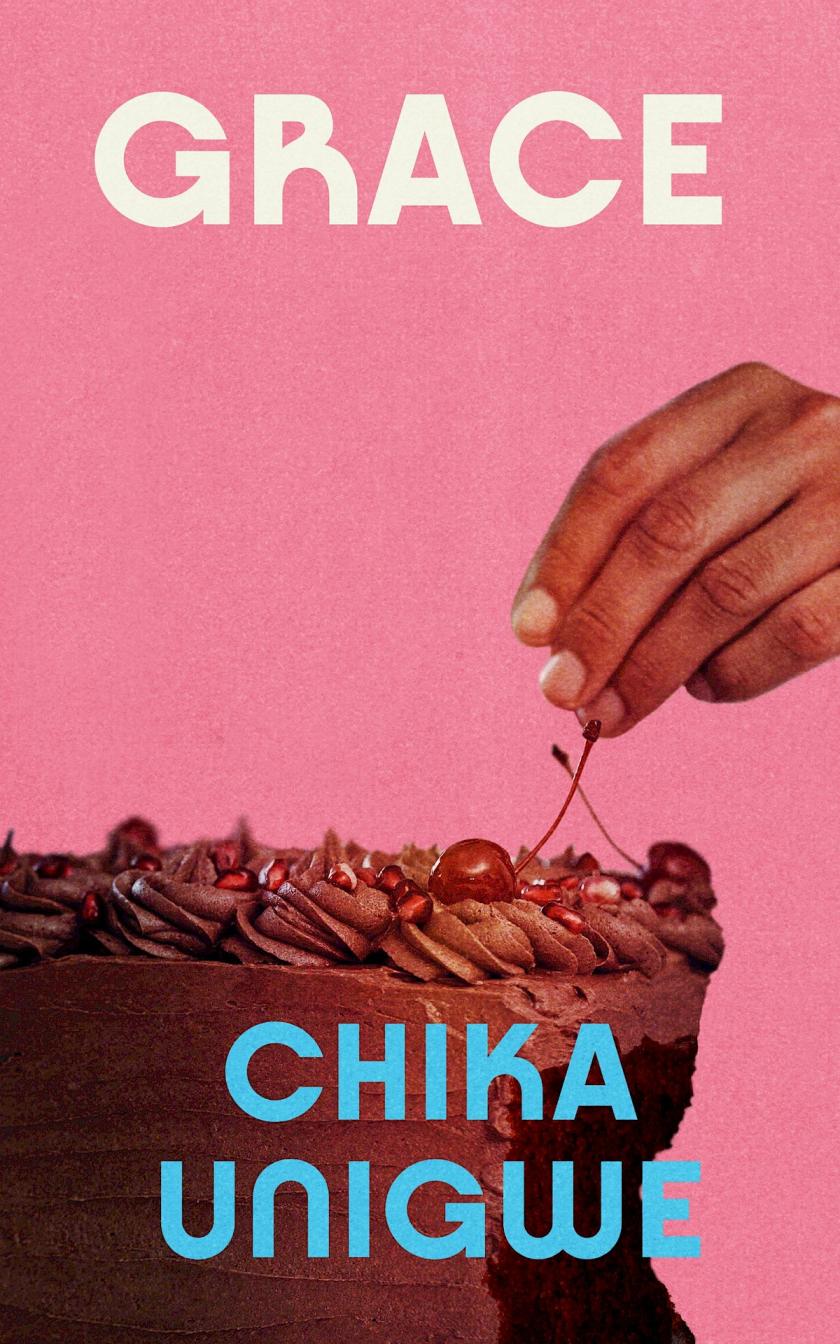
But there are also times when she seems to override what her story has to offer, promising suspense that never yields anything resembling that kind of adrenaline anticipation. When, early on, the novel repeatedly tells us that something is missing in the family, we do not particularly feel any anticipation for the revelation being promised, despite being told that Grace often engorges herself with cake on a particular day every year.
Which is perhaps why, when “secret” or the “missing link” is revealed, we do not attach any significance to it. Why is this? Because Unigwe has a tendency to make underwhelming revelations after promising or hinting at something more. An example:
“The day before Grace’s mother turned up at her door, she had had the dream of the baby again.
The one she herself bundled up and left by the roadside like a heap of rubbish because her parents had left her no choice. And neither had Ben’s.”
Unigwe’s prose here is the culprit, or perhaps she is rather too eager at times to expose the complexities of her themes than on all other aspects of her storytelling. This is nonetheless a good novel if one can put critical pickings aside. It’s a good story from a writer who had previously won the Nigeria Prize for Literature for a much better one.
Chimezie Chika is a staff writer at Afrocritik. His short stories and essays have appeared in or forthcoming from, amongst other places, The Weganda Review, The Republic, The Iowa Review, Terrain.org, Isele Magazine, Lolwe, Fahmidan Journal, Efiko Magazine, Dappled Things, and Channel Magazine. He is the fiction editor of Ngiga Review. His interests range from culture, history, to art, literature, and the environment. You can find him on X @chimeziechika1