


If there’s anything the post-Netflix/Prime Video “exit” has made clear, it is that Nollywood can no longer afford a singular distribution model.
By Joseph Jonathan
In 2024, Nollywood was thrown into a frenzy. Reports that Netflix and Prime Video were scaling down—or outright cutting back—on their investments in Nigerian original films and series rippled across the industry. For the past few years, the global streamers had been positioned as Nollywood’s future: deep pockets, international visibility, and the promise of creative expansion. Their sudden retreat did not just raise eyebrows; it forced a difficult but necessary question: what next for film distribution in Nollywood?
The immediate answers were predictable. More cinema releases. More filmmakers turned to YouTube. Local streaming platforms such as Kava, Circuits, and EbonyLife ON Plus were launched. Yet, amid this scramble to replace lost pipelines, one distribution avenue barely entered the conversation: community cinema—film screenings organised outside traditional multiplexes, in event centres, halls, campuses, open-air spaces, and other local venues, taking films directly to audiences rather than waiting for audiences to come to cinemas.
My first encounter with this model was in 2019. As an undergraduate at the University of Nigeria, Nsukka, I watched Ishaya Bako’s 4th Republic in my faculty’s lecture hall. The screening was part of a nationwide university tour organised in collaboration with the Independent National Electoral Commission (INEC) and Enough is Enough (EiE Nigeria), using cinema as a civic tool to spark conversations around electoral violence ahead of the 2019 general elections. There were no plush seats, no popcorn stands, or fancy premières—just a hall full of students watching a film together and debating its politics afterwards.
At the time, I did not think of it as anything remarkable. It was simply a film screening. In hindsight, it was my introduction to community cinema: a mode of exhibition that prioritises proximity, access, and audience specificity over prestige venues and commercial spectacle.

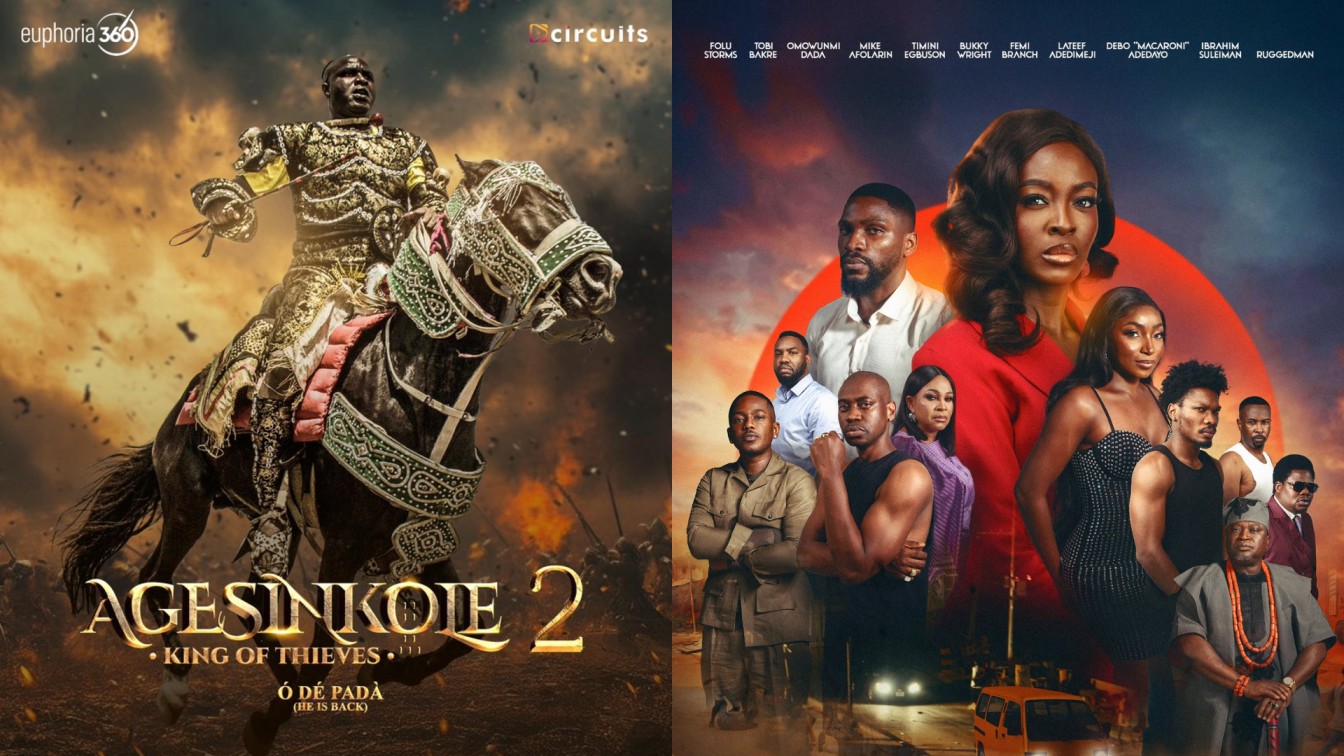
It was therefore exciting to learn that filmmaker, Femi Adebayo, would be releasing Agesinkole 2: King of Thieves (2025) through community screenings from 24 December 2025 to 4 January 2026. Suddenly, what had once felt marginal was being discussed as a viable commercial strategy.
In the case of Agesinkole 2: King of Thieves, this approach yielded headline-making results. While detailed operational costs and revenue splits remain undisclosed—as is often the case with Nollywood releases—it is publicly known that the film screened across venues in Lagos, Ogun, Oyo, Ondo, Osun, Ekiti, and Kwara States, with tickets priced at ₦4,000 in Lagos and ₦3,000 outside Lagos. Within twelve days, the film reportedly grossed ₦417 million. Whatever one thinks of the model, those numbers demand attention.
However, it would be misleading to frame this as a radical innovation. Community-based screenings have been central to Nigerian cinema since the early 20th century, from early motion picture shows at Lagos’s Glover Memorial Hall in 1903 to mobile cinema vans run by the Nigerian Film Unit, which brought educational and health-themed films to audiences across the country. By the late 1960s through to the early 1990s, filmmakers such as Hubert Ogunde, Ola Balogun, and Moses Olaiya (Baba Sala)—former theatre practitioners—adapted the travelling-theatre model to screen their films in television houses, town halls, and other public spaces that prioritised communal experience over architectural grandeur.
What has changed is not the concept of community cinema itself, but the scale, technology, and financial stakes now attached to it. In recent times, the Nora Awolowo-produced Red Circle experimented with community screenings after its traditional cinema run. Through a partnership between Fusion Intelligence and Café One, the film was screened in Uyo, Owerri, Enugu, and Kaduna in August 2025.

Perhaps it is also important to point out that the community screening model is not unique to Nigeria alone. Across Africa, different forms of community cinema have emerged in response to infrastructural gaps, economic realities, and questions of access. In Angola, Cine Zunga operates open-air screenings in rural communities, pairing licensed local films with advertising and brand activations as its primary revenue model. Tunisia’s Cinématdour initiative—run by the Gabès Cinema Fen—transforms a touring bus into a 100-seat mobile cinema, bringing films to rural audiences excluded from urban exhibition circuits. Ghana’s Cinema 57 offers a more structured model of paid outdoor community screenings, featuring local feature films, short films, and occasional international selections. In Southern Africa, Sunshine Cinema’s solar-powered “Sunbox” enables film screenings in remote areas without reliable electricity, while the Western Sahara International Film Festival (FiSahara) has, for years, organised screenings in refugee camps as both cultural intervention and political statement.
What these models reveal is that community cinema is not a single blueprint but a spectrum of practices shaped by local needs. Nigeria’s renewed interest in it is less a breakthrough than a belated reckoning with possibilities the continent has long explored. Still, scale matters, and this is where the contrast between Agesinkole 2: King of Thieves and Red Circle becomes instructive. For the Red Circle screenings, tickets were priced at ₦3,000, with total sales of 100 tickets generating a gross of ₦300,000. The turnout was modest, but not necessarily because of weak audience interest.
A post-screening report published by Fusion Intelligence—the firm responsible for the secure delivery of the film through its Convoy platform—outlined several challenges. During the first screening, technical failures caused the Convoy encoding machines to stop midway, preventing audiences from completing the film. This understandably led to disappointment and eroded trust. Viewers also expressed interest in a broader programming slate, suggesting that a single-title offering limited repeat engagement.
These challenges expose a critical truth: community cinema is not simply about relocating screens; it is about building reliability, consistency, and audience confidence. Unlike multiplexes, where operational stability is assumed, community screenings place the burden of trust entirely on organisers. A single failure can undo weeks of audience-building, especially when screenings are positioned as special events rather than casual outings.
At its most optimistic, community screening presents itself as a seductive alternative to Nigeria’s tightly held cinema distribution system. For filmmakers with a recognisable name, a loyal audience, or deep roots in specific regions, the model offers a way to bypass the bottlenecks of traditional cinema chains: unfavourable revenue splits, restricted showtimes, and the quiet gatekeeping that determines which films are allowed to “blow”. By taking films directly to audiences—often in familiar, accessible spaces such as event halls, campuses, or cafés—community screenings reframe distribution as an act of proximity rather than permission. In this sense, they challenge the idea that cultural legitimacy must pass through the mall, suggesting instead that box office success can be locally constructed, audience by audience, without the infrastructural heft of cinema chains.

But the mechanics that make this model attractive also reveal its limits. Community screenings demand significant upfront coordination: venue hire, projection equipment, security, marketing, ticketing, and, crucially, trust that audiences will show up in sufficient numbers. While the financial upside can be substantial—fixed venue costs mean higher margins if attendance is strong—the risk is borne almost entirely by the filmmaker.


This raises a critical question of access. For emerging filmmakers without star power, institutional backing, or an existing fan base, community screenings may be less a democratic alternative than a high-stakes gamble. Cultural capital, not just creative merit, often determines who can mobilise crowds across cities or regions. In that sense, community cinema does not automatically dismantle the distribution hierarchy; it merely shifts it, privileging filmmakers who already command attention while leaving others to navigate the same structural inequalities in a different venue.
Take the contrast between Agesinkole 2: King of Thieves and Red Circle, for example. Adebayo’s success is inseparable from his cultural capital. He commands regional loyalty, benefits from name recognition, and works within a linguistic and cultural register that directly addresses the audiences being courted. Agesinkole 2: King of Thieves is a Yoruba-language epic steeped in historical mythology, designed for collective viewing and participatory response. Its success raises some difficult but necessary questions: who else can afford to try this, and can Adebayo replicate his success outside the South-West?
The recent experimentation with community screenings asks us to reconsider the definition of success in Nollywood. Is it gross revenue alone, or is it accessibility, audience engagement, and cultural relevance? If a film can spark conversation in a university hall or an event centre, reach a previously untapped demographic, and return healthy profits to the creator, perhaps we have been measuring success in the wrong spaces all along.
If there is anything the post-Netflix/Prime Video “exit” has made clear, it is that Nollywood can no longer afford a singular distribution model. Community cinema should not be seen as a utopian solution or a replacement for cinemas or streaming platforms, but as part of a diversified ecosystem in which films circulate through multiple, overlapping routes. In this regard, Bollywood offers a useful parallel.

Long before multiplex dominance, Indian cinema thrived on touring circuits, regional theatres, and staggered releases that allowed films to find audiences beyond metropolitan centres. Even today, star-led films often rely on deep regional loyalty, festival screenings, and localised exhibition strategies alongside mainstream cinema runs. The value of these systems lies not in their novelty, but in their adaptability: they acknowledge that audiences are unevenly distributed, culturally specific, and more willing to engage when cinema comes to them rather than waiting behind mall gates.
Seen this way, Nollywood’s renewed interest in community screenings feels less like disruption and more like institutional memory resurfacing under economic pressure. What has changed are the economics and the tools—digital projection, secure content delivery, mobile ticketing, and social media marketing—which make it possible to monetise scale more efficiently than in earlier eras of touring cinema. These new conditions raise the stakes of community exhibition, transforming it from a largely informal or promotional practice into a potentially revenue-generating distribution arm. If sustained beyond isolated success stories, this model could reshape how filmmakers think about access: who gets seen, where legitimacy is produced, and how revenue circulates outside traditional gatekeepers. In returning to the community, Nollywood may not be inventing something new, but it may finally be learning how to value what it already has.
Joseph Jonathan is a historian who seeks to understand how film shapes our cultural identity as a people. He believes that history is more about the future than the past. When he’s not writing about film, you can catch him listening to music or discussing politics. He tweets @JosieJp3