


Muscle is the kind of film that earns its place not by being conventionally digestible but by being formally committed and culturally specific.
By Joseph Jonathan
The African male body has long been a contested image; exoticised by colonial photography, hypermasculinised by Western popular culture, and flattened by documentary cinema into a shorthand for suffering or spectacle. Rarely has it been afforded the dignity of complexity; rarely has the camera lingered on it with curiosity rather than an agenda.
It is into this fraught visual history that Muscle, directed by British-Nigerian filmmaker Karimah Ashadu, arrives. The short documentary, which screened at the Forum Expanded section of the 2026 Berlin International Film Festival (Berlinale), plants its camera in the outdoor gyms of Lagosʼ slums and refuses to look away, not with the voyeuristic hunger that has so often defined the Western gaze toward African bodies, but with something closer to respect.
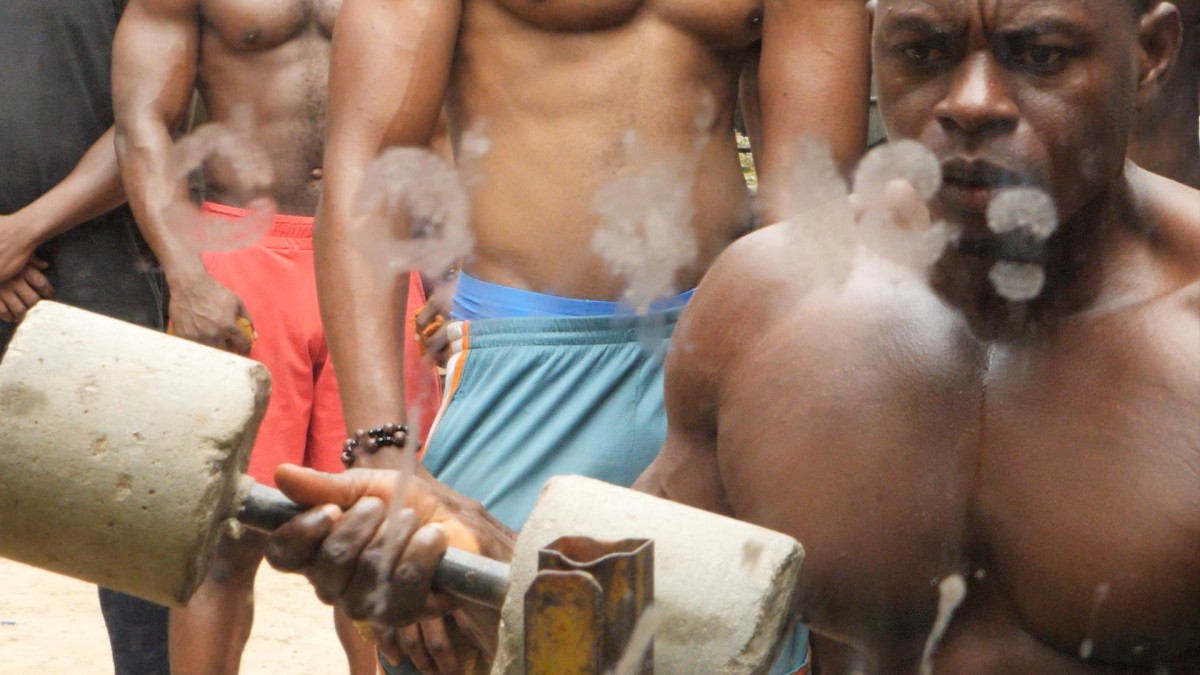
Shot almost entirely in close-up by cinematographer Aigberadion Israel Ikhazuangbe, Muscle immerses us in the bodybuilding culture of Lagosʼ slums; a world of inflated muscle, bulging veins, and luminous skin glistening under the weight of effort and sun. The camera moves softly, almost tenderly, like breath on skin, hovering so near its subjects that figures occasionally blur into abstracted forms: a shoulder becomes a landscape, a forearm becomes architecture, a chest becomes something close to scripture.
In these moments of visual dissolution, the film makes its most provocative gesture, insisting that the Black male body, so often rendered singular and fixed by the gaze of documentary cinema, resists easy categorisation. Ashadu is not interested in the body as a symbol. She is interested in the body as a site.
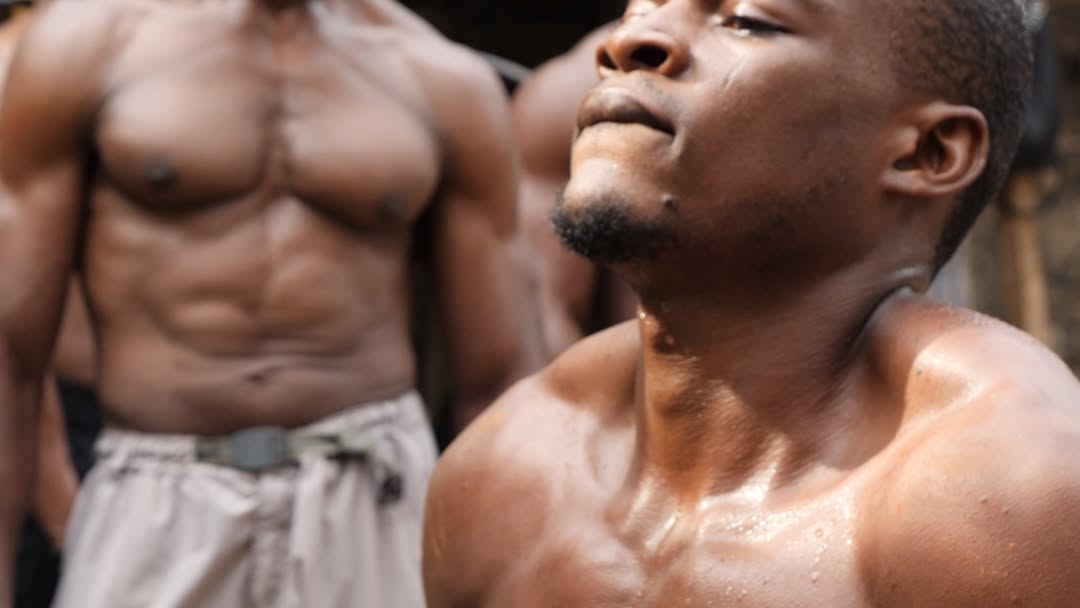
The metallic clang of barbells punctuates the filmʼs sonic world, layered with guttural sounds of exertion; the groans and moans of men in the full theatre of physical effort. It is difficult, watching this, not to feel the ambiguity of the sound: at once faintly comic and deeply serious, the soundtrack of ritual and of sacrifice.
Breath and muscle move in what can only be described as a syncopated sonic choreography, and the effect is to render the gym not merely a location but a kind of sacred space — a place where discipline is performed, where the body is remade, where men return daily as though in devotion. The streets of Lagos hum at the edges of the frame, a reminder that this world exists within, and often against, a city that offers little in the way of formal structure or institutional support.
The bodybuildersʼ voices carry the filmʼs thematic weight, delivered as voiceover while we watch them perform their rituals of lifting, straining, and sweating. Through these voices, a portrait of social value emerges. Muscle, in the Lagos of this film, is not merely a physical attribute; it is currency. It purchases visibility, and visibility, in a city as vast and indifferent as Lagos, is everything.
The men speak of the attention their bodies command, and in doing so, they illuminate a crucial tension: admiration and intimidation are, in this economy, twin currencies of the same denomination. Women look. Men look differently; some with a desire to emulate, some with the instinctive wariness of those who understand what concentrated physical power can mean on a street corner after dark. To be seen, the film suggests, is already a form of power. To control how you are seen is something closer to freedom.
What also emerges, quietly but insistently, is a sense of community that refuses the loneliness one might expect to find in an individual pursuit. The bodybuilders cheer each other, push each other, and mark each otherʼs progress. There is tenderness here, buried beneath the bravado, a fraternal intimacy that Muscle captures without sentimentalising. They speak of the confidence and freedom that come with the chiselled body, and one understands, watching them, that this freedom is not merely physical. It is psychological armour, crafted in response to an environment that otherwise offers these men very little protection.
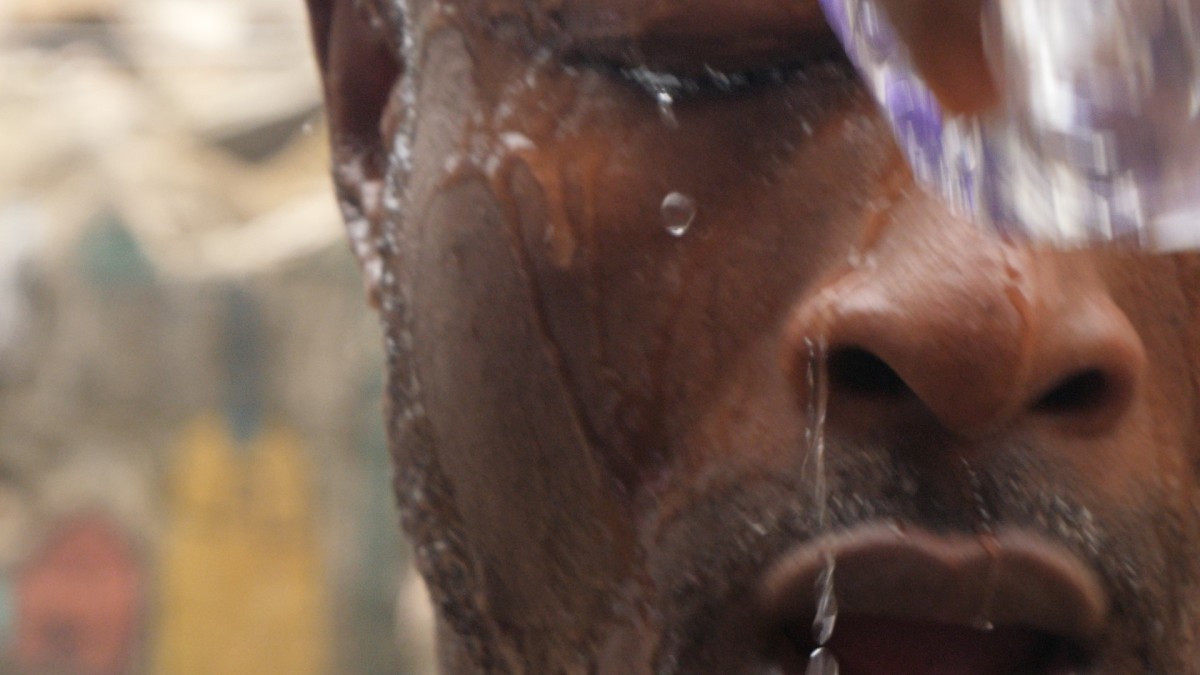
Ikhazuangbeʼs cinematography deserves extended praise. His decision to remain so resolutely close — to give us almost no faces, only bodies — is not a withholding but a redistribution of attention. We are not invited to read these men through their expressions or their biographies; we are asked to encounter them through their flesh, their effort, their stillness between reps.
It is a formally rigorous choice that refuses the familiar documentary grammar of the confessional interview, of the revealing glance, of the humanising anecdote. And yet, paradoxically, it is this refusal that makes the film feel most human. These are not case studies. They are present.
If Muscle carries a reservation, it lives in its single-mindedness. The film glories in the discipline and camaraderie of its subjects, and there is something genuinely moving about that loyalty. But the Lagos these men inhabit is also a place of economic strain, limited access to nutrition, and the physical consequences of training without medical oversight or adequate recovery.


The film gestures toward none of this. It is not obligated to, but its omission means that Muscle occasionally tips from intimate portrait into something closer to celebration, a space where the cameraʼs devotion risks becoming its blind spot. For those of us outside this world — which is most of us — questions inevitably arise about what it costs, in a place like Lagos, to maintain a body like this. The film, committed to its formal restraint, declines to answer.
Still, there is significant value in what Ashadu has achieved. Muscle does not traffic in the familiar pathologies through which Western documentary cinema has often approached Black bodies in African urban spaces: poverty as backdrop, struggle as spectacle, the slow accumulation of deficit.
Instead, it offers something more complex and more honest: an image of men who have chosen, deliberately and joyfully, to invest in their own embodiment as a form of self-authorship. In a cultural moment where the representation of the Black male body remains deeply contested — overdetermined by violence, by aestheticisation, by fear — this short documentary insists on a different kind of looking. Slower. Closer. More curious.
Karimah Ashaduʼs Muscle is the kind of film that earns its place not by being conventionally digestible but by being formally committed and culturally specific. It is a sensory act of witness; imperfect in its incompleteness, but precise in its attention. It reminds us that documentary can be a form of meditation, and that the camera, when handled with this much care, need not explain a world to illuminate it.
Rating: 3/5
*Muscle had its international premiere in the Forum Expanded section of the Berlin International Film Festival in February 2026.
Joseph Jonathan is a historian who seeks to understand how film shapes our cultural identity as a people. He believes that history is more about the future than the past. When he’s not writing about film, you can catch him listening to music or discussing politics. He tweets @Chukwu2big