

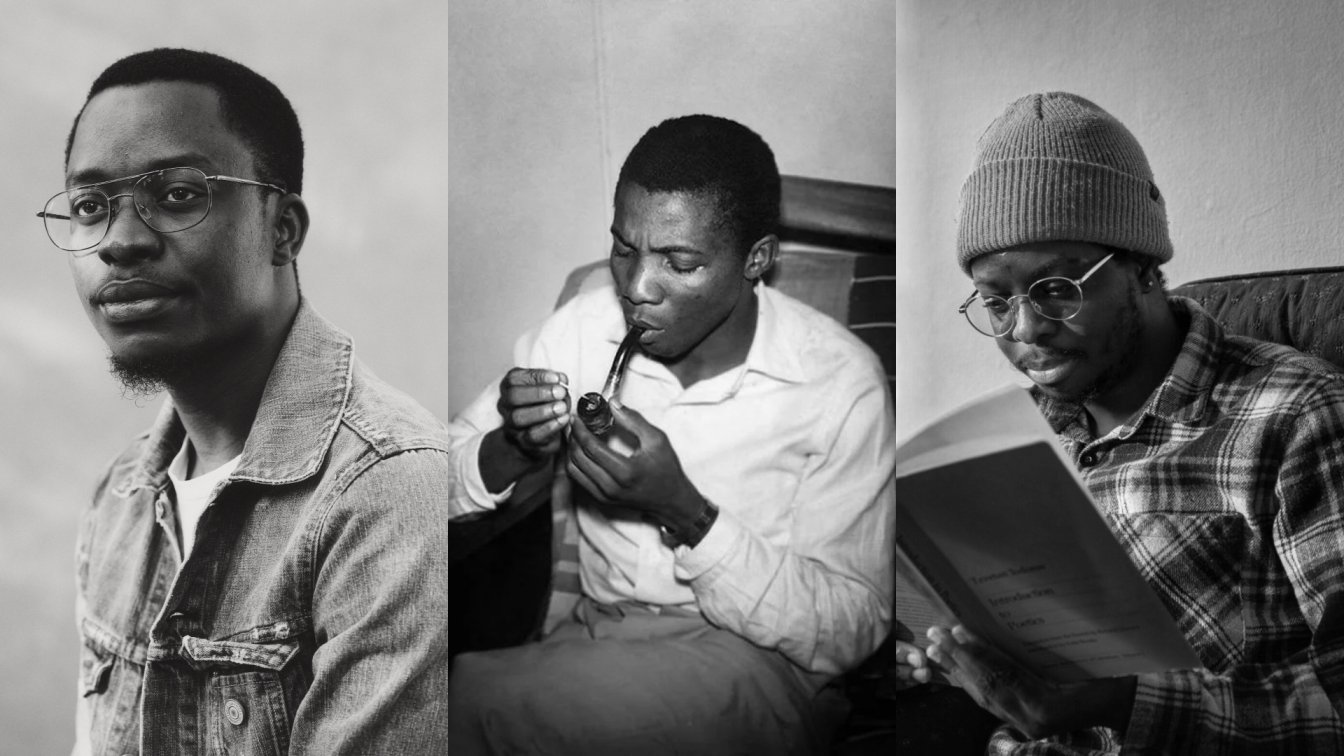

All three poems [“Tenebrae” by Agbaakin, “Come Thunder” by Okigbo, and “Mass” by Umukoro], in their various contextual layers, reveal something of the kind of ceremonies language enacts, and how.
By Ernest Jésùyẹmí
A poem, to use William Wordsworth phrase, is “a ceremony of imagination; expressing, consecrating, and invigorating”. Christopher Okigbo often referred to his poems as “a ceremony of innocence” (a phrase he uses in his notes on “The Passage”). Ceremony, because every true poem is a formal act—no poem worth reading can be completely informal; it brings a certain decorum even to its engagement with the trivial. It is language that expresses (which is not the same as language that self-expresses), consecrates, and invigorates—all at once. The poet’s vocation (whether he has any religious faith or not) is “sacred”.
A poem may be occasioned by a ceremony (a wedding, a funeral, political turmoil), which would make it ceremonial. But, in calling a poem a ceremony, I do not mean that. A ceremonial poem has meagre power, if any at all—like a ceremonial head of state. It must rise to (and above) its occasion. It needs to institute for itself and for us a new peace, whatever the reason for its coming into existence might have been. It vitalises the form of a ritual.
How does a poem “come into existence”? What can the way it is made tell us about its nature as a consecrated moment? How does a poem rub against the instigation in becoming itself an instigation towards… what? A new kind of seeing, knowing, a new non-fungible cause for doing time in the strange pulsing little black hole (badly lit but we follow, with our hands, the markings on the wall) that we refer to as consciousness?
I
Any poet who sets out to write an ekphrasis submits himself to a direct formal constraint. The art that he is to translate into words serves as both muse and as objective correlative for his work. We have something to measure the weight of his words by—is it equal to, or at least does it manage not to fall too far below the pitch of his muse?
O-Jeremiah Agbaakin’s “Tenebrae” attempts to translate a superb work by the fiery Italian angel, Caravaggio. “The Sacrifice of Isaac” was painted in the early 1600s. A packed piece: it depicts Abraham just as he is about to slaughter his son, Isaac, hand firm on the knife, as an angel darts into the picture, pointing to a ram on the other side of the frame, a ram submitting its neck in place of the little boy’s. The murderous instinct, the risk of the moment, is there. We can almost hear the cry of betrayal coming from the mouth of Isaac; Abraham’s eyes are keen, his look determined; the ram, quiet, waits meekly, and without fear. The ram’s face is a striking contrast to the boy’s.
Heightened contrast contributes to the effect that this painting has. We see, in “The Sacrifice”, a triangle of light entering from the left-hand side, illuminating shoulders, hands; but the dark is just as eloquent. Developed by Caravaggio, the technique is known as “tenebrism”: Agbaakin calls our attention to it in the title of his poem, “Tenebrae”—darkness, gloom, the shadow of death.
“The Sacrifice of Isaac” is a full picture. Nevertheless, Agbaakin “adds” to our understanding of the painting. He brings a renewed understanding to it. An ekphrasis is also inevitably an Ars Poetica; the poet cannot transfer figures to words without contending with how they came about. He is involved with the technique of the thing (the title of this poem) as he is with the thing.
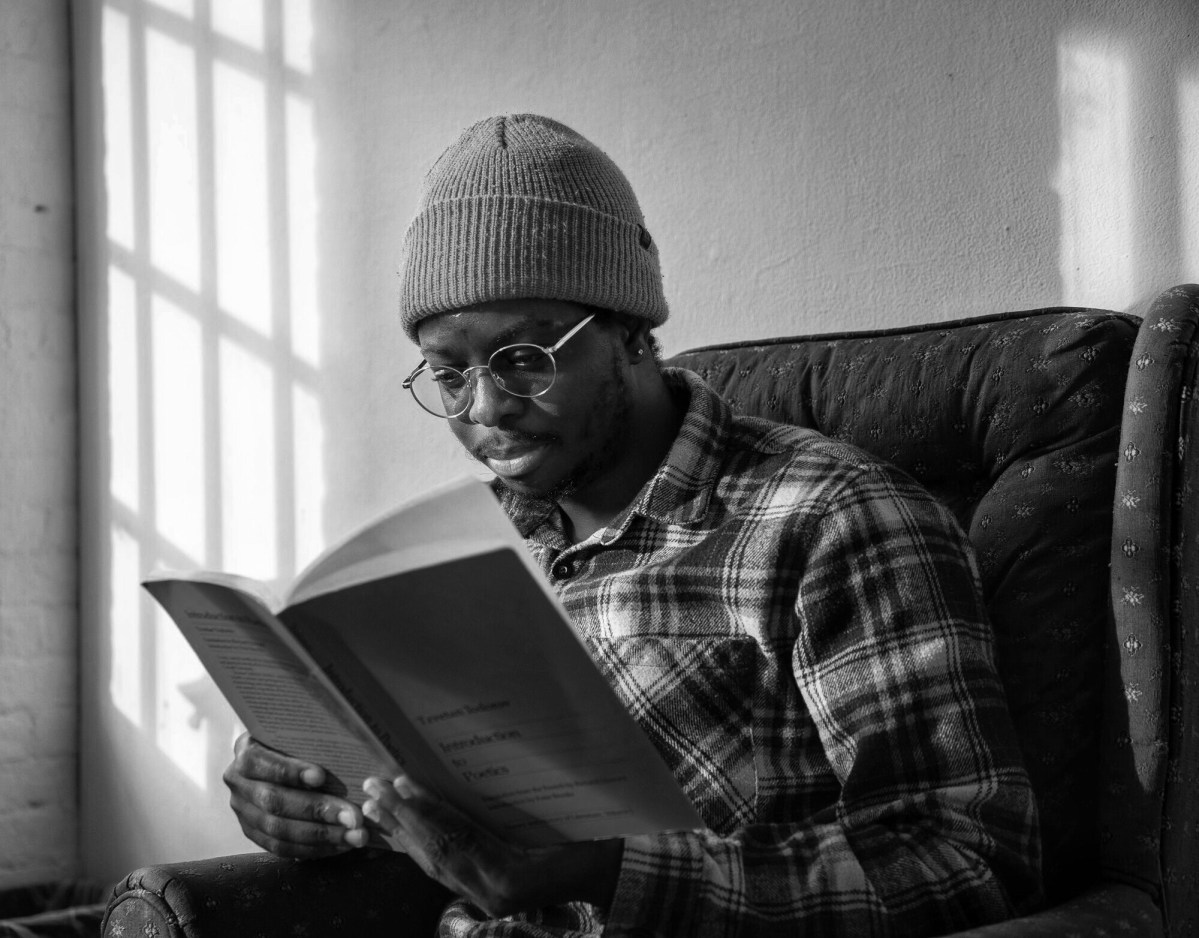
Agbaakin brings a new cultural context—a context that was excluded by Caravaggio and his patrons—to his reading of the painting: “come, find the sky & all its dark matter. its / sudden meteor shower like blood spurting / from the ram’s neck at the feast of the Eid.” The feast of the Eid is a Muslim ritual; Caravaggio’s painting was sponsored by Catholic patrons. Agbaakin acknowledges the Christian symbol of the ram (“the blood / crust of communion wine”) but he cannot be dogmatic about it.
One asks if, in placing a Muslim understanding, or at least the suggestion of a Muslim understanding, of what happened at Mount Moriah in his poem about this Caravaggio, Agbaakin has been faithful to the painting. Which would require us to ask what faithfulness might mean in this case.
If a poem “vitalises the form of a ritual”, it does not need to be dogmatic about the contents of that ritual. Of course, the form cannot be completely pried from the content. Achebe tells the story of the sacrifice of Isaac in Things Fall Apart, the scene where Okonkwo kills Ikemefuna. The potency of any ritual—or of any ceremony—is in its capacity to maintain a resonant form in whatever context it is translated into. For Agbaakin, the Eid is as true an understanding of the sacrifice as is the Christian perspective, because he is from a country (or at least a section of the country, southwestern Nigeria) where one understanding does not have predominance over the other; there, in that reference, he has snuck in something autochthonous.
But the question of “faithfulness” remains. In response, I think Agbaakin’s deviance is in good keeping with his muse. He has digested, or at least imbibed, the deviance that partially explains the genius of Caravaggio. This was the painter who painted the Holy Virgin with dirty feet; the one who killed a man—Caravaggio. In “The Sacrifice”, the young man painted as an angel, Cecco del Caravaggio, is believed by some to have been the painter’s lover. His work was so undogmatic that they scandalised Rome.
“so blessed
is the man who can make a mouth & make it
scream & stop at once . . .
blessed is the mouth too for talking to a painter . . .”
It was Hill who said that language, great language, has to be able to rear its head. I say it has to be able to rear its head—and strike! The glory of a poet, as is that of a painter, is to be able to “make a mouth & make it / scream & stop at once.” A man who can do that (“so blessed”) is beloved of the gods. In some places in his poem (the excerpt above is one), Agbaakin manages to; and here: “beware the bristles / stiffened like a cat’s whiskers soaked in blood.”
II
In May 1966, when Okigbo finished work on the poems that make up Path of Thunder, Nigeria had defined a clear path for itself—it was tottering on the edge, about to fall to serious destruction. Awolowo was jailed in 1963 for so-called treason; his son, Segun Awolowo, died in a car accident in the same year. There were the population censuses taken in the 1960s, which were contested; Operation Wetie (people were being doused with petrol and burned alive in Ibadan); the constitutional crisis of ’64/’65; all of which led to the 15 January Coup. Reading his last poems, that “sense of trepidation in the edgy and muted atmosphere of fear and violence in Ibadan” (as Obi Nwakama writes in Thirsting for Sunlight, 2010) is palpable.
The “ceremony of innocence” had ended; the ceremony of thunder had begun. The poems in Path of Thunder are some of his best—a maturity, and a concentration of energy, is present. Okigbo’s waywardness in his own life, his inability to focus, was also there in his work. The political awakening of Nigeria—an awakening to the destructive tendencies that are present among the political class—served as the spiritual awakening for the cultural elite. The new sense of purpose that is sister-in-law, Georgette Okigbo, saw in him when he returned home to Enugu before secession was declared, had cast forth its first green leaves in the poems.
Okigbo had always been a poet of mood—like the Impressionist composer, Claude Debussy, whose work he greatly admired. Okigbo was never one to talk directly, and now he had no need to. What he had to do was arrest that “sense of trepidation in the edgy and muted atmosphere” (my italics), but with the sense unmuted. The atmosphere had to be given utterance.
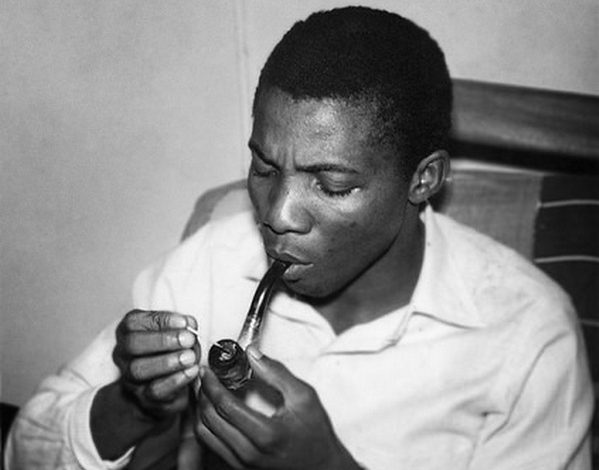
The trepidation in “Come Thunder” is euphoric—a jubilant trepidation. “Now that the triumphant march has entered the last street corners” and “Now that laughter, broken in two, hangs tremulous between the teeth”: these lines belong to a future that Okigbo had not lived, but that his poem was bearing witness to. The prophetic power credited to the poem (and other late ones) lies there. “The smell of blood already floats in the lavender-mist” is not exactly prophetic, likewise “The death sentence lies in ambush along the corridors of power”; both lines are about the coup, which Okigbo was let in on. But the first four lines of the poem are a different matter. When the South African journalist Colin Legum visited the East in 1966, when Okigbo had returned to Nsukka, like thousands of Igbo people (following the pogroms), he felt there was “an electrifying militancy” in the air in Nsukka. Think of “tremulous”—the erotic delight of that word—and think, too, of “electrifying”. And then think of “hangs” and “militancy”.
“The smell of blood already floats in the lavender-mist of the afternoon”: the blood here is sacrificial blood. It is the blood of those to be killed in the coup as a ritual cleansing for the saving of Nigeria. Okigbo did not mean the blood of those who died in the civil war, that was not in view for him. Perhaps tacitly, his language recognised the pogroms that would follow. But that blood is decidedly goat or ram’s blood. The idea of sacrifice and cleansing had always been there in Okigbo (“thro’ moonmist to hilltop / there for the cleansing”, “Lustra”; “I have had my cleansing, / Emigrant with air-borne nose, / The he-goat-on-heat”, “Limits”; “Here is a new laid egg / here a white hen at midterm”, “Lustra”). He noticed in the plot of Major Emmanuel Ifeajuna and his cohort something of his own personal creative fiction. Only in this case it was to be national, and not fictional. Life had come round to art.
I have made a bold statement above, but I do believe it to be borne out by the poem and by what we know of Christopher Okigbo’s life. Do we sense any reluctance on the part of this poet—in “Come Thunder”, any sense that this might go wrong? Yes, there is an apprehensiveness in the tone. His “Remember, O dancers” is beware. Not exactly like O-Jeremiah Agbaakin’s “beware the bristles / stiffened like a cat’s whiskers soaked in blood” (both poems play different stakes, and Okigbo’s is the higher, more dangerous stake).
Also, “the secret thing heaving”: the word is used as a verb here, but is there a possibility that Okigbo (subconsciously, perhaps) also intended us to get a sense of the “heave offering”—a ritual observance of the Jews under the Levitical Order? It is probable, but the main point here is the phrase (“the secret thing heaving”), it is not exactly ecstatic. But, again, depending on who is looking, it seems to have a conspiratorial glee to it, a mischievous whisper of dark delight.
Still, we are sure that Okigbo wanted thunder to come. And we know that, in anticipating the slaughter(s), he was also commemorating it. The poem has gone on ahead to wait for time to justify it—and time did. It is a ceremony on several levels.
III
“Mass” is a loaded word. It means “a quantity or aggregate of matter usually of considerable size”, and it refers to “the liturgy of the Eucharist” (the sacrament of taking the holy communion). The latter sense is often used as “service” (i.e., Catholic mass), which can have attraction and be stimulating for those who have no faith at all in the broken bread/body.
In “Mass” by Othuke Umukoro, both senses of the word (quantity; ceremony) are implied. But in putting that word at the head of a poem about his visit to a slave dungeon built by the Dutch in Ghana, he also slightly shifts the sense of what we mean by a church. Below is the poem in full.
What was I thinking about
on my way here? passing
the small kenkey with rabbit stew joint, passing
Elmina Fishing Harbour, where
I stood yesterday watching
as Fante fishermen mend nets—
acid cry of pied crows.
It goes on for miles. This scarred heaviness.
Above, bitumen letters
on wooden slab, FEMALE SLAVE DUNGEONS.
I am the last to enter. Shoeless.
The walls of this one have patches
the colour of stale turtle tank water.
The size is a bullet.
When Emmanuel, our tour guide,
lanky fellow with keen eyes,
says nearly 150 of them were crammed here every month,
the man with short dreads is the first to break. Someone,
not the middle-aged lady
whose name in Shona means give thanks,
not the man whose hands remind me of garden urns,
someone digs for words
but finds only a lint-free tissue instead.
The air pales.
I imagine gaunt bodies. The coffined dark.
I touch the walls. Then again.
Whichever way I look, I am what is bent.


An obvious thing to say about the poem is that it starts disarmingly and somewhat charmingly. “What was I thinking about”, and the question mark does not halt the thought; he carries on. But after getting through the poem, one wants to ask, What does thinking have to do with it?

One can infer from “The walls of this one” that the poet has visited other “ones” and perhaps that he was still trying to rationally digest what he had seen at the others. But Umukoro, without using the words, by leaving the question of “thinking” and not giving it a pause, may be suggesting that thinking really has nothing to do with it.
If thinking has nothing to do with, like believers at the Mass, all we have to do is be quiet and partake. Partaking in this case is to come, visit, keep the fact of what was done alive, don’t forget. The fact that this visitation has a ceremonial dimension is clear. The transatlantic slave trade is something to be commemorated politically and culturally. But a poem (in addition to having an occasion worthy of reverence), as I said previously, must conjure its own ritual.
Ritual things are all over the poem. For instance, he enters shoeless. Something which he forces us to see; it stands alone: “I am the last to enter. Shoeless.” (Is that because he is on sacred ground?) He is not the only one there, though only a few are mentioned; but the way they are listed, we are given the sense that there are more people. One of the people there has a name which in Shona means “give thanks”, and the tour guide is called “Emmanuel” (God with us).
I have said that Umukoro wants us to reconsider what a church might mean. “150 of them were crammed here every month” but God was with them there. “This coffined dark” (the tomb where Christ was buried) was their church. And those who have come—including the poet—come knowing the import of this place. They have come, in a sense, to worship, to “give thanks” (but for what?).
These things can be missed because the poem works in a very understated way. His subject is ceremonial in a political sense. And his burden (whether consciously realised or not) must have been how to do that duty without stopping there. He works these little things into the poem, like keepsakes, and uses them as a necessary fiction to elevate his poem over its occasion.
But there is a different kind of beware in this poem, different from those in Okigbo and Agbaakin.
Read the last line of “Mass” again. Pause. Consider. Read it again. What does Othuke Umukoro mean by “Whichever way I look, I am what is bent”? What is this “I”? Is it “Man”? Or is it “I, Othuke Umukoro”? Or is it “the African self”?
“I” cannot be “I, Man” in this case. It is the same “I” in “I am the last to enter”. It is “I, Othuke Umukoro”—and that fact makes the line very problematic.
What Umukoro has done in that line is to commit a travesty of the ceremony that he has “invented”. A mistake I believe was caused by an anxiety to be profound. And the anxiety has led him to a foolish statement. This is a female slave dungeon. You are a man. You live in the United States. You have come as a tourist. Now you equate yourself and your experience with theirs. It is like a devotee at Mass imagining that it is his body that is being broken, it’s his blood dripping into the cup. No, you are not what is bent. Not in this case. It is as careless a statement as I have read in any Nigerian poem in a long time, and it is not isolated in Umukoro. He does it in another poem in his book, Fenestration, “Ember”, where he refers to a boy bought in 1790 by Georgina Cavendish (Duchess of Devonshire) as “omo iya mi” (my mother’s son). This overweening attitude, this pretentious familiarity where it is non-existent, is common in contemporary Black African and Black American political and cultural conversations, where people arrogate an experience that is not theirs simply because they are Black.
That is no way to commemorate. The artist who chooses to use a form must not mar the form by intruding, unless, of course, his intrusion is like that of the leopards of which Kafka wrote: “Leopards break into the temple and drink all the sacrificial vessels dry; it keeps happening; in the end, it can be calculated in advance and is incorporated into the ritual.” Umukoro’s intrusion is not calculated in advance and hangs like a rotten limb at the bottom of his poem.
IV
“Beware the bristles / stiffened”, says Agbaakin; it’s an injunction to be exact and exacting but without exacting a poem to death. It’s what one might say to lords of ceremonies, make room for the leopards—make room for surprise. Artifice in poetry, as Okigbo’s poem shows, is not limited to the page—it ping-pongs with society, politics, and life. With a poem like “Mass”, we see that a poet who is not careful can implicate himself by the word of his mouth. Art will not keep you from evil, unless you are aware that to play with words is to walk a very treacherous road. All three poems, in their various contextual layers, reveal something of the kind of ceremonies language enacts, and how.
Ernest Jésùyẹmí is the author of A Pocket of Genesis (Variant Lit, 2023). His work has appeared in AGNI, The Sun, Poetry London, The Republic, and Mooncalves: An Anthology of Weird Fiction. He holds a BA in history and international studies from Lagos State University, Nigeria, and is the poetry editor of EfikoMag.