

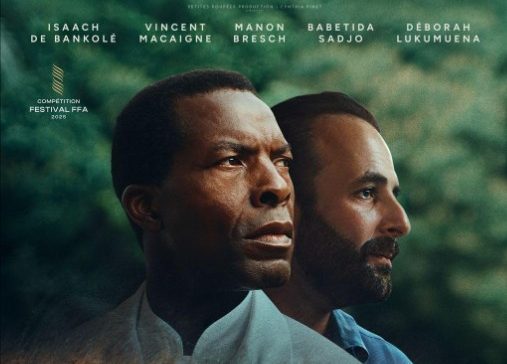


Muganga, Celui Qui Soigne advances a proposition that compassion practised daily, even without applause, remains one of humanity’s most subversive acts, and perhaps our surest, if modest, route toward a marginally better world.
By Frank Njugi
There are films in which a single protagonist hoards the narrative oxygen, and then there are films that understand, with confidence, that a lead character is only ever as meaningful as the human systems moving around them. Muganga, Celui Qui Soigne belongs emphatically to the latter camp: filmmaking that recognises that African stories are braided, one life tugging at another, histories overlapping, consequences echoing forwards and backwards. The journey in Africa is never solitary but cumulative; one presence carries the weight of those who stand alongside them, as well as those who came before and those who will arrive after. Sometimes, a film’s intelligence lies in its refusal to pretend otherwise.
Working from a screenplay she co-wrote with Jean-René Lemoine, Marie-Hélène Roux constructs a film anchored by two remarkable male performances, yet constantly, and deliberately, allows the frame to widen. As it does, a constellation of women emerges, each with a testimony that lands.
This is Roux’s second feature, and it shows a director working with increasing assurance. That confidence was recognised at the Angoulême Francophone Film Festival, where Muganga, Celui Qui Soigne collected three awards—the Audience Award, the Student Jury Prize, and Best Actor—no small feat for a film so unwilling to flatter its viewers. With a French cinema release in September this year via L’Atelier Distribution and executive backing that included the award-winning American filmmaker, Angelina Jolie, the film arrived with momentum.

The title “Muganga”, in Swahili, signals intent and irony too. Roux, who grew up in Gabon—outside the Swahili belt of East Africa—spent a decade bringing this project to the screen, ultimately choosing to shoot in her childhood landscape, particularly in Lambaréné.
The film unfolds against a bleak present, yet refuses nihilism. It tells the story of Dr Denis Mukwege, Nobel Peace Prize laureate, and his Belgian colleague Guy-Bernard Cadière, whose work restores faith in humanity. Through acts of care extended to women shattered by sexual violence, abandonment, illness, and unwanted pregnancies, Muganga, Celui Qui Soigne advances a proposition: that compassion practised daily, even without applause, remains one of humanity’s most subversive acts, and perhaps our surest—if modest—route towards a marginally better world.
The film insists that healing itself can be a form of resistance, and that tending to broken bodies may also be a way of pushing back against a broken moral order.
Inspired by true events, the film revisits the grievously underreported suffering of thousands of women in South Kivu, in the eastern Democratic Republic of Congo, where women are subjected to systematic rape and mutilation by militias amid the protracted violence of the Great Lakes region. The context is never far from view: a land saturated with coltan, that rare and strategically vital mineral without which our smartphones, laptops, and other sleek emblems of modern convenience would not function. The film shows how the comforts of a global industry are tethered, invisibly yet indelibly, to atrocity.

For more than four decades, Dr Denis Mukwege has stood against this barbarism, dedicating his life to restoring dignity and hope to women often cast out by their families, deemed “impure” after surviving unspeakable assaults. Isaach de Bankolé portrays Mukwege, anchoring the film in seriousness rather than saintly myth. The narrative finds its emotional axis in Mukwege’s unlikely friendship with an eccentric Belgian surgeon, Guy-Bernard Cadière, a laparoscopy specialist whose arrival proves transformative.

Together, they pioneer non-invasive techniques to reconstruct bodies left shattered by violence. This partnership—professional, personal, mutually sustaining—revitalises Mukwege’s resolve at a moment of profound exhaustion. In Muganga, Celui Qui Soigne, heroism becomes not a thunderclap but a long, gruelling collaboration, sustained by friendship, ingenuity, and perhaps a refusal to look away.
Dr Denis Mukwege and Guy-Bernard Cadière work almost as a single organism, four hands moving with the precision of long practice, yet animated by something far less clinical. What is in force are the women who stand behind them, whose survival lends gravity to their labour. The film understands this partnership as a shared burden: two lead figures collapsing into a single presence, attempting—methodically and patiently—to repair what history, ideology, and indifference have so brutally broken.

This is, ultimately, the more important story the film insists on telling. In real life, since the late 1980s, at Panzi Hospital in the eastern Democratic Republic of Congo, as mentioned, Dr Denis Mukwege and his teams have treated thousands of women who survived sexual violence used as a weapon of war. The scale is almost impossible to hold in the mind, and Roux is careful not to reduce it to statistics. The hospital emerges as an indictment: as proof of compassion’s necessity, and of the world’s prolonged failure to prevent such suffering.
Standing firm and well composed, Marie-Hélène Roux’s film may provoke indignation directed at those who allowed such tragedy to be buried beneath geopolitics and fatigue. But Muganga, Celui Qui Soigne, as a whole, does not remain in outrage. Through its striking visuals and its sincerity, it becomes an argument for hope—hope as repetitive, unglamorous, and stubbornly human.
Frank Njugi, an award-winning Kenyan Writer, Culture journalist, and Critic, has written on the East African and African culture scene for platforms such as Debunk Media, Republic Journal, Sinema Focus, Culture Africa, Drummr Africa, The Elephant, Wakilisha Africa, The Moveee, Africa in Dialogue, Afrocritik, and others.