



The problem with Nollywood was never that it showed the difficult dimensions of traditional practice. The problem was that it showed nothing else.
By Joseph Jonathan
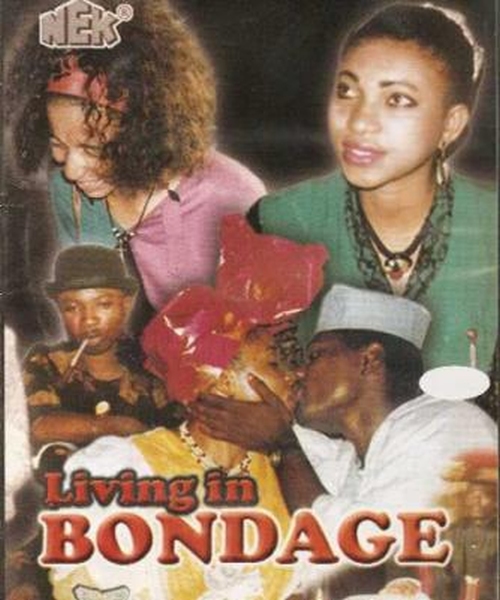
For as long as Nollywood has existed, African spirituality has played the villain. A masquerade moves through a village square, draped in raffia and indigo cloth, carrying the compressed spiritual authority of centuries, moving the way masquerades have always moved: with the weight of the ancestral world pressing through it. Children scatter. Elders watch. The air thickens. And then the pastor arrives. He raises his hand. He speaks in tongues. He rebukes the spirit in the name of Jesus. The masquerade convulses, shrieks, and flees. The village is saved. The screen cuts to closing credits and a gospel soundtrack.
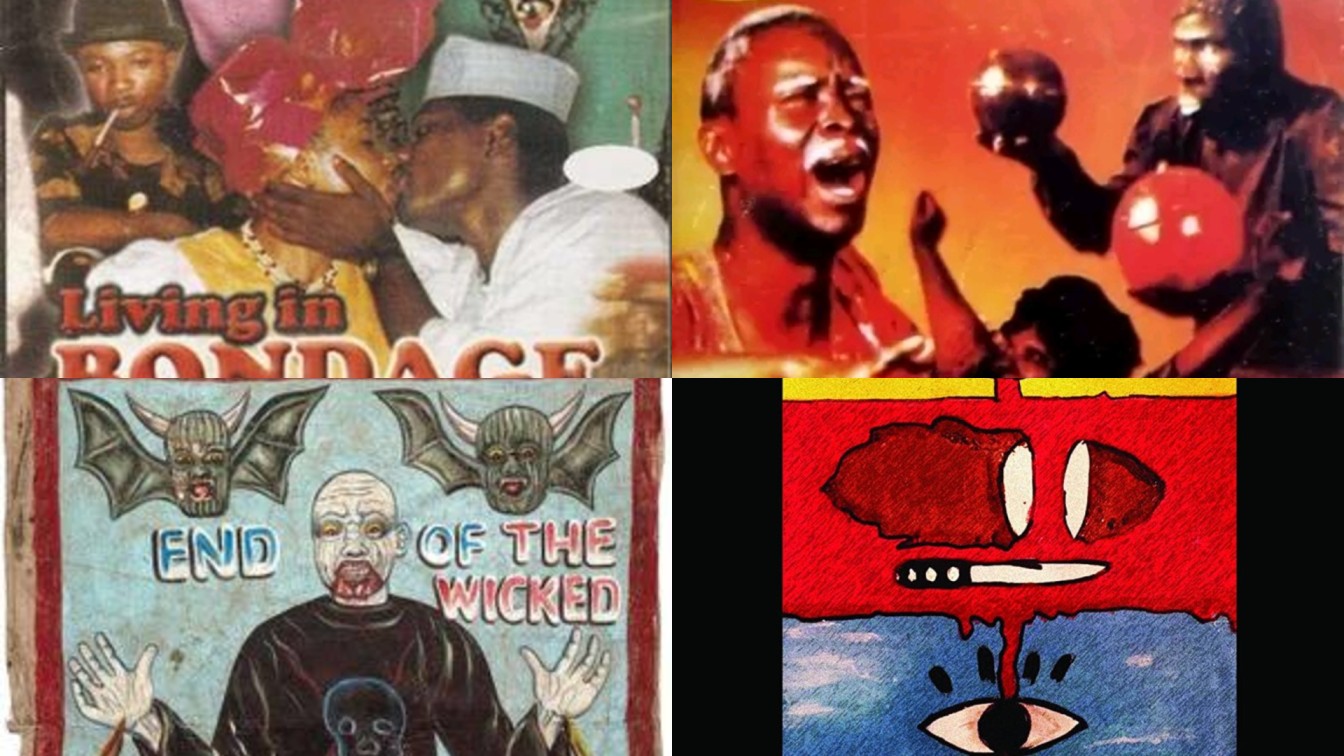
This scene, in one variation or another, has repeated itself across thousands of Nollywood films across decades — Living in Bondage (1992), Karishika (1996), End of the Wicked (1999), Last Burial (2002), The Blood Covenant (2022), The Masked King (2024), among countless others. The films span over thirty years, two distinct industrial eras, and every level of budget and ambition. What they share is a single, unwavering conviction: that African spiritual practice is the source of the problem, and that the solution lies elsewhere. Taken together, they amount to the systematic demonisation of an entire continent’s tradition.
It has repeated itself so many times that it no longer registers as a creative decision. It has become the default visual and moral language through which Nigerian cinema processes the encounter between Christianity and indigenous spiritual practice. And like all grammar, it operates below the level of conscious thought. Filmmakers reproduce it without necessarily intending to. Audiences receive it without necessarily noticing. Children absorb it the way they absorb language: not just as ideology, but as the obvious structure of the world.
It is a conversation that has been growing louder on Nigerian social media for some time now. The recurring frustration that Nollywood has spent decades making African spirituality the villain of its own story. The people expressing this frustration are not always practitioners of traditional religion. Some are cultural nationalists.
Some are Pan-Africanists, genuine or performative. Some are simply Nigerians who have noticed that their cinema seems constitutionally incapable of showing a masquerade without coding it as evil, a shrine without treating it as a threat, or a herbalist without eventually revealing her as a servant of darkness. Whatever their motivation, they are pointing at something real.
That is the real indictment. Not that Nollywood made some films that portrayed African spirituality negatively; every film industry in the world has done that with its own cultural heritage at some point. The indictment is that Nollywood did it so systematically, so commercially, and so completely that it didn’t just shape what Nigerians believe about their own traditions. It shaped what they are able to imagine. It foreclosed possibilities of self-understanding so thoroughly that even people who intellectually reject the demonisation have been conditioned by it. The person who dismisses Christianity and considers themselves culturally aware still flinches when a masquerade appears on screen. That involuntary flinch — operating below theology, below conscious belief, below intellectual position — is the measure of what Nollywood actually did. Not persuasion. Conditioning.
To understand how this happened, and what it cost, you have to begin before Nollywood. You have to begin with what was actually there.
The World That Was There
Before the missionaries arrived, before the colonial archive decided what African belief systems would be called and how they would be classified, there were cosmologies. Cosmologies: internally coherent, philosophically sophisticated systems for understanding the relationship between the living, the dead, the unborn, the divine, and the natural world. The word matters. A superstition is an error. A cosmology is a framework for meaning-making, and it deserves to be encountered on its own terms before it is judged. For the purpose of this essay, we’d consider the cosmologies of the two ethnicities that have shaped Nollywood the most.
The Yoruba Ifa corpus is one of the most elaborate philosophical and divination systems in human history. UNESCO recognised it as an Intangible Cultural Heritage of Humanity in 2005, and not as a courtesy. Its 256 Odù — the foundational texts of Ifa — contain ethical frameworks, medical knowledge, historical narratives, psychological insight, and metaphysical inquiry that scholars across the world continue to excavate. The Ifa system does not offer simple moral instruction. It offers a way of navigating the irreducible complexity of human existence: how to understand failure, how to interpret suffering, how to locate yourself within a cosmos that is not indifferent but responsive. It is, in the deepest sense, a philosophy of attention, a trained practice of reading the world with care.
Igbo cosmology is equally sophisticated, though differently structured. The concept of Chi — a personʼs individual spiritual identity, the divine portion assigned to each soul before birth — is not a simple guardian angel. It is a philosophical position on the nature of personhood: the idea that each individual carries within them a unique spiritual signature that determines capacity, shapes destiny, and demands alignment between the person and their deepest nature. The moral implications are profound. Chinua Achebe spent decades excavating them. When Okonkwo in Things Fall Apart fights against his chi, he is not simply a stubborn man resisting fate. He is a philosophical figure enacting the tragedy of self-division. The concept of Ani — the earth deity, the ultimate moral enforcer in Igbo thought — positions morality not as obedience to a transcendent God but as alignment with the living earth, the community, and the ancestors. What Ani prohibits are not arbitrary commandments. They are violations of the social and ecological fabric that makes communal life possible.
These are not the beliefs of people who had not yet encountered sophisticated thought. They are sophisticated thoughts. And yet — and this is where intellectual honesty demands something uncomfortable — they are also traditions that existed inside human societies. And human societies are capable of harm.
The same Igbo cosmological world that produced Chi also produced the Osu caste system, which designated certain people as the property of the gods and condemned them and their descendants to permanent social exclusion. Osu could not marry freeborn people. They could not hold certain offices. Their exclusion was religiously sanctioned, which made it nearly impossible to challenge from within the tradition.
The Yoruba spiritual world that gave the world Ifa also sanctioned, in certain historical periods, the sacrifice of servants at royal funerals. Widowhood rites in several Nigerian traditions subjected women to humiliating, sometimes physically violent rituals in the immediate aftermath of their husbands’ deaths. The conflation of sickle cell disease symptoms with the ogbanje phenomenon — the belief that certain children were malevolent spirits cycling in and out of the family to cause grief — led to the abandonment and death of children who were sick, not possessed.
None of this is fabricated. None of it is colonial propaganda. All of it happened, and an honest reckoning must hold it without flinching, because the argument is not that African spiritual traditions were perfect. No tradition in human history has been perfect. The argument is about something far more specific: what Nollywood did with the complexity of these traditions. Whether it engaged with them honestly — showing the depth alongside the harm, the wisdom alongside the cruelty — or whether it did something else entirely. And what it did was something else entirely. It took a cosmological world of genuine depth and genuine contradiction, stripped out everything that could not be coded as evil, and handed the residue to a pastor to rebuke.
How the Money Shaped the Story
To understand why Nollywood did this, you have to follow the money. Because the demonisation of African spirituality in Nigerian cinema was not primarily an artistic choice. It was a business model. And to understand the business model, you have to begin where Nollywood, as it is now understood, began: in 1992, with Living in Bondage.
Kenneth Nnebue produced, and Chris Obi Rapu directed a film about a desperate man named Andy Okeke who joins a secret cult, sacrifices his wife for wealth, descends into madness and ruin, and is ultimately redeemed through Christianity. The film was shot cheaply, distributed on VHS through Nnebueʼs electronics supply business, and sold hundreds of thousands of copies across Nigeria. It was, by any measure, a phenomenon. And what it established was a template: African spiritual practice as the engine of corruption, Christianity as the mechanism of salvation, born-again conversion as the narrative resolution. The film didnʼt create a formula; it confirmed that an existing cultural logic was commercially viable at an industrial scale. What followed was no coincidence. It was market logic operating at speed.
To understand the scale of what happened next, you need to understand what was happening to Nigerian Christianity in the same period. The Pentecostal explosion in Nigeria through the 1980s and 1990s was not a gradual religious shift. It was a social transformation of the first order. Ministries like the Church of God Mission International, Redeemed Christian Church of God, and Living Faith Church grew from modest congregations into institutional empires with their own schools, publishing houses, television stations, and distribution networks.
The theological framework at the centre of this explosion was spiritual warfare: the idea that the world is a battlefield between the forces of God and the forces of Satan, that Satan operates through specific cultural and material channels, and that African traditional religion was among Satan’s primary instruments in Nigeria. This was not a fringe position. It was mainstream Pentecostal theology, preached from the most prominent pulpits in the country, absorbed by millions of Nigerians who were themselves the primary audience for Nollywood films.
The church and the industry found each other because they needed each other. Nollywood needed distribution networks, audiences, and financing. The Pentecostal church needed cultural products that reinforced its theological framework and could be used as evangelism tools. The alignment was almost perfect. Church-financed or church-adjacent films were guaranteed distribution through thousands of parishes. Congregations were pre-sold audiences who arrived at every screening already convinced that the content was literally true. The films didn’t need to persuade anyone of anything. They needed to confirm what the audience already believed, and in confirming it, make the belief feel more real.
No institution embodied this fusion more completely than Mount Zion Film Productions. Founded by Mike Bamiloye in 1985 and thrust into national prominence by Agbara Nla in 1992, Mount Zion was not a film company that happened to have Christian values. It was an evangelical ministry that used film as a weapon of spiritual warfare. Bamiloye was not a filmmaker making morality tales. He was a minister making sermons with production values. The distinction matters enormously. A filmmaker making a morality tale is still, at some level, bound by the demands of cinema: character complexity, narrative credibility, the understanding that even villains have recognisable human logic. A minister making a sermon has no such obligations.
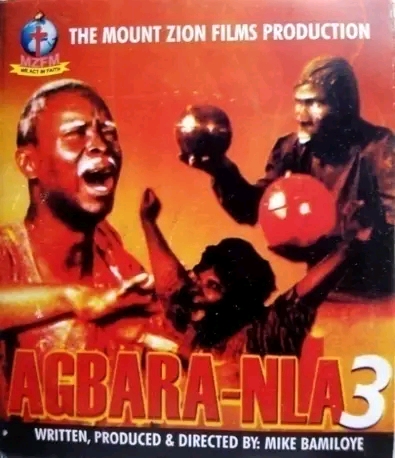
The demons in Mount Zion films were not metaphors to be interpreted. They were literal enemies of God to be identified, feared, and rebuked. The herbalist was not a complex human figure embedded in a community’s healing traditions. They were servants of Satan. The masquerade was not a sophisticated ancestral institution. It was a portal for demonic activity.
Then there is Helen Ukpabio. And Ukpabio is not merely an example. She is the case that makes the argument impossible to avoid. Ukpabio is the founder of Liberty Foundation Gospel Ministries, a prolific producer and actor, and the driving force behind End of the Wicked (1999), directed by Teco Benson. The film depicted children as recruitable agents of Satan. The witch children in the film were not monsters from folklore. They were ordinary-looking Nigerian children whose evil was invisible to those around them. That specificity was the film’s most dangerous quality. It didn’t create a distant, fantastic monster. It created a template for suspicion that could be applied to any child in any household.
In the years following the film’s release and distribution through Ukpabio’s ministry network, a documented wave of child-witch accusations swept through parts of southeastern Nigeria and the Niger Delta. Children — some as young as two — were accused of witchcraft by their families, subjected to violent exorcism rituals, abandoned, mutilated, or killed. Human rights organisations, including Stepping Stones Nigeria, documented hundreds of cases in which children suffered severe abuse on the basis of witchcraft accusations, inflamed by exactly this theological and cinematic climate.
The demonisation of African spirituality in Nollywood was not a harmless aesthetic choice that merely offended cultural sensibilities. In the specific case of Helen Ukpabio’s work, it contributed to an ideological climate in which real children were tortured and killed. The causal chain is not simple or direct; Ukpabio did not expressly instruct anyone to harm a child. But the framework her films propagated, in which children could be identified as witches and exorcism was the appropriate response, provided the cultural logic within which the abuse occurred. Cinema shaped reality. Not through persuasion, but through the systematic construction of a world in which certain acts became thinkable.
Nollywood did not impose this worldview on reluctant audiences. That is the crucial point. It gave willing audiences exactly what they wanted to see and believe. The audiences who made Living in Bondage, Agbara Nla, and End of the Wicked into successes were not being deceived. They were being confirmed. The masquerade fleeing from the pastor was not artistic laziness. It was a transaction between a cinema and its audience, an agreement about the nature of reality, expressed in the only language cinema speaks: images that feel true.
The Coloniser’s Inheritance
Here is the historical irony that the demonisation story cannot be told without. Nollywood is celebrated, rightly, as one of the great achievements of African popular culture; an industry built largely without Western financing, controlled by Nigerians, consumed by Africans. Economic independence is real. And yet Nollywood, in the specific domain of African spirituality, did not decolonise. It did something more troubling: it indigenised the coloniser’s argument. It took the missionary’s judgment — that African spiritual practice was demonic, backward, and incompatible with civilised modernity — and made it Nigerian. Made it African.
The framework that positions African spirituality as dark and Satanic did not originate in Africa. It arrived with the missionaries, who classified what they encountered not as philosophy but as paganism, fetishism, and devil worship — categories designed not to understand African religious life but to delegitimise it. The masquerade was not a complex ancestral institution. It was a demonic idol. The shrine was not a site of communal spiritual practice. It was a gateway to hell.
What made this framework durable was the institution through which it was transmitted: the mission school. Colonial education in Nigeria was almost entirely mission-controlled for its first century. To attend school — the gateway to literacy and economic participation — was to be educated inside a framework that explicitly pathologised African traditional religion. African spiritual practice was taught as a superstition that education was designed to overcome.
The first generation of Nollywood filmmakers were products of this system. They did not consciously choose to replicate the missionary’s framework. They expressed what they had been taught to believe so completely that it no longer felt like belief. It felt like the obvious truth. Mike Bamiloye was not cynically exploiting religious anxieties. He genuinely believed the world worked the way his films depicted it. You can argue with cynicism. You cannot easily argue with the conviction of someone who believes they are doing God’s work.
The coloniser went home. The ideology stayed. And the first Africans to build a genuinely mass African cinema used it to do the missionary’s work; more effectively than the missionaries ever could, because they did it in Igbo, in Yoruba, in Pidgin, in the languages and emotional registers that reached people the missionaries never could. Nollywood completed the colonial project of cultural delegitimisation with tools the colonisers didn’t have. It did it from the inside. And it called it entertainment.

The Complexity Nollywood Refused
What would an honest cinema do with African spirituality? It would engage with these traditions in their totality: sophisticated and sometimes cruel, philosophically rich and sometimes socially unjust.
Thunderbolt: Magun (2001), directed by Tunde Kelani, is one of the most important Nollywood films ever made, and it is important precisely because it does what mainstream Nollywood consistently refuses: it takes a traditional Yoruba spiritual practice seriously as a subject of moral inquiry rather than reflexive condemnation.
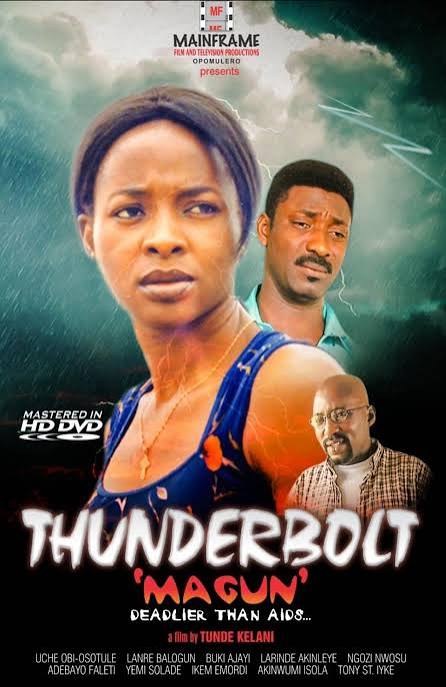
Magun is a spiritual trap placed on a woman, without her knowledge, by a husband who suspects infidelity. When she is intimate with another man, the magun activates, causing his death. Kelani does not present this as Satanic evil requiring pastoral intervention. He presents it as a human practice embedded in patriarchal logic; about male authority, female sexuality, and the use of spiritual power to enforce social control. The film demands that the audience think rather than simply recoil.
The result is a film that teaches you something true about Yoruba social and spiritual life that no amount of pastoral rebuke could illuminate.
The Surreal 16 collective’s Juju Stories (2021) does something different but equally significant. The anthology treats juju not as spectacular horror but as ordinary cultural logic operating within the mundane rhythms of Lagos life. In Love Potion, a charm that makes someone love you works and then continues working in ways that become oppressive, raising questions about consent, desire, and the ethics of spiritual intervention that no Nollywood film of the Pentecostal era ever thought to ask.
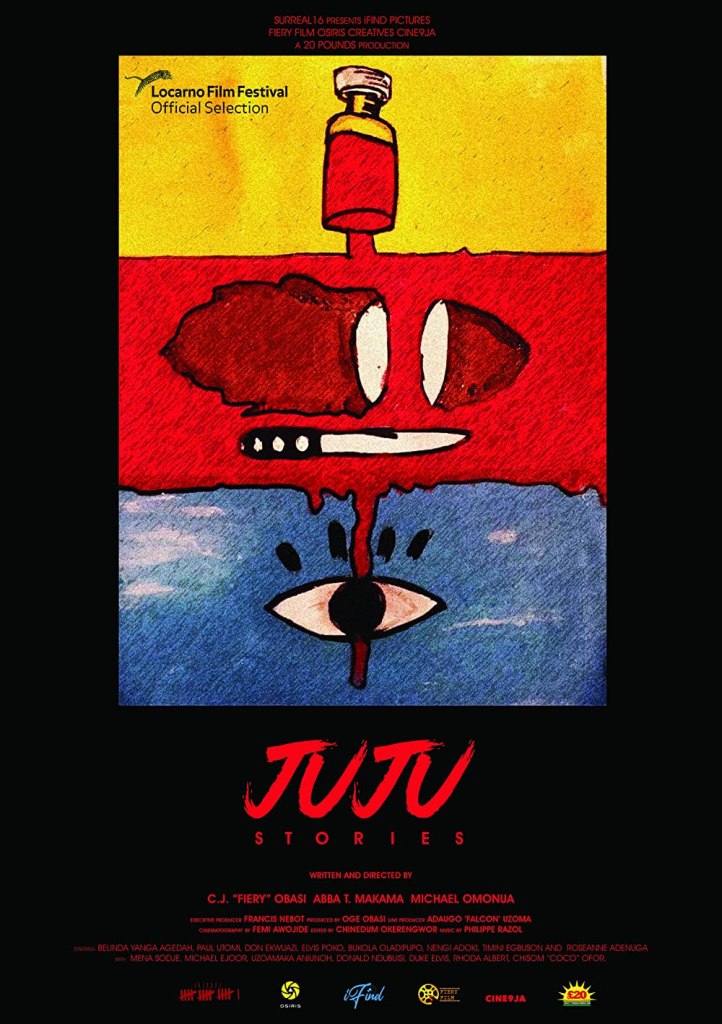
In Yam, money picked from the ground may or may not carry a spiritual consequence, and the film’s genius is that it never resolves the question, leaving the audience to sit with the uncertainty that actual encounters with traditional belief produce. In Suffer the Witch, witchcraft in a university dormitory operates in a register that is simultaneously supernatural and entirely explicable in terms of jealousy, social competition, and the desire for power, refusing the film the comfort of a clear supernatural explanation.
And then there is Mami Wata (2023), C.J. Obasi’s feature, which takes the West African water spirit mythology and builds from it a film of genuine visual and philosophical ambition. Shot in luminous black and white, set in a remote coastal community negotiating the tension between traditional spiritual authority and the pressure of outside forces, it treats Mami Wata not as a demon to be rebuked but as a cosmological presence whose meaning is contested, whose authority is real, and whose relationship with human beings is genuinely complex.
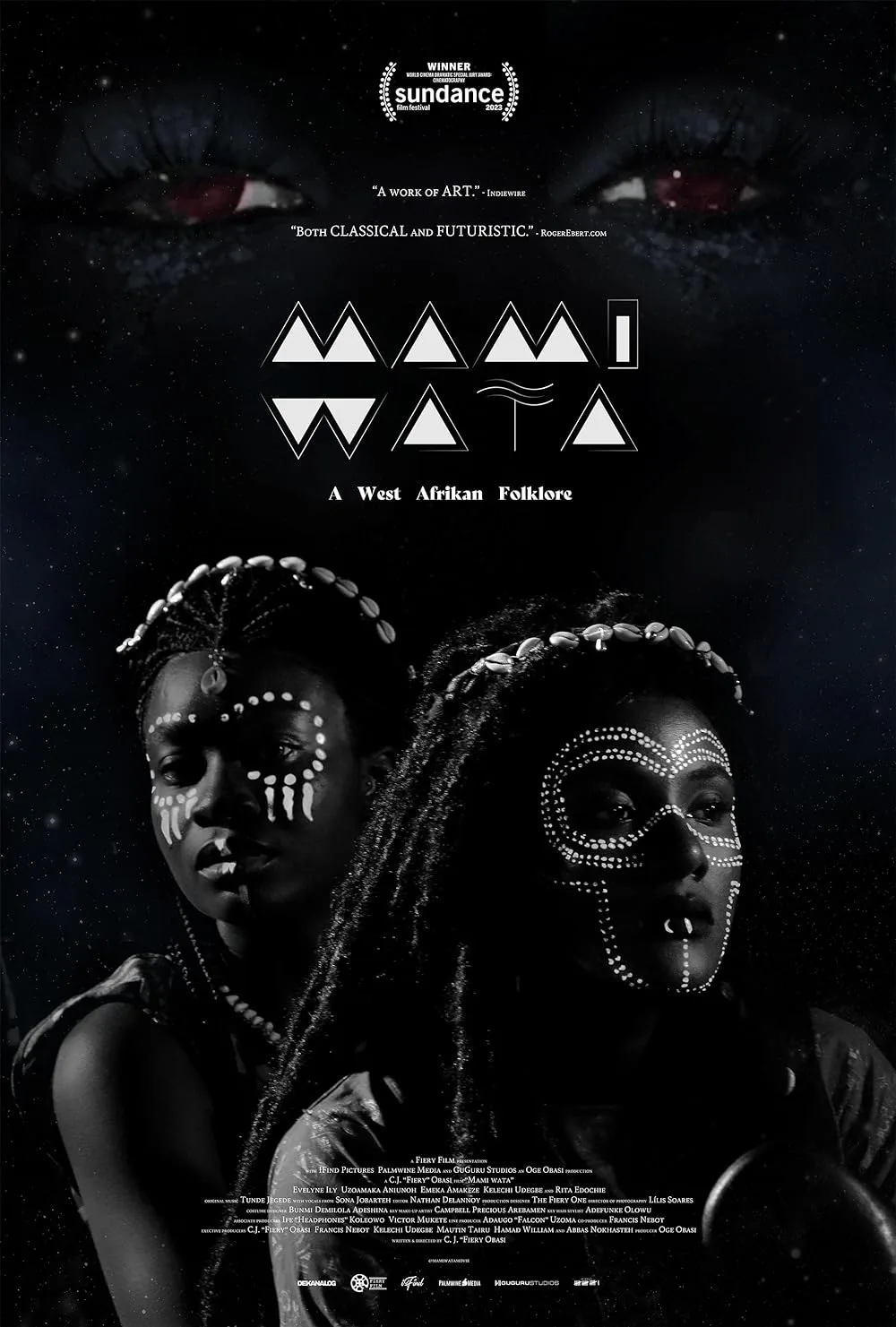
The film does not romanticise the tradition it inhabits. The spiritual world it depicts carries real costs; lives bent, choices foreclosed, communities trapped between devotion and doubt. What it refuses to do is flatten that complexity into a moral verdict. In that refusal, Mami Wata joins Juju Stories as evidence of something significant: a deliberate counter-tradition, built by a specific kind of filmmaker — formally ambitious, postcolonially conscious, unwilling to inherit the missionaryʼs grammar — who is quietly doing what mainstream Nollywood has consistently declined to do. Not defending African spirituality. Reckoning with it honestly. The Surreal 16 Collective is the clearest expression of this counter-tradition.
These films are remarkable. They are also exceptions. The ratio matters. Against hundreds of Nollywood films per year that demonise traditional practice or treat it as background danger requiring Christian resolution, these constitute a small and marginal counter-tradition. The mainstream has not moved. It has simply allowed the exceptions to exist.
Reckoning
Nollywood demonised African spirituality. It did so systematically and commercially, with the enthusiastic participation of audiences prepared by colonial education and Pentecostal theology to receive the demonisation as truth, with documentable consequences: child-witch accusations, violent exorcism practices, and the deepening of a cultural estrangement already two centuries in the making.
But a fair accounting requires holding the full complexity that the grievance’s most passionate advocates sometimes prefer to avoid. African spiritual traditions were not simply victims of misrepresentation. They were also, in specific and documented ways, sources of genuine harm — the osu system, the twin-killing, the treatment of sickle-cell children as ogbanje, the widowhood rites. These happened inside the very traditions Nollywood flattened into caricature. The people who suffered them deserved honest cinematic engagement, not as proof that their traditions were Satanic, but as evidence that every human tradition contains both the capacity for wisdom and the capacity for cruelty.
The problem with Nollywood was never that it showed the difficult dimensions of traditional practice. The problem was that it showed nothing else. It never made films that interrogated the Osu system honestly, or showed the herbalist as what they often were — a healer, a keeper of communal knowledge. Instead, it made, over and over, the film in which the masquerade flees, the shrine burns, and the pastor wins.
You can measure the damage in the bodies of Nigerian audiences — in the involuntary flinch when a masquerade appears on screen, even in secular viewers who would intellectually reject everything Nollywood’s Pentecostal grammar stands for. That flinch is not theology. It is reflex; conditioning written so deeply it operates below thought, below argument. Not persuasion. Conditioning. And conditioning, unlike argument, cannot be won against.
The flinch is still there. Until Nollywood makes films honest enough to undo it — not through romantic nationalism, but through genuine reckoning — the renaissance will remain incomplete. A cinema that cannot imagine its own ancestors honestly has not yet earned its freedom. It has only learned to tell the story it was given. And a cinema that only tells the stories it was given is cinema, yes, but it is the least interesting kind.
Joseph Jonathan is a historian who seeks to understand how film shapes our cultural identity as a people. He believes that history is more about the future than the past. When he’s not writing about film, you can catch him listening to music or discussing politics. He tweets @Chukwu2big