

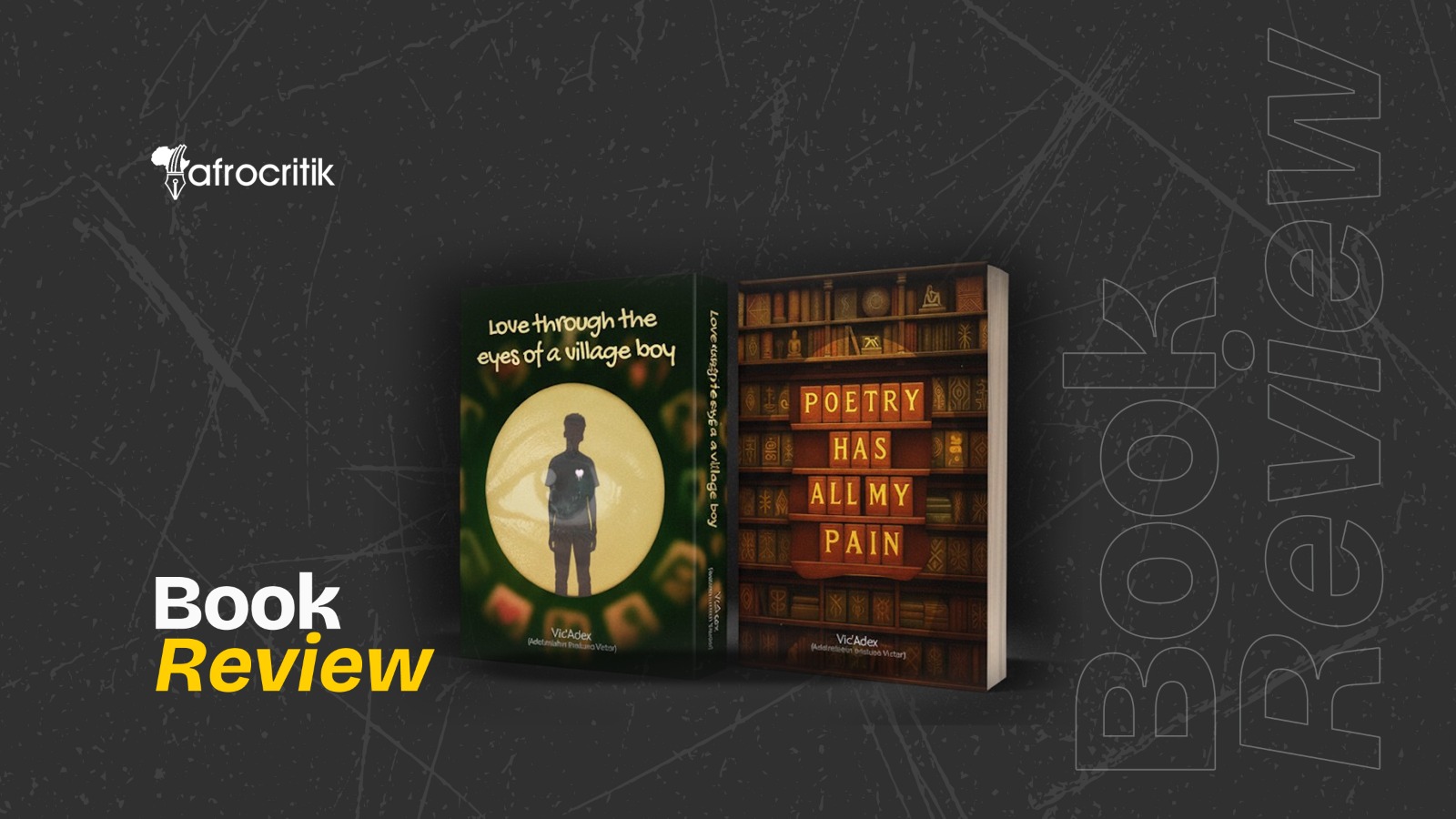


Poetry Has All My Pain and Love Through the Eyes of a Village Boy straddles the line between the classical and the contemporary.
By Michael Imossan
The relationship between father and son is often said to be fraught with tension—whether as a result of the male ego or the father’s staunch, unyielding posture over time—which may be interpreted by the son as a lack of care or presence. Sometimes, this perceived lack of care can only be assuaged by a greater kind of love, perhaps that of the mother, or a lover found later in life.
In Vic’Adex’s (Adetimilehin Inioluwa Victor) twin collection, Poetry Has All My Pain and Love through the Eyes of a Village Boy, this tension is brought to the fore with bold and audacious language. There is a psychoanalytic approach through which Vic’Adex engages the subjects and poems in the first half of the collection. This approach allows him the chance to be vulnerable, to splay himself open in search of what “eats at his rind”. This is particularly noticeable in the opening poem of the collection, “I Swore I’ll Never Be like My Father”.
I swore I’ll never be like my father-
The villain in my pain poems, my ink-painted grief
so I planned my life like a marketing brief
tailored my confidence over baggy dreams
jumped and fell so far from the tree; I was sure his
shadow would never darken my glee
As evident in the title of the poem, Vic’Adex opens the collection with a vow not to be like his father, an assertion that beckons the reader towards the dichotomy that exists between the speaker and his father. More than this, however, Vic’Adex goes on to accuse his father of being “the villain in his pain poems”. Although the reason for this accusation is not made explicit, the courage to speak such a truth is compelling. Here, Vic’Adex turns truth into a weapon—a means through which the reader is both invited and entrapped within the gospel of vulnerability.

Existing in a predominantly patriarchal society where boys are often taught not to express their pain, or even to trace the etymology of their ache—be it their parent(s) or certain childhood experience(s)—the consequence of such silence can be an accumulation of trauma: trauma from lived experiences, and trauma from the inability to articulate them.
In Sigmund Freud’s Trauma Theory, where he speaks of a “mind wound” as a consequence of repressed experiences, is pertinent to understanding this. Nonetheless, Vic’Adex makes a decision to face this pain and interrogate them; both as a way of therapy and a way towards catharsis. It is here that Vic’Adex finds the multiplicity of himself, the ones “murdered” by his father and “reincarnated”.
The first time my father murdered me
I reincarnated without my naivety
The second time he killed me
I came back as a voiceless ghost
Buried my heart in a lie
what better way to love those you hate
than to give them a shadow of yourself?
In the poem “My Father’s Murders”, the manifestation of this tension is made bold through language. Vic’Adex navigates the terrain of hate and love, straddling these delicate lines while revealing just how difficult such navigation can be.

Through a rhetorical question, the paradox of hate and love—the philosophy that hate is merely another side of the same coin as love—is explored. The reader is led to wonder, “what better way to love those you hate?”. And although, within this same pain, Vic’Adex suggests that the best way is “to give them a shadow of yourself”, this answer is itself only a shadow. The actual way to love, to purge the heart of hate, is revealed through the parallel structure of the twin collection, where Vic’Adex explores the subject of love through the eyes of a village boy.
In the poem “Surrender at First Sight”, he shows how the resentment he held towards his father is assuaged through a different kind of love;
When I saw you for the first time
My lungs pleaded
to surrender their oxygen
at your feet
Dying in such a manner
would be a fitting worship-
A holy offering
to a god who experimented on the universe
to perfect artistry in the creation of you.
From the resentful, hating boy who craved distance between himself and his father, Vic’Adex, upon encountering love, becomes a romantic, willing to “surrender” the “oxygen” in his lungs at his lover’s feet. There is a way Vic’Adex wields parallelism and contrast, both at the level of content and structure, that emboldens and fosters the thematic movement of the entire collection, disrupting and moulding it altogether.
In the first half of the collection, Vic’Adex’s language is stronger, more direct, and overt. Here, he is being murdered by his father, and, in defiance, he reincarnates. In the second half of the collection, however, Vic’Adex’s voice is softer; typical of a romantic, he is willing to sacrifice himself for his lover, believing that “dying in such manner would be a fitting worship”.

There is also a noticeable elevation of language here. This elevation reflects Vic’Adex’s depth of love, so much so that he employs synecdoche in his confessions, describing how his “lungs pleaded to surrender their oxygen at” his lover’s “feet”.
The ultimate lesson here is one of sacrifice—a reinforcement of the postulation that, in love, one is capable of surrendering everything, including one’s life. In this act of surrender, redemption and healing are found.
Such healing and redemption are reflected in the final poem of the collection, “Let the Memory Find Us”. As if borrowing from the opening line of Shakespeare’s “Shall I compare thee to a summer’s day”, Vic’Adex asks thus;

Shall I pass by your face
And not wonder what grace shaped them?
Or how timeless they seem
As though destined to meet mine
In a story written across generations?
You’ve been dipped
In the glassy streams of the heavens,
Drawing me upward by the gentleness
Of your presence.
Let me weave a garment of care
From the silken strands of your hair,
Your touch kindling a stillness
Deep within.
In the excerpt above, Vic’Adex’s willingness to sacrifice himself for the sake of love is reinforced. This sacrifice may stem from his experience with his father—his understanding of what the absence of love can do to a man, how a lack of care can foster resentment, and how it can raise a lineage of trauma.
Unlike his father, Vic’Adex chooses the path of care, pleading with his lover to let him “weave a garment of silken strands of her hair”, to let her “touch kindle stillness/deep within”.
It is in Vic’Adex’s willingness to offer himself to his lover, and in his capacity to care for her, that he is redeemed from his father’s absence and lack of love. In this, Vic’Adex finds healing—so much so that his lover’s “beauty stills his restless thoughts/and hushes all performance”.
Poetry Has All My Pain and Love through the Eyes of a Village Boy straddles the line between the classical and the contemporary. By indulging the personal with such proximity and intimacy, the collection reveals a poet of promise, one unafraid to bare himself in the pursuit of truth. It is a collection that will linger in the minds of its readers.
Michael Imossan is a poet and Editor of Ibibio origin. He is the winner of the Sillerman Prize for African Poetry, 2024. His Chapbook, “The Smell of Absence” was selected by Kwame Dawes and Chris Abani for inclusion in Kumi Na Mojo New-Generation African Poetry Series, 2025. He is a recipient of the PEN international grant. You can tweet him via @michael_imossan