

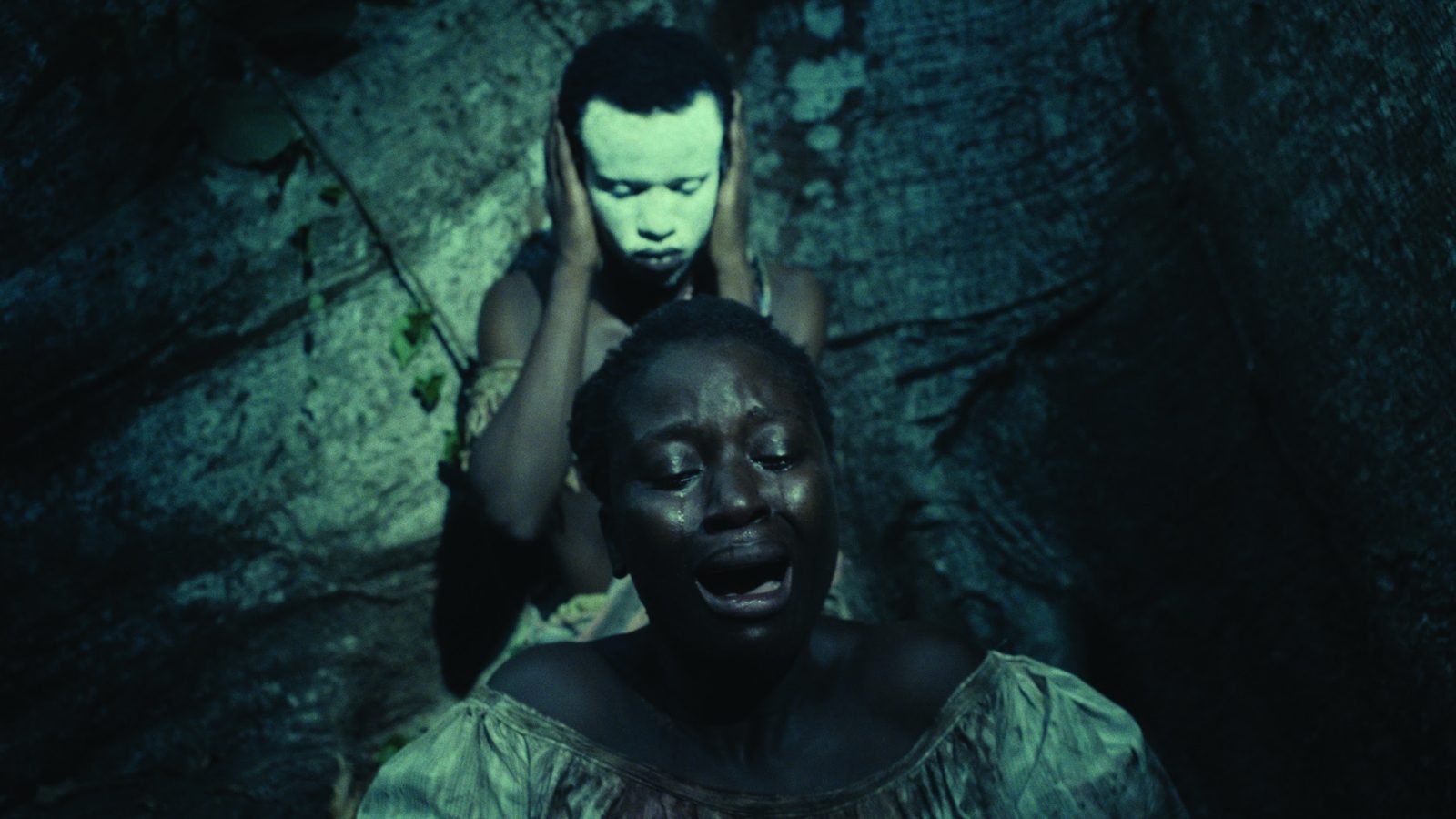


Nome is not just a historical film; it is a reckoning: one that insists African cinema can grapple with its past without reverence or denial, and can do so with formal daring and spiritual depth.
By Joseph Jonathan
There is a particular sound that returns again and again in Nome: the low, foreboding call of the bolombo. In the village, it signals death. In the bush, it warns of an impending Portuguese attack. In Sana Na N’Hada’s film, it becomes something else entirely: a reminder that history does not announce itself cleanly. It arrives layered, ambiguous, carrying both prophecy and consequence. Watching Nome, it becomes clear that this is not a film interested in recounting Guinea-Bissau’s war of independence as a closed chapter, but in tracing how its echoes continue to reverberate through bodies, landscapes, belief systems, and moral compromise.
Na N’Hada’s third feature unfolds across the late 1960s and the aftermath of liberation in 1974, moving fluidly between the village, the battlefield, and the corridors of post-revolutionary power. At its centre is Nome (Marcelino António), a young man who impregnates his cousin Nambú (Binete Undonque), and flees his village out of fear and shame, choosing the guerrilla movement as both escape and absolution. It is a decision that appears, on the surface, to align with the nobler currents of history—the collective struggle against Portuguese colonial rule—but Nome is far too perceptive to romanticise such alignments. From the outset, the film positions personal cowardice and political commitment uncomfortably close to one another.

What distinguishes Nome from many cinematic treatments of African liberation movements is its refusal to anchor history around a singular heroic arc. Instead, the film disperses its attention across multiple perspectives: the village that sustains the revolution without ever fully benefiting from it; the women who carry its emotional and material burdens; the guerrillas whose machismo both fuels resistance and corrodes it from within. Na N’Hada is patient and watchful, allowing these worlds to coexist without forcing them into narrative hierarchy. The revolution, here, is not a monolith but a shifting constellation of desires, fears, betrayals, and fragile hope.
The film’s most devastating emotional throughline belongs to Nambú. Her struggle—abandoned, pregnant, and left to negotiate survival while Nome chases a sense of purpose elsewhere—becomes a quiet indictment of how revolutionary narratives so often sideline women’s experiences. Nambú does not occupy the periphery of Nome; she anchors it. Her endurance and the small, hard-won victories she achieves offer one of the film’s few rays of light in an increasingly compromised post-independence landscape. Where Nome drifts further from his origins, Nambú remains tethered to the land, to memory, to accountability.
Visually, Nome is intoxicating. Na N’Hada’s approach is minimal and stylised, yet suffused with lyrical beauty and spiritual unease. The cinematography oscillates between ultra-precise digital images and degraded archival footage shot during the actual period the film depicts—material Na N’Hada himself helped capture after being sent to Cuba for training.
The result is not mere juxtaposition but contamination: fiction and documentary bleed into one another, destabilising any comfortable distinction between recreation and reality. History is not illustrated here; it intrudes. The grain of the archival images scratches against the clarity of the present, reminding us that memory is neither stable nor neutral.

As the film progresses, its scope widens. Nome charts not only the exhilaration and brutality of armed struggle but also the moral erosion that follows victory. After the war, Nome relocates to Bissau and reinvents himself as a government official, exploiting his position while disavowing his village roots and betraying former comrades.
In this latter movement, the film confronts—with remarkable clarity—the utopian promises of African revolutionary movements alongside the seeds of corruption that always lay dormant within them. Yet crucially, Na N’Hada never succumbs to despair. His gaze is critical but not cynical, mournful but not nihilistic.
The film’s spiritual dimension—embodied by unseen presences, rituals, and the constant dialogue between the living and the ancestral—gradually recedes in the second half, making way for a colder reckoning with human failure. Nature, once a source of grounding and meaning, becomes indifferent. The land survives, but it does not absolve. This shift is one of Nome’s most unsettling gestures, suggesting that independence does not restore moral balance by default, and that liberation without accountability risks reproducing the very violences it sought to undo.
If Nome falters, it is largely due to its ambition. The film attempts to hold too much at once—village life, revolutionary fervour, post-war disillusionment, spiritual inheritance, political critique—and occasionally the weight shows. Some sequences linger in lyricism at the expense of narrative clarity. But these excesses feel less like missteps than the inevitable consequence of a filmmaker refusing simplification. Na N’Hada trusts his audience to sit with complexity, contradiction, and unresolved tension.


By the time Nome reaches its bleak yet strangely luminous conclusion, what remains is not a lesson neatly learned but a wound still open. The titular Nome comes to embody how greed and self-preservation undermine collective ideals, how revolutions can be hollowed out from within, and how the innocent often pay the highest price for historical transformations they neither initiated nor controlled. Yet in Nambú’s survival, in the persistence of memory, and in the film’s very existence, there is still the faint pulse of belief.
Nome is not just a historical film; it is a reckoning: one that insists African cinema can grapple with its past without reverence or denial, and can do so with formal daring and spiritual depth. It is flawed, demanding, and deeply resonant. Above all, it is a reminder that independence is not an ending, but a beginning fraught with unfinished business.
Rating: 4/5
*Nome had its world premiere at the ACID Section of the Cannes Film Festival 2023. Continuing its strong festival run, it screened at the African Diaspora International Film Festival (ADIFF) 2025.
Joseph Jonathan is a historian who seeks to understand how film shapes our cultural identity as a people. He believes that history is more about the future than the past. When he’s not writing about film, you can catch him listening to music or discussing politics. He tweets @Chukwu2big.