



The outrage over kissing is not the expression of ancient tradition. It is the performance of a relatively recent and heavily engineered consensus.
By Joseph Jonathan
Sometime in early 2025, Nigerian Twitter (now X) went agog when a clip of a kissing scene from Summer Rain surfaced online a few weeks before the filmʼs release. The scene was, by any global cinematic standard, tame. No nudity, no extended passion, no suggestion of anything beyond what two people in a fictional relationship might ordinarily do.
Within hours, the comments were a battlefield. One of the actors was married. The discourse that followed was swift, loud, and remarkably consistent in its moral certainty: this was unacceptable. Married actors should not kiss on screen. Better yet, kissing scenes should be removed from Nollywood films altogether.
This was not an isolated incident. It is a ritual. Every few months, a scene, an outfit, a role triggers the same cycle of outrage, condemnation, and counter-argument across Nigerian social media. The targets are almost always female. The language is almost always moral. And the people participating in the outrage are, statistically speaking, the same people consuming American television, British drama, and Korean film — media in which kissing is, at minimum, unremarkable.
The contradiction is so obvious that it invites easy mockery. But mockery misses the more interesting question. Why does this keep happening? What is the outrage actually doing? And what does it cost — the industry, the artists, the audience itself — when a culture performs conservatism it does not entirely believe?
The Performance of Virtue
The sociologist Erving Goffman spent much of his career arguing that social life is fundamentally theatrical: that people are always performing, managing impressions, presenting versions of themselves calibrated to their audience. His 1959 work The Presentation of Self in Everyday Life remains one of the sharpest tools available for understanding why people behave differently in public than they do in private.
Goffman was writing about face-to-face interaction, but his framework has never been more applicable than it is to social media, where the audience is always watching, and the performance is always on.
When a Nigerian social media user publicly condemns a kissing scene, the primary audience is rarely the actor being condemned. It is the other users watching the condemnation unfold. The statement being made is not simply “this is wrong” but rather “I am the kind of person who knows this is wrong”.
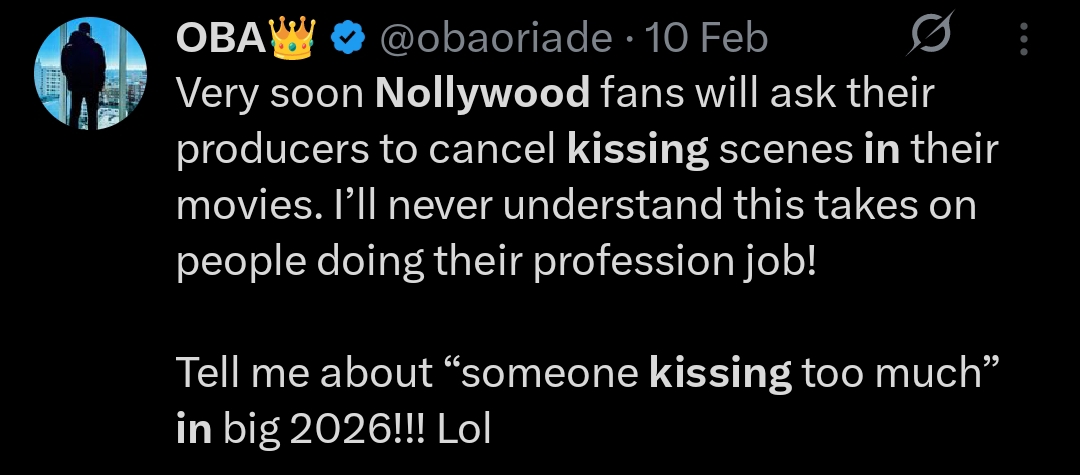
Moral outrage on social media is a form of identity signalling. It communicates belonging; to a religious community, to a cultural tradition, to a vision of Nigerian society that the speaker wants to be associated with. The actor on screen is almost incidental. They are a prop in someone else’s performance.
This does not mean the outrage is entirely insincere. It means sincerity is not the point. People can simultaneously believe something is wrong and perform that belief for social gain. They can be genuinely offended and also aware that expressing that offence publicly rewards them with likes, agreement, and social capital. These are not contradictory states. They are, in fact, precisely how moral communities sustain themselves; through the collective performance of shared values, repeated until the performance and the value become indistinguishable.
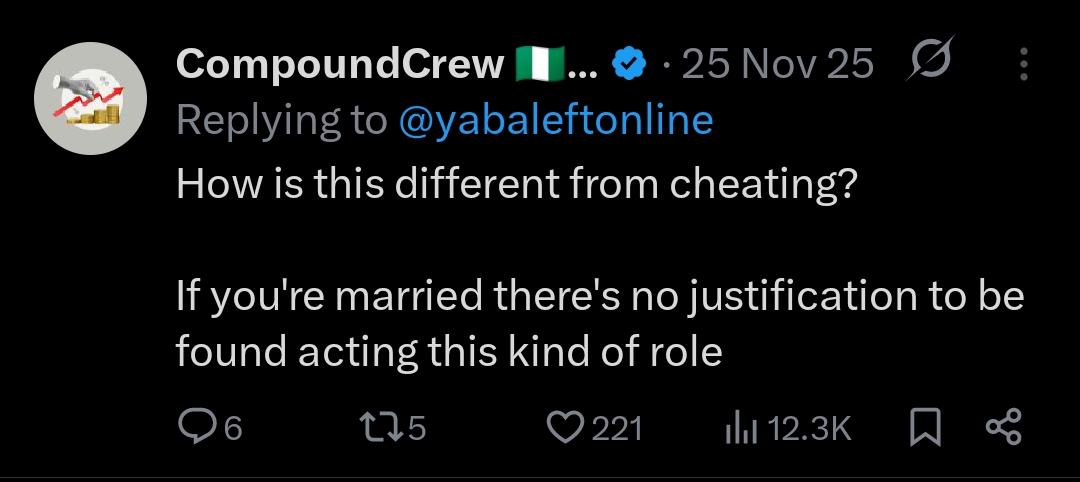
What makes this faux conservatism rather than conservatism proper is the selectivity of its application. The same audience that condemns a Nollywood kiss watches Game of Thrones (2011) — a series in which sexual content is not a subplot but a structural feature. They watch Bridgerton (2020), Normal People (2020), Euphoria (2019). They consume Afrobeats videos in which the female body is treated as scenery. They attend parties where the dancing would, by the logic of the kissing discourse, constitute a moral catastrophe. As such, conservatism is not a general principle applied consistently. It is a position adopted selectively, activated by specific triggers, and directed at specific targets.
The screen — specifically the Nigerian screen — is one of those triggers. And understanding why requires going back further than social media. It requires going back to how Nigerian moral life was constructed in the first place.
The Architecture of Manufactured Tradition
There is a version of the kissing debate that frames it as a defence of African values against Western decadence. In this telling, the demand to remove kissing scenes is a form of cultural self-determination; a refusal to import foreign norms into a society with its own traditions. It is a compelling frame. It is also largely false.
Sylvia Tamale, the Ugandan legal scholar and activist, makes this case with uncomfortable precision in her edited volume African Sexualities. The sexual conservatism that many African societies now treat as traditional is, in significant part, a colonial inheritance. Victorian missionaries arrived in West Africa with a specific moral agenda; one in which the body was sinful, sexuality was shameful, and propriety meant European propriety.
The colonial project actively suppressed indigenous expressions of sexuality, many of which were far more fluid and less policed than what replaced them. What was installed in their place — respectability, modesty, the sanctification of domesticity — was then handed down through generations until it became indistinguishable from authentic tradition.
Nigeria did not receive this inheritance passively. It was reinforced, turbocharged, and given a new institutional home by the Pentecostal Christianity that swept through southern Nigeria from the 1970s onward and has only grown more dominant since. The scholar Jonathan Haynes, whose research on Nollywood and its religious entanglements is indispensable, has documented how deeply Pentecostalism shaped early video film culture in Nigeria.
The first generation of Nollywood films was not merely sympathetic to a Christian worldview; they were, in many cases, produced within a Pentecostal framework that treated cinema as a tool of evangelism and moral instruction. Evil was to be shown so it could be condemned. The world was a spiritual battleground. And the body — particularly the female body — was a site of both temptation and danger.
This framework did not disappear as Nollywood professionalised and metamorphosed into what it is today. It calcified into audience expectation. Viewers raised on the moral grammar of early Nollywood brought that grammar with them as the industry evolved. It became the water the industry swam in, so pervasive as to be invisible, until something like a kissing scene made it suddenly, violently legible.

To call these African values is therefore doubly misleading. It is not African in origin, or at least not purely so. And it is not consistent with how most Nigerians actually live. It is a constructed moral architecture, built by colonial missionaries and Pentecostal pastors, that has been so successfully naturalised that its adherents experience it as primordial. The outrage over kissing is not the expression of an ancient tradition. It is the performance of a relatively recent and heavily engineered consensus.
Why the Screen Specifically?
If conservatism were genuinely principled, it would apply everywhere. It does not. It concentrates on screen — specifically the Nigerian screen — with an intensity it does not bring to other cultural forms. The question of why deserves more attention than it typically gets.
Part of the answer lies in what cinema demands of its audience psychologically. The film and cultural studies scholar Richard Dyer, in his essential works on stardom — Stars and Heavenly Bodies — argued that film stars are uniquely powerful cultural figures because audiences invest them with a kind of belief that they withhold from other performers.
A musician can inhabit a persona — we accept that the stage version of an artiste is not the whole person. An actor, particularly in realist drama, does something more troubling. They appear to simply be. The cameraʼs intimacy, its attention to the face, its illusion of unmediated access — all of this creates a relationship between audience and actor that feels less like watching a performance and more like knowing a person.
This is why the married actor problem is so revealing. When a Nigerian audience condemns a married actor for kissing on screen, they are not confused about the difference between fiction and reality in any simple sense. They understand that it is a film.
What they are responding to is the collapse of that distinction at the level of intimacy; the sense that the actor really did put their lips on someone elseʼs, really did simulate desire, really did use their actual body to produce the fiction. The body, unlike a voice or a line of dialogue, cannot be entirely fictionalised. It was really there.
American and European audiences have largely made peace with this. The history of Hollywood stardom is, among other things, a history of audiences learning to separate the actor from the role: to accept that Meryl Streep playing a Nazi camp commandantʼs mistress in Sophie’s Choice (1982) does not make Meryl Streep complicit in Nazism. This decoupling was not automatic. It was learned, over decades, through exposure to a cultural form that demanded it.
Nollywood audiences have not been given the same opportunity. The industryʼs moral gatekeeping structures — Pentecostal, conservative, risk-averse — have actively resisted creating the conditions under which audiences might learn to hold fiction and reality separately. And so the body remains raw, unmediated, uncomfortably real. The kiss is not between two characters. It is between two people, one of whom is married, and the marriage matters.
Music videos escape this logic partly because they operate in a different register: more abstract, more stylised, more obviously performative. The Afrobeats artist grinding against a model in a video is not presenting themselves as a real person in a real situation in the way a Nollywood actor playing a character in a domestic drama is. The realism of the narrative form is precisely what makes it more threatening. The closer the fiction gets to life, the more the audience feels entitled to police it by lifeʼs standards.
The Body as Communal Property: Gender and the Asymmetry of Condemnation
None of this falls equally on everyone. It never does. The kissing debate, like almost every moral panic in Nigerian public life that involves bodies, distributes its weight with remarkable consistency. Actresses bear more of it than actors.
Female bodies are policed more aggressively than male ones. The married actress who kisses on screen is more condemned than her married male co-star. The actress who wears a revealing costume is subjected to a volume of moral commentary that her male colleagues almost never encounter.
This asymmetry is not incidental. It is structural. In Nigerian — and more broadly West African — moral culture, the female body functions as a symbol of communal integrity in ways the male body does not.
A womanʼs sexual behaviour, her modesty, her presentation of herself in public, is understood not merely as personal choice but as a reflection on her family, her community, her ethnicity, her religion. She carries the groupʼs honour in her body. When she transgresses — or when she is perceived to transgress — the response is not merely personal disapproval. It is a communal alarm.
Nothing illustrated this more starkly than the discourse around Bamike Olawunmi, known as Bam Bam, and her husband, Tope Adenibuyan, known as Teddy A. When rumours of trouble in their marriage began circulating online, a significant portion of the public did not treat it as a private matter.
They treated it as a consequence; specifically, a consequence of Bam Bamʼs kissing scenes in the romantic comedy Love in Every Word (2025). The logic was swift and unambiguous: she had kissed someone on screen, her marriage was allegedly struggling, and the former had caused the latter. That Teddy A had also appeared in productions, that he too existed as a professional in an industry where intimacy is occasionally part of the work, barely registered.

The scrutiny landed on her. The blame settled on her. The marriage was her responsibility to protect, and the screen was the weapon she had carelessly picked up. It was a textbook illustration of the asymmetry at the heart of this discourse; acquit the man, indict the woman.
This is why the condemnation of actresses who “show skin” or take on intimate roles so often slides, without apparent irony, into language about what kind of woman she must be. The professional decision to take a role becomes evidence of personal character. The actress is not exercising craft. She is revealing herself. And what she is revealing is, in the logic of the discourse, shameful. The invisible tax on female creativity in Nollywood is immense, and the kissing debate is one of its most visible collection points.
What is rarely acknowledged in the discourse is that this tax does not protect anyone. It does not make Nigerian society more moral. It does not strengthen marriages, families, or communities. What it does is restrict the creative range available to female artists, limit the kinds of stories Nollywood can tell about women, and concentrate cultural power in the hands of those — often male, often institutionally religious — who define the terms of acceptable femininity. The performance of purity is not neutral. It is a mechanism of control dressed in the language of tradition.


What Does It Cost the Cinema
Art that cannot be dangerous cannot be great. This is not a provocative claim; it is almost a tautology. The works that endure, across every tradition, are the ones that made their original audience uncomfortable. That put something real and difficult into the world and refused to resolve it neatly. That trusted the audience to sit with contradiction without requiring reassurance.
Nollywoodʼs conservatism, driven by the kissing discourse and the broader moral framework it represents, works directly against this. Its damage is aesthetic before it is anything else.
Consider what the demand for moral clarity does to character. A character who cannot be shown to desire — to want something they perhaps should not want, to feel something complicated, to exist in the murky territory between virtue and failure — is not a full human being. They are a lesson. And lessons, however moral, are not interesting. They do not accumulate into myth. They do not linger in the audienceʼs imagination long after the credits roll. They are consumed and forgotten, like a sermon that you agreed with but cannot quite remember.
Summer Rain is instructive here, though perhaps not in the way its makers intended. Before the film had even been released, a clip of its kissing scene had already consumed the entire conversation around it. Whatever the producers set out to make — whatever story was being told, whatever performances were being delivered, whatever emotional or dramatic stakes the film had constructed — none of it entered the public discourse.
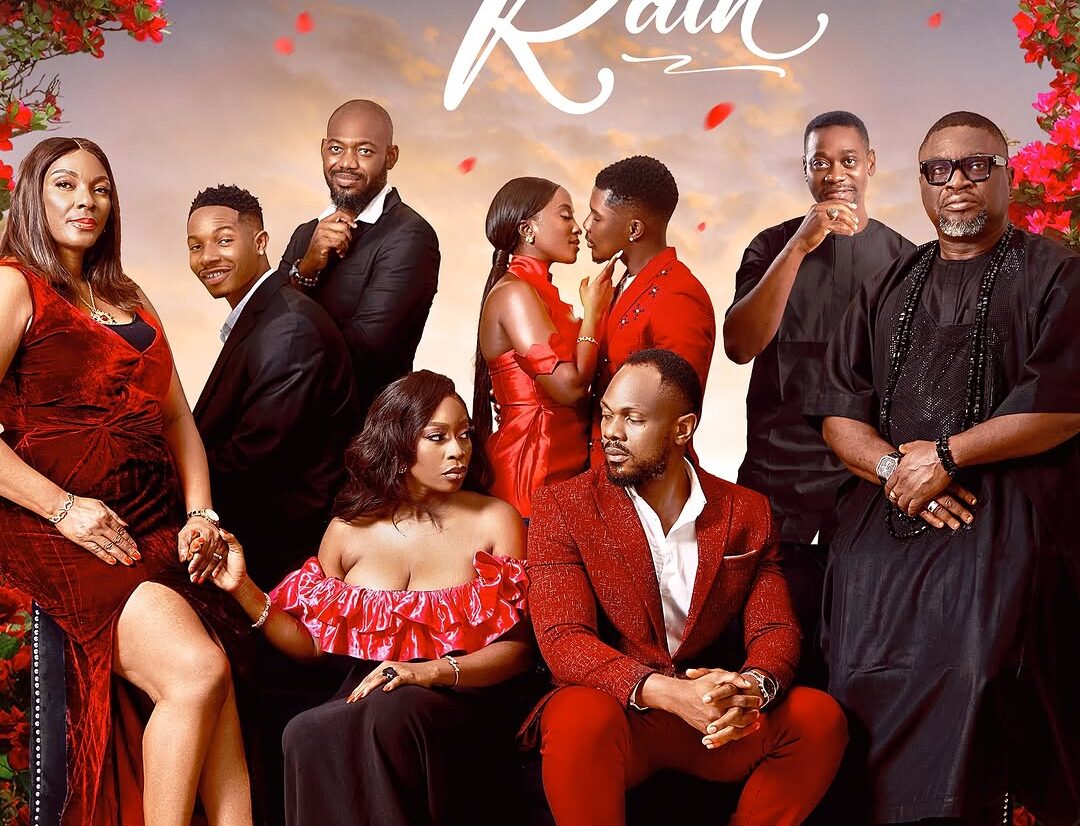
The kissing scene became the film in the public imagination weeks before anyone had seen the film. This is what moral gatekeeping does at the level of reception: it forecloses the possibility of engagement before engagement can begin. The work is tried and convicted on a single count, and the rest of the evidence is never heard.
But the damage runs deeper than reception. The more corrosive effect is what happens before the camera rolls; the self-censorship that occurs in development rooms and script meetings and casting decisions, as producers and filmmakers quietly calculate what the market will tolerate and adjust their ambitions accordingly.
This is harder to document precisely because it leaves no trace. The complex scene that was never written, the morally ambiguous character who was softened before shooting, the filmmaker who chose a safer story because they knew what the alternative would cost, none of this appears in the final film. It is visible only as absence, as a kind of imaginative poverty that accumulates across an industry over time.
The greatest performances in cinema history are almost always performances of moral complexity. Cate Blanchettʼs Carol Aird in Carol (2015) is a married woman who falls in love with another woman — the film does not punish her for it, does not resolve the contradiction, does not offer the audience the comfort of a moral verdict.
Joaquin Phoenixʼs Freddie Quell in The Master (2012) is violent, broken, pitiable, and frightening in almost equal measure. The film holds all of it without flinching. These performances are possible because the industry that produced them, whatever its many failures, has largely accepted that fictionʼs job is not to tell audiences what to think but to show them something true.
Nollywood cannot yet make these films. Not because its actors lack the talent — they manifestly do not — but because the moral ecosystem surrounding the industry makes them too costly. A producer who greenlights a film in which the protagonistʼs desire is allowed to be complicated, in which the kissing is not the problem but the point, takes on a risk that the market still finds “uncomfortable”. And so the roles are sanitised, the contradictions flattened, and the stories that could have been extraordinary become merely adequate.
This is the real cost of the kissing discourse. Not the individual scenes that get edited or removed. Not even the actresses who turn down roles. It is the imaginative poverty that accumulates over time in an industry that has decided, collectively, that purity is more valuable than truth.
The Mirror Problem
There is a version of this essay that ends with a solution; that calls on Nigerian audiences to mature, on producers to take creative risks, on the Pentecostal establishment to loosen its grip. But solutions feel dishonest here, because the problem is not really a policy problem. It is a cultural one. And cultural problems do not resolve through argument. They resolve, if they resolve at all, through accumulated experience — through enough exposure to complex art, made with enough courage, consumed by enough people willing to sit with the discomfort.
What can be said, though, is this: the Nigerian audienceʼs relationship with international cinema reveals what it is actually capable of. The same viewer who condemns a Nollywood kiss watches Fleabag (2016) — Phoebe Waller-Bridge’s masterpiece of sexual and spiritual chaos — and finds it brilliant. They watch Moonlight (2016) and are moved by it.
They discuss Normal People on group chats with an engagement and nuance that never appear when Nollywood is the subject. The imaginative generosity they extend to foreign fiction — the willingness to enter a world on its own terms, to follow characters into moral territory they would not personally endorse, to allow a story to be complicated — is exactly the generosity they withhold from their own cinema.
This is, when you sit with it, a form of self-disrespect. It says, implicitly, that Nigerian stories are not worthy of the same seriousness. Nollywood characters must be exemplary because they are Nigerian, not simply human. That the ambiguities that make foreign drama rich and true are somehow inappropriate when applied to Lagos, to Onitsha, to Ibadan, to the marriages and desires and failures of people who look and sound like the audience watching.
The kissing debate, in the end, is not really about kissing. It is about what Nigerian audiences believe their own stories are for; whether cinema is a mirror or a lesson, whether fiction is a space for exploration or a contract of moral reinforcement.
Until that question is answered differently, the ritual will continue. Someone will kiss on screen. The timeline will erupt. The actress will bear the brunt of it. And a film that might have been extraordinary will, somewhere in development, become something safer, smaller, and more forgettable.
The purity will be performed. The cost will be invisible. And Nollywood will keep making films that are watched and forgotten, rather than films that last.
Joseph Jonathan is a historian who seeks to understand how film shapes our cultural identity as a people. He believes that history is more about the future than the past. When he’s not writing about film, you can catch him listening to music or discussing politics. He tweets @Chukwu2big