


What ultimately holds Colour Me True back is not a lack of ideas, but a reluctance to interrogate them.
By Joseph Jonathan
The modern celebrity lifestyle is built on a fragile contract with the public: we agree to believe the version of you that you present, and you agree never to remind us how easily that version can be manufactured. In an era where influencers rename themselves overnight, brands reinvent backstories, and reality television thrives on curated authenticity, identity is already understood as performance. It is this contradiction that Colour Me True gestures toward, even as it struggles to fully understand the world it wants to critique.
As the tenth film in the First Features slate, Colour Me True is the directorial debut of Toluwani Obayan Osibe, who has made a name for herself as a screenwriter, frequently collaborating with acclaimed director, Kayode Kasum, on projects like This Lady Called Life (2020), Ponzi (2021) and Something Like Gold (2023).
Co-written by Osibe and Paul S. Rowlston, Colour Me True opens with spectacle. On a glossy reality TV set, Sylvia Philips (Shalewa Ashafa) —former beauty queen, philanthropist, public darling—is swept into a televised proposal by her football-star boyfriend, Miles (Nnamdi Agbo). Then, without warning, the screen behind them fills with live tweets from a faceless account alleging that Sylvia is a fraud, that her name is not Sylvia at all. Within seconds, Miles recoils, the crowd stiffens, and the woman at the centre of the storm stands exposed. It is an effective opening in form if not in logic, immediately situating the story within Nigeria’s social media coliseum, where reputations are built and dismantled in real time.

But the scene also introduces the film’s most persistent problem: disbelief masquerading as drama. The speed with which everyone accepts the accusation—Miles abandoning the proposal, the crew freezing in moral judgment, Sylvia herself seemingly conceding guilt—raises questions the film never answers. In a culture where stage names are standard practice and public figures routinely curate their identities, why does this revelation provoke such immediate, unquestioned outrage? Why does no one demand proof? Why does Ivie—because we soon learn that is her real name—accept the narrative so quickly? The film wants this exposure to feel catastrophic, but it never earns the scale of its own reaction.
From that moment, Colour Me True retreats inward. Ivie flees the world she has built and returns to the orphanage where she was raised, seeking refuge, clarity, and perhaps absolution. The film frames this journey as a reckoning between past and present, between who Ivie was and who Sylvia became. Identity becomes the organising idea: the tension between origin and aspiration, between survival and self-invention. On paper, it is a compelling premise, especially in a society where reinvention is often not only aspirational but necessary.
Yet, the film treats identity as something mystical rather than structural. Ivie’s “lie”—adopting a new name and persona—does not convincingly justify the punishment she receives, either narratively or socially. The backlash she faces is disproportionate to the offence, making the film’s emotional engine sputter. Instead of interrogating why society demands moral purity from public figures while consuming illusion as entertainment, Colour Me True treats Ivie’s exposure as self-evidently devastating. The result is a story weighed down by stakes it never convincingly establishes.

Much of the film unfolds through convenient turns: chance reunions, softened conflicts, emotional beats that arrive on schedule rather than through organic escalation. Ivie’s journey toward self-acceptance feels less like excavation and more like a guided tour, touching on relationships with old friends, and surrogate family without lingering long enough to allow any of them to deepen. The orphanage, which should function as an emotional anchor, often becomes a symbolic shorthand rather than a lived space, more idea than environment.
The performances mirror this unevenness. Shalewa Ashafa brings a quiet vulnerability to Ivie, especially in moments of solitude, but the script rarely gives her the interior complexity required to fully sell the character’s supposed crisis. Eseosa Bernard’s Ruth provides emotional counterweight, and her shared history with Ivie carries some of the film’s most convincing scenes. Bucci Franklin’s Adolphus feels overly familiar, echoing some previous roles without much variation, while Nnamdi Agbo’s Miles is most effective only at the film’s closing stretch, long after his initial emotional failure has already damaged the story’s credibility. The younger actors inject warmth and charm, though the writing frequently pushes them toward levity that undercuts the gravity of Ivie’s reckoning.
Visually, Colour Me True commits to brightness through bold colours, playful compositions, and a polished aesthetic that matches its title. But the technical execution falters, particularly in sound design, where uneven audio dulls key emotional exchanges. These lapses pull the viewer out of scenes that should feel intimate, reinforcing the sense of a film more invested in surface than depth.
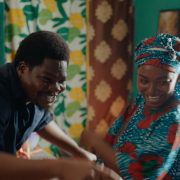


What ultimately holds Colour Me True back is not a lack of ideas, but a reluctance to interrogate them. Identity is raised as a question but treated as a conclusion. Reinvention is framed as both sin and salvation without examining the social pressures that make it inevitable. The film gestures toward the cruelty of public judgment, the violence of sudden exposure, and the loneliness beneath celebrity, yet never fully commits to exploring their implications. Instead, it opts for emotional shorthand, hoping resonance will emerge where groundwork has not been laid.
By the time the film reaches its closing moments, Ivie’s journey feels less like a transformation and more like exhaustion. The conflict has not deepened; it has merely repeated itself in different locations. Colour Me True wants to be a meditation on authenticity in a performative age, but it settles for affirmations without inquiry. In the end, it is a film that believes sincerity alone can substitute for scrutiny.
There is a version of this story that could have been sharp, unsettling, even urgent; a film that interrogates why society punishes self-invention while rewarding illusion, why women are demanded to be transparent in systems designed to exploit them. Colour Me True gestures toward that film but never becomes it. What remains is a well-meaning, visually lively drama that mistakes emotional insistence for depth and, in doing so, renders its central crisis strangely colourless.
Rating: 2/5
Joseph Jonathan is a historian who seeks to understand how film shapes our cultural identity as a people. He believes that history is more about the future than the past. When he’s not writing about film, you can catch him listening to music or discussing politics. He tweets @Chukwu2big