

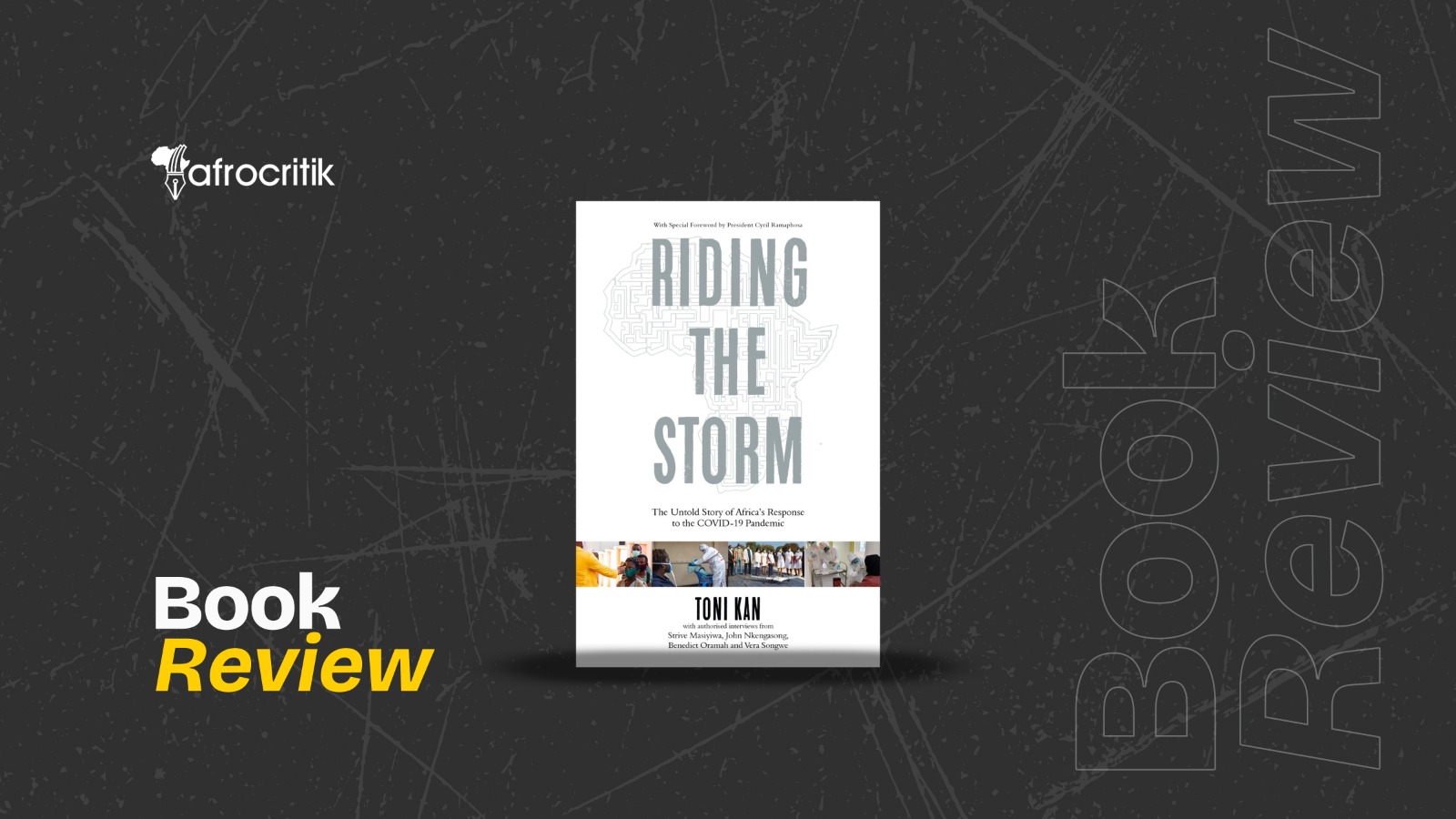

The strength of Riding the Storm lies in the affirming facts it shows us about our continent’s capability to deal with disease emergencies, chief of which is sheer human willpower.
By Chimezie Chika
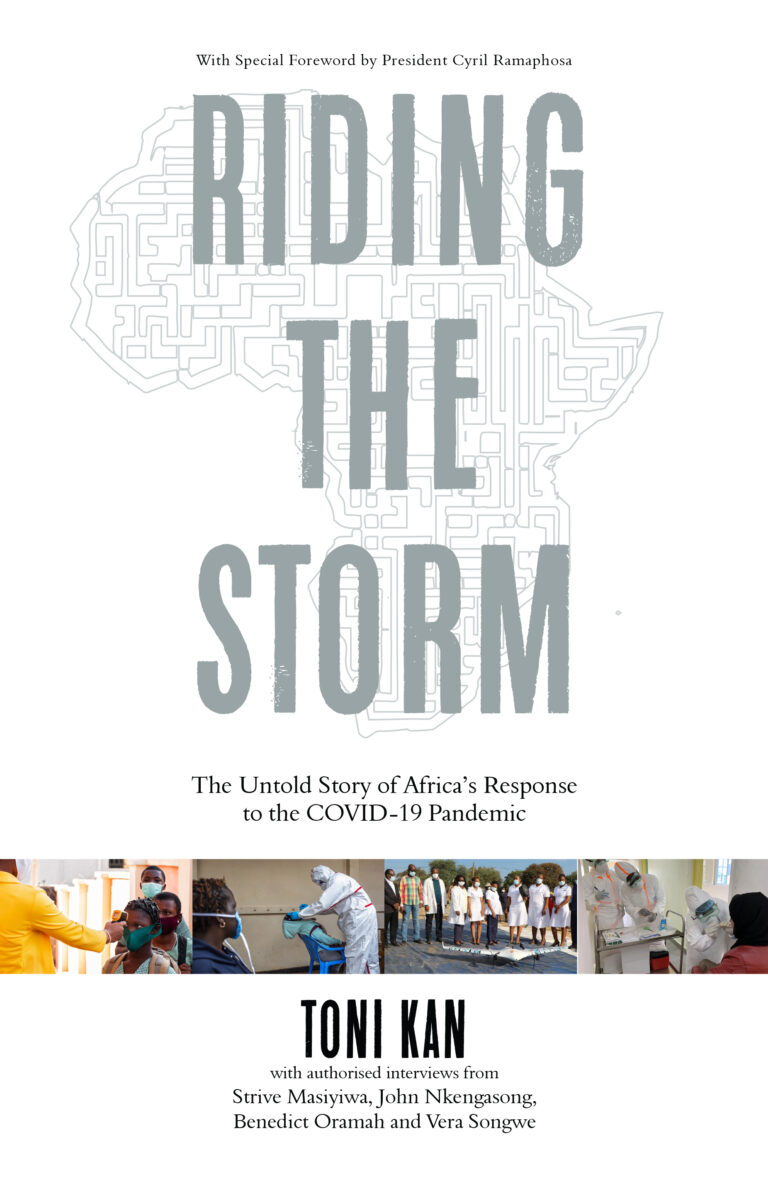
The author of Riding the Storm: The Untold Story of Africa’s Response to the COVID-19 Pandemic (2024), Toni Kan, one of Nigeria’s most respected writers, writes in the introduction that this book came out of “serendipity and coincidence”, perhaps throwing both words together for emphasis. Regardless, one thing becomes immediately clear from the beginning to the end: this is a necessary book. Whether it took the directions one expected is a different matter, but its necessity to the formation of Africa’s pandemic story cannot be impeached.
In early 2020, Kan was busy with the upcoming birthdays of two people closest to him, including his wife, Peju. Part of those plans was subsequently disrupted as the world rapidly took a downward turn with the rise of COVID-19 cases—a situation which forced the world to shut off and almost grind to a halt (except for the rescue of virtual meeting apps) in what became known as the worldwide COVID lockdown. The rapidity of it all, from its first recording in Wuhan, China, only months before, to the orchestrated closure of the world caught most people, including Kan, at the initial stage, in a state of fear and confusion.
Kan tells us that there are people in Africa who were apparently prepared, or were rather equipped by experience and knowledge, to respond to the COVID-19 emergency with adequate actions. These people are Zimbabwean billionaire, Strive Masiyiwa, Dr. John Nkemgasong then of the Africa CDC, the former president of the Afreximbank Professor Benedict Oramah, the former Under-Secretary-General of UNECA (UN’s Economic Commission for Africa), Vera Songwe, and no less a personage as South African president Cyril Ramaphosa, who was then the AU Chairman. (Mr Ramaphosa also wrote the foreword to Riding the Storm). As well as other significant heroes in public and private capacities, documented or mentioned in the book. Quite a bit of name-dropping is evident in this book, which, I suppose, this kind of narrative calls for.
Kan spent the early parts of Riding the Storm quickly establishing the aforementioned individuals as the pivotal cogs in the wheel of Africa’s response to the global pandemic of 2020. We are left in doubt, through the author’s own repeated emphasis, that these are the main characters critical to Africa in the pandemic era.
Again and again, the author insists on tabulating near-minute details of these individuals’ pivotal roles for Africa, concluding, at one point, that their strategic synergy may have been the work of destiny. “In those early weeks of the pandemic,” Kan writes, “they found themselves drawn inexorably towards each other, as though destiny was a puppet master tugging at unseen strings.”
Most of Riding the Storm follows the individual testimonies of these characters, the major players for Africa during the pandemic, in a narrative that sometimes reads somewhat like a thriller with alternating switches between character viewpoints (each beginning from February 14, the date on which Africa’s index case was recorded in Cairo).
The only trump for that is that the action, or what might be the action, is reported passively, almost if we are seeing them through a third screen, which squashes any pretensions towards that kind of adrenaline propulsion. This book, however, still manages to present and disambiguate the serious issues at play in the African front of the COVID-19 pandemic.
Kan himself is rather well-positioned to present these issues to us. Beginning in May 2020, he began a new job as the chief of communications at Nigeria’s Ministry of Humanitarian Affairs, Disaster Management and Social Development, during which tenure he was in close contact with all information regarding the pandemic and the management of the crises while forging the communications of it to the country through the ministry.
Thrust into the thick of affairs, as his main characters were at that time, the major question on the lips of Kan and these hardworking people was a straightforward one: how does Africa respond to the pandemic? It was clear to all involved that Africa was like nowhere else in the world: it was spectacularly challenged economically and politically. If Europe and China were struggling to contain cases, what hope does Africa have with its massive challenges?
As Masiyiwa would think, according to the book, “How does one anticipate and stop the spread of a virus across a continent of 1.3 billion people?”And worse: it was an airborne disease. All the notable individuals that the book mainstreams in the narrative recognised that only pre-emptive and proactive measures would be acceptable or effective in a continent wracked by poverty, crumbling and inadequate infrastructures, and other social issues of healthcare access and poor governance.
One of the most important achievements of Riding the Storm is to show us in painstaking detail that there were people who rightly thankfully thought far ahead of the crises, whose signal foresight gave the continent the crucial headstart that allowed it to successfully combat the pandemic in a way that surprised the world. By and by, they would orchestrate financial facilities, fundraising, medical supplies, scientific intervention, and other mammoth leaps. There were no out-of-the-way individuals, but outstanding individuals who have built illustrious careers in the fields of business, health, science, economics, and politics.
Those are aside the thousands of foot-soldiers—health workers, philanthropists, aid workers, clerical officers and bureaucrats, government officials, journalists, emergency personnel across all areas of the continent—who contributed in one way or another to the successful defeat of the viral enemy. The book tells us, if nothing else, that the success was a collective and coordinated effort, showing one of the rare instances when the continent’s best minds came together to accomplish a common good.
Kan reveals that that kind of high synergy has danced at the high stage before. Part of the success of Africa came from previous experience with the Ebola Virus outbreak of the mid 2010s, which Africa’s response to was a resounding success. Coming from the back of that, the continent found itself bestowed with rare experience for a pandemic emergency.

Although, as we learn further on in the book, that didn’t, of course, prepare it for the vaccine politics that ensued as the pandemic progressed. The challenge became (one would say, as it has almost always been) how to find adequate finance for vaccines for the entire continent, how to find enough vaccines, and how to disburse and administer the vaccines transparently. In short, it seems that at one point, these became the major challenge of the pandemic for Africa.


The portion of the book devoted to vaccine procurement and its challenges makes for riveting reading. Parts of it also highlight a refrain that features throughout the book: the sheer number of meetings and re-meetings that have to be held across the continent to push through several issues that came up almost by the minute.
To that end, many initiatives and working groups were created in the public and private sectors. Any reader will be struck by the complicated nature of the groups and sub-groups that worked together, directly and indirectly, to help Africa combat the pandemic.
Reading this book on the sidelines of the recent war in the Middle East throws certain things into perspective. Supply chain issues and economic destabilisation are always the immediate results of such global shocks, whether it is a war or a pandemic (which is a war of its own). The reportage in this book does dwell on the minute details of all the shocks of the COVID-19 pandemic, which makes it a slightly overwritten book, featuring explanations readers may find anathema to the movement of the narrative (including explaining who created the Teams app, etc).
Yet, Riding the Storm is a book that answers an integral question of how on earth Africa was able to combat COVID-19, with its historical and socioeconomic disadvantages. In simple terms, the continent played to the strengths of its best minds.
It leveraged that, as well as its previous experience with viral outbreaks, to strengthen its emergency institutions at the continental level and formed its own multilateral financial institutions and laboratory capacities rather than depend too much on external aid.
The strength of this book lies in the affirming facts it shows us about our continent’s capability to deal with disease emergencies, chief of which is sheer human willpower. Anything is possible in Africa if we put our minds to it, and if the right people are given the right seats in the right places.
Chimezie Chika is a staff writer at Afrocritik. His short stories and essays have appeared in or forthcoming from, amongst other places, The Weganda Review, The Republic, The Iowa Review, Terrain.org, Isele Magazine, Lolwe, Fahmidan Journal, Efiko Magazine, Dappled Things, and Channel Magazine. He is the fiction editor of Ngiga Review. His interests range from culture, history, to art, literature, and the environment. You can find him on X @chimeziechika1