

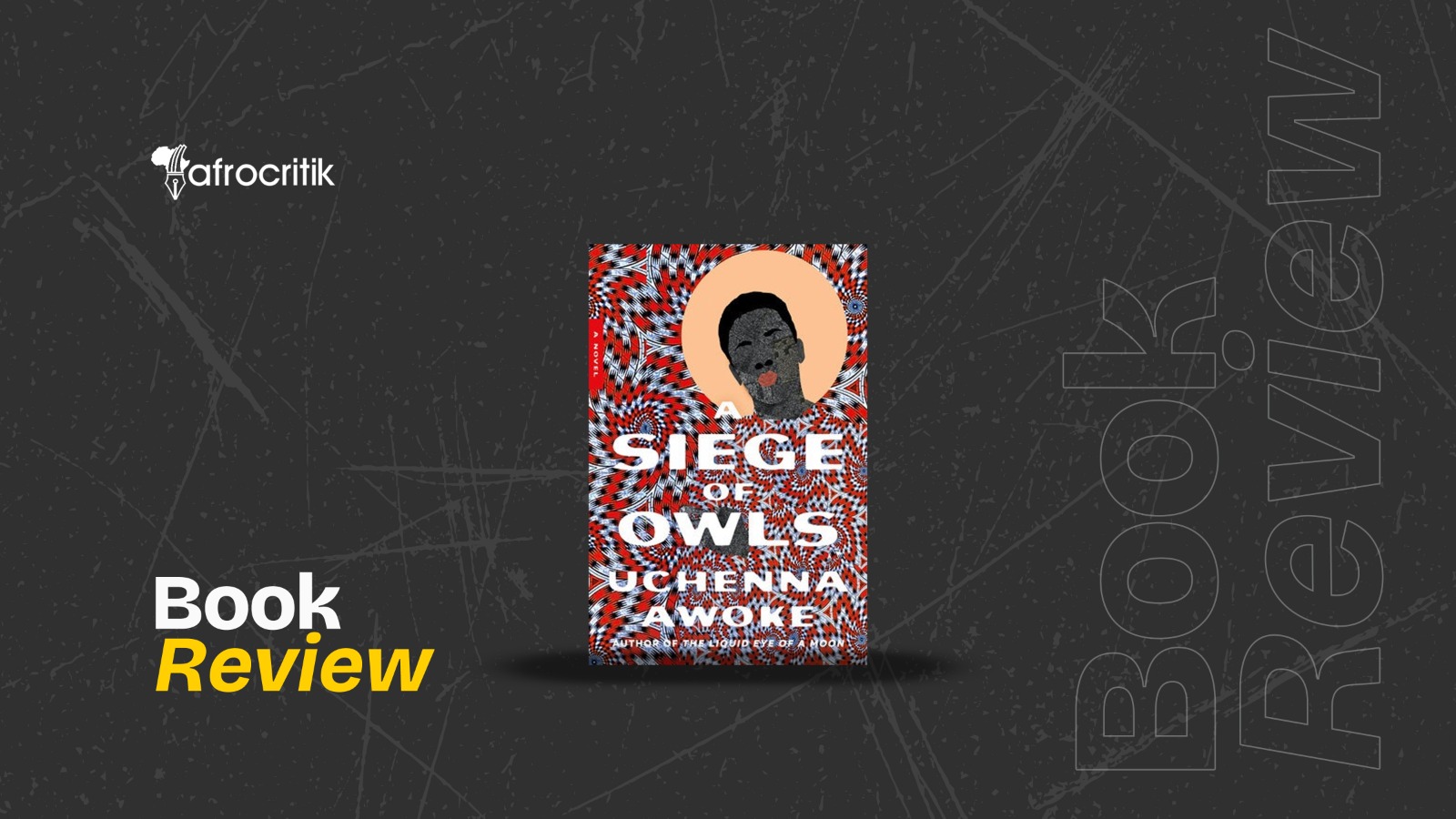

A Siege of Owls is a thoroughly multidimensional novel with multidimensional characters whose survival in a carnivorous world seems hinged to all sorts of arbitrary decisions and situational anxieties.
By Chimezie Chika
According to their genre, style, themes, or depth, certain books require different approaches or reading methodologies. There are books whose lightness makes us read them on the go. But there are also books that task us (without seeming to) with how much experience, knowledge, and intellect we can bring to them. There are indeed books that require us to not merely parse through the pages, but to linger on lines and passages whose meanings and references extend in all directions beyond the page.
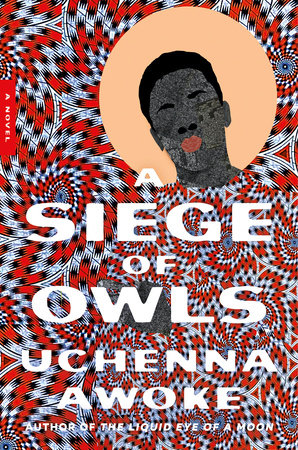
Uchenna Awoke’s new novel, A Siege of Owls, his second, is one such book. Awoke had debuted as a novelist in 2024 with The Liquid Eye of a Moon, which I described in a review here as an “expansive novel about a young man’s education of the heart and mind” which singles out Awoke as “an author to look out for, a novelist who understands the twists and turns of human relationships and the literal metaphors that define our lives and interactions with others”. In light of his new novel, that declaration has aged spectacularly well, for I should like to pre-empt this review’s conclusion by stating that Awoke has written a masterpiece.
A Siege of Owls follows its young protagonist, Ekwe, who is between 8 and 9 years old, through a meandering coming-of-age in literal terms. Ekwe is growing up in a village in Nsukka called Enu-Ozara, couched in an idyllic landscape of rolling hills, streams, springs, and mangroves, and ruled by real legends and manifest mythologies.
Ekwe’s life is no more significant than following his poor subsistence farming family to the farm every morning and returning home in the evening. One day, on their way to the farm, out of curiosity and childhood defiance, Ekwe touches a forbidden leaf called Ekwukwonjo, which is said to cause intense wanderlust.
The same night, Ekwe begins a journey as a stowaway on a goods lorry that takes him to the far north of Nigeria, arriving in the city of Maiduguri, hungry and homeless. From this point, Ekwe begins a journey, a more-or-less picaresque adventure through Nigeria’s geographical landscapes, encountering in each the contentions of the present.
He meets Danjuma, a Fulani cowherd whose family he joins subsequently. One violent upheaval after another—religious terrorism in the North, inter-tribal violence in the Middle Belt, and herdsmen-farmer clashes in much of the South—Danjuma’s family begins a long trek through the country, featuring one escape after another, losing animals and family members along the way.
Finally, the party arrives in Ekwe’s village, Enu-Ozara, or what can be seen as a full-circle journey for Ekwe, who still has no idea what’s going on in his life, or rather takes it all too literally. But his journey would not end there; further journeys orchestrated in the arena of the endless multivalent violence ravaging all regions of Nigeria would manifest, including, at one point, bandits and their kidnapping racket.
The impetus for Ekwe’s cyclical and somewhat quasi-physical and spiritual peregrinations is, we must remember, the forbidden Ekwukwonjo leaf. The manner in which Awoke places that signifier makes it so realistic as to be almost unremarkable in the larger scheme of things. The magical realist sleight of hand here, blending seamlessly with the socio-political state of the country, is so masterfully realised that one can only take it as a matter of course. In one sense, this comes directly from the way in which much of West Africa and, particularly, Nigeria, regard what might elsewhere be seen as extraordinary or paranormal: they are, for the most part, seen as a matter of fact.
A Siege of Owls is highly political, but a reader of the novel would find that its politics does not occur in the gossipy and quotidian way in which it occurs in many other Nigerian fictions. Here, politics appears as another dimension of reality or even unreality, as a hot, boiling allegory of contemporary times in which violence, a character in itself, has become the propulsive machinery around which everything else revolves.
To bring it home to us, animals in Awoke’s novel are not merely there to do animal things. Wherever they appear, they appear significantly. Cows are valuable possessions. Owls are bad omens, symbols of bloodletting, preceding or orchestrating every act of violence. Sheep are the perpetual victims of this unending siege, if you get the drift. All this is to say that myth and reality become one in A Siege of Owls. If mythmaking—that is, mythmaking the becoming or unbecoming of our country—is Awoke’s goal in writing this novel, he immensely succeeds in mythologising the aggressive extremities of our times.

And it’s all captured in a near pitch-perfect prose with lyrical undertones. That lyricism is elevated when Awoke begins to look at landscapes with his peculiar parabolic vision. His description often characterises them as equally benevolent and foreboding.
And in one sense, the nature being described seems to be enacting a silent act of autosarcophagy, roiling itself, eating itself. The blurring we sometimes see here between fact and allegorical symbolism can be (at least in one instance) wrong.


Early on, when Ekwe arrived in Makurdi, the air was described as having a salty tang of “sea air”, which seems anachronistic since the sea is over 200 miles away from Makurdi. But then, again, magic realism can factualise the anachronistic.
A Siege of Owls is fiction as contemporary mythology. The high symbolism that comes out of its grim environmental vision feels, in hindsight, as though Awoke were positing a novel philosophy about the way to survive or not survive Nigeria in these times.
In this sense, it bears affinities to J. M. Coetzee’s Waiting for the Barbarians (1980) as fiction that chronicles a psycho-existential adventure through disintegrating landscapes and environment, which in some way also doubles as a philosophy of surviving in a warring world.
It is the same quasi-spiritual metaphor we find in Peter Behrens’ The Law of Dreams.
A Siege of Owls is a thoroughly multidimensional novel with multidimensional characters whose survival in a carnivorous world seems hinged to all sorts of arbitrary decisions and situational anxieties. What Awoke has written here is an allegory of these violent times, a masterpiece of psychological and philosophical depth, such as seems rare in this shallow adrenaline age.
Chimezie Chika is a staff writer at Afrocritik. His short stories and essays have appeared in or forthcoming from, amongst other places, The Weganda Review, The Republic, The Iowa Review, Terrain.org, Isele Magazine, Lolwe, Fahmidan Journal, Efiko Magazine, Dappled Things, and Channel Magazine. He is the fiction editor of Ngiga Review. His interests range from culture, history, to art, literature, and the environment. You can find him on X @chimeziechika1