

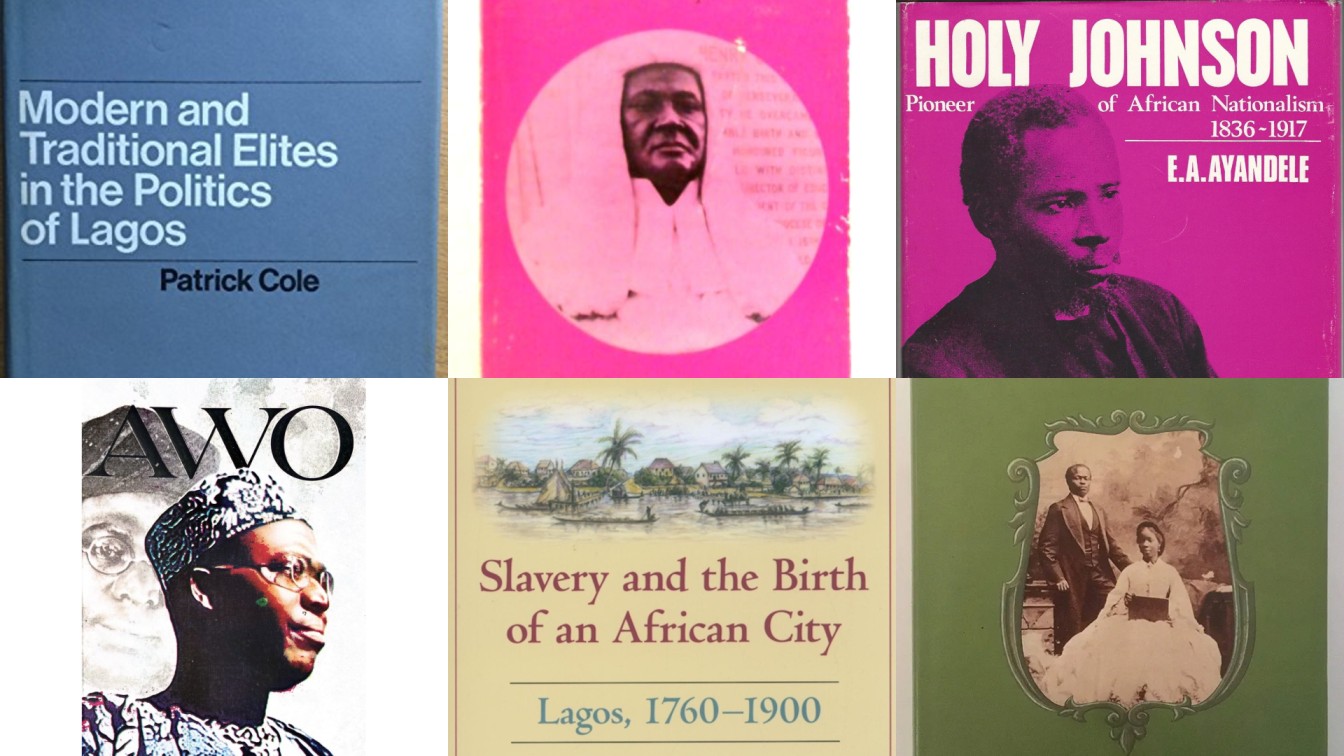

All seven books that I have included here cast a solid light on colonial Lagos. Each one makes for interesting reading.
By Ernest Jésùyẹmí
The history of Lagos from about a decade before it was annexed in 1861 up until the independence of Nigeria in 1960, when it became the country’s capital, is one of the most remarkable periods to read about in Nigerian history.
Many reasons account for that fact. First, there was the evolution of Lagos. By 1750, what was previously a small coastal town, Lagos had begun to gather some weight as a slave-trading port. By the 1850s, the wealth that accrued from the trade had turned it into a flourishing city. The allure that we associate with the city today can be traced to this time. As Kristin Mann shows in her book included in this list, in a year in the 1820s, the city made as much as £547,000 from the slave trade: that is roughly £68,623,640 today. (This was an exceptional year, but the revenue rarely fell far below that level.)
Second, there was the instability that attended the British’s quest to enforce the abolition of the trade, which led to a clash with the daring, never-to-be-daunted Oba Kosoko. The bombardment of Lagos in 1851 would disturb the Obaship and eventually give the British a foothold at Curamo.
At the same time, returnees from Cuba, Brazil, and Sierra Leone flocked to the city, slightly bulging its population size. This group added a new dynamic to the life of the city. Known as Black Englishmen or “White Blacks” (as indigenous Lagosians called them), they helped shape Lagos in many ways—through their buildings, by their interventions in local politics, their intellectual contributions, and even by their service in the colonial government.
Then you had the British, some of whom lived in Lagos as they could not live back in England. And all of whom made out of Lagos something of England: they hosted tea parties and balls on a regular basis. Together with the Black Englishmen, they constituted the elite, until racism became pervasive in the late nineteenth century and a nationalist consciousness started to develop.
When you put all those things together and pay attention to the calibre of the men and women who lived through this period, and how they bore out the spirit of Lagos while also fashioning it—it becomes easy to see why it is an endlessly fascinating era to read about in books (and to see, one day, on the screen).
Unfortunately, there are very few works of imaginative literature set in Colonial Lagos, and almost no movies. The available studies have been the work of academics. That said, in putting this list together, I have tried to include books that are readable, whoever the author may be. It is why I have kept out a book like Marrying Well by Kristin Mann, because it reads too much like a sociological study for sociologists. All seven books that I have included here cast a solid light on colonial Lagos. Each one makes for interesting reading.
Slavery and the Birth of an African City by Kristin Mann
This is the most comprehensive book on this list. It is a historical study of what made Lagos so prosperous: slavery. But Mann considers slavery not just in terms of the Atlantic Trade.
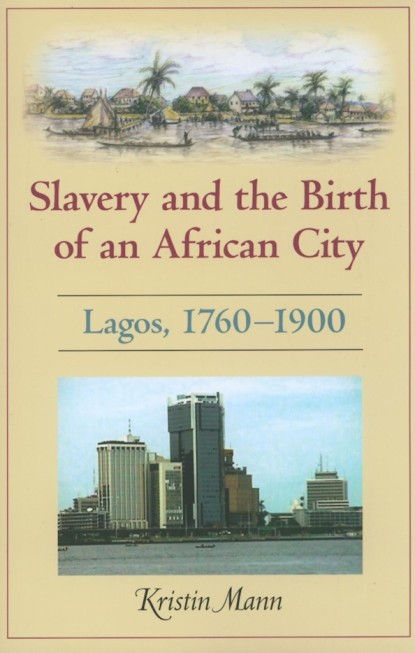
She considers how the trade in palm produce, for which there was demand and to which many in the Southwest turned in the latter part of the nineteenth century, in some ways also necessitated local slavery and how it made room for new kinds of social mobility. A fascinating book, immensely rich, and grounded in data, it was published in 2007. The book is a must-read to understand how the Colony rose.
Modern and Traditional Elites in the Politics of Lagos by Patrick Cole
What kind of book would a historian with the heart of a thriller-writer and the analytical power of a detective produce? It has to be something like Modern and Traditional Elites (1975). By the Nigerian historian and journalist, Patrick Cole, I consider it a classic work.
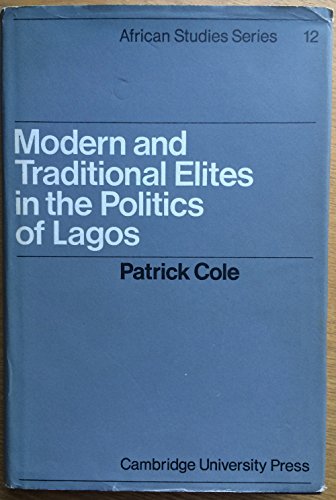
It was first recommended to me as a student of history at Lagos State University, but I read it after graduating. Intrigue is the word that comes to my mind when I think about it. It is a study of coalitions and shifting allegiances, of old men trying to hold their ground in a new era. It’s a book for anyone who cares to know and feel the passions that drove Lagosians in the nineteenth and early twentieth century. Its thirty-plus pages of “Notes” are as rich as the book, filled with epic historical scenes.
Afro-Brazilian Architecture in Southwest Colonial Nigeria by Adedoyin Teriba
This is not a published book. It is the thesis presented by the author for his PhD at Princeton University in 2017. (It can be downloaded from the university’s dataspace here.) I came upon the work while doing an essay on precolonial Yoruba architecture. Teriba is a remarkable historian, and this is a seminal work.
The following statement by I. H. Willoughby would have resonated with many returnees, Saro (the returnees from Sierra Leone) and Aguda (those from Brazil and Cuba): “Among my parents’ people here I am practically ignored.” Teriba makes the case that this feeling of not belonging, this sense of a lack of place, informed the kind of structures the returnees erected. They extoriorised, in a manner of speaking, their longing and their nostalgia for “home”—though the Caribbean was itself never home. The interplay of memory and imagination expressed through architecture was how the returnees tried to mend a displaced selfhood. After reading him, we begin to see Afro-Brazilian architecture as art and as “a search for self-identity”.
It is a stimulating read.
Holy Johnson: Pioneer of African Nationalism by E. A. Ayandele
The Reverend James Johnson was born in Kakanda Town in Sierra Leone, but came to Lagos in 1874, when he must have been close to forty, as the historian E. A. Ayandele argues in this sprawling biography. Up until his death in 1917, Johnson was a singular figure in Lagos society. As Ayandele says, he became (in the colony) “the most respected, the most popular, the most influential and the greatest patriot for the rest of the century”.
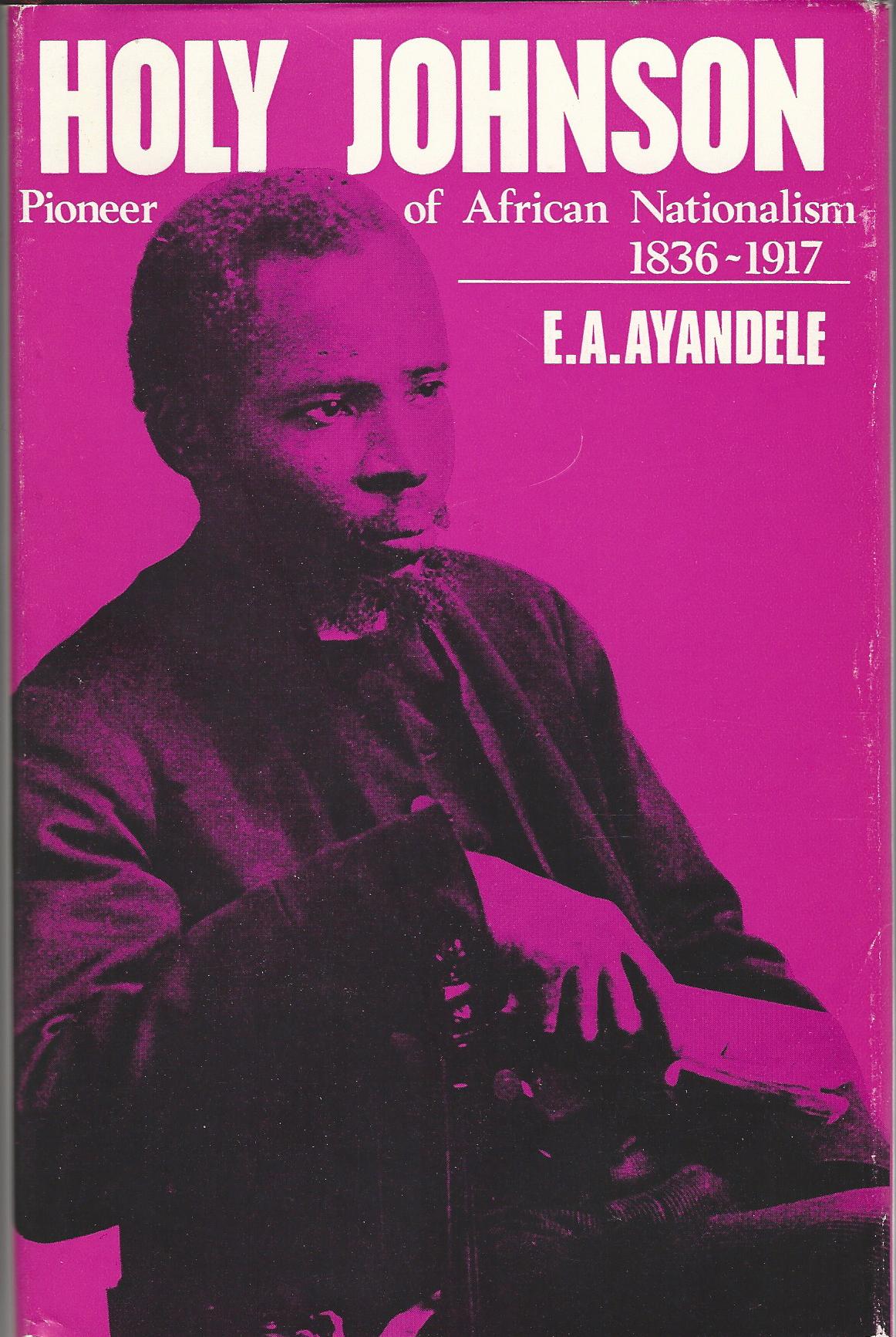
This biography, which appeared in 1970, presents him to us vividly and in the mesh of issues that he had to tackle. It shows us a principled and independent-minded man who initiated the nationalism that men like Obafemi Awolowo and Nnamdi Azikiwe eventually built upon.
Lectures and Speeches by Henry Carr
The twelve pieces in this slim volume were collected by L. C. Gwam, who passed before the completion of the work. C. O. Taiwo edited and saw it to publication in 1968. The pieces—the earliest was given in 1892—address issues related to education and religion (Christianity) and how they go together. For Carr, “knowledge and virtue” are “of capital importance to the educationalist” and to the citizens of a country. Henry Carr was far-seeing; his thoughts looked beyond their day. E. A. Ayandele once said of him that Carr was “one of the best minds of his age” (and not only in Nigeria).

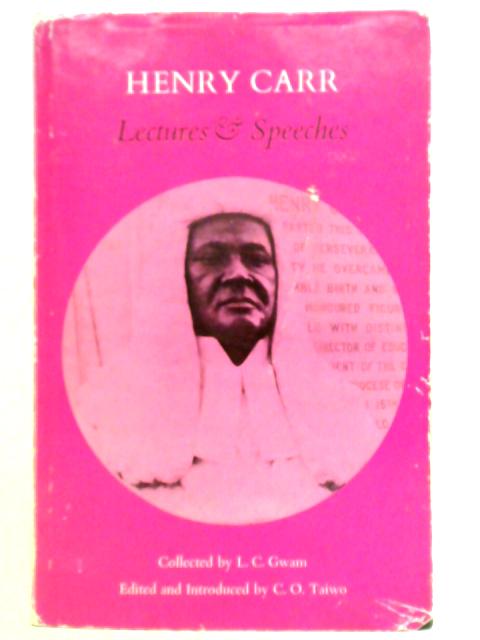
When he died in 1945, Carr left a library 18000-books-strong—many of them marked—which was later procured for University College, Ibadan (now University of Ibadan). To read this book of his speeches is to see how an essential and sensitive nineteenth-century Lagosian mind turned, and where.
Awo: The Autobiography by Obafemi Awolowo
Like Johnson’s biography, Awo (1960) is not directly about Lagos. For example, it begins in Ikenne, where Awolowo was born and spent his childhood years, then Abeokuta, and later Ibadan. However, in 1929 Awolowo came to Lagos to work as a shorthand typist, and through him, we see what life was like in the city at the time. His first job was with a German company called J. W. Jaeckel & Company.
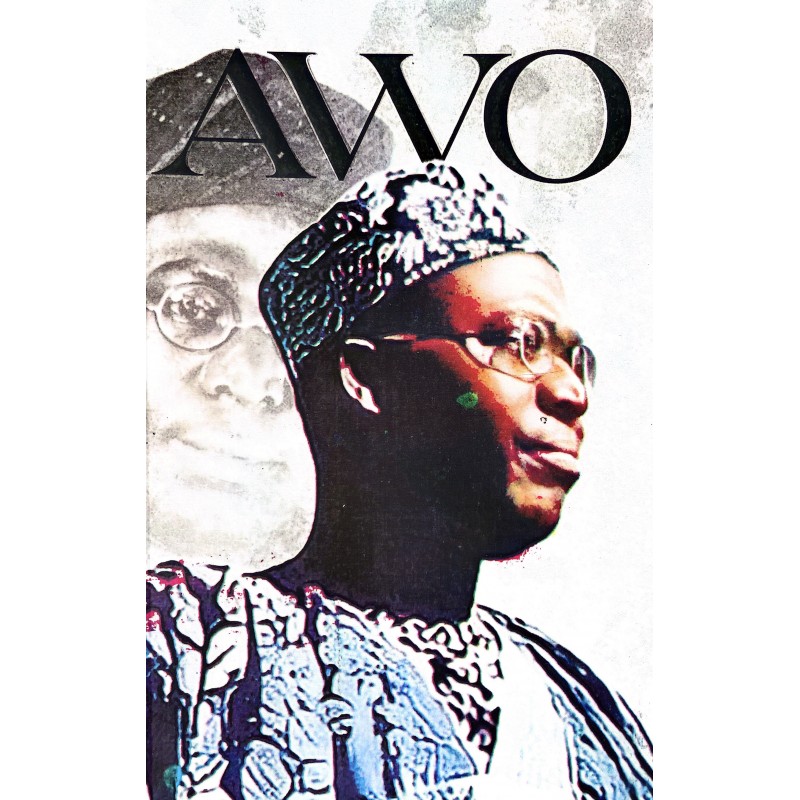
One morning, he came to work and found his seat taken by an applicant who had been rejected previously due to underperformance. Though lacking the qualifications, room was made for the person because “[h]is brother… was an important personality in Lagos”. We see that “NEPO baby” goes way back. We also see how the depression of the late twenties through the thirties affected Lagosians. Jobs were scarce. Try as he did, Awolowo could not get another one and soon began writing for newspapers—an occupation which brought him closer to the political arena. The chapters on his political maturity, on the formation of the National Youth Movement, and his clashes with Nnamdi Azikiwe all take place in Lagos and show the city emerging in a new light. A deadly desperation for political power starts to bud. One sees the pettiness, the lack of discretion, the tribal sentiments that came to ruin Nigeria already cooking during this time, in Lagos.
I should add that Awolowo is an engaging writer, excellent at pacing, never bores, is careful to not overstate his case, and tries to be fair to his opponents.
Victorian Lagosians by Michael Echeruo
The book came out of a huge loss. Before the Civil War, the Nigerian scholar Michael Echeruo began putting together an anthology of Lagos newspaper pieces from the nineteenth century. The papers published at the time included the Observer, Mirror, Eagle, the Anglo-African, Lagos Times. They dealt squarely with the Colony, though issues in the interior were also addressed, especially when these affected the stakeholders in the city. The manuscript was lost, unfortunately, during the war.
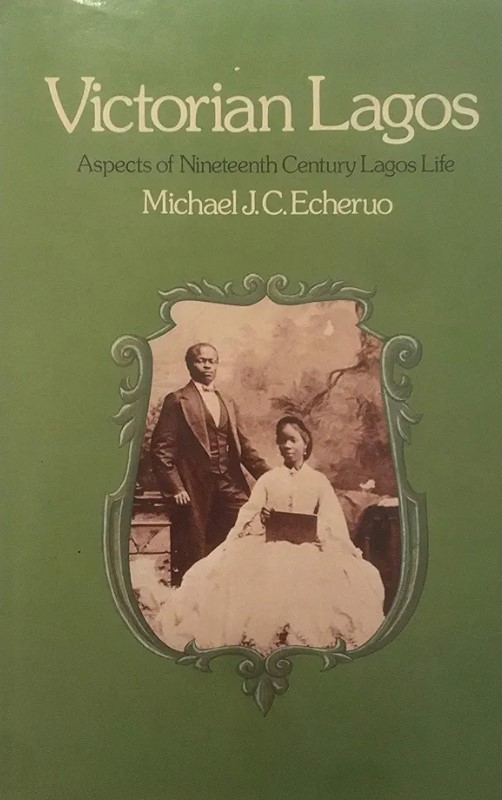
Published in 1977, the book draws solely on the newspaper pieces of the time to give a portrait of Lagos. It is like listening in on the difficult and drawn-out conversations that the Black Victorians (James Johnson, Macaulay, Carr, R. B. Blaize, etc.) were having. Some of the issues they fought out in print are still with us today. In 1899, the streets of Lagos were unlit, and robbers broke into people’s houses more often than not. In 1884, complaints were made about sanitation—today Lagos probably stinks far worse than it did then.
Other issues have been solved for us over time, like what language students should be taught in and the clothes to be worn for school uniform, polygamy, and tax. But reading the paper pieces now, it is not unusual to find their earnestness—those men who invented a Nigerian identity which we put on—funny. As an example, “Latin and Greek and Algebra cannot administer to the cravings of an empty stomach.” Of course.
Of all the books on this list, if there is one to start with, though I have placed it last, it is this one.
Ernest Jésùyẹmí is the author of A Pocket of Genesis (Variant Lit, 2023). His work has appeared in AGNI, The Sun, Poetry London, The Republic, and Mooncalves: An Anthology of Weird Fiction. He holds a BA in history and international studies from Lagos State University, Nigeria, and is the poetry editor of EfikoMag.