

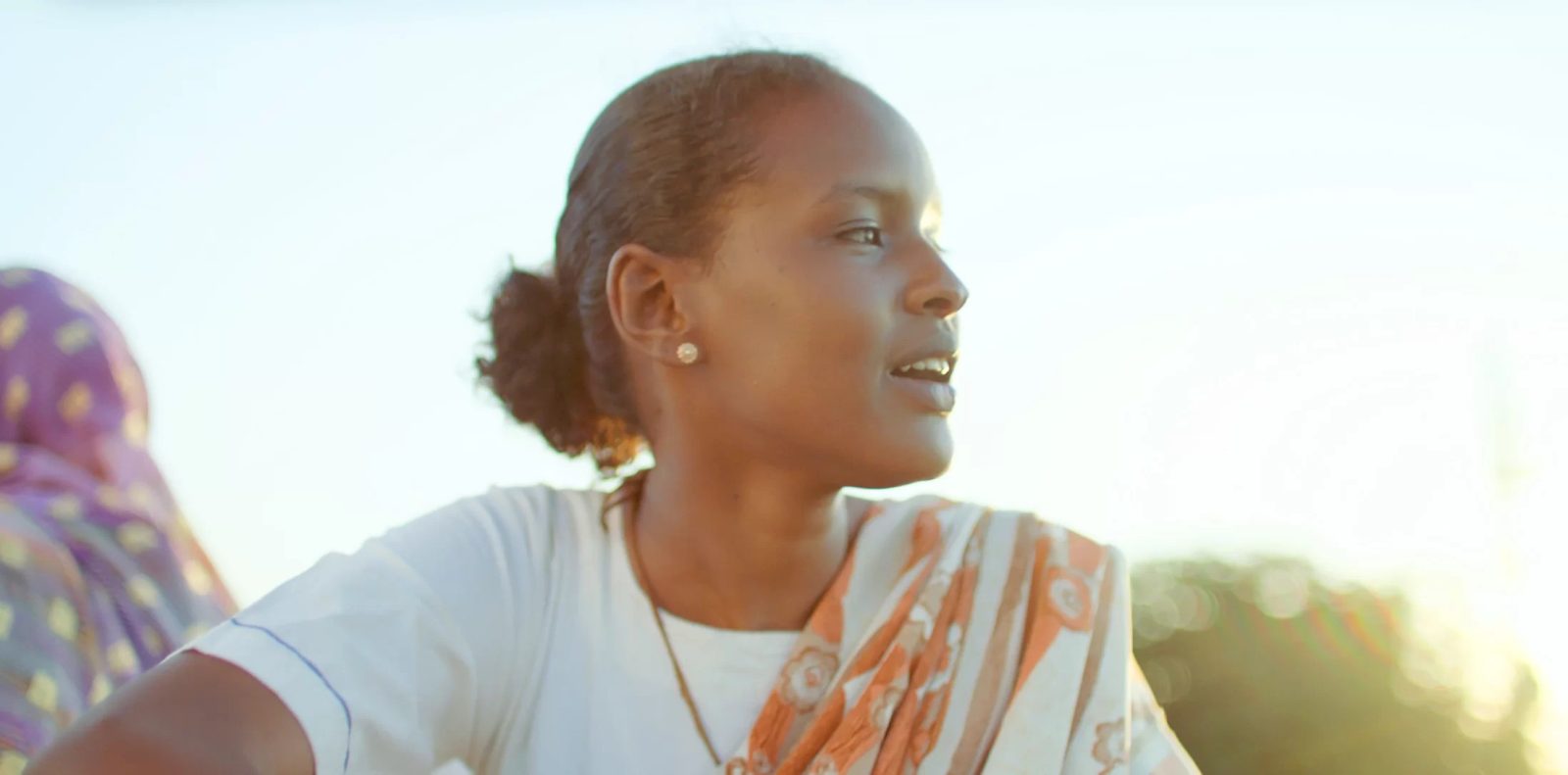

Cotton Queen insists on female joy, centring the complexities of female relationships across generations, celebrating the romance of young womanhood, and demanding empathy as opposed to sympathy.
By Vivian Nneka Nwajiaku
It seems inconceivable that any country would only just be getting a first in female directing in 2025. But that is precisely the case with Sudan, where Sudanese-Russian writer-director, Suzannah Mirghani, made history this year as the first female Sudanese director to make a fiction feature, with her prudent but evocative debut feature, Cotton Queen (2025).
That, in itself, is a win for cinema, especially in a country where cinema has been historically suppressed both as a part of political control and as a byproduct of political instability—Cotton Queen was shot in Egypt, no thanks to the Sudanese civil war that broke out in 2023—and women have been grossly underrepresented and systemically excluded.
In that context, the female perspective that Mirghani brings is very much welcome. Cotton Queen is a film about women, their dreams and their choices. But even more refreshing is Mirghani’s refusal to situate the women—and the men—within the context of conflict or to frame them solely as victims and casualties, in the way that the media typically does. Instead, Cotton Queen insists on female joy, centring the complexities of female relationships across generations, celebrating the romance of young womanhood, and demanding empathy as opposed to sympathy.
In a striking early scene, a group of teenage girls are singing and laughing as they pick cotton on a farm. The very essence of that playful introduction is rebellion, emphasised by their choice of song. At the centre of the group is Nafisa (Mihad Murtada, delivering a charming but well-restrained performance), who may very well be the most rebellious of them all, courtesy of her relationship with her snarky and historically defiant grandmother, respected and known about town as Al-Sit (a grounded but magnetic Rabha Mohamed Mahmoud).

When Nafisa is not working on Al-Sit’s farm—the most fertile of the cotton farms in a village that depends on the cotton trade—she is playing with her friends at the River Nile. Their community frowns at girls visiting the river, in a bid to keep them cloistered.
Yet, the river is where the girls are happiest, brimming with unadulterated delight and being there for one another as they navigate the restrictive expectations of society. When she is doing neither of those things, she is typically listening to Al-Sit lecture her on purity, responsibility, the foolishness of young love, and the old woman’s exaggerated history of fighting off the British during the colonial era.
With that history of colonial exploitation in the background, Mirghani introduces an outsider, in the form of an eligible bachelor and businessman in suit, to upend the routine of the locals. Though Nadir Tijani (Hassan Kassala) has roots in the village, he lives abroad. He has acquired the abandoned mansion once occupied by the British, and he has come with the promise of modernising and saving cotton farming with genetically modified seeds that the farmers would be bound to repurchase each planting season. And though Al-Sit opposes the idea of modified cotton, Nafisa’s parents (Haram Basher and Alsir Mahjoub) have bought into the dream and are convinced that their daughter’s marriage to Nadir would secure all their futures.
Neither the modified seeds nor the marriage appeals to Nafisa, who would rather patiently pluck a fruit with a fruit picker, unlike Nadir, who prefers to pull forcefully at a tree’s branches, even if it destroys a bird’s nest. Besides, she is already interested in a boy much closer to her age, Babiker (Talaat Fareed), a modest but somewhat clueless young onion farmer who has dreams of exploring the outside world with his boat.

Admittedly, for a film about women, Cotton Queen can be so men-centric that it barely passes the Bechdel test. But for many of its women, marriage is all they have been allowed to aspire to, and even when they dream of more, marriage seems the only available path to such a destination.
Yet, salvation for the women of Cotton Queen is not to be found in its men. After all, the same Babiker who initially educates Nafisa on the sexist basis for banning women from taking boats eventually turns around to rely on that prohibition when she seeks his help in escaping the expectations of her family.
In Cotton Queen, it is the women who must do the saving, in their own different, well-meaning but often misguided ways. In the complex and often fraught relationships between the women in Nafisa’s family, the common thread is a desire to ensure a decent future for Nafisa and to establish some level of control on her behalf. Still, ultimately, it is Nafisa who must assert her agency and save herself, culminating in a powerful albeit hole-riddled open-ended closing sequence that leaves a strong impression long after the credits roll.

Tensions rise as Nafisa’s impending forced marriage becomes more feasible. And while the witty dialogue remains, the joy that defined Cotton Queen’s earlier moments noticeably declines. As the film’s events unfold, Mirghani introduces additional uncomfortable themes, weaving them deftly into the film’s already established routines.

Cotton Queen explores heavy subjects, from female genital mutilation—reflected in a puppet show performed to a crowd of scarred children—to the social and economic consequences of purity culture—exemplified by a dizzying scene shot like a seance and cheekily described as an “annual conference of demented witches”. But they are handled with an intensity that somehow still registers as subtle.
Cotton Queen is visually pristine, with colours and compositions that emphasise order. Yet, it is radical in its own way. It is well-performed, too, especially for a mostly inexperienced cast under the direction of a first-time feature director. This is an undeniably remarkable debut, seemingly simple, but thematically rich, and full of life and heart.
Rating: 4/5
* Cotton Queen premiered at the 2025 Venice Critics’ Week, an independent parallel section of the Venice International Film Festival, and subsequently screened at the Thessaloniki Film Festival 2025 where it won Best Feature Film. Cotton Queen was the opening night film at the S16 Film Festival 2025.
Vivian Nneka Nwajiaku is a writer, film critic, TV lover, and occasional storyteller writing from Lagos. She has a master’s degree in law but spends most of her time watching, reading about and discussing films and TV shows. She’s particularly concerned about what art has to say about society’s relationship with women. Connect with her on X @Nneka_Viv