


What happens with Afolayan’s quest in Aníkúlápó: The Ghoul Awakens is the pathetic compartmentalisation of ideas that are forced to work without much care for nuance and memory.
By Adedamola Jones Adedayo
Aníkúlápó: The Ghoul Awakens, a five-episode series, is the latest instalment in Kunle Afolayan’s epic fantasy franchise. The franchise began in 2022, with a pilot film Aníkúlápó, that laid the foundation for the universe, combining Yoruba mythology and cultural ethos, presenting the story of Saro (Kunle Remi), a serial sojourner who luckily comes in possession of a death-revoking charm that alters his life from that of a commoner to one who is respected. Like many people who become intoxicated with power and abuse it, Saro becomes prideful, eventually running into trouble that claims his life when the film ends.
About two years later, in 2024, Afolayan launched the first season of the series, Aníkúlápó: Rise of The Spectre, in which Saro gets yet another opportunity to undo his excesses. This time around, returning in a semi-otherworldly status with a limited lifeline as the messenger of death, he must take back the lives of the people he previously resurrected. His attraction to worldly pleasures momentarily prevails over his mission as he negotiates his way into overstaying his welcome on earth, during which he creates a family and leaves behind an offspring.
Season one spreads the scope of the overall narrative, introducing new central characters like the ruthlessly selfish, overambitious Basorun Ogunjimi of Ilu Oyo (Owobo Ogunde) and the compassionate partner, Akin (Gabriel Afolayan), but also slightly decenters its protagonist. The debut season ended with the aggrieved Ede warriors invading Oyo, killing Basorun and taking away the princess, following the mysterious death of one of their royal sons, Prince Kuranga (Uzee Usman); and with Saro departing, parting with his family, having overstayed his welcome on earth.
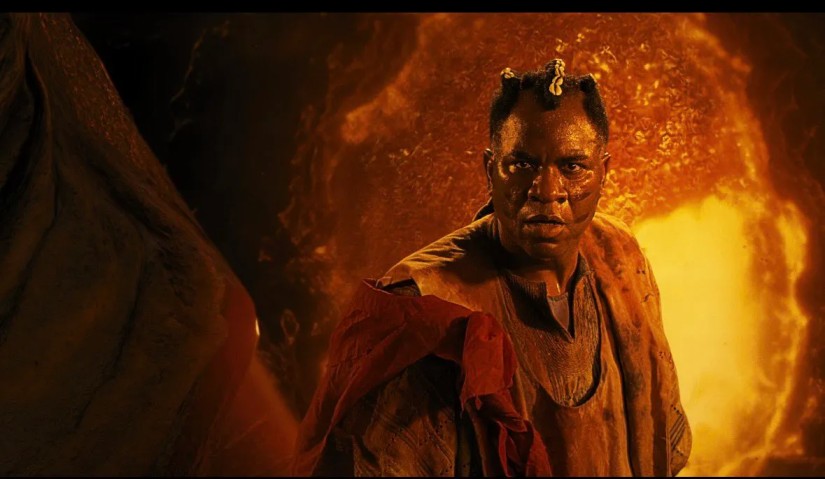
In Aníkúlápó: The Ghoul Awakens, Afolayan picks up from where the previous season ended, building on past tensions among kingdoms, on the one hand, and a conflict between the human and supernatural worlds on the other hand. Attention settles on the spirit of Basorun Ogunjimi travelling through a path to the place of eternal damnation, where he, among others, will be punished for their evil deeds on earth.
This opening experience reminds us of that of the previous installment where Saro is part of a queue that marches towards the divine gatekeeper. However, the latest show reconstructs Basorun’s encounter in the afterlife differently, his hellish and dreadful environment crafted from computer-generated imagery.
Fuelled by his inherent ego, Basorun boycotts his ugly fate and returns to the human world as a forest ghoul in constant need of human lives to renew his existence. This embarrassing condition means that he is unable to reintegrate himself into society and even makes him a threat to the surrounding Oyo people he used to protect during his lifetime.
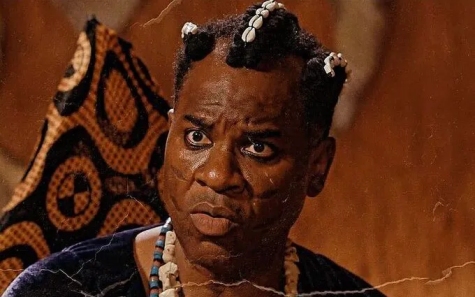
Two years have passed since the previous tensions between Ede and Oyo. There have been very little developments in the 17th-century Yoruba community, such as the arrival of crown prince Aderoju (Saga Adeoluwa) and slave trade activities with the Portuguese on the outskirts. The political arrangement remains intact: an Alaafin with a council of advisors known as Oyo Mesi. Surprisingly, as we observe, a new Basorun, who is supposed to be the leader of the Oyo Mesi and the prime minister, has not been appointed. This omission is not explained or justified throughout the show. For a position known to hold real political and military powers, the entire absence of an office holder compromises the authenticity and legacy of the Oyo Empire that the series appears to champion.
As the show progresses, pockets of conflicts and subplots emerge, with intersecting characters and thoughts explored. Prince Aderoju tries to “rescue” his sister, Princess Omowunmi (Eyiyemi Afolayan), from Ede and attempts to prove his courage against a bizarre creature in the dreaded forest. An emotionally disturbed Omowunmi longs endlessly for her family in Oyo. Akin and Arolake, now a couple, chase economic survival in their home outside Oyo. And there’s Awarun (Sola Sobowale) and her daughter Latorera (Oyindamola Sanni) forging and expanding trade relations with foreigners. Each main character in the series acquires more than just a life of their own. They let down their guards, while the camera amplifies both the interesting and mundane parts of their lives.
Afolayan’s allegiance to narrative world-building is conspicuous. He takes on the responsibility of an omniscient narrator, unseen and unheard of, tacit and eagle-eyed, prying into the affairs of every character that matters to the story. Through the eye of the camera and his directorial acumen, the filmmaker adds flesh to the plot and breathes breadth into character arcs. With this attempt at character development, however, comes the unmitigated risks of unconvincing acting, narrative negligence, disjointedness and the sparseness of core elements of Yoruba epic storytelling such as proverbial language.
The beauty and problem of Aníkúlápó: The Ghoul Awakens is its lack of focus. It is beautiful because it attempts to challenge conventional storytelling patterns where the protagonist is deemed indispensable to the plot. This feels as though the filmmaker intends to institute a show where characters are key but fluid and malleable, sustaining a fictional world that mirrors the ruthless impermanence of time and transience of worldly pleasures and sufferings. It feels like a transgenerational narrative gesture, one in which memory and culture are framed and handed down from place to place, person to person. While this sense of longevity can be gleaned from little details, it is not certain how long the filmmaker, working together with Netflix, will keep the franchise running.
A major downside to Afolayan’s expansive imagination in the Aníkúlápó franchise is the often annoying disconnection between events that arise. When there’s an action or line of thought that could be read as a symbol and milked for good across board, the filmmaker passes on this opportunity, adjusting for momentary value that occupies only a fragment of time. An example of this is the mythical akala, recognised and instrumental to the previous instalments of the franchise as a spiritual bridge, regenerative authority and harbinger of evil. We realise how instrumental this bird is to Saro’s survival and resurrection powers in the 2022 film.
In Aníkúlápó: Rise of the Spectre, the ifa priest informs the Oyo royalty about the wrath of akala, which can only be nullified when Arolake returns, and sacrifices are carried out. But here in Afolayan’s latest work, there’s no mention of this creature, as if its prophecy or whatever it stood for in the first place never really mattered. Overlooking this detail in the current season waters down the cultural and superstitious foundations of the franchise.

The return of Owobo Ogunde, son of the legendary theatre practitioner Hubert Ogunde, as the ghoul of Basorun brings an interesting dynamic to the show. In the previous season, his character occupied a pivotal position in Oyo royalty, commanding respect within and around. Despite his flaws, he took it upon himself to protect the sovereignty of his people, standing up against external aggression. But this time around, his revelation as a ghoul comes with a personality irony. He has descended into an utterly vile, reprehensible figure, an outcast expunged from the community, a bloodsucking monster.
Ogunde approaches this character with measured, quiet intensity, without the redundant melodrama common to demoniac character-actors in Yoruba epic home video films. But then, while the current series is supposed to revolve around this character in theory, the filmmaker makes it less about him in reality, with more screen time accorded to other major characters. This delimits the weight of the title and shrinks the heart of the narrative.
In the acting department, the disservice to characters can be linked to the performances of actors like Eyiyemi Afolayan and Saga Adeoluwa. Afolayan, daughter of the producer-director, reprises her role as Omowunmi, an Oyo princess who endures living among the Ede people, following the death of Prince Kuranga, to whom she was married. Her fate hangs in the air. But Eyiyemi does not approach this character with the girly vulnerability and emotional intensity that a young lady long separated from her noble family and friends deserves. Her amateurish delivery dwarfs the psychology of the character, rendering the character bland and forgettable. A similar case may be made for Deolu. There are noticeable attempts by him to embody Aderoju, with the expression of apprehension, but his Yoruba dialect falters, and his overall body language comes off as largely one-dimensional.
When Aníkúlápó: The Ghoul Awakens eventually ends, it does so, leaving behind unresolved issues. The main pain plot and essence of the show are elusive. The influence of the ghoul remains sketchy. And the entire discourse around the slave trade, involving Awarun and her daughter Latorera and even the escaping ill-fated Omowunmi, does not effortlessly reinforce the metaphysical sentiments on which the entire series is originally grounded. What happens with Afolayan’s quest in this series is the pathetic compartmentalisation of ideas that are forced to work without much care for nuance and memory.
Rating: 2/5
Adedamola Adedayo is a film journalist and critic with special interest in African cinema. Through writing and audiovisual mediums, he creates conversations around cinema in Africa and the Diaspora. You can find him on Instagram @jonesthegoodboy and X on AdedamolaAdeda4.