

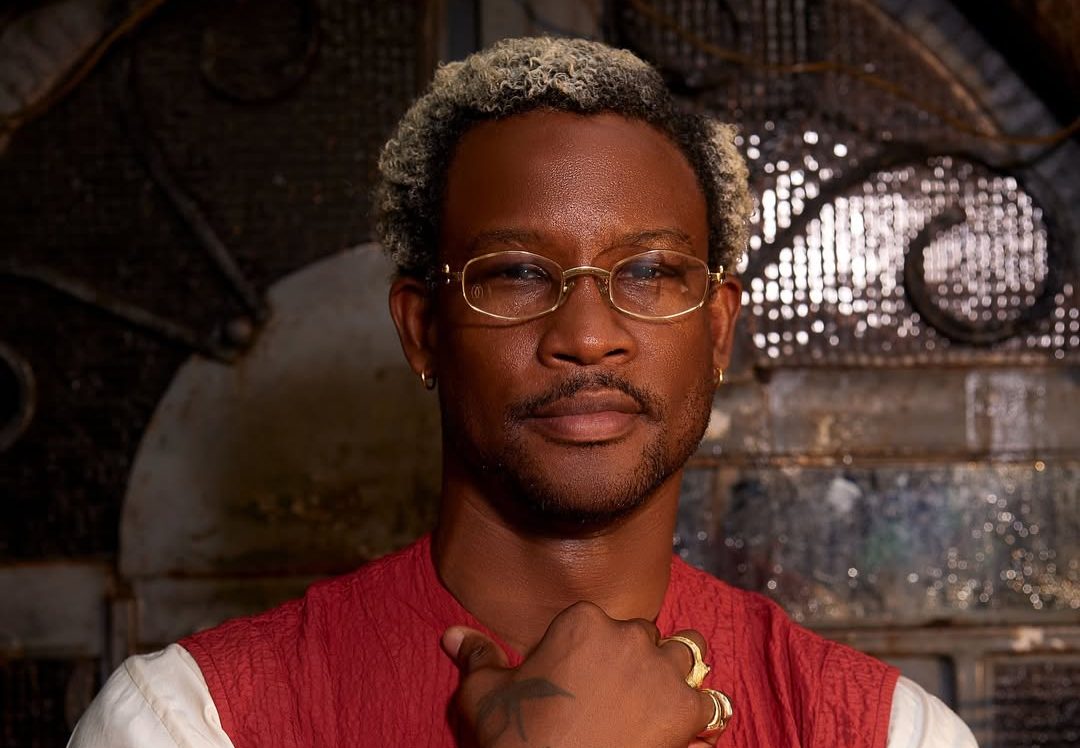
“As a filmmaker, I’m even more committed to making those stories that make people want to take resources and invest back in Nigeria.” – Akinola Davies Jr.
By Vivian Nneka Nwajiaku
When Afrocritik interviewed Akinola Davies Jr. for the first time, his short film, Lizard (2020), had only recently won the Grand Jury Prize for short films at the 2021 Sundance Film Festival and the Best Short Narrative at the 2021 Blackstar Film Festival. At the time, he told film journalist Jerry Chiemeke that he definitely wanted to make feature films, especially in Nigeria, but he also just really wanted to learn his craft.
Fast forward a few years, and Akinola Davies Jr.’s debut feature, My Father’s Shadow, is enjoying an incredible run. Making history as the first Nigerian film to be featured in the Cannes Film Festival official selections, the Nigeria-United Kingdom co-production premiered in the 2025 Un Certain Regard section and received the Caméra d’Or Special Mention for Best First Feature.
The film has been a success on the international festival and awards circuits, becoming the UK’s official submission for the Best International Feature Film category at the 98th Academy Awards and earning Davies Jr. the award for Best Director at the 28th British Independent Film Awards (BIFA). It has also received a British Academy Film Awards (BAFTA) nomination for Outstanding Debut by a British Writer, Director or Producer. Afrocritik named the film one of 30 Remarkable African Feature Films of 2025.
Co-written with his brother, Wale Davies—whom Afrocritik previously interviewed during the film’s Nigerian theatrical run in October 2025—and shot on 16mm film, My Father’s Shadow tells a semi-autobiographical story described in an Afrocritik review as an “intimate tribute to fatherhood, a nation in distress, and its biggest city.” The film is set in Lagos during the tumultuous 1993 Presidential elections and follows two boys, Remi and Akin (Marvellous Egbo and Godwin Egbo), as they spend a day with their estranged father, Folarin (Ṣọpẹ́ Dìrísù).
Following the film’s UK cinema release on 6th February 2026, and ahead of its 13th February release in United States theaters, Afrocritik caught up again with Akinola Davies Jr. to discuss My Father’s Shadow, its personal and political contexts, casting choices, and the importance of building a bridge between Nigeria and the diaspora.
What does My Father’s Shadow mean to you personally and how did you approach making it?
For me, it’s quite simple. I’m the youngest of four. I’m named after my father. My father’s name is Akinola as well. I never really got to meet my father, so there’s always been this projection back to me of who he is. So, effectively, I’ve always had to live in his shadow because I’m named after him.
So, quite a lot of my life, especially my teenage and early 20s, it was just very difficult because I’d heard all these great things about my dad, and I was like, how are you ever going to live up to any of these things, you know? And I think up until I found confidence in myself and confidence in who I am and my version of masculinity, I think I’ve been able to sort of contend with not being in his shadow, but just being my own man.
I’ve been in therapy since 2016, I think, because of a lot of curiosities around not having a father, and being a lot more averse to being quite a sensitive person, growing up with my mother and being allowed to be a lot more emotional.
So, I’ve had a beautiful, consistent relationship with my therapist in terms of trying to understand a lot more about myself and being, you know, like the apple doesn’t fall far from the tree. However, what I am is a version of how my parents are and would have been at a period in time.
Technically, I’ve been very fortunate because my brother and I started a production company almost 11 years ago to shoot in Nigeria. So, we’ve been working with the local community, working in Nigeria, putting back resources into Nigeria. Trying to give people a sense of dignity in their work, trying to tell these arthouse stories about emotions and feelings and sort of the familial settings.
But in addition to that, I think working with my brother has also allowed me to be very protected by the process because he’s my older brother, he’s a musician, and he’s very well-known in Nigeria. And I think that has always allowed me to carve out my own space as an artist, albeit predominantly in the UK, but coming back to Nigeria, always feel like an extended family member of our film community in Nigeria. He’s also been my connection and my bridge to constantly being in Nigeria and sort of romanticising Nigeria in very many ways.
I think all those, in combination, have just meant that this film has been a very cathartic, emotional and spiritual journey on so many levels. Because I feel like being Yoruba in the way we made the film has also allowed us to be very intentional about the film not being a linear story, being a film that jumps time and allows you to move and shapeshift. Because we really respect our culture and want to lean into the way we tell stories as well as the way other African filmmakers—the Ousmane Sembène, the Mati Diop, you know, of that ilk—tell stories. So, a lot of it has been by intention, by design, and it’s been a very wonderful experience.
Beyond the personal, My Father’s Shadow is also a political portrait of Nigeria. How did the current political climate in Lagos and Nigeria affect the storytelling, and how do you think My Father’s Shadow speaks to contemporary Nigerian audiences?
I think that’s a very important question. I think it’s a question that maybe gets sidelined. How does it speak to Lagos today? In 2015, I organised a rally outside the Nigerian High Commission in the UK in solidarity with the Chibok Girls who went missing, the 300 girls that went missing.
Subsequently, a few years later, we were back outside the Nigerian High Commission after the EndSARS movement, after young people were killed at the toll gate, and their bodies disappeared. And I think it’s actually been a lot of the canon of what it means to be Nigerian, growing up in military dictatorships, growing up under a certain type of brutality and inhumane treatment from the military at times.
I think that’s something that’s definitely within our family tree as Nigerians. If you even want to hark back to the Biafran War, where people were genocidally starved and killed, and people fled, and there was never any reconciliation. And even further beyond that, the colonisation of Nigeria and the looting of our communities and things like that.
So, I think to be from that region called Nigeria, I think, is contrived with, unfortunately, a lot of violence. But I think what is really important is that the most important resource in that area is the human resource, is the people in Nigeria, is the 300 different tribal groups and dialects and people.
And I think really what the film is trying to do is trying to give a lot more context and nuance to aspects of our history that we don’t communicate about, that we don’t talk about. A lot of the trauma and experiences of the older generations are things that they haven’t been equipped with a toolkit to be able to talk to their children about.
So, sometimes those in the diaspora have a disconnect with their families because they don’t have access to that information. Certainly, under the military dictatorship, things weren’t taught in schools. So, unfortunately, a lot of those tricks have been used against us consistently.
I think it’s really important within the film and within our zeitgeist of those in the diaspora and those in Nigeria, as artists, to try and create a platform for dialogue, continual dialogue, ongoing dialogue, generational dialogue. Because I think that is what serves to enable us to be more understanding and empathetic of our collective experiences, for sure.
It’s also a nostalgic love letter to Lagos, aided by it being shot on film. This is not your first time shooting on location in Lagos or shooting on film, but this is a feature. What was different about making My Father’s Shadow on film in Lagos?
I think we’ve done it before. I shot a music video for a band called Kokoroko in Makoko, which is being dismantled recently. Obviously Lizard. And I shot celluloid in the UK before, as well. I think having done it before gave me a lot more confidence to be able to do it.
I love to reference, I love to be a reference for the next generation. I think it’s really important that there are film references to Nigeria and Lagos available. I think it’s really important for Nigerians to see themselves in the most beautiful format. I think it’s important for the cast and crew to see their work in the most beautiful format. Mainly because I think we deserve it. I think we deserve to see ourselves in the most beautiful format.
Equally, I think the international community needs to have a recognition of Nigeria architecturally. We’ve seen America, we’ve seen the UK, we’ve seen France. I think it’s important for people outside to be able to see Lagos in the context in which Lagos exists.
Shooting on film is difficult, but I love shooting on film because I think the pace is a lot slower. It allows us to really enjoy making a film together. It’s obviously a little bit stressful and a little bit hard, but I think enjoying the film and being together as a community, working and making work, shooting on film is the best because it’s slow. We’re able to just be with each other.
I think, also, film enables us to transport back to ‘93 Nigeria. It’s nostalgia. It allows us to yearn for something that doesn’t exist anymore, as well. For all those reasons, I’m a big, big advocate of shooting on celluloid, especially in Nigeria.

There’s a recurring conversation about diasporan actors playing home-based characters in international-facing films. That applies to Ṣọpẹ́ Dìrísù but also, in a sense, the child actors, Godwin and Marvellous Egbo, who are not from Western Nigeria. What motivated the casting choices?
That’s a great question. I really love that you asked that question. Really and truly, I think that question is very layered. First and foremost, the film was developed in the UK. In order to get financing in the UK, you need an actor who has the stature that people are going to be encouraged to give you money to make a film. That’s not to discount actors in Nollywood because our film is also stacked with actors from Nollywood. Everybody in the Nigerian roles are leads within Nigerian films.
I think it was equally to bridge that diasporan gap and also for funding. One is by design in terms of how we’re going to financially make this [film]. Another is to bridge a gap because I think it’s to encourage actors from the diaspora to come back home and engage. Those in Nigeria don’t always have the privilege of being able to travel with their passports. Ultimately, it’s like, how can we bring more resources? How can we share more resources? How can we continue to engage and encourage people to engage? We want to make things in Nigeria, and we want that connection to be more and more developed.
In terms of the boys, really, we were just governed by the talent that’s on ground and the talent we managed to find. I think the boys reflect a little bit of our childhood, where we didn’t really speak Yoruba growing up. My brother speaks fluent Yoruba now. My Yoruba is there; I can understand more than I can speak. But I think it’s also just to find the best talent that can be reflective of the story we’re trying to tell.
I think it’s down to individual choice. What we set out to do as the Davies brothers is to pour into Nigeria. By bringing resources into Nigeria, by using local talent, below the line, cast, crew. But I think we also need to have a responsible conversation on funding. I think a lot of film communities around the world accept that you need to have international collaboration for funding. What I realised on this festival run is that the more international collaboration, the potential for the film to go a lot further.
There’s a huge community in Brazil that identifies as Yoruba, identifies as Nigerian. I think we need to build a bigger bridge between them. Equally in the Caribbean, I think there are so many people, whether in Barbados or Jamaica, who equally feel that connection. I think in the US and in the UK. As filmmakers, I think it’s really important to try to bridge those gaps and bring us together, because if one of us succeeds, then we all succeed.
I think Nollywood has a vast depth of talent. I’m sure that in the next project, we are going to continue to pull from there. But I think we also need to be aware of how we are able to take resources back home. Often enough, that comes with casting from either the UK and America. I think if we want to all progress together, as someone who identifies as being part of Nollywood, I think we also need to have a variety and dynamism in the way we can work in our casting.

My Father’s Shadow has gone far internationally. Well-accepted at home and abroad. What speaks to you the most now, considering all of it?
I think having been fortunate enough to see what the effect on people would be to see the film, especially in the diaspora. Because I think it affects loads of people in Nigeria, but also, I think people in diaspora are in pain and really distanced from Nigeria. So many people have watched the film and are yearning to go back home, yearning to have more of a relationship with Nigeria. The film has transported people back to Nigeria that they’ve long abandoned.
I think as a filmmaker, I’m even more committed to making those stories that make people want to take resources and invest back in Nigeria. Because ultimately, I look at Nigeria [from] a really romantic perspective. I think our leaders have consistently done us a disservice, but I think as artists, art has the capacity to really move the needle in a way that allows people to see themselves. I just want to build more bridges. I want to work in the diaspora. I want us to share our resources across the continent, across multi continents. Because I think there is a space for that. I think we can all participate in that.
And I think as a director, that’s probably what I’m latching onto for projects moving forward. How do we collaborate? How do we work with actors from all over the continent? In the right capacity, in the right manner, for the right roles. But yeah, I’m just really excited because I think there’s so much talent to be tapped into. And I’m just really excited to try and leverage that.
Vivian Nneka Nwajiaku is a writer, film critic, TV lover, and occasional storyteller writing from Lagos. She has a master’s degree in law but spends most of her time watching, reading about and discussing films and TV shows. She’s particularly concerned about what art has to say about society’s relationship with women. Connect with her on X @Nneka_Viv