


Dao is the kind of film that announces its ambitions in every frame and then, with remarkable consistency, delivers on them, not through the conventional architecture of plot and resolution but through the sustained, patient act of being present with people as they live.
By Joseph Jonathan
In 1970, four years before Guinea-Bissau won its independence from Portugal, Amílcar Cabral, the revolutionary theorist and leader of the liberation movement that would eventually free the country, delivered a lecture in which he argued that culture is not merely the expression of a people but the very seed of their liberation.
“A people who free themselves from foreign domination,” Cabral said, “will be culturally free only if, without complexes and without underestimating the importance of positive accretions from the oppressor and other cultures, they return to the upward paths of their own culture”.
It was an argument about politics, but it was also an argument about memory: about what happens to the inner life of a people when the ceremonies, the rituals, the communal practices that connect them to their own history are interrupted by colonial displacement, and what it costs to recover them across the generations that follow. Cabral was killed by Portuguese agents in 1973, a year before the country he spent his life liberating would raise its own flag officially.
His question about what cultural return does actually look like, feel like, cost, and give back, has never been fully answered, because it cannot be. It is a question that each generation of the diaspora must answer for itself, in its own body, at its own family gatherings.
It is into this question that French-Senegalese director, Alain Gomis releases Dao, his sixth feature, which screened at the Melbourne International Film Festival having had its world premiere in competition at the Berlinale 2026, where it received a Golden Bear nomination. The film follows Gloria (Katy Correa), a second-generation Bissau-Guinean immigrant in France, through two ceremonial family events that the narrative holds in deliberate parallel: a traditional memorial in the remote village of her late father’s Guinea-Bissau homeland, and the lavish French countryside wedding of her daughter Nour (D’Johé Kouadio).
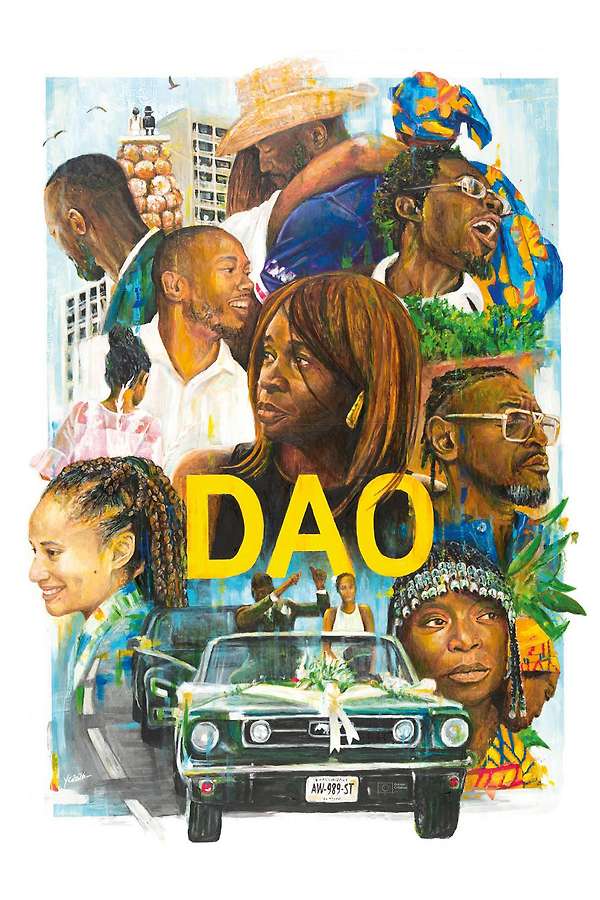
Three hours and five minutes long, structurally unscripted, formally restless, and emotionally vast, Dao is the kind of film that announces its ambitions in every frame and then, with remarkable consistency, delivers on them, not through the conventional architecture of plot and resolution but through the sustained, patient act of being present with people as they live.
The film’s title is defined in its opening frames as “a perpetual and circular movement which flows in everything and unites the world”: a philosophical concept borrowed from Taoist thought and applied here to the specific circularity of diasporic existence, the way identity in the African diaspora moves continuously between origin and displacement, between the village and the metropolis, between the self you inherited and the self the host country has been constructing around you without your full consent.
That Gomis reaches for this concept across cultural traditions (Chinese philosophy to frame a Guinea-Bissau story told in French) is itself a statement about the kind of film Dao is: one that understands belonging not as a fixed address but as a perpetual negotiation, a movement that never fully arrives because arrival was never the point.
The formal device through which Gomis enters his story is one with a specific and honourable lineage in African cinema. The film begins in a Paris rehearsal room, where we watch the casting process for the actors who will play the film’s family — a sequence that blurs documentary and fiction in ways that recall the ethnofiction tradition pioneered by Jean Rouch, the French ethnographer and filmmaker whose collaborations with African subjects in the 1950s and 1960s (Moi, un Noir, Jaguar, Chronique d’un Été) — established the methodology of treating the camera not as an observational instrument but as a participatory one.
This tool changes what it documents by being present. Gomis tells his assembled cast, “You’re going to be a real fake family”, and the line is both a directorial instruction and the film’s thesis statement: that the family assembled here, however constructed, will generate something real in the act of assembling. Reality, the film insists from its first minutes, is not something that precedes the gathering. It is something the gathering produces.
What the gathering produces, over its three-hour duration, is one of the most textured and emotionally honest portraits of diasporic family life that African cinema has produced. The Guinea-Bissau sequences, centred on the memorial rituals for Gloria’s father, a man who came to France as an economic migrant and returned to his village in his later years, are conducted with the documentary patience of a filmmaker who understands that ritual is not merely symbolic but functional, that the ceremonies through which communities mark their dead are doing real psychological and social work that cannot be hurried without damage.
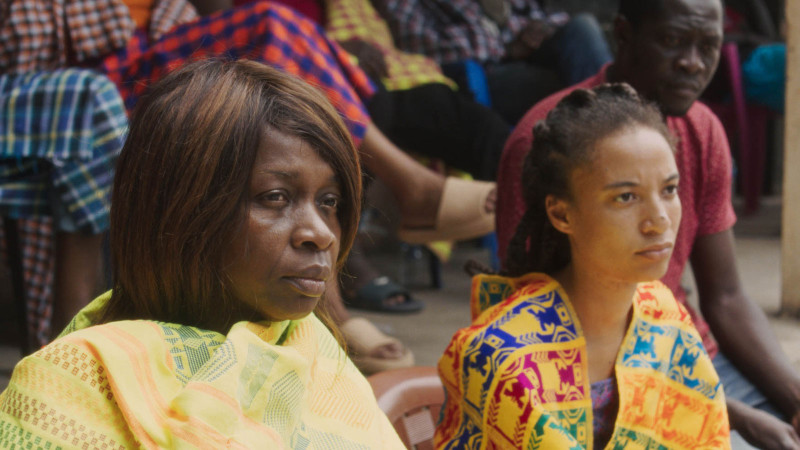
The camera observes the wooden idols representing the deceased being anointed, the rounds of traditional dancing, the accommodation made for the spiritual presence of ancestors, and it does not explain, does not translate, does not mediate between the ritual and the international audience watching it. This is the correct choice, and a brave one: to trust that the uninitiated viewer can be drawn into the meaning of a practice they have never encountered, through the sheer attentiveness of the filmmaking, without the condescending scaffold of narration.
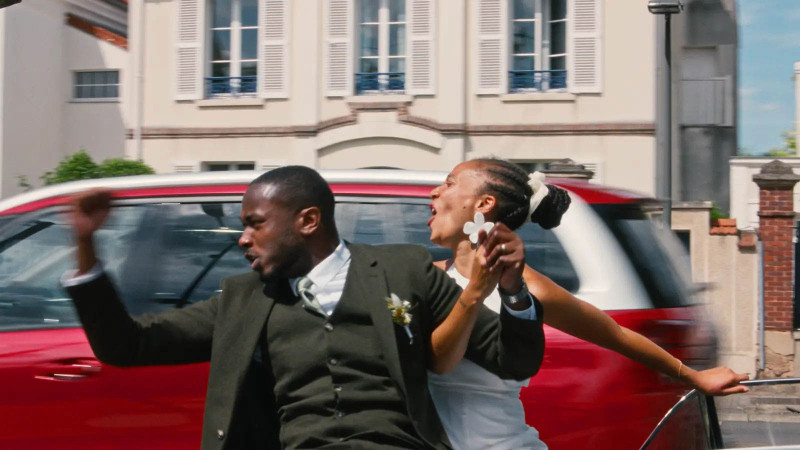
The French wedding sequences operate in a different register but pursue the same essential inquiry. Where the Guinea-Bissau memorial is rooted, ancient, and oriented toward the dead, the French wedding is mobile, contemporary, and oriented in its surface organisation toward the future.
Nour’s minimalist Chanel gown, the ivory linen table settings, the evening’s climax in a collective singalong to the Fugees’ version of “Killing Me Softly” — an American soul song by Haitian immigrants, performed here by the French-raised children and grandchildren of West African migrants — these are the details through which Gomis maps the specific cultural geography of second and third-generation diaspora life: the way Western forms are adopted and inhabited without the original African identity being surrendered, the way a community can be simultaneously inside and outside every cultural tradition it touches.
Gloria is the film’s centre of gravity, and Correa’s performance is one of the year’s most quietly astonishing. She plays Gloria largely through observation; through the specific quality of attention she directs at the world around her, at her daughter’s wedding, at the village she has not visited in years, at the white boyfriend she keeps at a careful relational distance that communicates more about her self-understanding than any dialogue could. There is a straight-backed, self-sufficient dignity to Gloria that costs her something, that is revealed over the film’s duration to be partly a defensive formation: the posture of a woman who has learned to occupy the margins of every room she enters without complaint.
Correa finds, within this restraint, the full emotional landscape of a woman at a specific crossroads: her direct responsibilities of motherhood receding as Nour marries, her father’s death having severed the most direct thread connecting her to an origin she visits with the fond, slightly touristic nostalgia of someone who grew up hearing about a place more than inhabiting it. Her performance is magnetic in its silence and devastating in its accumulated weight.

The film’s six editors (including Gomis himself) maintain across the three-hour runtime a rhythm that is less the rhythm of conventional narrative than the rhythm of memory: non-linear, associative, prone to dwelling and to sudden departure, cutting between the two ceremonies without chronological signposting in ways that gradually make the temporal gap between them feel less important than the emotional continuity connecting them.
The trio of cinematographers, including Félicité (2017) collaborator Céline Bozon, match the editing’s restlessness with a camera that moves between immersive proximity, charging into the fray of dance sequences, pressing close to faces in conversation, and the observational distance of someone who knows when to hang back and let a moment complete itself without intervention. The Abdullah Ibrahim jazz score, drawn from his landmark 1989 album, Blues for a Hip King, moves through the film’s emotional temperatures with the suppleness of music that has always understood the relationship between freedom and form.
The film’s critical liability is also, in a sense, its most honest quality. At three hours and five minutes, without a conventional plot to provide forward momentum, Dao makes real demands on the viewer’s patience, and there are passages, particularly in the film’s middle section, where the deliberate pacing tips from meditative into meandering, where the film’s resistance to narrative urgency becomes its own kind of fatigue.
The unscripted structure that gives the film its remarkable authenticity also means that certain scenes ramble without sufficient dramatic shape, that the ensemble’s vastness occasionally makes it difficult to maintain the emotional thread connecting character to character. These are not incidental failures but structural costs; the inevitable price of a formal ambition this large, paid in the currency of audience attention.
But the ambition is the right ambition, and the film that pursues it is, in its most sustained passages, genuinely extraordinary. Gomis has made a film that understands diaspora not as a condition to be explained but as an experience to be inhabited; that knows the only way to communicate what it feels like to belong to multiple places simultaneously, and fully to none of them, is to put the camera inside that simultaneity and let the audience find their own footing.
Cabral argued that cultural return is an act of liberation. Dao argues, more quietly and more personally, that it is also an act of grief: for the self that was formed in the gap, for the language half-remembered, for the grandfather who died in the village he returned to after a life spent elsewhere, for every family gathering that ends with the knowledge that the next one will not have the same faces. Home, in Dao, is not a place but a perpetual and circular movement. And the film, in its best moments, is exactly that.
Rating: 4/5
Joseph Jonathan is a historian who seeks to understand how film shapes our cultural identity as a people. He believes that history is more about the future than the past. When he’s not writing about film, you can catch him listening to music or discussing politics. He tweets @Chukwu2big.