



The Autograph of Nothingness understands loneliness as a concept; it is less successful at making loneliness an experience for the viewer.
By Joseph Jonathan
Loneliness is usually difficult to film because it is, by definition, an absence. You can show an empty room, an unanswered call or a person sitting alone, but none of these things necessarily communicates what isolation feels like from inside. The Autograph of Nothingness, directed by Moses Ipadeola and written by Cynthia Dozie-Onwusoh and Kemi Rebecca Osiyi, attempts to solve that problem by giving loneliness a body. In the film, Nothingness is not simply Menundo’s condition; she is a woman who lives with him, comforts him, controls him, and gradually becomes the most consequential relationship in his life.
The short film follows Menundo (Levi Chikere), a man struggling beneath the weight of a life that seems to be moving further away from him. His girlfriend has left Nigeria through the familiar “japa” route, while his own attempts to leave repeatedly fail. What begins as the loneliness of being left behind develops into something more complicated. Nothingness, played by Omowunmi Dada, offers Menundo companionship when the rest of his world seems unavailable, but that companionship comes with a price. She dictates who he should speak to, who he should avoid and, increasingly, how much of the outside world he should allow back into his life.
There is something recognisably contemporary about this loneliness. Nigeria’s japa era has produced a peculiar emotional geography: people are increasingly separated not only by physical distance but by opportunity. One person leaves, another stays behind; one gets a visa, another receives another rejection; one begins a new life abroad while someone else remains in the same room, watching their own plans collapse. The Autograph of Nothingness understands this emotional residue, even if it does not always explore it as deeply as its premise suggests it might.
Its most interesting idea is the transformation of loneliness into an intimate antagonist. Nothingness initially appears almost benevolent. She gives Menundo the companionship he lacks, filling the silence left by his failed relationship and frustrated ambitions. But her affection gradually reveals itself as possession. She does not want Menundo to recover; she wants him dependent on her. In that sense, Dada’s performance gives the metaphor its necessary menace. She has the seductive confidence of a femme fatale, except that what she is seducing Menundo into is not crime or destruction but continued isolation.
Dada understands the contradiction at the centre of the character. Nothingness has to be comforting enough for Menundo to want her around and threatening enough for us to understand that her comfort is dangerous. Her presence carries a quiet authority, and her chemistry with Chikere gives their strange relationship some credibility. Chikere is less consistent, occasionally allowing the performance to become visibly constructed, but he works best when he allows Menundo’s exhaustion to sit beneath his words rather than trying to announce it. Dada’s gravitas helps anchor those moments.

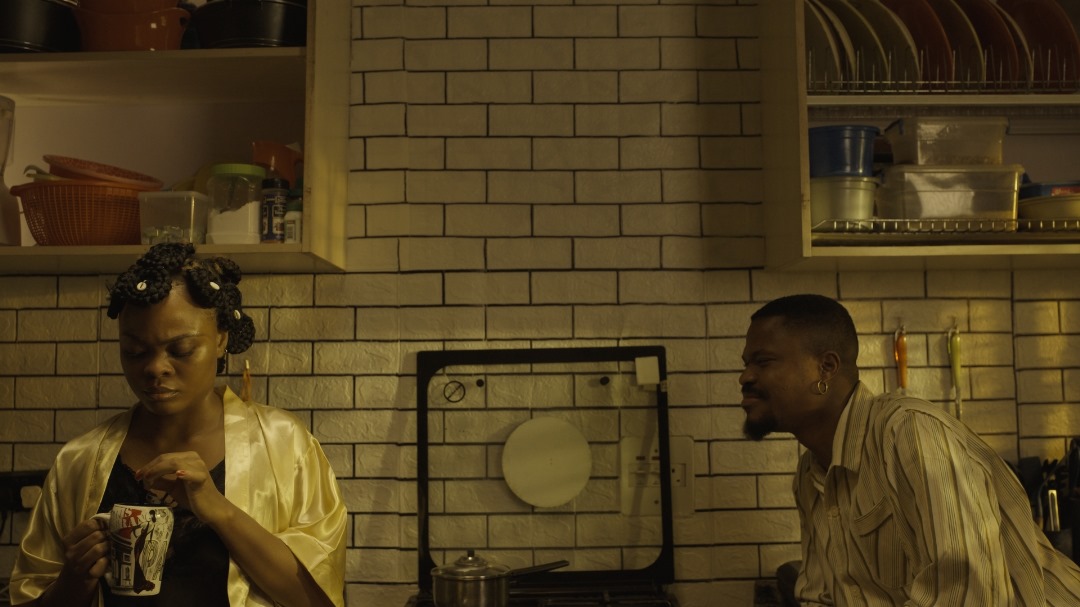
The film is also at its most cinematic when it finds ways to make memory feel physically present. One of its more effective techniques occurs during a coffee-making scene. As Menundo stirs the coffee, the image shifts into a memory of his former girlfriend performing the same action with the same cup. Rather than cutting away to a conventional flashback, the film creates a visual rhyme between past and present, making the memory appear to occupy the same space as the man experiencing it. It is a simple but thoughtful way of showing how memory works: the past does not always arrive as a separate scene. Sometimes an ordinary object, gesture or routine collapses the distance between then and now.
Okwong Fadamana’s cinematography gives the film an appropriate visual melancholy. The images often feel composed around Menundo’s emotional isolation, allowing spaces and objects to carry some of the psychological weight. The apartment does not simply contain him; it feels increasingly like an extension of his internal world. This is particularly effective because the film does not need to constantly explain what Menundo is feeling. Its visual language often understands that emptiness can be communicated through space. But there is an important distinction between making a film about loneliness and making an audience feel lonely. This is where The Autograph of Nothingness ultimately loses some of its power.
The film has the ingredients of an emotionally devastating short: a man abandoned by someone he loves, frustrated by repeated attempts to escape his circumstances, dependent on an embodiment of his own isolation and seemingly incapable of breaking the cycle. It is a rich emotional premise. Yet when the film ends, you find yourself admiring what it was attempting more than feeling what it wanted you to feel.
That is not necessarily a failure of concept. In fact, it may be the consequence of the film being so committed to its metaphor. Menundo’s loneliness is constantly externalised through Nothingness, and because she is such a clearly constructed representation of his inner state, there are moments when the audience becomes more conscious of the idea being presented than the person experiencing it. We understand the metaphor. We can appreciate its symbolism. But understanding loneliness intellectually is different from being made to inhabit it.
This is particularly noticeable in the film’s treatment of Menundo’s relationship with his former girlfriend. The film does offer glimpses of their time together, using fragments of shared routines and memories to establish the intimacy that existed before her departure. Yet while these moments give us a sense of what Menundo has lost, they do not always carry enough emotional weight to make that loss deeply felt. We understand why her absence matters to him, but understanding the source of his grief is not quite the same as sharing in it. The memories establish the relationship; they do not always make its absence hurt.


Still, there is an admirable restraint to Ipadeola’s approach. The film does not turn Menundo’s suffering into a conventional melodrama, nor does it offer an easy psychological diagnosis. Instead, it sits with the uncomfortable possibility that sometimes the thing keeping us alive can also be the thing preventing us from living. Nothingness gives Menundo company, but she also permits him to remain exactly where he is.
That contradiction is where the film finds its richest idea. Isolation can become comfortable precisely because it removes the risks that come with connection. To reconnect means accepting rejection, disappointment and the possibility of being hurt again. Nothingness offers Menundo a safer alternative: stay with me, and you never have to risk losing anyone again.
The Autograph of Nothingness is therefore a thoughtful and visually considered short with a compelling central metaphor and a strong performance from Omowunmi Dada. Its filmmaking occasionally reaches beyond conventional realism to find an appropriate language for memory and emotional interiority. But its emotional impact does not always match the ambition of its ideas. The Autograph of Nothingness understands loneliness as a concept; it is less successful at making loneliness an experience for the viewer.
Perhaps that is the film’s most frustrating contradiction. A story about a man desperate for connection leaves you more impressed than moved. And for a film whose entire premise depends on making an invisible feeling visible, that distinction matters.
Rating: 2.9/5
Joseph Jonathan is a historian who seeks to understand how film shapes our cultural identity as a people. He believes that history is more about the future than the past. When he’s not writing about film, you can catch him listening to music or discussing politics. He tweets @Chukwu2big.