



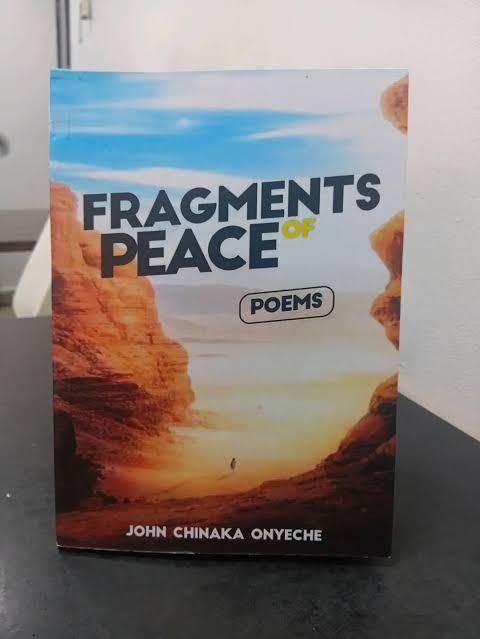
John Chinaka Onyeche has, in Fragments of Peace, demonstrated admirable attentiveness to language and thematic consciousness.
By Nket Godwin
Chinaka Onyeche’s debut full-length collection of poems, Fragments of Peace (2026), can best be read as a “familial jeremiad”. It is a collection in which the poet proves, again, that he is the kind of poet who can spend 81 poems turning over grief with a baker’s flair. He elegises the travails of a relationship he could no longer hold together due to circumstances within and without his making.
The poet is a presumed passive father who has been away from (rather than in the lives of) his children, as echoed in a plethora of poems in the collection. He is a father figure whose voice is only heard across frequencies away from his family. This is why his “faraway wishes” for his children are only carried “through time and memories” (as captured in poems such as “Distances Bound for Sobeife” and “Nights Apart”). Other times, too, he grieves the loss of immediate and extended family members.
But I dare not say Onyeche romanticises grief; his is a necessary misery. And he understands this necessity. But this “understanding”, on his part, left to stand bare in the poems, is Fragment of Peace’s undoing. Readers, upon reading French novelist and playwright Marguerite Duras’ epitaph with which he opens the collection, will find themselves betrayed before being plunged into the story Onyeche seems preoccupied with telling. The epitaph reads: “[w]riting isn’t just telling stories; it’s in telling everything all at once.” (And one cannot but admire Onyeche’s proclivity in telling his story, a task he undertakes from the first poem to the last.) But he does not succeed in “telling everything all at once,” as Duras implies.

In fact, in some of the poems, apart from a handful of them, the poet tells the reader nothing about his language; some of the poems refuse to turn the light (of language) toward themselves, as Northrop Frye posits. Poetry, unlike other genres, isn’t solely about the story it tells; it’s as much about language as it is about the story. But, in some of these poems, the poet offers his reader nothing with which to carry his stories “to places he could never go”, as the American spoken word poet and writer, Rudy Francesco (also epitaphed in the collection) says.
Away from these shortcomings. It is important to identify and examine the handful of poems in the collection whose language magnifies their lights. These poems —“Amen”, “Radio Bodies”, “Fragments of Absence”, “3:50am, 04/10/2024”, “Staring at my Kids Portrait”, and “Of Solitude and Echoes” — not only capture the themes of loss, betrayal, distance between father and children, divorce, trauma of childhood outside fatherly care, explicit in the collection; they also attempt to tell everything all at once.
The poem “Amen,” which opens the collection, sets the tone of the rest of the poems. With it, Onyeche establishes the main purpose of the book: “I’d need this moment to admire my misery”, he writes. The use of “admire” depicts a sense of necessity and acquaintance with this misery. He has become used to his emotional “crisis”, symbolised by the “river”, so that the act of recounting it becomes an act of admiration. The poet does not only tell, but gives the thoughtful reader something to brood over in the story he tells: an understanding of, not repulsion to, one’s misery.
At the end of the poem, we read: “God take my carcass/let it dance with the wind/And float in the eyes of men,” the men he hopes will carry his story to places he could never go. The tone of finality which the poem carries evokes hope, not only in the religious sense, but also in the ability of art to sustain our existence when, as the 17th-century English poet Alfred Lord Tennyson says in his poem “Crossing the Bar”, the call comes for us.
The second poem in the collection, which this writer considers his most rigorous attempt at being attentive to language as much as to the story he narrates, is more meditative in the way it approaches grief. But the poem’s lure is in its structure and style. The opening line is as evocative as it is memorable. It reads: “So many nights I am bent into a key”. The act of retrospection, such as the persona engages in this poem, involves opening/unlocking (as with a key) vaults of memories, thoughts and reflections of events in his life and his family.
Thus, when the persona says he’s bent into a key, the imagery of a door unlocking cannot be missed. But what kinds of memories are contained in this room that the persona is bent into a key to open? We’re told: “Some nights are black dogs/others are drawers filled with moths of laughter/…Static from not hearing the radio bodies of your children/learning which frequency broadcasts your fear.” The poet is flooded with memories of his children, whom he can no longer tell how they’re faring, having been away from them for too long. What can be more miserable?
But one must admire how Onyeche renders the emotional trauma that comes with not being able to tell how your kids are faring because of distance, in a language that is as mechanical as it is tender. These communication registers — “static”, “frequency”, “broadcast” — signify the severed communication between the persona and his children.

Towards the end of the poem, the poet laments: “As time ticks/the realities of home are built on the jawline of the sea/The coming of the teeth erases the trace of the house/Built with our wandering feet/that are not fossils in the rocks of becoming”. The image of the desolate state of the family comes clearly here: the picture of a home whose reality is built on the jawline of the sea, a sea whose teeth (tide) erase traces of that home. In this poem, Onyeche seems more concerned with imagery than the rest of the poems in the collection. He aspires to allow language to do the work of ushering the story in, and not the other way around, as in other poems.
After carefully following Onyeche’s poetic journey through his numerous self-published chapbooks, I could admit, as the American critic, Cleanth Brooks, says of Alfred Lord Tennyson, that though he is “one of the poets one would not think of associating with the subtleties of paradox and ambiguity”, he is not a peripheral poet either — as he has exemplified in some of the poems in Fragments of Peace.
In the poem “Fragments of Absence”, the persona again broods over the distance between him and his children. But this time, the grief is inspired by a disturbing thought of the sheer incomprehension or indifference of elderly people to the emotional travails of children, especially children in his son’s condition, kept away from the reach of either of their parents.
Sometimes, this emotional state is usually misconstrued by elderly people as the children, though silently disturbed, still go about playing with other kids as though all is well. But Onyeche is much more disturbed about the attitude of these elders toward his children whenever they try to ask about their father. He writes: “Dear son/You stand in a triangular beam/becoming the beauty of nights/where fatherly hands have not/for shadows of earthen women have taken over your shine” (“Song 1”).
This triangular beam suggests three worlds: his (now absent), his divorced wife’s, and that of his children’s maternal uncles with whom they live. He expresses his anxieties and suspicion that the children will be brainwashed into believing that he does not love nor care for them as a father; his children’s “aching limbs” (concerns for their father) will be “cut and shaped,” leaving only the necessary parts the maternal relatives need. This is the act he associates with the “earthen women” who now surround the children.
The poet’s longing for his children is further echoed in “Nights Apart”, a poem in which he reminisces about “time we sat under the still moon”. “Nights Apart” ends with two poignant questions that surmise the poet’s ideation of his grief: “What is a man without his children?/What is this world without life?” Through parallel rhetorical structures, Onyeche works the personal into the universal and the universal into the personal. To him, a father is not a father without his children, much as the world is not a world without life. We must preserve one to preserve the other.
It is crucial to point out that some lines in the poem “Nights Apart” could have been done without, especially the line: “I speak of memories/picking them up with toothpicks.” The imagery (if there’s any), not to mention the illogicality of “picking memories up with toothpicks,” is rather dull, lacking collocation. Reading the line, I try to picture a man on a dining table picking his teeth (or his meat?) with toothpicks. But associating that activity with “memory” in the context in which it is used seems to me like a metaphor borne of a shallow or carefree imagination rather than a conscious and cautious recollection.
Another fine poem in the collection is “3:50am, 04/10/2024,” although botched by its titling. I know that Onyeche’s academic background in History and International Relations often than not creeps into his literary production, seen in his recourse to dates and times in his titles, a style that could have yielded much, if properly utilised.
However, one can hardly deny the dearth of creativity in the manner in which some of his poems, as the one cited above, are titled. This style of numerical titling may not be peculiar to Onyeche; however, I would like to cite another example from one of Niyi Osundare’s short poems in his Tender Moments: Love Poems (2006) to buttress my point, which is the need for nuance when choosing numerical titles. The poem “04 04 04”; Osundare’s title may not be an actual date as in Onyeche’s, but it is memorable. The whole poem is quoted below:
I harvest
This day
A flurry
Of fours:
Four stars
Four stones
Four songs
Four pathways to the queendom of your heart (12)


The rhythm flows from the title into the poem itself, even though the use of “four” appears rather invented for the purpose of style: the poem is titled “04”, each stanza has four lines, and the poet “harvests” a flurry of fours (“stars”, “stones”, “songs”, “pathways”) to his lover’s heart. Its lyrical lure, evoked by the title, cannot be missed.
However, although the technicality in Onyeche’s title wrangles the brain and belabours memorisation, the content of the poem makes up for itself, especially its minimalist style. The content is not ruined by the kind of wordiness one encounters in “In Memoriam” (another poem dedicated to the poet’s deceased mother) and “Love’s Rainstorm.” Written as a letter addressed to his son, some of the finest lines in “3:50am” are: “Some nights, your face in my dream/is a knife pruning me” and “Your agony…cuts my fathering into shreds.”
Onyeche has, in this collection, demonstrated admirable attentiveness to language and thematic consciousness. However, it is equally important that he be more meticulous with his narrative poems, and those about death, especially those meant to memorialise his deceased friends and relatives. He needs to put his language to task over his grief, and not his grief over his language.
Nket Godwin is a poet and literary critic. His works have appeared in Yarnz, Harbor Review, African Writer, Afrocritik, The Nigeria Review, Lion and Lilac, Ebo Quill, Eunoia, and elsewhere. He was longlisted for the Unserious Collective Fellowship Prize in 2024. He lives in Port Harcourt, where he teaches English Language and Literature-in-English.