

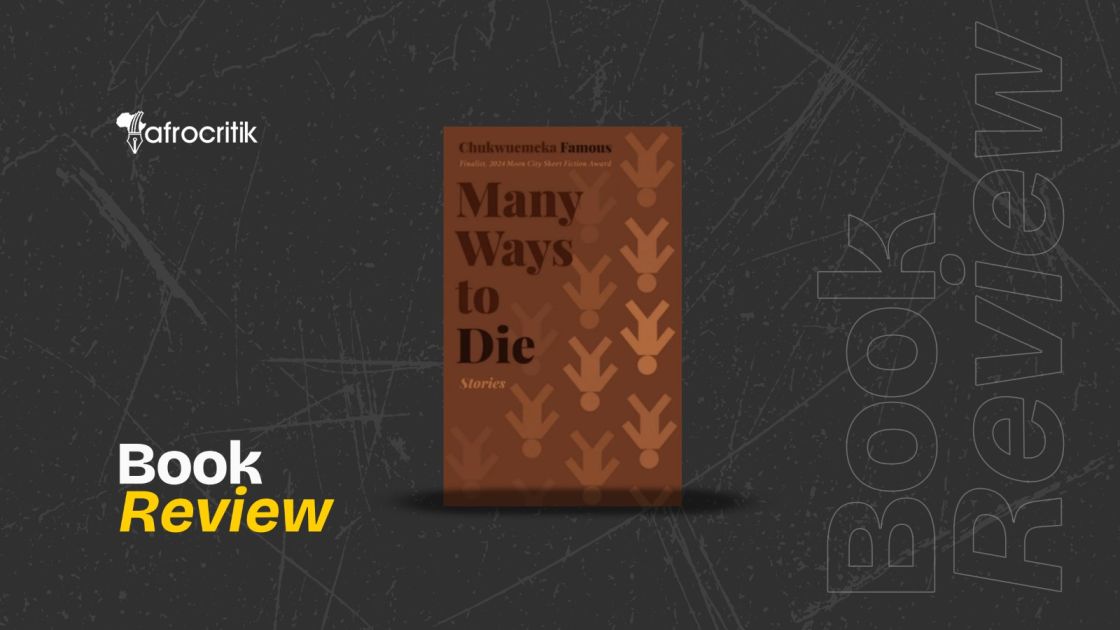


Many Ways to Die succeeds because of its capacious ability to reimagine worlds and deliver vulnerable characters whose plight moves the audience.
By Azubuike Obi
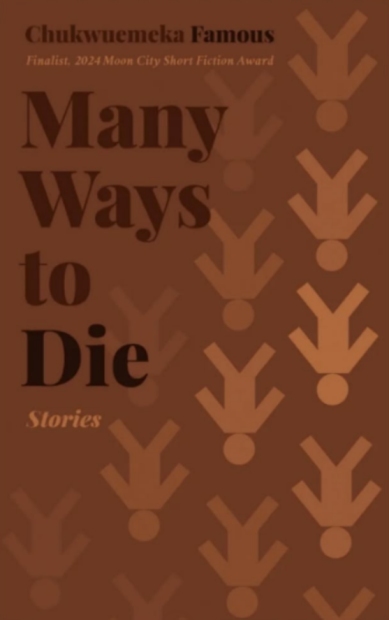
On the cover of Famous Chukwuemeka’s Many Ways to Die lie upturned stick figures: dead. Within that cover, across eight stories, dead bodies are littered everywhere in Chukwuemeka’ fervid X-ray of mortality in its physical and psychological dimensions. “Life is fragile”, and his protagonists reckon with that fragility. In some of the stories, the principal characters die a physical death, even if by their own hands; in some others they take the lives of others, while a part of them continues to ebb away.
The people who populate the pages of these stories are all struggling to keep their heads above water, often against forces beyond them. It is as though fate has conspired against these souls, and so they are left tugging, flailing, gasping for air. In “Paradise”, that force is un(der)employment; in “It is Finished”, it is poverty; and in “Water Takes All of Me”, it is nature itself.
But sometimes, in this odyssey of small lives, the characters manage to own moments of triumph— at certain points, they take their own fates into their hands, even if they are uncertain what direction to take after the fact.
Many Ways to Die opens with “Fly”, where in the wake of her mother’s passing, a young woman is sold into prostitution by her alcoholic father. Ozichi, however, opposes oppression in all of its forms— from her father and from the ring she has been sold into. In a damning sequence, she decides to “take charge” of her life, “to fly” like her mother once urged her to. Chukwuemeka’s protagonist resists pity with brazen boldness in this peculiar, vividly imagined tale of female emancipation.
In “It is Finished”, a girl reveals she has just clubbed her rapist father to death. The rest of the story flits through memory to uncover what happens to vulnerable people when all turns against them, and how much further they, too, are willing to go to free themselves. This story is tender, heartbreaking and genuine. Chukwuemeka has a heart for powerless people, who in small, rare moments of bravery become captains of their lives.
However, sleights of hand manifest in his chalking up of his antagonists’ motivation to alcoholism: in “Fly”, a father turns to alcohol after he fails to acquire a job. After his wife dies, he sells his daughter into prostitution.
Another father, in “It is Finished”, turns to alcohol to live with the immense poverty he finds himself muddled in. When his wife leaves for an overnight church service, inebriated, he sexually assaults his daughter. Isn’t it a dearth of imagination, this set-up of predator fathers who, in different states of inebriation and with their wives absent, prey on vulnerable daughters?
Nnamdi’s life is caught in the belly of an organ trafficking pit after a young woman’s patronage at his tailoring shop in “Paradise”. In “Paradise”, Chukwuemeka asks how far we are willing to go to change our life’s fortune, what we are willing to give up in the pursuit of wealth and who we become in that process.
In a pallid imitation of a child’s voice, “Water Takes All of Me” chronicles Tochi’s emotional travails after he loses his entire family to a flood. In “When Flesh Summons”, Korie returns to the village of his death to exact revenge on his killers and begin a “purging of evil” in the land of Ishimmiri. Here, Chukwuemeka’s success lies in his ability to reimagine forgotten worlds, rather than in the examination of revenge and justice (the premise is simply not compelling or believable enough to ferry the thought-provoking idea behind the story).
Chukwuemeka conveys these tales of loss and pain in lush, vivid prose that roots the reader in the scene. Even when the events are uncomfortable, his prose rises and carries. Consider this line from an accident scene: “A gaping semi-circle at the centre of her forehead leaked blood in hiccups.” Or this, from a woman’s sudden realisation of her miscarriage: “The blood was already there, thick and dark, sliding down your thighs and pooling on the wet tiled bathroom floor…. A raw scream broke out of you, echoing off the bathroom walls.”
Nsote wakes up to find her only child dead in “Magic Child”. Here, Chukwuemeka interrogates a culture that holds motherhood as ultimate and casts away women who are unable to reach it. In addition to this examination, he places side-by-side the contradiction between superstition and reality, asking how tethered one can be to beliefs they choose not to have links with.
In the same vein, “This Is Not A Way to Die” questions belief and responsibility when belief seemingly fails— in the wake of Tony’s father’s death, Tony seeks to exact revenge on Pastor Japheth, who convinced his father to refuse a surgery that could have saved his life, citing an instruction from God. Pastor Japheth and Tony’s father’s relationship is reflective of that particular strain of New Pentecostalism that has swept through Nigeria in recent times — individuals relinquishing their cognitive abilities completely and profoundly to a spiritual leader.

Lives continue to slip through because of decisions such as this, and in the presence of zero institutional consequences, private individuals, like Tony, are forced to take matters into their hands. However, the question of autonomy and responsibility is called because why should the spiritual leader bear the brunt of a choice made consciously by individuals only because that choice has not yielded preferred fruits?

Chukwuemeka’s rumination on religion—the principal preoccupation of his debut novel—its capacity to hold and tear apart families is made manifest in “This is Not A Way to Die” more than in any other story. This story, however, is bogged down by its choice of POV and does not possess the psychological acuity that characterised his exploration of the character of Papa in We Will Live Again (2022).
Refreshing in its second-person narration, “Leaving” offers a moving account of a world that spits out women it has deemed inadequate. After four miscarriages, all comes crumbling beneath Ije after she realises her husband has left her for another woman.
Chukwuemeka’s characters in Many Ways to Die are very often small, pitiable people, drawn from different settings and different walks of life. All of them are united by their passivity to life. But, in moments of admirable grace, they are injected with a rush of vigour, and they take charge over the course of their lives: in “Fly”, Ozichi slits her wrist in rejection of a life of sexual slavery; in “Paradise”, Nnamdi chooses death in the face of a moral dilemma; and in “It is Finished “, Erima resists her rapist father in an act of rare bravery. One never stops rooting for these people. One never stops caring.
If We Will Live Again (2022) succeeded because of its psychological penetration of religious syncretism and moving exploration of the impact of war; Many Ways to Die (2026) succeeds because of its capacious ability to reimagine worlds and deliver vulnerable characters whose plight moves the audience. Overall, these are competently written, even if unmemorable, stories by a young writer who is capable of exploring storytelling in myriad forms.
Azubuike Obi is an Igbo storyteller who believes in the transformative power of language. He won second place in The Republic Student Writing Competition (2025) and was nominated for Chika Unigwe’s Awele Creative Trust Award (2024). His fiction and nonfiction have appeared online and in print in The Republic, The Weganda Review, Naira Stories, Afapinen, Efiko Magazine, and elsewhere. He is a regular contributor at Afrocritik