



The women in Black Market are too generic to carry the full weight of the premise. They function as a collective rather than a convincing ensemble, defined by their roles in the plot rather than the interior lives that would make their decisions feel inevitable rather than convenient.
By Joseph Jonathan
On September 26th, 2026, over fifty-one thousand people gathered at Tafawa Balewa Square in Lagos to watch a film together, breaking the Guinness World Record (GWR) for the largest attendance at a single film screening. Tickets cost ₦2,000 each, less than a fifth of a standard cinema ticket, deliberately priced, as the promotional material noted, at “black market” prices. A film about the underground economy, marketed at underground economy prices, to fifty-one thousand people assembled in a public square.
Whatever its artistic limitations, Black Market understood something about its audience that many Nigerian films do not: the people most likely to recognise this story are not necessarily those who can afford a standard cinema ticket. Bringing the film to its natural audience rather than waiting for that audience to come to the film is the most genuinely interesting thing about the entire Black Market project. The film itself is, unfortunately, a more complicated story.
Directed by Fatimah Binta Gimsay and written by Gimsay and Abdul Tijani-Ahmed, Black Market is produced by Nora Awolowo and Nicole Ofoegbu. The film follows four women—Zimuzo (Linda Ejiofor-Suleiman), Aramide (Scarlett Gomez), Adesua (Omowunmi Dada), and Jumai (Susan Pwajok). Their rivals, led by Junior (Lateef Adedimeji), smuggle fuel but repeatedly get caught at checkpoints that the women pass through without incident. The men’s wounded pride curdles into coercion, and the conflict becomes personal when Adesua’s daughter is kidnapped. The film opened in cinemas on October 2, 2026.
The market woman is one of the most politically significant and cinematically underserved figures in Nigerian cultural life. She is the infrastructure of the informal economy: the Mama Put, the Iya Alata, the trader who moves goods across borders and through checkpoints with a logistical intelligence that formal commerce cannot replicate and formal economics cannot fully account for.
She has sustained Nigerian households through structural adjustment programmes, currency crises, fuel scarcity, and the governmental incompetence that has marked much of the country’s post-independence history. She is, in the most precise sense, the person who keeps the country alive when the state fails. Yet her labour is consistently underestimated by the men who share her markets, the institutions that regulate her trade, and a culture that treats her work as ordinary rather than extraordinary.
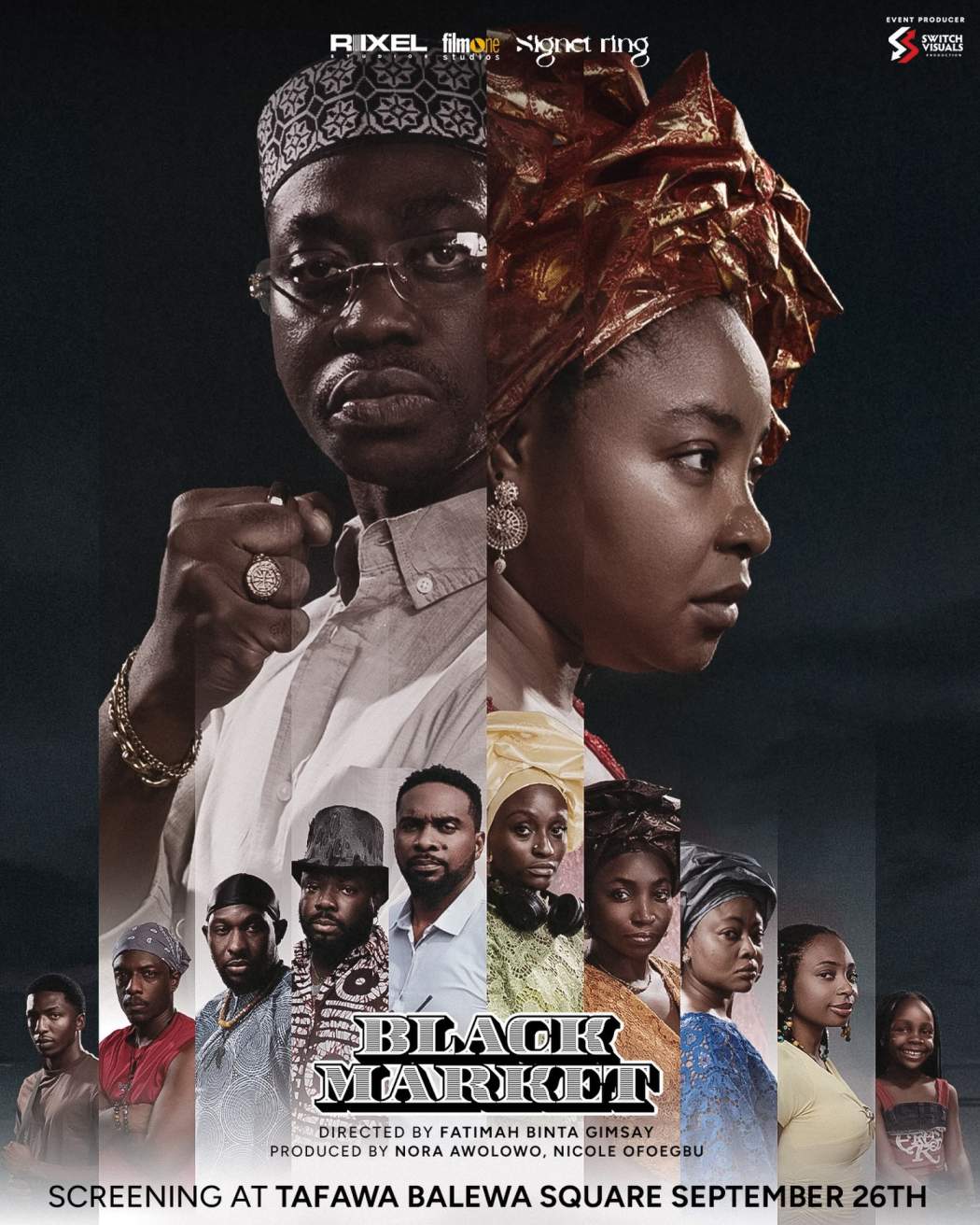
A film that takes four market women and makes them the most competent criminal operation in their environment is making a specific and resonant argument: the skills that sustain the informal economy can also sustain the criminal one. The line between trader and smuggler is not always a question of character; it can be a consequence of economic pressure, drawn by circumstances rather than an inherent difference in competence or ambition.
This is genuinely interesting material. Handled with the seriousness it deserves, it could produce one of the more culturally significant Nigerian crime films of its generation. Black Market however does not approach the material with that seriousness. The specific ways in which it falls short are also the most instructive things the film has to offer.
For much of the film, the women at its centre are more concept than character. We know they are traders, resourceful, and loyal to one another. We see them in bright Ankara prints, keeping plants in their shared space and displaying the solidarity familiar to the crime-drama ensemble. What we do not sufficiently understand is who they are beyond the operation. The informal economy that inspires the film is not merely an economic system but a social one, built on relationships of trust, obligation, and mutual vulnerability, each with its own history, texture, and cost.
The market women who sustain Nigeria’s trade networks are not interchangeable. Their individual circumstances, calculations about risk and reward, and particular histories with institutions that have failed them shape their choices. The women in Black Market are too generic to carry the full weight of the premise. They function as a collective rather than a convincing ensemble, defined by their roles in the plot rather than the interior lives that would make their decisions feel inevitable rather than convenient.
This lack of specificity weakens the film’s central dramatic conflict. Zimuzo’s refusal to collaborate with Junior is supposed to carry the weight of a shared history, a past between the two operations that has made cooperation impossible on terms the women would accept. Gimsay dramatises this history, but dramatising something and making an audience feel it are two different things.
Here, the two remain frustratingly distant. Zimuzo’s refusal reads as the logical response of someone who simply does not want to cooperate, rather than the surface expression of something deep and unresolved. The past is present but not alive in the scene. That is the difference between a crime drama with genuine emotional stakes and one whose conflict operates primarily through plot mechanics.
Adesua’s daughter is kidnapped at the point when the conflict should escalate from professional to personal, when the film should make us feel what is actually at risk. But the story has not given us sufficient reason to care about Adesua as a specific person rather than a plot function. The film understands that a mother’s child in danger is an emotionally significant premise.
What it fails to recognise is that emotional significance in cinema is not automatic; it must be built through the accumulated evidence of who a character is and what a relationship means to them. We understand that the daughter’s life is in danger, but we cannot fully feel the weight of that danger for this particular woman because the screenplay has given us the type rather than the person.
Junior compounds these problems from the other direction. Lateef Adedimeji is a capable actor whose work elsewhere has demonstrated genuine range, but here he plays a character whose menace must be asserted through dialogue rather than established through the visible machinery of his power. His supposedly formidable operation appears to run on a handful of couriers.
A criminal enterprise that small cannot project the threat the story assigns to its leader. No amount of performative ruthlessness, including the killing of one of his own men in a moment intended to establish his dangerousness, can compensate for a world that has not been built to scale. The killing itself is too thinly motivated to land as anything more than a plot device. The best villains rarely have to work so hard to convince an audience that they are dangerous. Junior tries very hard. You remain unconvinced.
The police insider who helps the women move their consignments through checkpoints is the film’s most structurally significant unexplored character. Someone who moves freely between a criminal operation and a state institution could be the most dangerous and interesting figure in the story: a living embodiment of the film’s implicit argument about the porous boundaries between the formal and informal, the legal and illegal.
Instead, he is treated as a narrative convenience, introduced to explain the women’s advantage without sufficient development to convey the risks his position entails. The resulting imbalance—the women have institutional protection, while the men do not—turns what could have been a compelling thematic contrast into something resembling structural favouritism. The screenplay seems more interested in ensuring the men lose than in building a world in which their defeat feels earned.


The film’s technical execution is more reliable than its screenplay. Linda Ejiofor-Suleiman, who made history at the 2026 AMVCA by becoming the first actress to win both Best Lead Actress and Best Supporting Actress in the same ceremony, grounds her performance in a specificity that the writing does not always support. She builds her own character logic where the screenplay has provided insufficient architecture.
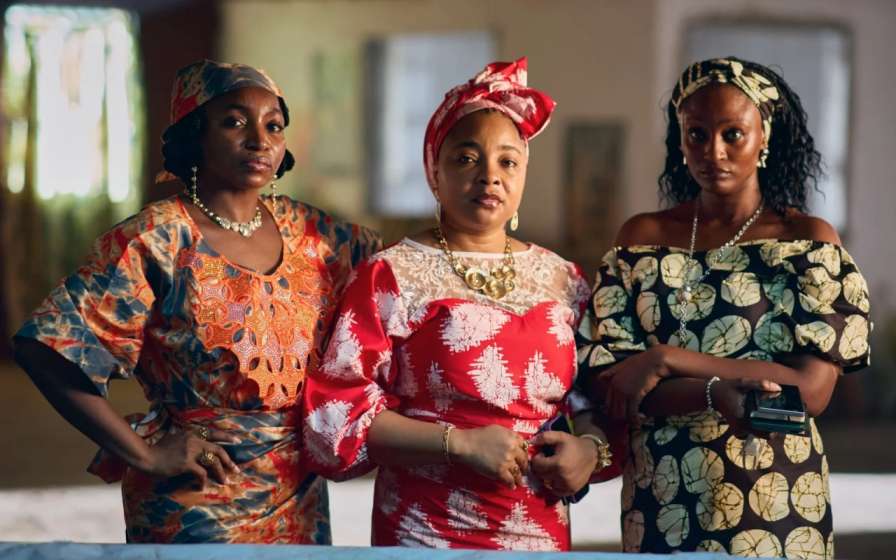
Omowunmi Dada and Scarlett Gomez lend their scenes a collective credibility that makes the ensemble feel inhabited even when the writing gives them too little to work with. The cinematography establishes the mood with sufficient precision to orient us within the world these characters inhabit, accomplishing visually what the script often fails to achieve on the page. The art direction is equally considered. These are genuine craft achievements, and they make the film’s hollow centre more frustrating, not less: it is a solid house with too little life inside it.
The ending confirms this deficit. The group that kidnapped a child is arrested. The women, who have spent the entire film smuggling, are left untouched, and the film never pauses to reckon with what that outcome means. It does not ask what it costs, morally or practically, to survive this particular night in this particular way.
In a crime drama built around the premise that survival in Nigeria’s informal economy requires people to trade something of themselves, the ending should be the moment the bill comes due. Instead, it is the moment the bill is forgotten. The women have won, and the film moves on. The audience is left with the particular dissatisfaction of watching a story raise a serious question only to decline, at the last possible moment, to answer it.
Gimsay’s most significant achievement may not be the Guinness World Record, but its premise: taking the market woman, one of Nigeria’s most politically significant and cinematically underserved figures, and building a crime drama around her competence rather than her victimhood. It is the right instinct. Nigerian cinema has spent too long treating the informal economy as background texture rather than a subject worthy of serious dramatic investigation.
In Black Market, these women keep the economy functioning when formal structures fail. Their knowledge of trade, survival, and the systems that govern everyday life makes them compelling subjects for a crime drama. Yet the film does not give them the interiority or narrative depth their circumstances demand. It identifies a story worth telling without fully realising its potential. The women at its centre deserved a more rigorous examination of the world they inhabit and the choices they make within it.
Fifty-one thousand people gathered at Tafawa Balewa Square to watch a film about market women navigating a system built against them, at prices ordinary Nigerians could afford. The appetite for this story is real, and the film that fully does it justice is still waiting to be made. Until then, Black Market is really black market.
Rating: 2.2/5
Joseph Jonathan is a historian who seeks to understand how film shapes our cultural identity as a people. He believes that history is more about the future than the past. When he’s not writing about film, you can catch him listening to music or discussing politics. He tweets @Chukwu2big.