


The year bore witness to historic triumphs that reaffirmed Africa’s place at the apex of global music culture.
By Afrocritik’s Music Board
African music has always been an ecosystem of infinite dimensions, a cultural phenomenon where creativity knows no bounds and innovation flows as naturally as the rhythms that have defined the continent for generations. In 2025, this multidimensional artistry has not merely persisted; it has ascended, and, with deliberate purpose, claimed new territory on the global stage while simultaneously deepening its roots across the continent.
The year bore witness to historic triumphs that reaffirmed Africa’s place at the apex of global music culture. South African flautist, composer, and producer, Wouter Kellerman, secured his third Grammy Award in February 2025 for the album, Triveni, winning Best New Age, Ambient, or Chant Album. Nigerian superstar, Tems, claimed the Best African Music Performance Grammy for “Love Me JeJe”, while Ayra Starr etched her name into history as the first African female artiste to win Best International Act at the MOBO Awards. These accolades affirm what the continent has always known: African music is a force of boundless artistry and universal resonance.
Yet, beyond the awards and international acclaim, 2025 has been a year of remarkable sonic exploration across the continent. Kenya’s Arbantone continued its steady rise, capturing the energy of a new generation. In Nigeria, more artistes tapped into the rich, percussive traditions of Fuji, breathing contemporary life into the ancestral sound, while a resurgence of R&B saw artistes crafting intimate, soul-stirring records that recalled the genre’s golden era.
African Hip-Hop also saw notable moments, with Nigerian rappers reasserting their lyrical prowess and North African artistes pushing the genre’s boundaries with multilingual flows and innovative production. South Africa’s 3-step, a genre-blending notes of Amapiano, Afro-Pop, Afro-Tech, and Afro-Jazz, dominated airwaves, with talents like Jazzwrld and Thukuthela delivering hit after hit.
From Côte d’Ivoire’s Himra to Nigeria’s melodist, FOLA, from Ghana’s Beeztrap KOTM, who pushed Ghana Drill, also known as Asakaa, into bold new territories, to a constellation of other rising stars across the continent, the year delivered projects and singles that affirm the inexhaustible wellspring of African ingenuity.
Still, we would be remiss not to acknowledge the complexities that have shaped this year’s creative landscape. Across East and Central Africa, political upheaval—wars, uprisings, the consolidating grip of authoritarian power—has cast long shadows over artistic communities. The ground beneath many artistes has been unstable, and their work inevitably marked by the turbulence surrounding them. Yet, even amid these challenges, the resilience of African artistes remains unshaken, and the brilliance of their craft endures.
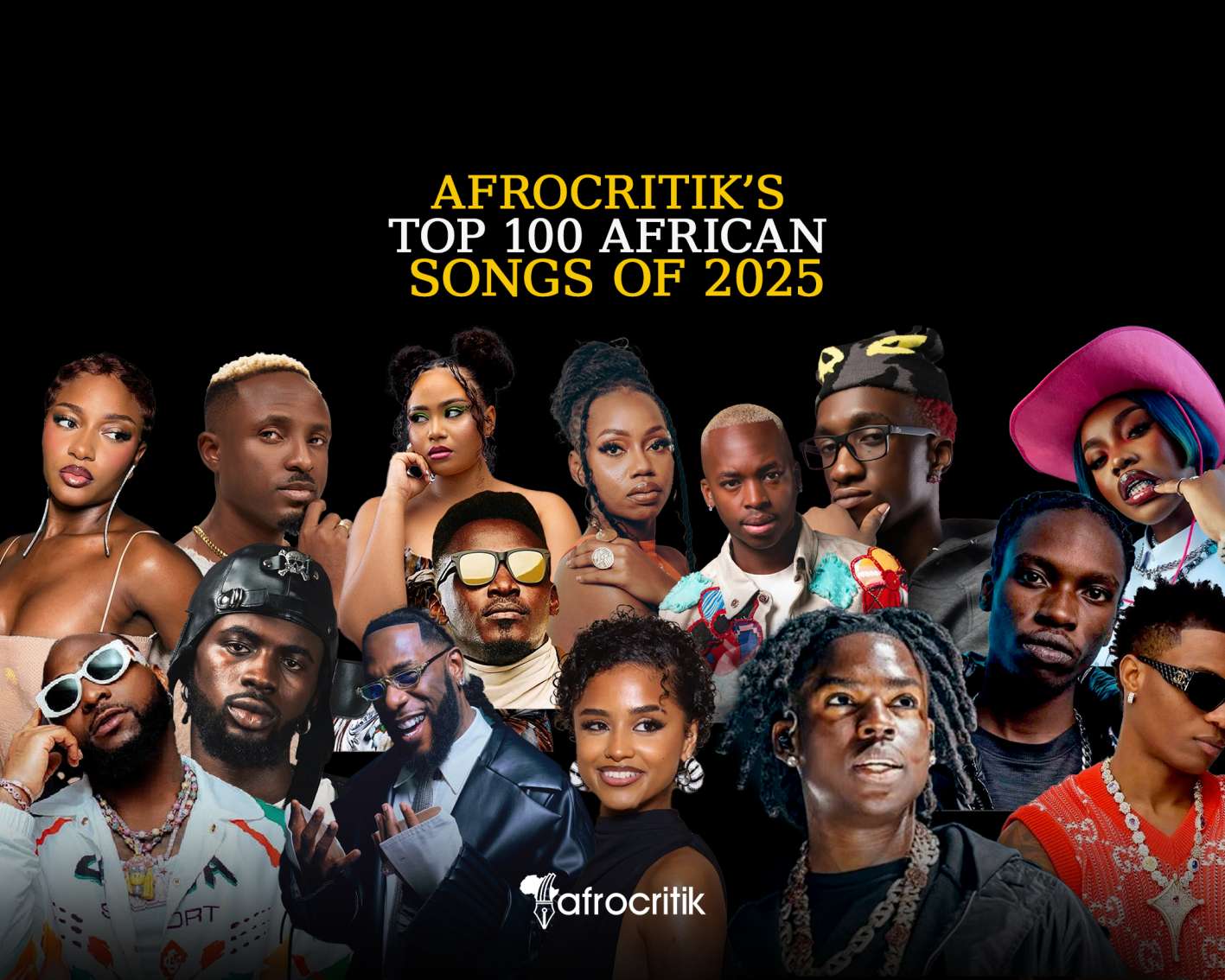
Expanding upon the format we introduced in 2024, Afrocritik’s Top 100 African Songs of 2025 reflects our ongoing commitment to contextually and comprehensively documenting the music that defines this continent.
What began as a list of 50 has grown in response to the sheer volume of excellence emerging from every corner of Africa. It’s a recognition that the old frameworks could no longer contain the abundance before us. This compilation celebrates the exceptional songs that have shaped the year, honouring both the established luminaries and the emerging voices who remind us that African music is not a monolith but a living, breathing ecosystem of endless possibilities.
100. “Faraway” – Sabrina (Cameroon)
Rising Cameroonian star, Sabrina, acclaimed for her iterations of Makossa and Bikutsi, scored one of the biggest tunes out of Cameroon this year in “Faraway”.
On this ballad, the Yaoundé-born singer extols a love interest, pouring adulations amidst hyperbolic expressions of love and romance. Released as a single from her album, Freely, “Faraway” is delivered in pidgin English, exploring frenetic piano chords, while Sabrina’s vocals shine through. A definitive sonic cultural statement in Cameroon for the year in review. – MH
99. “Escaladizzy” – Mavo, Wave$tar (Nigeria)
Depending on who you ask, Mavo’s “Escaladizzy” featuring Wavestar ranks among Nigeria’s most viral records of 2025. The song propelled Mavo into mainstream attention, positioning him as one of the year’s most exciting new acts and a strong contender for breakout artiste honours.
Built on a buoyant Afro-Pop rhythm, the track rides steady, infectious log-drum patterns and street-ready lyricism, laced with slang and indigenous inflexions. Wavestar’s breezy delivery complements the song’s easy bounce, giving “Escaladizzy” the kind of effortless appeal that thrives on dance floors. — Abioye Damilare
98. “Donjo Maber” – Iyanii, Dufla Diligon (Kenya)
Walk into almost any club in Kenya, or step just beyond its borders, and if “Donjo Maber” doesn’t come on, your sense of place is probably off. Iyanii and Dufla Diligon made one of those songs that functions like a communal signal: a high-energy Afro-Dancehall banger that announces itself the moment the beat drops.
The track’s popularity in 2025 bordered on inescapable, with its lyrics climbing search charts and the music video racking up millions of views. And the ubiquity didn’t dull its impact. “Donjo Maber” has catchy hooks, relentless momentum, and a sense that it knows exactly where it belongs; on crowded dance floors. – Frank Njugi
97. “SNOKONOKO” – Al Xapo, Benzoo & EeQue (South Africa)
“SNOKONOKO” thrives on playful energy and rhythmic confidence, showcasing a vibrant collaboration between Al Xapo, Benzoo, and EeQue.
Driven by bouncy Amapiano percussion and animated vocal exchanges, the track leans into street-level exuberance without sacrificing structure. It is a celebratory cut that reflects the genre’s youth-driven creativity and its ability to transform everyday expressions into infectious musical moments. — Yinoluwa “Yinoluu” Olowofoyeku
96. “Casanova” – Savage (Nigeria)
Since he was introduced to the Nigerian audience via the BNXN’s assisted “Confidence”, Savage has continued to rise. While the progress has been slow, it is impressive that he keeps getting better as the months pass.
This is evident on one of his songs released this year, “Casanova”, the third track on his Melovia album. The song is a celebration of love amid infidelity raised by his better half. While he showers her with encomiums, he is also quick to pledge his faithfulness and loyalty. The production is skilfully built on Amapiano, with the singer effortlessly making the best use of the beat. —Emmanuel Daraloye
95. “you” – FOLA (Nigeria)
Rave of the moment, Fola, has always shown that he can sing. His array of singles and collaborations attests to this. “you” finds him celebrating his lover.
Sung in Pidgin and Yoruba, the singer effortlessly moves through the verses with his velvety vocals, while the Yoruba words used are deeply rooted and enshrined in familiarity. —Emmanuel Daraloye
94. “Uzizwa Kanjan” – Jazzworx, MaWhoo, Thukutela (South Africa)
Arguably 2025’s biggest proponents of the 3-step sub-genre, Jazzworx & Thukuthela team up with Mawhoo to deliver this dance masterpiece.
“Uzizwa Kanjani”, Zulu for “How Are You Feeling?”, is a melodious heartbreak tune that captures the forlorn emotion of bewilderment born out of abandonment and disappointment. Another marquee 3-step moment from the acclaimed The Most Wanted album, “Uzizwa Kanjani” reinforces the mastery of Jazzworx, Thukuthela and Mawhoo as true prodigies of the sub-genre. – MH
93. “Tombe” – Element Eleeh (Rwanda)
“Tombé” is Element Eleéeh—whose work as a producer is more than legendary—at his most disarming: a love song that lets its confession bloom through repetition. Built around the simple, looping admission of having fallen—tombé, tombé, tombé pour toi—the track moves with a gentle assurance, mixing French, English, Kinyarwanda, and Swahili.
The Afro-pop and R&B blend is sleek and inviting, carried by a melody that lingers without insisting, and production that understands restraint as a form of intimacy. Its chart-topping run in Rwanda feels like a natural extension of that openness, as the song’s appeal lies in how universally it frames love as the relief of being seen. — Frank Njugi
92. “Push It” – K.O (South Africa)
On “Push It”, K.O leans into pure Hip-Hop bravado, delivering a swagger-laden performance that commands attention from the first bar.
Stripped of Amapiano embellishments, the track relies on laidback bounce, bringing K.O’s charisma to the fore. “Push It” is proof that attitude and charisma can carry a track without any frills. – Emmanuel ‘Waziri’ Okoro
91. “Amalanga” – Piano City, Kelvin Momo, Thatohatsi, Major League DJz (South Africa)
Piano City needs no introduction. The music collective is one of the defining forces of the Amapiano movement in South Africa, steadily releasing records that keep the dancefloor in motion. On “Amalanaga”, they assemble a formidable lineup of Kelvin Momo, Thatohatsi, Major League DJs, alongside Tracy and PYY Log Drum King to craft a slow-burning Amapiano groove that gradually takes hold of both the body and spirit.
The track builds gradually, guided by a slight log-drum pattern, layered textures, and a rich interplay of styles and voices. Each contributor on the track leaves a distinct imprint, creating a hypnotic, immersive experience that rewards attentive listening as much as movement. — Abioye Damilare
90. “Gasoline” – Odumodublvck, Vector (Nigeria)
“Gasoline” is a high-octane collaboration between Nigerian Hip-Hop firebrand Odumodublvck and veteran lyricist, Vector, closing out Odumodublvck’s 2025 project, The Machine Is Coming.
The track blends raw street energy with polished lyricism, pairing Odumodublvck’s gritty delivery and confrontational imagery with Vector’s sharp technical control. Anchored by an aggressive beat and unflinching bravado, the song reads as a statement of persistence and artistic defiance, reinforcing the duo’s commitment to uncompromising rap excellence. — Yinoluwa “Yinoluu” Olowofoyeku
89. “Mikono Juu” – 4Mr Frank White, Breeder LW (Kenya)
Ask almost any Kenyan who’s been paying attention, and if the answer to who has released the most music in recent times isn’t 4Mr Frank White, then someone is either lying or hasn’t been listening closely enough. Consistency has become his flex. He drops so often, so steadily, that trying to pinpoint a single peak feels beside the point. And yet TAIGWA GOMA, his 2025 album, is the most focused and assured of his three, and makes the case anyway. If there is a song that crystallises the album, it is “Mikono Juu”.
A high-energy Afro-swing rap banger, “Mikono Juu” doesn’t bother with subtlety. 4Mr Frank is always slipping into conversation with his collaborators, never crowding them, never receding. On this track, that instinct sharpens further in his pairing with Breeder LW, the two trading verses like sparring partners who already know each other’s tells. — Frank Njugi
88. “Mama Pt 1” – K1 De Ultimate (Nigeria)
K1 De Ultimate, the Fuji music legend, waxes a tribute song to his beloved mother. Unsurprisingly, just two minutes into the long play, he deviates as the song turns into name-dropping—a familiar Fuji music characteristic. On “Mama Pt 1”, the singer pays tribute to his mother, with the opening minutes dedicated to tracing her ancestry and her connection to the Ilupeju Ekiti royal house.
K1 is not sad; he is thankful for a life well spent. At over a hundred years old, one would expect nothing less. It becomes a dance of victory in celebrating his mother’s passing. Towards the last eighteen minutes of the song, he reels out the names of personalities who helped him, namedropping personalities operating in Nigeria’s political circles.—Emmanuel Daraloye
87. “Nights in the Sun” – Odeal, Wizkid (Nigeria)
On Odeal’s second project release this year, he enlists Afrobeats superstar Wizkid for a sensual collaboration.
Odeal lays the perfect foundation for Wizkid’s R&B-infused inflections, and together they create a heart-throbbing piece of art in “Nights in the Sun”. The track glides effortlessly between smooth melodies and sultry rhythms, with Odeal’s velvety vocals complementing Wizkid’s signature melodic phrasing.
86. “Kum Baba” – Wakadinali, Abbas Kubaff, Wakuu, Papela, Masterpiece King (Kenya)
“Kum Baba” is Wakadinali doing what they have always done best: turning the street into a chorus loud enough to carry across a country and a region. Built on Aress66’s infectious, dance-ready beat, the track fuses raw estate lyricism with an ease that flirts openly with the mainstream, sliding between Sheng, Swahili, and English without losing its edge.
The lineup is a statement of intent: Wakadinali, flanked by Wakuu, Pepela, and Masterpiece King, each folding their style into the momentum. Its chart-topping run and viral TikTok dance challenge made it unavoidable in 2025, even as brief controversy around the video only amplified its visibility. The song’s energy is polished, yet still unruly enough to feel alive. — Frank Njugi
85. “Waist” – Omah Lay (Nigeria)
Omah Lay leans fully into hedonism, letting desire, indulgence, and self-awareness collide in typically unfiltered fashion on “Waist”.
Helmed by the production credits of LIOHN and Pontus, Omah Lay captures a moment of reckless pleasure, where attraction overrides better judgement and excess feels inevitable. It’s messy, provocative, and deliberately unserious, a reminder of Omah Lay’s knack for turning something impulsive into oddly compelling pop numbers.
84. “again” – Ckay, Sabrina Claudio (Nigeria)
Emo-Afrobeats crooner, Ckay, and American singer and songwriter, Sabrina Claudio, craft a delicate dialogue about love, accountability and the struggle to grow within a relationship.
CKay’s verse is confessional, exposing his flaws and the tension between desire and self-sabotage, while Claudio’s measured response asserts the need for sincerity and effort. “Again” thrives on this exchange, balancing vulnerability and firmness over a smooth, emotive composition. – Emmanuel ‘Waziri’ Okoro
83. “Abazali” – Nanette (South Africa)
On “Abazali”, South African singer-songwriter Nanette offers a heartfelt tribute to her parents while grounding the song firmly in local musical traditions. Drawing from Soweto funk and jazz-leaning arrangements, the track feels like a reflective homage, bridging generational memory with contemporary songwriting.
Her expressive vocal delivery and warm instrumentation underline themes of gratitude, lineage, and cultural pride, positioning “Abazali” as both a personal narrative and a broader celebration of familial roots. — Yinoluwa “Yinoluu” Olowofoyeku
82. “Jirani” – Jay Melody (Tanzania)
Ushered in by guitar riffs that are laced throughout the song, “Jirani” sees Jay Melody transform a simple neighbourhood story into a tender heartbreak song. Set atop a mid-tempo beat produced by Chibby, the song captures the ache and the regret of unspoken feelings.
Lifted from his Addiction album, the song reinforces Jay Melody’s place among the new generation of artistes pushing Bongo Flava to the forefront through intimate and relatable storytelling. — Abioye Damilare Samson
81. “Tarat Tarat Tat” – Lella Fadda (Egypt)
In “Tarat Tarat Tat”, Lella Fadda turns raw energy into testimony, using industrial, abrasive production and razor-edged Arabic lyricism to speak on behalf of women who are too often spoken over.
The chorus—Tarat Tarat Tat—lands as a sensation, and the track’s hip-hop spine is unflinching, its atmosphere dense and confrontational, refusing comfort or gloss. It became one of 2025’s most lauded North African songs, and the first Egyptian track to appear on A COLORS SHOW. — Frank Njugi
80. “Spirit” – Vicoka, Wizard Chan (Nigeria)
In the oversaturated music industry, the duo of Wizard Chan and Vicoka have already carved a niche for themselves, continuing to make their mark with the type of music they release. On this track, “Spirit”, they sing about the supernatural and how it has guided their decision-making.
It’s a conscious tune, centred on looking inward whenever life’s challenges arise. The beat retains the gyrating rhythm that Wizard Chan is known for. “Spirit” is a victory-lap song; the kind you sing after a triumph or a new feat.—Emmanuel Daraloye
79. “Sacrifice” – Black Sherif (Ghana)
On Black Sherif’s “Sacrifice,” he details his constant battle with life’s challenges, his desire for success, and the many factors militating against his growth. It is a heartfelt acceptance of life’s complexities.
Black Sherif has always been an artist known for digging into his emotions to create hit tracks. The two verses in this song are filled with warnings. He is aware of what he needs to do to succeed, and the presence of fear is also noticeable. Just as the title suggests, sacrifices are necessary in order to achieve success.—Emmanuel Daraloye
78. “Ngyozama” – Kabza De Small & Dlala Thukzin, Sykes, Young Stu (South Africa)
“Ngyozama” hits with the confidence of artistes who understand exactly how the floor moves before it does. Kabza De Small and Dlala Thukzin lock into a groove that fuses Amapiano’s elastic swing with harder edges, landing squarely in the emerging 3-step territory where tension and release do their best work.
The bass thumps with intent, percussion snaps into place, and the track feels engineered for peak-hour moments. Over it, Sykes and Young Stu deliver isiZulu lines that translate simply to I will try—a promise that carries surprising weight. The song lets rhythm speak first, then slips the feeling in through repetition. —Frank Njugi
77. “Leftie” – Nasty C, Blxckie (South Africa)
“Leftie” is a song by two artistes who know exactly where they stand, as Nasty C and Blxckie meet over a hard, head-nodding beat that keeps things laid-back but never loses its bite, each bringing a distinct energy that snaps neatly into place.
Using being left-handed as a shorthand for difference—moving against the grain without asking permission—Nasty C’s melodic confidence glides through with veteran ease, while Blxckie’s delivery gives the track its replay value. The song feels like both a flex and a confirmation of South African hip-hop at a moment comfortable with its own ability. — Frank Njugi
76. “Ghazali” – Nordo & KTYB (Tunisia)
“Ghazali” is a skilful iteration by Nordo and KTYB. The elite storytelling is punctuated by hip-hop production, as both artistes take a back-and-forth approach to the song’s creation.
The piano chords, bassline, and synth form the core of the production, and the beautiful instrumental is put to excellent use by the artistes.—Emmanuel Daraloye
75. “Fuji Fusion” – Bella Shmurda, K1 De Ultimate (Nigeria)
As Fuji music continues to shape contemporary Nigerian Pop, more artists are drawing on its rhythmic and cultural depth to create forward-leaning sounds. Bella Shmurda’s “Fuji Fusion” sits firmly within this lineage. While the track isn’t traditional Fuji in its production, it reimagines the genre through an Amapiano-and-House-inflected framework, built around a sample from Fuji icon K1 De Ultimate’s classic “Atagba Atamode”, with the legend himself appearing on the record.
Positioned as a Neo-Fuji experiment, the song demonstrates how Fuji’s percussive energy and call-and-response spirit can be fluidly woven into modern, club-ready rhythms. Bella Shmurda navigates this hybrid space with ease, bridging generations and genres while reaffirming Fuji’s enduring influence on Nigeria’s evolving pop soundscape. — Abioye Damilare
74. “Entre Nous Deux” – Didi B, Doupi Papillon (Côte d’Ivoire)
In French, “Entre Nous Deux” means “between us”, a secret not to be shared. Didi B and Doupi Papillon sing about an escapade that shouldn’t remain a secret.
The distorting production rarely elevates the song; it hinders the artists from fully exploring their potential. While the danceable instrumental makes this less noticeable, it is clear that the track could have been stronger. —Emmanuel Daraloye
73. “Don’t Let Me Drown” – Burna Boy (Nigeria)
“Don’t Let Me Drown” sees the African Giant stripping away the armour of stardom to confront isolation head-on. Over an EDM-inflected tune, he wrestles with spiritual doubt and emotional exhaustion, admitting that success has not shielded him from fear or self-blame.
Lines about praying into silence and living under constant visibility give the song its aching core. This is one of Burna Boy’s most vulnerable moments, capturing the weight of carrying greatness. It’s no surprise that this gem found its way onto the soundtrack of the celebrated F1 movie. – Emmanuel ‘Waziri’ Okoro
72. “Cocoa Butter” – Joeyturks ft. Øbed (Ghana)
This is a soulful, emotion-laden, velvety vocal spice track by the duo Joeyturks and Obed. They blend seamlessly on this track. “Cocoa Butter”, in this context, celebrates African beauty, with lyrics focusing on the body of their lover.
In less than three minutes, the message is delivered—so quickly and beautifully that listeners might be tempted to press the repeat button. The song evokes the spirit of 1980s R&B.—Emmanuel Daraloye
71. “Gozi” – Fireboy DML & Pheelz (Nigeria)
What’s an Afro-Pop number without a celebration of luxury? “Gozi” leans fully into the pleasures of success, as Fireboy DML and Pheelz trade tales of pulling up in Bentleys, private jets to Monaco, and nights in St. Tropez.
Pheelz’s sparkling production complements Fireby’s effortless delivery, cements “Gozi” as a personal testimony and celebration of blessings. It’s unapologetically opulent, joyful, and irresistibly catchy to boot. – Emmanuel ‘Waziri’ Okoro
70. “BODOUIN” – Didi B (Côte d’Ivoire)
African Hip-Hop has experienced a renewed spark in 2025, with lyrical rivalries once again becoming central to its energy, mirroring moments like the highly publicised clash between Odumodublvck and Blaqbonez in Nigeria. In Côte d’Ivoire, Didi B channels that same competitive fire on “BODOUIN”, a sharp, confrontational record aimed squarely at his rivals.
The track functions as a declaration of supremacy, as Didi B addresses personal jabs and challenges the credibility of his opponents with biting precision. Its impact has extended beyond streaming numbers, fuelling conversations and reigniting debate within the Ivorian rap scene. With “BODOUIN”, Didi B reinforces his status as a commanding force in West African Hip-Hop, and also reminds listeners that rivalry remains one of the genre’s most potent creative engines. — Abioye Damilare
69. “Amour Illusoire” – Ferre Gola (DR Congo)
“Amour Illusoire” sees Ferré Gola turning heartbreak into something exquisitely measured. The title—illusory love—signals ache, a meditation on the gap between the romances we imagine and the realities we often refuse to confront. Gola’s voice, while deeply expressive, carries that tension with veteran precision, never overselling the pain, and never retreating from it.
Anchored in modern Congolese rumba, the song glides on soulful piano lines and a timeless cadence, subtly inflected with contemporary French musical touches that give it a cosmopolitan hush. Arriving two years after his Sony Music Africa catalogue deal, the track serves as a confirmation that Ferré Gola is an artist still expanding the emotional grammar of rumba. — Frank Njugi
68. “ECHEH ECHEH” – Chirine Lajmi (Tunisia)
Tunisian singer and songwriter, Chirine Lajmi, has always been renowned for serving up Arabic Pop numbers, and on “ECHEH ECHEH”, she doesn’t seem to be losing her steam.
She draws deeply from Tunisian folk traditions to craft a song that is equal parts communal, celebratory, and intimate. Its somewhat repetitive, call-and-response structure mirrors shared ceremony, buoyed by her spirited delivery. – Emmanuel ‘Waziri’ Okoro
67. “99” – Olamide, Seyi Vibez, Asake, Young Jonn, Deacolm (Nigeria)
Olamide called on his disciples for this soulful tune—a mid-bridge between nostalgia and contemporary. While they vow to party like ’99, the kicks and log drums are driven by Amapiano.
For the first time, Asake and Seyi Vibez appear on the same track, with both artistes showcasing their sonic skill sets. Their delivery aligns seamlessly with the hedonistic message of the song. Zimbabwean singer Daecolm’s verse is pure beauty, easing the listener out as he croons in a low voice, further reinforcing the theme of the song.—Emmanuel Daraloye
66. “Wameyo” – Elsy Wameyo (Kenya)
Elsy Wameyo turns her surname into a manifesto with the song “WAMEYO”, a hard-edged assertion. Over a punishing beat, her bars land with razor-sharp clarity, each line demanding attention and respect.
As the titular track of her 2025 EP, the single sets the tone with authority, emerging as the standout in a project featuring heavyweight collaborators like Khaligraph Jones and Femi One. In the song, she sounds neither overshadowed nor deferential, not asking to be placed in Kenyan hip-hop’s lineage, but letting the track plant her flag and make the lineage adjust. — Frank Njugi
65. “Peace in Your Heart” – Obongjayar (Nigeria)
Obongjayar’s “Peace in Your Heart,” from his sophomore album Paradise Now, captivates with rhythmically intricate percussion and dreamy indie-pop textures, evoking the atmospheric minimalism of acts like The xx. The track explores a fractured relationship, as he implores his partner to release the shadows of past trauma, painting stark emotional imagery with lines such as, “There’s blood in your hands. Knife in my neck/ from things that you said to me”.
Layered second verses add emotional resonance and textural depth, enhancing the song’s reflective quality. Within the album’s eclectic soundscape, “Peace in Your Heart” shines as a luminous and poised moment, marrying vulnerability with courage and leaving a lingering, introspective impression. — Abioye Damilare
64. “Offa Me” – Davido, Victoria Monet (Nigeria)
Off his fifth studio album, 5ive, Davido teams up with Victoria Monét on the vibrant track “Offa Me”, where their energies intertwine effortlessly.
The song unfolds as a dialogue between a couple in love, with the woman seeking clarity on the relationship. While her feelings are genuine, she wants to understand what he is willing to offer, making the track a playful yet probing exploration of love and expectations. —Emmanuel Daraloye
63. “Mind Strong” – Camidoh (Ghana)
Ghanaian Afro-Pop/R&B sensation, Camidoh, off his 2025 EP, TrustnGod +, delivers hopeful, positive affirmations in “Mind Strong”.
The Aflao-born singer expresses optimism against despair in this one, albeit with lush vocals. “See me see gbege, I no come Accra to play play oh”, he refrains, as Camidoh leaves us with a contender for top inspirational tune out of the continent this year.
62. “Carta Rouge” – Manal (Morocco)
Moroccan chanteuse, Manal, in “Carta Rouge”, employs sporting metaphors to emphasise defiance, sending warning shots to friends and foes alike.
In typical Manal fashion, she spares no detail in addressing her detractors with this rai-infused track. Channelling the genre’s rebellious spirit, Manal is remorseless and unapologetic as she asserts victory over betrayers and adversaries in her Darija dialect.
61. “Me Too” – Abigail Charms, Harmonize (Tanzania)
Abigail Chams and Harmonize meet in the middle of a warm, melodic Bongo Flava groove on “Me Too”, letting chemistry do the heavy lifting as they trade verses with a natural ease that makes the emotion feel effortless.
The track weaves gentle guitar lines with touches of Afro-R&B, creating a softness that never slips into fragility. Lyrically, it explores arriving—after missteps and wrong turns—at a love that offers safety and clarity instead of chaos. The song deservedly helped propel Tanzania’s hidden gem, Abigail Chams, to wider recognition. — Frank Njugi
60. “Khatfoony” – Amr Diab ft. Jana Diab (Egypt)
“Khatfoony” by Amr Diab reminds listeners why summer pop, when done right, never really ages. Built on his trademark Mediterranean warmth, the song floats on breezy rhythms and Latin-tinged melodies. The title’s playful metaphor—being “kidnapped,” or utterly captivated by love—sets a tone that is light, flirtatious, and knowingly excessive.
The presence of his daughter, Jana Diab, whose English lines introduce a modern touch, gives the track extra energy, adding a generational counterpoint to a father’s effortless charm. Their voices blend with surprising naturalness, turning the collaboration into something intimate. As an instant fan favourite and a centrepiece of a high-profile campaign, the song refines a formula Diab has perfected over decades—a reminder that joy, when sung with such ease, remains a powerful currency. — Frank Njugi
59. “Jugular Jugular” – Lawrence Oyor, Greatman Takit (Nigeria)
“Jugular Jugular” is militant worship, delivered with the urgency of a battle cry. Lawrence Oyor and Greatman Takit channel spiritual warfare into sound, turning scripture into confrontation.
The chant-like hook is relentless, while the verses draw vivid lines between faith and resistance, naming oppression, fear, and temptation as enemies to be crushed. It is intense, uncompromising, and deliberately confrontational music that refuses laxity, leaning instead into the raw, physical language of authority and victory. – Emmanuel ‘Waziri’ Okoro
58. “Fun” – Rema (Nigeria)
On “Fun”, Rema trades excess for ease, delivering a mellow, piano-led record that leans into reflection as much as escape. Produced by longtime collaborators London and AoD, the song captures an artist craving lightness without losing sight of ambition. Opening with the lines, “Abeg, pass me my cup/ I just want to have fun/ I no wan worry too much”, Rema frames the track as a momentary exhale, even as his lyrics reveal the mindset of a restless hustler always thinking ahead.
The song’s playful calm is mirrored in its visuals, which follow Rema and his circle through carefree scenes: beachside hangs, late-night outings, and shared laughter, reinforcing the idea that joy, for him, is intentional. — Abioye Damilare
57. “Abalozi” – Kabza De Small, Da Muziqal Chef & DJ Maphorisa ft. Sykes & Mnqobi Yazo (South Africa)
In this mid-tempo séance, Kabza De Small, Da Muziqal Chef, and DJ Maphorisa slow Amapiano down to crawl where every bass thump feels like a spiritual pulse rather than a club demand.
Mnqobi Yazo’s voice hovers like that of a choir leader, in a song riddled with an arrangement that prioritises atmosphere and rhythmic continuity, avoiding abrupt transitions in favour of long, hypnotic sections. “Abalozi” was an optimal exemplification of spiritual Amapiano done through tempo control, and in doing so became one of the album, Bab’Motha’s, deepest moments. — Frank Njugi
56. “Tanko” – Victony, Terry G (Nigeria)
“Tanko” is a wonderful collision of the smooth melodic sensibilities of Victony and the unfiltered eccentricity of Street-Pop luminary, Terry G. The track thrives on contrast;
Victony coasts effortlessly over the EDM-infused groove, while Terry G injects bursts of chaotic vibe that he’s well renowned for. “Tanko” is both a club-ready banger and a showcase of two distinct personalities coexisting in perfect, unbridled harmony. – Emmanuel ‘Waziri’ Okoro
55. “Pawa” – Mbosso (Tanzania)
“Pawa” sees Mbosso leaning fully into his gift for turning vulnerability into spectacle. Released as the lead single from his album Room Number 3, the song suggests that love is a voltage—energising and destabilising in equal measure. When he sings naishiwa pawa, the phrase lands with double meaning: a loss of power, yes, but also surrendering to it, allowing affection to short-circuit pride.
Set over a graceful fusion of Bongo Flava and soulful Afro-Pop, Mbosso’s voice glides with tenderness, never rushing the feeling or diluting it. While the song’s swift domination of charts across Kenya and Tanzania, along with its runaway streaming numbers, is impressive, these achievements feel secondary to its emotional clarity. — Frank Njugi
54. “Magini” — Driemo (Malawi)
Built around a playful twist on the word magnet, “Magini” captures the pleasure of attraction—how love can pull you in without force, without warning, simply with inevitability. Driemo’s vocals are smooth yet emotionally alert, gliding over clean, contemporary Afro-Pop production that knows when to shimmer and when to step back.
What makes the song stand out is not just its chart dominance—fifteen non-consecutive weeks at number one in Malawi and months of streaming success—but its intimacy, how lines that feel like private admiration transform into a chant, particularly in the dance-friendly chorus that turns tenderness into a refrain. — Frank Njugi
53. “Lagos Lovin’” – Ṣẹwà (Nigeria)
Canadian-based Nigerian singer, Ṣẹwà, renowned for wearing her heart on her sleeve, returns with the long-form project, Detox. Among its soulful offerings, which explore varying degrees of vulnerability, is “Lagos Lovin’”, featuring refrains such as, “I put my trust in you and you broke it too. I’m so done with all the shit you’ve put me through”.
Ṣẹwà pairs adept instrumentation with her lush vocals in this rendition, continuing to forge her sonic pathway and etching her name into soulful landmarks with meticulous precision. – MH
52. “Hope & Love” – Eddy Kenzo & Mehran Matin (Uganda)
“Hope & Love” sees Eddy Kenzo collaborating with Mehran Matin to craft an Afro-Pop track that wears its optimism without naïveté. Built on a clear, memorable melody and a rhythm that moves forward with insistence, the lyrics underscore that love survives not because it is effortless, but because people choose to keep going together.
Detached from local chart chatter, the song earned Kenzo his second Grammy nomination in the Best African Music Performance category for 2026, signalling both the track’s and the artist’s growing fluency in a global pop language. — Frank Njugi
51. Gidi Gidi – Stonebwoy (Ghana)
“Gidi Gidi” sees Ghanaian reggae-dancehall star Stonebwoy leaning into his strengths as a commanding vocalist and seasoned hitmaker.
Built on upbeat rhythms and chant-ready hooks, the song balances confidence with accessibility, delivering a performance that is both celebratory and assertive. It serves as a reaffirmation of Stonebwoy’s place within African pop and dancehall, showcasing his ability to merge energy, charisma, and cultural resonance. — Yinoluwa “Yinoluu” Olowofoyeku
50. “Grooving” – Odumodublvck, Davido, Seun Kuti (Nigeria)
Nigerian rapper Odumodublvck, on the Highlife-infused track, “Grooving”, enlists Davido and Seun Kuti for a mellow, melodious anthem primed for celebrations and festivities.
Odumodublvck delivers his usual braggadocious swagger—albeit in measured pockets—against Davido’s signature Pon Pon rhythmic elements and Seun Kuti’s nimble flow. “Grooving” highlights Odumodublvck’s knack for melody, a skill his career continues to reveal with consistency.
49. “Can’t Hold Us” – Sampa the Great (Zambia)
With “Can’t Hold Us”, Sampa The Great announces a new era with conviction.
Fusing Hip-Hop, Soul, and Rock in the project, Nu Zamrock, the track reimagines Zambia’s contemporary sonic rebellion for the present moment. Its inclusion on the EAFC 26 soundtrack feels symbolic—a signal flare for Zambian music on the global stage. — Frank Njugi
48. “Abantwana Bakho” – DJ Maphorisa, Xduppy ft. Thatohatsi, Young Stunna & Nkosazana Daughter (South Africa)
“Abantwana Bakho” brings together a formidable lineup of Amapiano heavyweights under DJ Maphorisa’s seasoned direction. The track unfolds over lush log-drum patterns and layered harmonies, with each vocalist delivering measured performances that complement the song’s reflective tone.
It feels like a communal offering rather than a display of individual dominance, emphasising cohesion, groove, and emotional restraint within South Africa’s evolving Amapiano soundscape. — Yinoluwa “Yinoluu” Olowofoyeku
47. “Toro” – Ruger (Nigeria)
Ruger digs into his emotions to score a heartbreak anthem on “Toro”, where he details how a seven-year relationship hits the rocks, weighed down by unfulfilled promises and unattained desires.
In the song’s first verse, Ruger provides background on the relationship—how it started well and what it eventually led to—an example of elite storytelling. Although the singer is heartbroken, he remains open to reconciliation, the pristine example of a lover boy. — Emmanuel Daraloye
46. “Reverse Back” – OluwaMillar (Nigeria)
OluwaMillar’s “Reverse Back” is one of the standout tracks from his debut EP, Agbalagbi. The song opens with an ominous, tension-setting soundscape before OluwaMillar delivers the playful, tautological line, “Reverse back, padà s’ẹ’yìn díẹ’ mú ‘dí wọlé, óyá ko wá nàá mọ”, instantly setting a humorous tone. Featuring Bayoo and Mojo AF, the track unfolds through coded lines and cheeky innuendos as the trio rap about a covert rendezvous.
Their seamless exchange of verses produces one of the EP’s most memorable moments, balancing wit and swagger with technical precision, while underscoring OluwaMillar’s prowess as a skilled and confident rapper. — Abioye Damilare
45. “London Summers” – Odeal (Nigeria)
On “London Summers”, Odeal captures the intoxicating warmth of romance set against the city’s sunlit streets. The track brims with a carefree intimacy, as he revels in the freshness of love and the magnetic pull of his muse.
His lines encapsulate the euphoria of being present in a connection, while the minimalist, breezy production mirrors the effortless joy of summertime. It’s a sensual ode to love, a perfect soundtrack for stolen moments under bright skies. – Emmanuel ‘Waziri’ Okoro
44. “Wrong Places” – Joshua Baraka, Jae5 (Uganda)
In “Wrong Places”, Joshua Baraka treats ache with a light touch, almost as a punchline. Riding a smooth Afrobeats groove, the song leans into a feeling that is embarrassingly familiar: searching for love—or at least validation—in spaces never meant to hold it.
Baraka’s vocals are gentle without being passive, offering comfort and reassurance. References to late nights and parties resonate deeply, especially with a young East African audience navigating pleasure, heartbreak, and self-worth simultaneously.
Its viral rise across Uganda and Kenya affirmed once again that Joshua Baraka’s gift lies in bending everyday moments toward soulfulness, allowing listeners to see themselves reflected in the music. — Frank Njugi
43. “Guidance” – Maya Amolo (Kenya)
Maya Amolo crafts a quiet rebuttal to the theatrics of modern romance, favouring certainty and calm over spectacle. “Guidance” is R&B that lingers in the in-between moments when love feels safe.
Her velvet-toned vocals move effortlessly across piano-laced production, with alternative R&B rendered in a way that glides rather than pushes, confident in its restraint. What stands out is the maturity of its emotional posture—the sound of an artist turning inward, extending the arc of self-discovery and healing, and setting the tone for her album, The Sweetest Time. — Frank Njugi
42. “FTYD” – M.anifest, A-Reece (Ghana)
On “FTYD” (free the youths dem), Ghana’s towering rap luminary, M.anifest, pairs with South African lyricist, A-Reece, to deliver razor-sharp lyricism with a pan-African perspective, serving up a cerebral, socially-conscious Hip-Hop record.
Both rappers glide over complex wordplay and metaphor; M.anifest weaves calculated, reflective bars, and A-Reece grounds the track in raw ambition and lived experience. With intricate flows, political undertones, and a sense of urgency, “FTYD” is a masterclass in intelligent rap that balances skill and cultural resonance. – Emmanuel ‘Waziri’ Okoro
41. “Police” – Kizz Daniel, Angélique Kidjo, Johnny Drille (Nigeria)
On paper, a collaboration between Kizz Daniel, Angélique Kidjo, and Johnny Drille might seem unlikely, but “Police” proves that sonic alchemy happens when contrasting styles align. The track is a feel-good, dance-ready number, driven by pulsing log-drum rhythms and buoyant Afro-Pop grooves.
Kizz Daniel and Johnny Drille sing about being hopelessly smitten, playfully threatening to “call the police” over their lover’s mesmerising charm. Meanwhile, Angélique Kidjo’s iconic vocals add warmth, authority, and cross-generational richness, elevating the song’s joyful energy and transforming it into a vibrant celebration of love and musical synergy. — Abioye Damilare
40. “Buss It” – Good Girl LA (Nigeria)
On “Buss It”, Good Girl LA delivers a confident, flirtatious performance that highlights her pop-leaning versatility. The track’s upbeat tempo and catchy phrasing are matched by her assured vocal presence, creating a song that feels playful yet self-possessed.
It reinforces her ability to straddle the line between mainstream appeal and personality-driven expression within Nigeria’s pop landscape. — Yinoluwa “Yinoluu” Olowofoyeku
39. “Will I Run Again?” – Tiwa Savage (Nigeria)
On “Will I Run Again?” Tiwa Savage turns inward, offering one of her most emotionally exposed performances in recent years. Set against sparse, melancholic production, the song wrestles with doubt, exhaustion and the quiet fear of starting over after heartbreak.
Her delivery feels deliberately restrained, allowing every crack of doubt and uncertainty to linger. “Will I Run Again?” is a mature, unguarded record that frames vulnerability not as weakness, but as an honest reckoning with emotional fatigue and hope. – Emmanuel ‘Waziri’ Okoro
38. “If You Like Gym” – Odumodublvck, Modenine (Nigeria)
On “If You Like Gym,” Nigerian rap provocateur Odumodublvck links up with veteran wordsmith Modenine to deliver a hard-hitting hip-hop cut anchored in lyrical precision and street-level bravado.
Released as part of Odumodublvck’s INDUSTRY MACHINE project, the track pairs rugged, drum-driven production with sharp metaphoric writing that draws parallels between physical strength and lyrical stamina. Both rappers approach the record as a demonstration of craft rather than spectacle, trading dense verses that prioritize technique, cadence, and control. Odumodublvck’s confrontational energy is balanced by Modenine’s measured, technically assured delivery, creating a dialogue between generations of Nigerian hip-hop. — Yinoluwa “Yinoluu” Olowofoyeku
37. “Ego” – Qing Madi, VALORANT (Nigeria)
In one of the standout tracks of her career, Qing Madi delivers a ballad on self-awareness, faith, and emotional restraint.
Floating over soft, orchestra-driven production, she confronts insecurity and the quiet fear of being moulded by external pressures. “Ego” is a contemplative, soul-searching record that shows Qing Madi at her most honest, choosing emotional clarity over noise. – Emmanuel ‘Waziri’ Okoro
36. “Mr Media” – Tyla (South Africa)
There is something deeply hypnotic about Tyla’s vocal tone and delivery, a quiet magnetism she wields fully on “MR. MEDIA”. Set against thudding 808s, rattling log drums, and hard percussive kicks, the track rewards repeated listening with its layered intensity.
Tyla confronts the scrutiny that comes with fame, letting her voice glide over and through the production as she sings, “Misdemeanour, why, why, why?/ Why you gotta tell ‘em, lie, lie, lie?” Her restrained yet assured performance sharpens the song’s message. It is, however, the hook—“Bare ke lemeke (woza la)”—that becomes its addictive core. Built around a choral call-and-response, the refrain lodges itself firmly in the listener’s mind, underscoring Tyla’s growing command of Afro-Pop and Amapiano-inflected pop. — Abioye Damilare
35. “Laye Mi” – BNXN (Nigeria)
“Laye Mi” sees BNXN turning perseverance into quiet motivation, reflecting on ambition, patience, and the hunger to survive in uncertain times.
The production is gentle and sombre, allowing his words about sleepless nights, self-belief, and emotional endurance to take centre stage. “Laye Mi” captures the resolve of an artiste intent on living his life on his own terms. – Emmanuel ‘Waziri’ Okoro
34. “Khali Cartel 5” – Khaligraph Jones, Jakk Quill, Ruyonga, Dyana Cods, Mex Cortez, Abbas Kubaff, Fresh Like Uh (Kenya • Uganda • Tanzania)
“Khali Cartel 5” was the flagship release of The Book Of Jones 1st Chapter, playing like both a victory lap and a roll call. Khaligraph Jones assembles a pan–East African cast that feels both strategic and instinctive: Dyana Cods and Jakk Quill bring youthful ferocity; Abbas Kubaff lends the calm authority of a legend who has witnessed cycles come and go; Uganda’s Ruyonga delivers a verse that reverently nods to the region’s forebears; and Tanzania’s Mex Cortez and Fresh Like Uhh add their own distinctive accents to the sprawling track.
The beat, heavy with subharmonic rumble, gives the cypher a physical presence, ensuring each verse lands with impact. Across its sprawling eleven minutes, languages slip and collide—English, Swahili, Sheng, Luganda, and more—without apology, underscoring what a region sounds like when it refuses to shrink itself. — Frank Njugi


33. “uValo” – JAZZWRLD, Thukutela, Babalwa M (South Africa)
An intersection of Amapiano and 3-Step, the track captures South Africa’s gift for transforming emotional weight into rhythmic release. The title, “uValo”, Zulu for anxiety or fear—sets the emotional stakes, and the song lives comfortably within that tension.
The groove feels both muscular and fluid, with the production keeping the beat infectious. Babalwa M’s vocals, in particular, bring a human softness that grounds the track’s pulse, giving anxiety a voice. — Frank Njugi.
32. “Who’s Dat Girl” – Ayra Starr, Rema (Nigeria)
“Who’s Dat Girl” pairs Ayra Starr and Rema in a playful exchange that leans into star power and effortless chemistry.
Over glossy production, both artistes trade confident lines with ease, letting their personalities drive the song’s momentum. The track is a lighthearted celebration of swagger and allure, showcasing two of Afro-Pop’s most charismatic voices in perfect harmony. — Yinoluwa “Yinoluu” Olowofoyeku
31. “Favour” – Lawrence Oyor
On “Favour”, Lawrenece Oyor distils worship into its purest, most intimate form, building moments of devotion that feel personal and yet communal.
Anchored by gentle instrumentation and a call-and-response refrain, “Favour” is a declaration spoken in confidence rather than desperation. Its impact as a staple in worship music on the continent is undeniable, allowing the message of grace and providence to warmly resonate. – Emmanuel ‘Waziri’ Okoro
30. “Many People” – Adekunle Gold, Yinka Ayefele, Adewale Ayuba (Nigeria)
Adekunle Gold continues to stretch his creative range on “Many People,” a lively, party-ready record from his album Fuji. The song features Fuji legend Yinka Ayefele and draws on a rich lineage of Nigerian music, interpolating Ayefele’s 2003 hit “Mi o Mo J’orin Lo” from his album Aspiration, which itself interpolates Adewale Ayuba’s 1995 classic “Fuji Musik”.
Built on the rhythmic foundations of Fuji and Juju music, the track bursts with lively percussion, call-and-response chants, and celebratory energy. Its music video deepens the tribute, embracing vintage aesthetics, classic Fuji visuals, and a cameo from Fuji icon Adewale Ayuba, reinforcing the song’s role as a cultural homage. — Abioye Damilare
29. “Wonderful” – Tay Iwar (Nigeria)
On “Wonderful”, Tay Iwar folds nostalgia into intimacy, sampling Zule-Zoo’s 2007 classic, “Necessary”, to ground his yearning within the framework of Nigerian pop memory.
The result is tender and reflective, as he seemingly drifts between admiration and self-doubt, questioning worthiness while committing fully to love. It’s a warm record that thrives on feeling, making it one of the standout moments of his eponymous project.
28. “Backbencher” – Toxic Lylikali, Country Hype Music (Kenya)
Is it Dancehall, or is it Hip-Hop? You can never be entirely sure, and that uncertainty is precisely the point. “Backbencher” succeeds because Toxic Lyrikali refuses the comfort of clear borders, blurring genres so deftly that questioning them feels beside the point.
The track barrels forward on raw nerve and lived detail, its Countree Hype–produced beat thumping with dancehall muscle while leaving space for rap’s verbal precision. Toxic’s bars, delivered in Sheng, Nairobi’s local lingo, feel like pressure finally finding a crack. One of East Africa’s biggest hit songs of 2025, “Backbencher” is street music that is authentic without posturing, aggressive without bravado, and charismatic enough to demand the rare pass it earns. — Frank Njugi
27. “Fineshyt” – Amaarae (Ghana)
Amaarae’s “Fineshyt” is a bold showcase of her genre-fluid instincts and unapologetic individuality. The track blends pop, alté, and Afro-inflected elements while foregrounding her distinctive vocal tone and expressive phrasing.
Simultaneously playful and assertive, it cements her status as one of Ghana’s most adventurous and globally minded artistes.— Yinoluwa “Yinoluu” Olowofoyeku
26. “Dynamite” – Tyla, Wizkid (South Africa)
“Dynamite” from Tyla and Wizkid serves as a blueprint for global pop, seamlessly folding Afrobeats, Amapiano’s bounce, R&B’s softness, and pop’s clarity into a groove that feels effortless.
The bouncy bassline, syncopated drums, and subtle hints of Spanish guitar lend warmth and motion, creating a track designed for movement yet grounded in feeling. Its rapid rise on international charts and its positioning as a “song of the summer” contender reflect a recognition of craft. Even the video, with its cinematic flair and controlled spectacle, reinforces the point: this is what happens when African stars embrace their roots without dilution. — Frank Njugi
25. “Colors” – Njerae, Bensoul (Kenya)
With “Colors”, Njerae steps into the glow of Nairobi pop and makes it intimate. Teaming up with Bensoul, she delivers a danceable track that blends R&B and Afro-Pop, moving with effortless ease, carried by the chemistry of two voices circling each other with curiosity.
Released as the lead single from her surprise Four Letter Word Deluxe EP, the song has been hailed—perhaps breathlessly, but not unfairly—as one of the highlights of Kenyan music in 2025, a year when both artists seemed perfectly aligned with their moment. — Frank Njugi
24. “Class of ‘66” – A-Q (Nigeria)
“Class of ‘66”, one of the deep cuts of A-Q’s critically acclaimed album, GE3: The Beginning, sees the celebrated lyricist delivering a searing commentary on Nigeria’s troubled history with military rule.
With precision and poignancy, he connects the dots between the past and the present, showing how the ripple effects of the military Generals’ actions continue to haunt the nation’s political and economic realities. – Emmanuel ‘Waziri’ Okoro
23. “eko” – FOLA (Nigeria)
Lagos continues to serve as a muse and a source of motivation for Afro-Pop artistes, shaped by its pressures and possibilities. On “eko”, Fola, one of the most compelling voices in the current Afro-Pop scene, channels the city’s duality into a deeply reflective record from his debut album, Catharsis.
Carried by fluid melodies, emotive vocals, and understated harmonies over a steady mid-tempo groove, the song captures the tension of ambition and exhaustion. The chorus line, “Go home or go harder/ Ko shine bright like no other”, draws directly from lived experience, expressing a hunger to win while capturing the pressure and emotional weight young men carry as they navigate life in Lagos. — Abioye Damilare
22. “Very Soon” – BNXN, FOLA (Nigeria)
Building on the chemistry they displayed on Fola’s “Alone” remix in 2024, BNXN enlists Fola for the romantic “Very Soon” from his album, CAPTAIN.
BNXN’s enigmatic vocals and introspective lyricism intertwine seamlessly with Fola’s magnetic hook, while lush guitar strings thread through the arrangement, which adds warmth and texture. Anchored by a slow-tempo groove, the track is intimate and infectious, balancing heartfelt emotion with melodic appeal, making it one of the most compelling Afro-Pop songs of 2025. — Abioye Damilare
21. “Getting Paid” – Sarz, Wizkid, Asake, Skillibeng (Nigeria)
“Getting Paid” is unadulterated affluence music, built on Sarz’s sleek, minimalist production and powered by the soft cool of Wizkid, Asake, and Skillibeng. The record simply glides, letting mood and texture do the heavy lifting.
Wizkid’s smooth delivery radiates quiet wealth; Asake injects a sharper, street-leaning edge that keeps the song grounded; and Skillibeng ties it all together with a breezy verse that chronicles “Getting Paid” as a standout single from Sarz’s Protect Sarz At All Costs. – Emmanuel ‘Waziri’ Okoro
20. “Love” – Burna Boy (Nigeria)
A song about self-preservation doesn’t get sharper than the Grammy-nominated “Love” by the African Giant himself. This soulful track is a powerful anthem, exploring the art of discerning true allies from fair-weather friends in a world quick to pass judgment.
The lyrics function as a blunt survival guide, emphasising the importance of directing energy only toward those who offer genuine support: “Na who love me I go love/ Na who love us we go love”.
19. “Gimme Dat” – Ayra Starr, Wizkid (Nigeria)
On their second collaboration, following Wizkid’s “2 Sugar” featuring Ayra Starr in 2022, the duo deepens the sonic chemistry that first brought them together. Produced by VybeO and Mikaba_beatz, “Gimme Dat” is a sultry love song that cleverly interpolates Wyclef Jean and Mary J. Blige’s 2000 classic “911”, reimagining its emotional core through a contemporary Afro-Pop lens.
Backed by bouncy, groove-led production and honeyed lyricism, Wizkid delivers smooth, intimate serenades, while Ayra Starr anchors the track with a chorus that becomes its emotional centrepiece. With deft vocal inflections and melting melodies, she heightens the song’s sensuality, making “Gimme Dat” a standout moment of romantic Afro-Pop in 2025. — Abioye Damilare
18. “Embrace Me” – Manana, Shekhinah (South Africa)
“Embrace Me” positions Manana as a compelling voice within South Africa’s alternative soul space. The song unfolds with gentle instrumentation and restrained pacing, allowing intimacy and vulnerability to take centre stage.
It reads as a tender appeal for connection, underlined by subtle production choices that prioritise mood and emotional clarity. — Yinoluwa “Yinoluu” Olowofoyeku
17. “Arike” – Kunmie (Nigeria)
Kunmie is one of Nigeria’s fast-rising artistes, known for his ability to evoke deep emotions through music. His slow love ballad, “Arike”, propelled him into mainstream consciousness in 2025, captivating social media with its heartfelt intensity.
Marked by the hallmarks of a quintessential Nigerian love song, its lyrics, “Oh Arike oh, if you leave me I might die before my time/ If you leave me I might die before the sunset shines in the morning just before you wake up”, resonate deeply, elevated by tender delivery, emotive arrangement, and lush choral harmonies in the chorus. — Abioye Damilare
16. “Taya” – Okello Max (Kenya)
“Taya” rides a supple Afro-Pop groove, carrying Okello Max’s voice like a confession as he sings in a fluid blend of Swahili and Dholuo. The track transforms heartbreak into an acknowledgment of pain—“love iliisha mapema”—while persistently reaching for peace.
Balancing contemporary polish with Dholuo textures, the song found viral life through the TikTok “Taya Challenge”. Its replay value lies not only in the catchy chorus but in its emotional generosity: playful yet thoughtful, and deeply human. — Frank Njugi.
15. “Girlie-Pop!” – Amaarae (Ghana)
On “Girlie-Pop”, Ghanaian superstar, Amaarae, delivers a track that is as hypnotic as it is assertive, blending her signature Alté sound with pure, irresistible pop energy.
With a focus on intense connection –“Flip positions, switching genres ‘til you make it pop” – Amaarae takes charge, demanding replay and honest interaction while shedding past baggage: “I just got all rid of my hoes/ Can’t turn back text from my phone”. “Girlie-Pop” is an addictive anthem about embracing freedom, demanding passion, and just making the moment pop.
14. “Pardon” – Burna Boy, Stromae (Nigeria)
Nigerian Afro-fusion sensation, Burna Boy, enlists France’s Stromae in this stirring track, which explores themes of forgiveness, regret, and repentance—whether towards a loved one or acquaintances.
As Stromae refrains, “Est-ce qu’un jour vous me pardonnerez?”, with his signature chords on the grand piano, the melancholic strain evokes deep emotion, as both artistes fuse reflective themes almost seamlessly in French, Pidgin English, and English. An unmistakably introspective offering, “Pardon” is emblematic of some of the finest artistry from these maestros in recent times. – MH
13. “So It Goes” – Black Sherif, Fireboy DML (Ghana)
“So It Goes” sees Black Sherif and Fireboy DML meet at the intersection of ambition and emotional memory. Over the Drill-paded production, Black Sherif’s verse carries the weight of survival and relentless hustle, reminiscing on a journey marked by quiet determination.
Fireboy softens the edges with a melodic rendition about his lived experiences on his walk to fame. This song is a poignant meditation on sacrifice and success. – Emmanuel ‘Waziri’ Okoro
12. “Erehwon” – Bas, The Hics & Saba (Sudan)
If you’re a music fan seeking a low-tempo single that is alt-adjacent without being cloying, and romantic without tipping too far into sentimentality, “Erewhon” delivers. Sudanese–American rapper, Bas, slips seamlessly into The Hics’ gauzy indie world, while their hook, sung with a light, almost teasing sweetness, lodges itself effortlessly in your head.
Bas remains unhurried and assured, a reminder of why his presence commands attention and how naturally he leads a track. Featured artiste, Saba, enters midway, delivering a spirited, lucid rap verse that sharpens the song’s mood and injects fresh energy.— Frank Njugi
11. “No Turning Back II” – Gaise Baba, Lawrence Oyor (Nigeria)
“No Turning Back II” brings together Gaise Baba and Lawrence Oyor in a spiritually charged collaboration rooted in conviction and faith. Built on minimalist yet powerful production, the track emphasises lyrical devotion and unwavering resolve.
Perhaps the biggest Gospel song out of Nigeria this year, the song is powerfully worshipful and declarative. It stands to establish and reinvigorate the growing presence of contemporary gospel expressions within Nigeria’s music ecosystem. — Yinoluwa “Yinoluu” Olowofoyeku
10. “Badman Gangsta” – Asake & Tiakola (Nigeria)
“Badman Gangsta” thrives on pointed swagger, but its true strength lies in the ease with which Asake and French rapper, Tiakola, slide into each other’s worlds.
Riding on a laidback, bass-heavy production that subtly borrows from Naija and Francophone Street-Pop, “Badman Gangsta” feels borderless in both sound and attitude. This is a collaboration that understands that cool is often best expressed without trying too hard. – Emmanuel ‘Waziri’ Okoro
9. “One Condition” – DJ Tunez, Wizkid, FOLA (Nigeria)
“One Condition” unites DJ Tunez, Wizkid, and FOLA on a smooth, mid-tempo record driven by laid-back melodies and understated groove.
The song’s restrained production allows each contributor to slide in effortlessly, creating a cohesive and relaxed atmosphere. It stands as a testament to DJ Tunez’s curatorial strength and Wizkid’s continued ease within collaborative spaces. — Yinoluwa “Yinoluu” Olowofoyeku
8. “Hot Body” – Ayra Starr (Nigeria)
Released shortly after Ayra Starr’s mid-year signing to Roc Nation, “Hot Body” captures everything that makes her music resonate deeply with a young, global audience. Produced by Ragee and The Elements, the track leans into retro-inspired textures while maintaining a sleek, contemporary Afro-Pop bounce.
Ayra embodies body confidence with ease, turning self-appreciation into a bold sonic statement. Lines like “Look, look what a hot body can do” are delivered with a mix of instruction and seduction, carried by hip-gyrating rhythms and sultry melodies. “Hot Body” stands as a sensual, self-assured record that celebrates confidence, freedom, and unapologetic self-expression. — Abioye Damilare
7. “ACL” – Blaqbonez (Nigeria)
In what music critics deem one of Nigeria’s most pivotal and plausibly historical moments in Hip-Hop, Blaqbonez encases months of tension with fellow rapper, Odumodublvck, in this diss track, aimed at lyrically obliterating his foe.
True to its intention, “ACL” takes the zeitgeist by storm, creating unmistakable consequences. In what became a resurgence of Blaqbonez’s often tested battle rap skills, Nigerian hip hop finally found vitality and vigour. “ACL” will go down as one of Nigeria’s most consequential rap diss records for years to come.
6. “Laho” – Shallipopi (Nigeria)
“Laho” captures Shallipopi’s unfiltered approach to Street-Pop, leaning heavily on slang-driven lyricism and infectious rhythm.
The track’s repetitive structure and assertive delivery come across as deliberate, reinforcing its appeal within grassroots and viral music spaces. It stands as another example of Shallipopi’s ability to translate street energy into widely resonant soundbites. — Yinoluwa “Yinoluu” Olowofoyeku
5. “Shake It To The Max (Remix)” – Moliy, Silent Addy, Skillibeng, Shenseea (Ghana)
In one of the continent’s biggest tunes this year, Ghana’s Moliy joins forces with Silent Addy, Shenseea, and Skillibeng on a dancehall-themed remix.
Shenseea’s bold lyrics, Skillibeng’s swagger, and Moliy’s distinctive vocals combine to create a track that has become one of Africa’s most resonant exports, achieving significant international success. This undeniable club banger not only underscores Moliy’s chart-topping prowess but also marks another sonically remarkable moment for the Black diaspora at large. – MH
4. “My Darling” – Chella (Nigeria)
The opening line, “Sweet Melody”, on Chella’s “My Darling” immediately sets the tone for what the song delivers: an intoxicating blend of soft yet irresistible melodies.
The track effortlessly fuses hypnotic vocals, catchy lyrics, and a shimmering guitar solo with pulsating logdrum patterns, creating a dance-ready Afrobeats anthem. Its charm has translated into viral success, making it the only Nigerian song on TikTok’s 2025 Global Year-End Chart. — Abioye Damilare
3. “With You” – Davido, Omah Lay (Nigeria)
One of the standout records and moments from Afrobeats superstar, Davido’s fifth studio album, 5ive, the artiste links up with Omah Lay to find common ground in vulnerability on “With You”.
Omah Lay’s aching delivery sets the emotional temperature, while Davido meets him halfway with a measured, almost tender performance that strips back his usual bravado. Anchored by a warm, understated production, it’s no surprise that this record stands tall in a constellation of releases. – Emmanuel ‘Waziri’ Okoro
2. “Isaka (6am)” – Ciza, Jazzworx & Thukutela (South Africa)
2025 marked a pivotal year for the global rise of South Africa’s 3-step dance sub-genre, with Ciza’s “Isaka” featuring Jazzworx & Thukutela leading the charge.
Dubbed the most-streamed song on Spotify South Africa, the song’s infectious rhythm resonated worldwide, serving as a marquee signifier of the sub-genre’s enduring potency. – MH
1. “Baby (Is It a Crime)” – Rema (Nigeria)
In one of the most adroit uses of a Sade sample, Nigerian superstar, Rema, stamped his dominance on 2025 with “Baby (Is It a Crime)”. The “Calm Down” crooner in swashbuckling swagger courses through this tune with unquestionable conviction as he quips “…you know I’m a G, shawty I’m always keep it real, I no dey for too much whining…”
Renowned for his melodious dexterity, this song is a reaffirmation of Rema’s status as Afro-Pop’s long-heralded prince. Its infectious energy, introspective flair, and global appeal make it not just the song of the year, but a defining anthem of 2025.
Honourable Mentions
- “Kalam Forsan” – Wegz, Mohamed Mounir (Egypt)
- “Entis” – Yared Negru, Jah Lude (Ethiopia)
- “Ewo” – Famous Pluto, Shallipopi, Zerry DL (Nigeria)
- “Sumomi” – Falz, DOTTi The Deity (Nigeria)
- “Intentions” – Fave (Nigeria)
- “Money Constant” – DJ Maphorisa, Wizkid, Mavo (South Africa, Nigeria)
- “Memories” – Lojay, Tyla (Nigeria)
- “Ndabaga” – Bwiza (Rwanda)
- “Sankofa” – Gyakie (Ghana)
- “Sugar” – Nandy (Tanzania)
- “Trojan” – M3lon (Nigeria)
- “Your Name” – Sirbastien, Nanette (Nigeria, South Africa)
- “Journey” – PholaPreye (Nigeria)
- “Pxy Wet” – Dwillsharmony (Nigeria)
- “Breakaway” – Rowlene & Christer (South Africa)
- “Desormais” – Innoss’B, Dany Syanthe (DR Congo)
- “Go Harder” – Rybeena (Nigeria)
- “KARMA” – Marwan Pablo & Abyusif (Egypt)
- “Le Monde Est À Nous” – Joséy (Côte d’Ivoire)
- “LOVE YA RS” – Innoss’B (DR Congo)
- “Oh Mama Tetema” – Rayvanny, Nora Fatehi, Shreya Ghoshal (Tanzania, India)
- “We Will Be Many” – Sounds of Salem, Lawrence Oyor & Moses Akoh (Nigeria)
Emmanuel ‘Waziri’ Okoro is a content writer and journo with an insatiable knack for music and pop culture, with bylines on Afrocritik, PM News Nigeria, Tribune, ThisDay Live, Vanguard, and The Guardian. When he’s not writing, you will find him arguing why Arsenal FC is the best football club in the multiverse. Connect with him on Twitter, Instagram, and Threads: @BughiLorde.
Emmanuel Daraloye is Africa’s most prolific music critic. He has more than 600 album reviews in his archive. Email: emmanuel.daraloye@afrocritik.com
Abioye Damilare Samson is a music journalist and culture writer focused on the African entertainment industry. His works have appeared in Afrocritik, Republic NG, NATIVE Mag, Newlines Magazine, The Nollywood Reporter, Culture Custodian, 49th Street, and more. Connect with him on Twitter and IG: @Dreyschronicle