



Watching Everything Is New Again, Nollywood’s non-committal approach to conflict becomes more glaring. One is reminded of how afraid they are to tackle the very elements that make their stories unconventional.
By Vivian Nneka Nwajiaku
If there is one romance trope that New Nollywood has not quite bought into, it is the age gap romance. The most remarkable from the last few years is Seyi Babatope’s Fine Wine (2021), starring Richard Mofe Damijo (RMD) and Ego Nwosu as an older man-younger woman pairing. It may not have aged like its title, but at least it is memorable. And when I reviewed it at the time, I noted that it would be referenced for years to come. Here I am referencing it while I work towards reviewing Everything Is New Again (2026), Inkblot’s take on the age gap romance drama. So, I guess I was right.
When I wrote about Fine Wine all those years ago, I also noted something else: its complicated approach to conflict. On one hand, Babatope’s romance eschewed the expected Nollywood theatrical handling of conflict, which was refreshing. On the other hand, what little conflict existed was left unconfronted. In essence, the age gap conflict never did come to a head and therefore did not earn a satisfying resolution.
Watching Everything Is New Again, Nollywood’s non-committal approach to conflict becomes more glaring. One is reminded of how conveniently films of this kind sidestep their primary conflicts. Of how they refuse to commit to the “audacious representation” that they build their plots on. Of how afraid they are to tackle the very elements that make their stories unconventional.
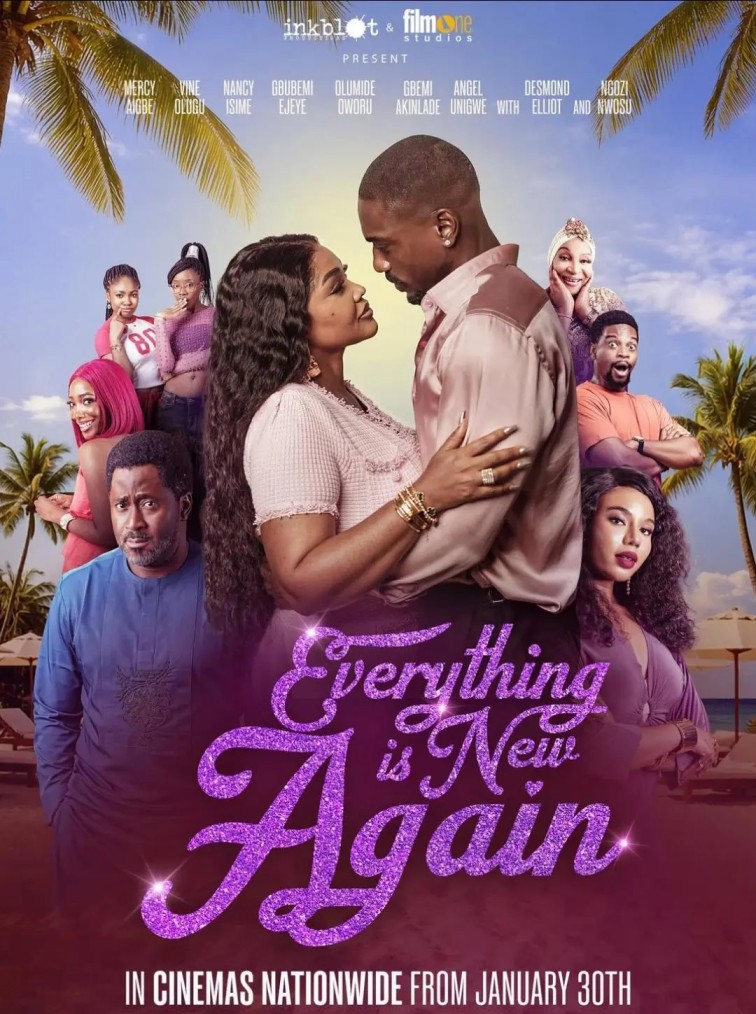
Directed by Inkblot co-founder Chinaza “Naz” Onuzo (The Perfect Arrangement (2022); A Lagos Love Story (2025)), Everything Is New Again stars Mercy Aigbe and Vine Olugu in the love story of 45-year-old Funmi and 27-year-old Ekene. Funmi is a hyperconscious woman spiralling out of control as she watches her ex-husband (Desmond Elliot) marry a much younger woman (Gbubemi Ejeye) in an influencer wedding. Her younger best friend (Nancy Isime) drags her out of bed and to a resort where they hope to improve their moods. There, Funmi meets Ekene, and the rest, as they say, is history.
There is certainly more romance here than in Inkblot’s last outing, the infamous A Lagos Love Story. In Everything Is New Again, we do get moments between the lovers that may not exactly be sparkly, but at least signal genuine interest. There are decently orchestrated scenes where they get to know each other. There is a passable montage through which they settle into familiarity. There is even a cute-enough first dance that earns the film major points despite its abrupt sound mixing.
But ultimately, it struggles to demand emotional investment, and not even the manipulative dialogue can succeed in compelling that investment. The unexpected but unsurprising result of this love affair is unable to achieve the desired effect. And every resolution the film presents registers as unearned.
Wobbly direction aside, the bulk of the film’s problems stem from its evasive engagement with conflict. Everything Is New Again fails because it reduces the age gap, its central conflict, to little more than a prop, repeating its existence over and over again but never really tackling it. The film simply does not sell the stakes.
There are hints that the film is interested in the hypocrisy of treating older man-younger woman pairings more respectably than the reverse, but it doesn’t wade into those waters. It makes a fuss about society’s reaction to age gap relationships only to skip past those reactions or rely on brand new conflicts and distractions—including one bombastic fight at a party—to avoid dealing with them.
Tensions dissolve as quickly as they are stoked, third-party pressures practically disappear into thin air, and even the love birds, who are so far apart in age that there is an entire generation between them, rarely encounter any of the frictions that should be inherent in the gaping difference in both their years of accumulated life experiences.

In fact, this film is so worried about confronting the optics of its controversial relationship that it essentially ruins its attempts at challenging society’s desirability politics. In Everything Is New Again, we have a middle-aged leading woman who is written and performed with an air of self-infantilisation, such that her teenage daughter (played by Gbemi Akinlade) is more grounded than she ever is, even though the film swears that she is a “firebrand”. Then, we have a much younger leading man whose maturity is insisted upon, tempered only by Olugu’s decent hold on vulnerability.
If the age gap were not so palpably obvious, and if the film did not have its characters declare so frequently that its leading man “is just a child”, you would not sense the age gap in the relationship.
What we get is a psychological shrinking of the leading woman, one that serves to maintain the “socially acceptable” perception of heterosexual romance while shielding the age-gapped lovers from any real conflict between them beyond third-party interference. It effectively tears to shreds the film’s own internal politics and converts its unconventional love story into, well, a boringly conventional one.
What is certainly unconventional is how the story unfolds and how the romance progresses. Everything Is New Again is the product of a screenplay by Nicole Chikwe in her feature-length screenwriting debut. Chikwe’s prior screenwriting experience is in TV, beginning her screenwriting career with Showmax’s 2025 original series, Under the Influence. And it shows.


Everything Is New Again is episodic in a way that a feature film simply should not be. If you kept count of every point in this film where it completes a three-act arc and begins the process afresh, you would note no less than five episodes.

Someone objects to the age gap. The screenplay invents a parallel conflict. That parallel conflict gets resolved. The age gap is forgotten. Another person objects to the age gap. The same process plays out. Rinse. Repeat. Everything is new again. But nothing really is.
It truly is unfortunate because films like this are particularly important precisely for their capacity to trigger introspection. What changes when any romance features an older woman? What is so unsettling about it? How does a person, man or woman, navigate a judgmental world while in such a relationship? How do they navigate such a relationship?
Whoever is interested in this discourse would be better off checking out Something Sweet (2025), Dika Ofoma’s indie short from the Zikoko Life anthology. As for this feature-length Everything Is New Again, beautiful people, beautiful bikinis.
Rating: 2.5/5
*Everything Is New Again premiered in Nigerian cinemas on 30th January 2026.
Vivian Nneka Nwajiaku is a writer, film critic, TV lover, and occasional storyteller writing from Lagos. She has a master’s degree in law but spends most of her time watching, reading about and discussing films and TV shows. She’s particularly concerned about what art has to say about society’s relationship with women. Connect with her on X @Nneka_Viv