

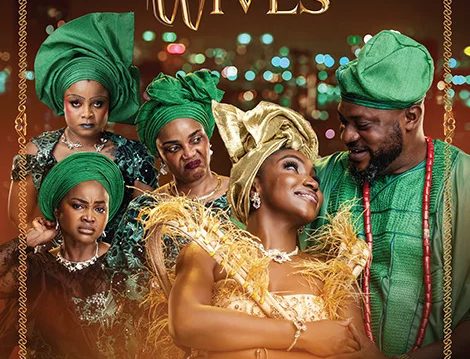

The Secret Lives of Baba Segi’s Wives remains an entertaining domestic drama, enlivened by its dialogue, committed performances and recognisable social dynamics.
By Joseph Jonathan
Adapting a novel concerned with the secrets people keep, as The Secret Lives of Baba Segi’s Wives does, presents a particular challenge: how do you make private thoughts, buried histories and the quiet calculations of domestic life visible without explaining everything? Lola Shoneyin’s 2010 novel finds much of its power in the contradictions of a polygamous household, where women can be both casualties of patriarchy and willing participants in the machinery that keeps it running.
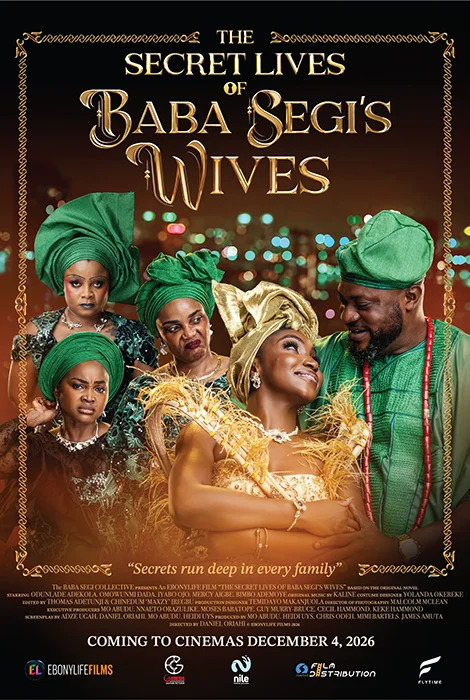
Daniel Oriahi’s film adaptation, written by Oriahi alongside Adze Ugah, Mo Abudu, and Heidi Uys, captures the entertainment value of this arrangement, often with considerable charm, but struggles to preserve the moral complexity that makes Shoneyin’s story so compelling.
The household belongs to Baba Segi (Odunlade Adekola), whose authority rests on the assumption that his wives and children exist within an order he has every right to control. When his fourth wife, Bolanle (Omowunmi Dada), remains childless after two years of marriage, his concern quickly becomes an accusation. A university graduate who arrives with a different set of expectations about marriage and womanhood, Bolanle unsettles a domestic arrangement that has long operated according to its own rules.
Her presence threatens the positions occupied by the first wife Iya Segi (Iyabo Ojo), second wife Iya Tope (Mercy Aigbe) and third wife Iya Femi (Bimbo Ademoye), each of whom has developed a particular way of surviving within the household. Their response is less a united campaign against an outsider than a series of calculations about what her arrival might cost them.
The polygamous household in Yoruba culture is not merely a domestic arrangement, and the film is set in territory with considerable historical depth. In pre-colonial Yoruba society, polygamy served specific economic and social functions — it was a system of labour organisation, resource distribution, and political alliance-building that the colonial encounter and Christian missionary activity began to disrupt without fully dismantling.
Its persistence into contemporary Nigerian life creates a specific cultural friction: the institution now exists in tension with constitutional gender equality, Christian monogamy, and the educational and economic opportunities that have given women like Bolanle access to a different set of expectations about what their lives might contain. The household in this film is not an anachronism. It is the living site of that unresolved friction, and the comedy and tragedy it generates are inseparable from the specific historical moment in which it is staged.
Oriahi understands that the household’s conflicts are fertile ground for comedy. The dialogue is among the film’s greatest pleasures, giving its characters a lively, recognisably Nigerian rhythm and allowing their rivalries to emerge through pointed exchanges rather than exposition alone. There is humour in what people say, what they refuse to say, and how quickly ordinary conversations become contests over status and influence.
The writing gives the actors room to play, and they respond with evident enthusiasm. Adekola is convincing as a man whose confidence in his own authority prevents him from recognising how little he understands about the people around him. Ojo, Aigbe and Ademoye bring distinct temperaments to the wives, while Dada’s comparatively restrained performance gives Bolanle a necessary point of contrast. The ensemble is not always subtle, but its commitment makes the domestic comedy lively and the more emotional confrontations affecting.
The film’s understanding of its characters is most interesting when it resists dividing them into the enlightened woman and the backward wives. Bolanle’s education places her at odds with the household’s established values, but education does not automatically make her superior in every respect. Nor are the other wives merely ignorant women waiting to be rescued from their circumstances.
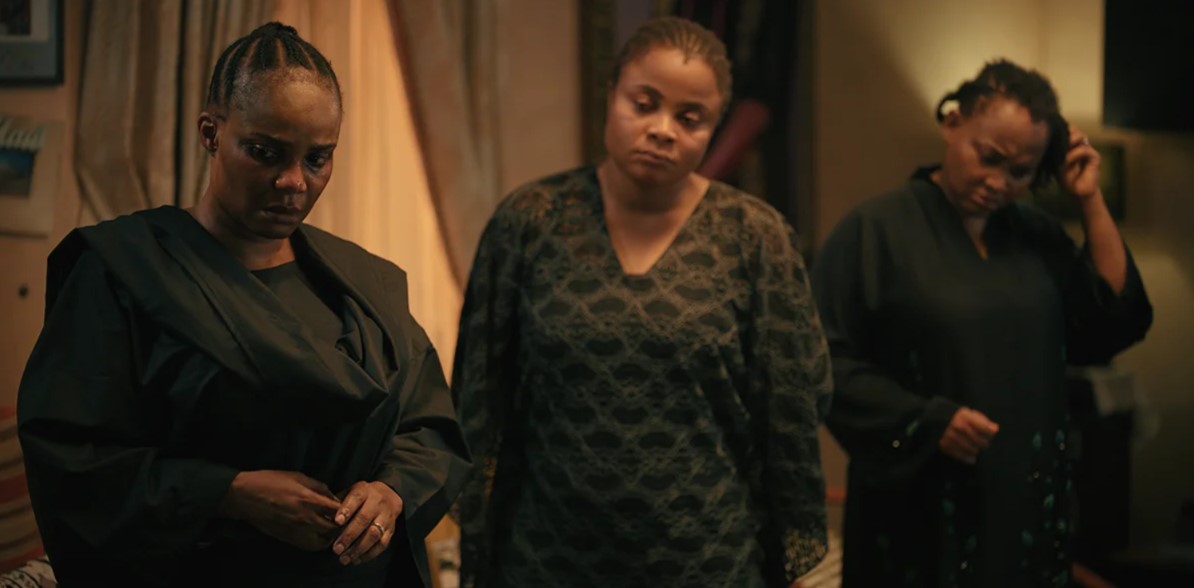
Iya Segi’s control, Iya Femi’s scheming and Iya Tope’s apparent passivity are different responses to a system in which security is scarce, and a woman’s position can depend on her husband, her children and her relationship with the other wives. Their agency is real, even when the choices available to them are constrained. They can be harmed by patriarchy and still inflict harm on one another. This is the story’s most productive contradiction, and the performances communicate it more convincingly than the screenplay’s broader moral framework does.
The production design reinforces the sense of a household with a history. The homes feel inhabited, shaped by the accumulation of objects and domestic details rather than dressed merely to look convincing on camera. Yolanda Okereke’s costume design is especially effective. Clothing initially establishes the wives’ alliances before gradually distinguishing their individual identities as suspicion and conflict pull them apart. These changes are not always foregrounded, but they give the film a visual means of registering shifts in relationships without requiring every development to be spoken aloud.
That restraint is less evident in the film’s use of internal narration. The voiceover occasionally offers access to thoughts that the characters cannot express openly, but it also repeats information that the dialogue and performances have already made clear. The film would benefit from trusting its actors more often. Its pacing suffers from the same lack of confidence: some sequences move briskly between intrigue and comedy, while others linger beyond their dramatic usefulness. The sex scenes are also unconvincing, an unfortunate weakness in a story that places women’s sexuality, reproductive expectations and the unequal terms of marriage near its centre.


As the story progresses, the comedy gives way to more troubling material, including sexual assault, rape, abortion and child death. The death of a child marks a decisive change in tone, after which the film allows its emotional weight to remain rather than quickly returning to domestic mischief. Yet the seriousness of the subject does not always translate into depth of treatment. These events are consequential, but the film rarely explores their implications with the attention they deserve. It can make suffering visible without fully examining how its characters live with it.

The final revelations expose another limitation. Secrets that have sustained the narrative for much of its runtime are eventually disclosed through convenient confessions, sacrificing the dramatic tension of watching carefully maintained deceptions unravel. Shoneyin’s novel has the space to build meaning through interiority and accumulated detail; the film needed a more compelling cinematic strategy for resolving its mysteries. Instead, its conclusion leans towards moral judgment, leaving less room for the ambiguities that make the household interesting in the first place.
The Secret Lives of Baba Segi’s Wives remains an entertaining domestic drama, enlivened by its dialogue, committed performances and recognisable social dynamics. It understands that the women in this household are neither wholly innocent nor simply wicked, but it does not always dare to follow that insight to its most uncomfortable conclusions. The result is an adaptation with plenty of life, flashes of genuine sharpness and a story that deserved a more searching examination.
Rating: 2.9/5
* The Secret Lives of Baba Segi’s Wives had its world premiere at the 2026 Toronto International Film Festival (TIFF) and its European premiere at the BFI London Film Festival.
Joseph Jonathan is a historian who seeks to understand how film shapes our cultural identity as a people. He believes that history is more about the future than the past. When he’s not writing about film, you can catch him listening to music or discussing politics. He tweets @Chukwu2big.