


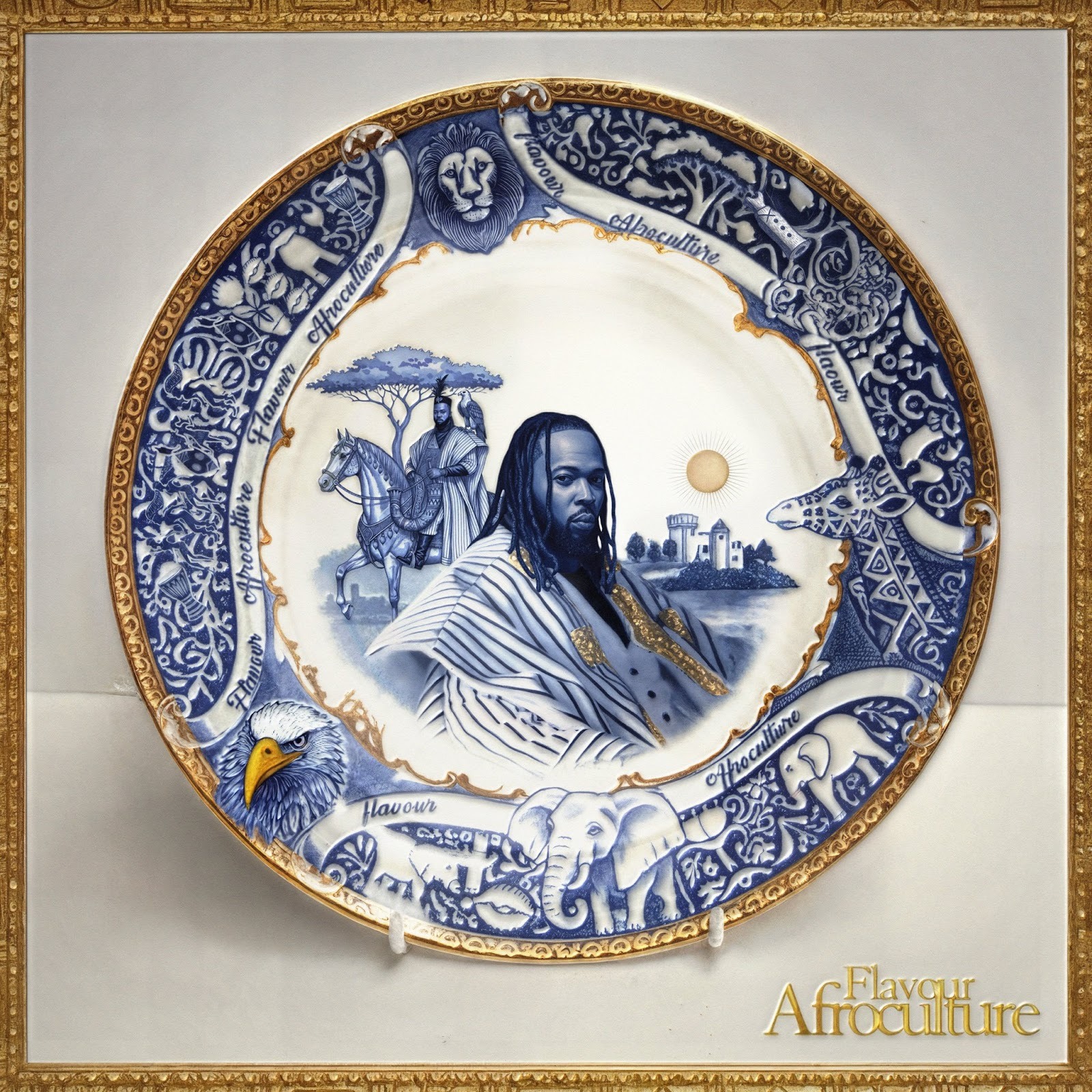
Afroculture stands tall as a highly enjoyable, strongly repeatable, energetic, charismatic, culturally rich, sonically diverse, and technically assured body of work with the potential to elevate Flavour’s standing even further as he steps into this new phase.
By Yinoluwa Olowofoyeku
Flavour, born Chinedu Izuchukwu Okoli, has evolved over nearly two decades into one of Nigeria’s most enduring and influential voices in modern African music. Raised in Enugu State and rooted in Igbo tradition, he began his musical journey at age 13 as a church drummer, a foundation that exposed him early to rhythm, melody, and the gospel choir aesthetic.
He exploded into broader recognition with his 2008 debut album, N’abania, which introduced his seamless blend of Igbo Highlife, Afro-Pop, and contemporary rhythms. His follow-up album, Uplifted (2010), powered by the smash hit “Nwa Baby (Ashawo Remix)” and other standout singles, cemented his place across Nigeria and beyond as a highlife-infused Afro-Pop star.
Since then, Flavour has maintained a prolific output, releasing multiple studio albums, including Blessed (2012), Thankful (2014), Ijele the Traveler (2017), and Flavour of Africa (2020), each exploring different shades of Highlife, Afrobeat, R&B, and contemporary African Pop. His reputation has been built not just on catchy melodies but also on cultural fidelity, singing fluently in Igbo even as he embraces modern production and pan-African collaboration.
In November 2024, Flavour signed a joint deal with Warner Music Africa and Africori, signaling a new chapter in his career with expanded global distribution and resources, a move that positioned him for greater reach than ever before.
Now, at the tail end of 2025, he presents his latest offering, Afroculture, a 13-track genre-blending album with cross-continental collaborations.
From the first notes of “Afroculture”, the album’s title track, it becomes clear what Flavour is aiming for: a wide-ranging fusion of old and new, heritage and modern rhythm. The track opens with tribal percussions, bold brass, the airy layers of female choral vocals, and touches of Igbo flute; all of it recalling native traditions and Highlife roots.
Into this mix comes Senegalese legend, Baaba Maal, whose folk-tinged vocals ride the tribal pulse. As the arrangement builds, Flavour steps in more as a conductor or hype-man, letting the composition’s energy rise around him until the closing brass and drum coda, a cinematic climax that feels like a powerful invocation of African musical unity and ancestral pride.
“Bam Bam”, featuring Pheelz, softens the tone with a cross-generational Afro-Pop texture. The production blends smooth 808 bass with rich percussive elements, and filtered chords that provide a mellow backdrop for lyrics that switch between English, Yoruba, and Igbo. “Is this love, is this love/ I don’t know if it’s true/ I go lie for you my woman?/ Never never/ Ti n ba ni kin soro/ M ga-agwakwa gi obi m o”.
The lyrics are delivered with sincerity and warmth as both men are transfixed in adoration of their love interest. Pheelz’s verse layers in soft soulful tones that complement Flavour’s own sweetness, creating a heartfelt duo that plays well to the strengths of both artists.
On “The Eagle Has Landed”, Flavour returns to his roots in Igbo Highlife. Armed with subtle hints of Soukous, strummed guitars, bass guitar, lively percussions, and live drum rolls frame a party-ready groove. Flavour’s vocals are bright, energetic, and laced with fun ad-libs and backing chorals delivering lines like “Comot body we dey come o/ Nyenu efe na anyi na-aga/ Na na na na na na eh/ The eagle has landed, shut down the city/ The life of the party, shut down the city … Odogwu pass odogwu”. The track feels like a celebration, a space that is undoubtedly a familiar space for him. His confident delivery and braggadocious energy give the track a strong presence on the tracklist.
With “I’m On Fire”, the Highlife energy persists, but the production leans into new hybrid territory. The instrumentation introduces rolling log drums, synth bass, incessant snares, and rattling shakers alongside bright rhythmic guitars and brass sections.
Flavour’s lyrics carry a message of self-confidence and personal triumph with lines like “Shine bright like a diamond, I’m on fire/ Stand tall like a stallion, I’m on fire/ Can’t stop me now, I’m on fire/ Everyday I be winning, I’m on fire … I dey live my life o, on my own terms/ I no send their papa eh.” The track merges danceable rhythm with aspirational themes, staying rooted in Highlife tradition even as it flirts with more modern Afropop-Amapiano-tinged sensibilities that bring its attitude into the new age.
“Pansa Pansa” ushers Afroculture firmly to the dance floor. Gongs, clacking percussion, and 808 drums lay the foundation for a waist-shaking groove. The melodic background remains sparse, pads and light key arpeggios, giving space for vocal repetitions and ululations: “Time to dance eh, time to dance / Igede dance, Igede dance / Shakira my baby, oh my baby / Igede dance, Igede dance … Iyayayayayayaya / Iyayayayayaya … Time to dance, time to dance / Shake your bunda, shake your bunda”.
The emphasis is on rhythm, movement, and unpretentious energy. Guest star, Kizz Daniel, adds his signature swagger and charisma, fitting the track’s mood perfectly. The song ends subtly with piano and soft choral ad-libs, leaving it light as we progress.
“Ada Bekee,” anchored by strummed guitars, swinging drums, and lively percussion, brings Flavour back to another familiar space: romantic Highlife. The focus here is more praise and admiration for a beautiful love interest.
Lines like “What a beautiful fine lady, what a beautiful maami/ She dey glow she dey glow she dey glow/ O mama, e dey show, e dey show, e dey show …Face card no decline, Adaugo m/ Very classy, very demure my bebe eh” ride over warm, welcoming instrumentation that feels comfortable and homey. The guest artiste, Waga G, complements this setting with subtle touches rather than bold interference, letting Flavour’s voice and the welcoming groove remain center stage.
“Orente” tunes the audience toward something softer and more intimate. An electric piano chord progression backed by rattling shakers and mid-tempo Afrobeats percussion underpins a duet between Flavour and Qing Madi. Their voices move in harmony and contrast: Flavour brings clarity and brightness, Qing Madi adds a tender softness. The bass guitar underscores their voices, giving the song warmth and emotional weight. It feels tailor-made for weddings or quiet nights, a smooth counterpoint to Afroculture’s louder moments.
“Big Masquerade (Okukuse)” starts big and bold, pulsing with tribal drums, shaking percussion, and periodic brass stabs that transition the listener through shifting segments. A female choral arrangement anchors much of the background, and at times a male ensemble joins in with tribal chants and ululations. Flavour guides the flow, leading what feels like an audio ritual, part celebration, part spiritual invocation.
The track works as an interlude of sorts, a cultural and rhythmic reset that mirrors Afroculture’s opening, grounding the listener in ancestral energy before the next phase begins.
“War Ready” brings a new, harder edge to Afroculture. Synth bass, saw synths, piano stabs, and aggressive drums form a grungy, triumphant soundscape. Featured guest Odumeje, better known for his pulpit presence, uses his signature rough, commanding voice to deliver a war-cry of defiance: “I am war ready/ I’m a dead man in a battlefield/ I am born ready … Yeah, I’m a born winner/ I’m a big force, I fear no one”. Flavour interjects melodic lines that soften the roughness, but Odumeje remains the focal point. The track feels less like a song and more like a statement, its energy charged with confrontation and danger.
With “Isabella”, the influence of Amapiano becomes clearer. The song opens with smooth piano chords, a growly synth bass, syncopated percussion, and synth stabs. As the song builds, emotional weight is added by featured Brazilian artiste, Azzy, whose rich, sultry voice blends with Flavour’s to create a sense of longing and desire. The lyrics glide over the instrumentation with a sweetness that reflects both love and yearning. Flavour hits high notes, and when his voice strains slightly, it sells the urgency embedded in the song’s emotional core.
“Jidenna” shifts the tone yet again. Reminiscent of 90s kwaito with its synth bass, log drums, electric piano chords, lighthearted drums, and poppy rhythm, the track is uplifting and Gospel-tinged, anchored by joyful choral singing and bright harmonies. The song closes with a lively saxophone solo and a vibrant, triumphant mood that feels celebratory rather than introspective.

With “Big Moves Only”, Highlife dominance returns, this time fully in Igbo and soaked in Odogwu energy. The instrumentation leans on energetic live percussion blended with subtle modern synth bass, traditional flute passages, and sporadic rhythmic guitar riffs. Flavour leads a male vocal troupe through ululations and traditional chants. The sparse melodic contribution – gentle flute and bass – ground the song purely in its rhythmic energy and percussive pulse. It is a track that would resonate at cultural gatherings and celebrations, and stands as a nod to heritage within Afroculture’s broader contemporary sweep.
Finally, “Ife Di Mma” closes Afroculture on a high note. Live percussion and energetic drums meet strummed rhythm guitars and bold brass, grounded by a walking bass guitar and punctuated by modern touches like log drums and rattling snares.
Flavour’s voice carries confidence as he sings on success, work, and reward: “We’re doing good o I say ife di mma/ Accomplishment plenty o por o por/ Doing choke o por o por/ I don work hard o, why I no go chop/ Na who wan fall the man wey God dey stand o”.
The instrumentation gives space for dance and movement, while the brass injects brightness, making this final song both danceable and celebratory. It rounds out the album’s journey, moving from spiritual invocation through love, dance, introspection, and cultural homage, finishing with a statement of fulfillment and gratitude.
Afroculture arrives at a significant moment in Flavour’s career, a point where longevity, heritage, and opportunity intersect. He has been a staple of the Nigerian music industry for years, loved nationwide, firmly tied to Igbo heritage and culture, and celebrated across the country as a cultural ambassador whose artistic identity has never wavered.
His new signing with Warner Music and Africori introduces the possibility of wider reach, continental expansion, and genuine global penetration, the kind of moment where many artists surrender to a homogenised sound in hopes of maximising perceived global appeal. Flavour refuses this temptation.
From its title alone, Afroculture announces itself as a celebration of the continent, an intentional act of upholding and uplifting African identity. This intention reveals itself in the album’s sonic breadth, weaving Amapiano and Kwaito influences from the south with Soukous, Highlife, Traditional West African Folk, and modern interpretations that splash across Afrobeats, Afro-Pop, and Amapiano. It becomes a living amalgamation of African sonic culture, both past and present, both home and away.
The effort is even evident in Flavour’s deliberate inclusion of Yoruba lines and phrases while maintaining an unmistakably Igbo core. The tracklist and the guest list become proof of this mission to combine and celebrate African musical culture, placing everything we are and everything we have been on the pedestal that his recent elevation has provided. And while some listeners might interpret the shifting genres and fluctuating moods as evidence of incohesion, the movement across styles is simply an extension of Afroculture’s central thesis, the thread tying all these expressions of Afro culture together under one roof.
The production becomes the next major pillar supporting this commitment. The team of producers is instrumental in marrying live recording with modern digital and studio techniques to create a hybrid sound that bends genres, merges instruments, and interlaces influences and expressions.
From the cinematic tribal drums that thunder across songs like “Big Masquerade”, to the pulsating Highlife rhythms that anchor the record’s spirit, to the subtle inflections drawn from Amapiano and the crisp polish of contemporary Afro-Pop sensibilities, Afroculture turns itself into a sonic melting pot for African musical language.


The engineers rise to the not-so-simple challenge of blending these varied inputs into a technically cohesive final product, especially when balancing the wealth of vocal chorales against lead vocals and layered instrumentals.
The vocals across the project elevate that ambition even further. Every performance is delivered with intention and flair. Flavour and his guests consistently bring their strengths to the forefront, from the soft tenderness of Qing Madi and Azzy, to the gruff, emphatic power of Odumeje, to the bold swagger and effortless charm of Kizz Daniel and Pheelz.
The choral arrangements become essential to Afroculture’s communal feel, filling the songs with harmonies, fluid vocal runs, and carefully blended voices that display range and versatility. These performances sit so comfortably within the production that they paint bright emotional colours across the album’s instrumental canvases.
Flavour’s own vocal prowess remains undeniable. Even while he stays largely within his comfort zone, there are dig-deep, belting moments scattered throughout the project that remind listeners of just how formidable a vocalist he is when the moment calls for it.

If there is any space for critique, it appears in the album’s lyricism. The themes explored are familiar, leaning into the run-of-the-mill standard fare of love, success, gratitude, more love, celebration, and confident braggadocio.
These topics are the well-known tropes of the genres Flavour moves through, but they still leave room for lyrical exploration and depth, especially from an artist as established as he is.
There were opportunities to shed a bit more light, to offer more context, to dip into more nuanced storytelling. Most of those opportunities are passed over in favour of expected phrasing and tried-and-tested lines. Nothing here is subpar or disappointing, and in some songs, sticking to the familiar is actually the better option since the desired outcomes lean toward either danceable energy or quiet introspection.
With Afroculture’s strong sense of movement and the sheer quality of performance on display, listeners are unlikely to notice unless they actively seek deeper lyrical meaning. The songs remain quotable, and certain lines may yet slip their way into the public consciousness because of how seamlessly they sit amidst all the surrounding musical elements.
With that small critique aside, Afroculture still stands tall as a highly enjoyable, strongly repeatable, energetic, charismatic, culturally rich, sonically diverse, and technically assured body of work with the potential to elevate Flavour’s standing even further as he steps into this new phase. It becomes a bold assertion of cultural grounding, the gesture of an ambassador offering the best of his home and his people to the world, showing the power of what they have created and the way it continues to bring people together.
Afroculture reaffirms that in a rapidly globalising world, the answer is not to abandon the beauty already in our hands. There is still much value to be found in it, much worth carrying forward, and Flavour arrives at this moment determined to share that worth with anyone willing to listen.
Lyricism – 1.3
Tracklisting – 1.5
Sound Engineering – 1.8
Vocalisation – 1.5
Listening Experience – 1.6
Rating – 7.8/10
Yinoluwa “Yinoluu” Olowofoyeku is a multi-disciplinary artist and creative who finds expression in various media. His music can be found across all platforms and he welcomes interaction on his social media @Yinoluu.