

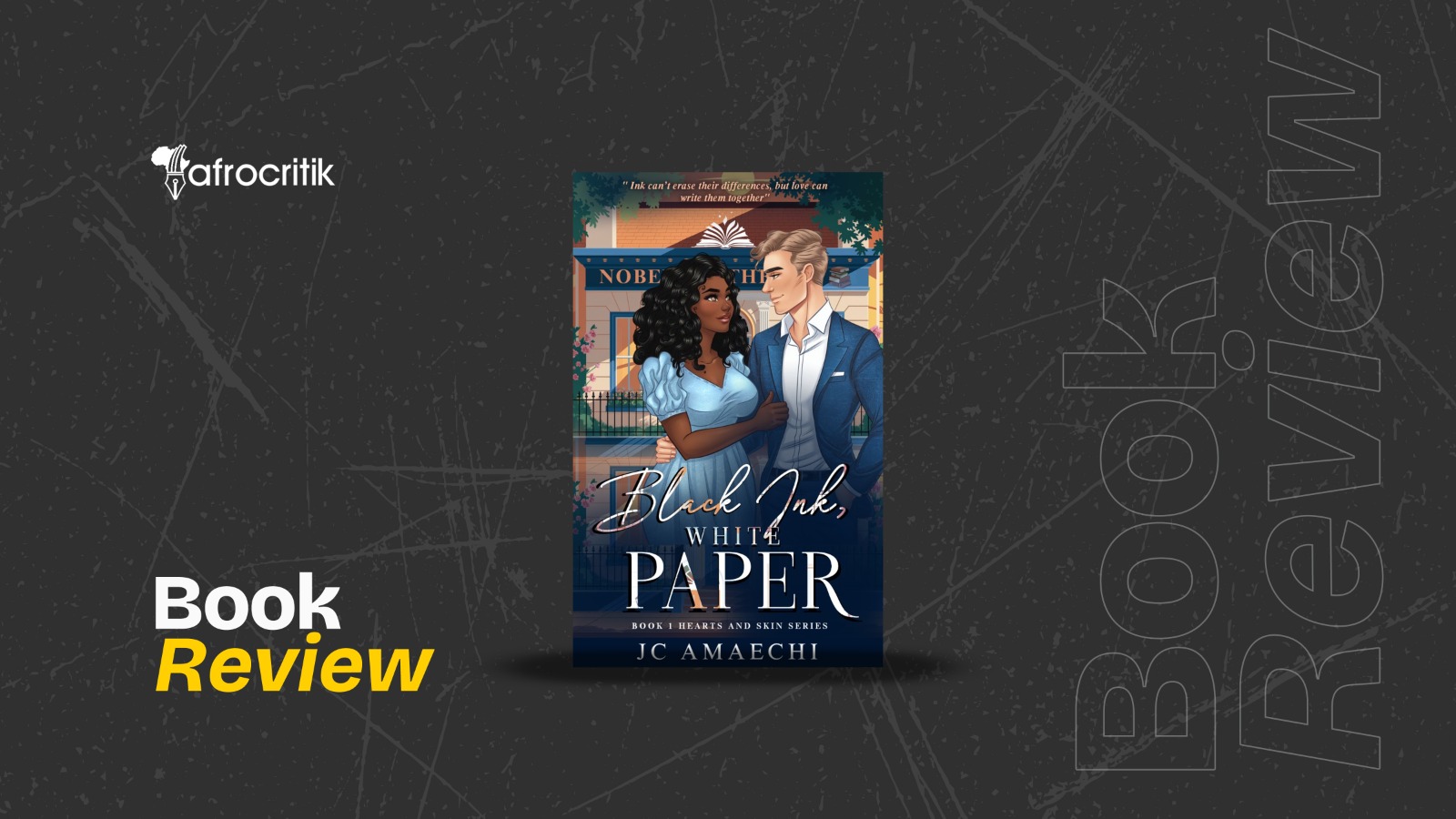

As familiar as the surface premise of Black Ink, White Paper is, the author succeeds in keeping us entirely invested in the developing love affair between the characters.
By Chimezie Chika
JC Amaechi’s debut novel, Black Ink, White Paper, the first book in the Heart and Skin series, begins with something unfamiliar in many romances: social incontinence. But do not be carried away, for you will realise quite quickly that this is a story that has all the trappings of a messy, uncertain, complex, yet rousingly earth-shattering romance.
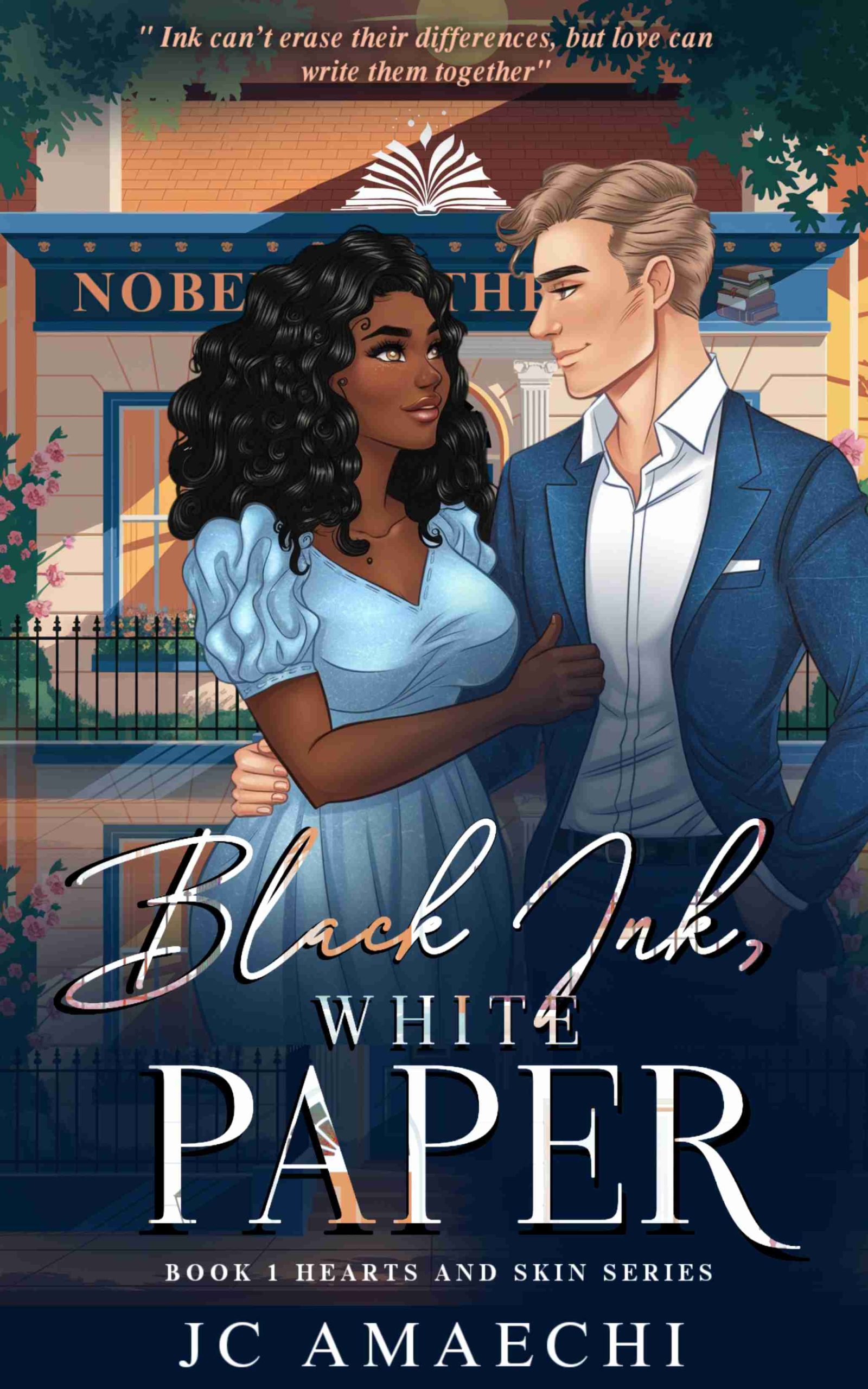
As the novel begins, Kambili Simpson, a strikingly beautiful Nigerian immigrant in London who is desperately on the hunt for a job, has an interview at Nobel Feathers, the most renowned publisher in the UK, with an incredible 99% bestseller success, according to the novel. Several misfortunes cause her to be late to the interview, whereupon she encounters a major racist resistance in the company receptionist upon her arrival, from which she was rescued by the incredibly good-looking Harry Cooper, one of the extremely handsome, nearly 7ft tall Cooper brothers, whose family owns Nobel Feathers.
Harry Cooper then takes Kambili to the interview room and goes away. During the interview, Kambili comes face-to-face with another dashingly handsome Cooper, Taylor Cooper, who is the actual CEO of Nobel Feathers Publishing. Intimidated by his unyielding presence, she soldiers on with the interview, which she ultimately fails to ace after Cooper coldly dismisses her.
Weeks later, Amber, Kambili’s upper-class best friend, asks her to be her company to a gala that has the crème de crème of London society in attendance. There, feeling out of place amidst the wealthy, Kambili’s natural nervousness gets the better of her, and the rather convenient—authorially orchestrated—misfortune that ensues causes Harry Cooper to come to her rescue a second time, claiming her to be his girlfriend. This event set off a chain of events that saw her return to Nobel Feathers as an intern, making natural enemies along the way who consider her adversaries or, more pointedly, an obstacle to the affections of the Cooper brothers.
By this point in the story, the author had set the stage for a long, messy entanglement that finally dominoes into the real love and attraction that had been there all along. The love affair is long, has several pauses, twists, false starts, and misleading leads.
In short, it’s easy to see how exciting these kinds of situations can be in the right circumstances, for the reader who wants a typical soap opera romance. If a reader is looking for a complicated and long-winded yet fast-paced love story, then Black Ink, White Paper meets the criteria.
Perhaps the most interesting part of Kambili’s problems, the origins of it, really, is her immigrant status. She’s an immigrant in London. She’s a new, broke graduate, barely getting by, with a few months left before her visa expires. And only a proper visa-sponsorship job stands between her and a likely deportation. Kambili’s desperation and messy emotions are therefore thoroughly justified. It makes our protagonist the most interesting character in the book when we juxtapose her against the overwhelmingly white world in which she finds herself.
Racism follows Kambili almost everywhere she goes. Sometimes it makes sense, sometimes it doesn’t, such as with some of her colleagues at work. The point of many of those situations seems to be to put Kambili in the position of a victim. The author has several other tricks up her sleeve that have us second-guessing situations we might seem certain of at first, best of all, the Harry/Taylor entanglement.
Black Ink, White Paper’s 500-page content never feels clunky. The prose flows, at least, and Kambili’s first-person narration carries its subject with a light touch. The author’s language is simple, which allows us to focus entirely on the events of the novel without being distracted. It works particularly well for the love scenes.
This book is written with an obvious deference to an international readership. This very fact is seen in—and influences—the kinds of creative choices the author makes, even when presented with more complex but perhaps socially problematising openings. Everything seems to revolve around the white, privileged men at the centre of the narrative. Some of the social and ethnic/African characteristics that would’ve made many of the racist situations in the novel more meaningful are almost totally forgone in Kambili’s case.



Where Black Ink, White Paper succeeds is in showing us how familiar romances can still be riveting, hold our attention, and leave us wanting more, a la Bridgerton. Like the famous book and TV show, there is a lot of wealth and the trappings of wealth, and the longing for wealth skulking and gallivanting through the pages of this novel, which is quite a familiar trope in much contemporary city romance. Often, the premise is either rich meets rich, poor meets rich, or a poor but secretly rich person meets a rich person or a poor lover. As familiar as the surface premise of Black Ink, White Paper is, the author succeeds in keeping us entirely invested in the developing love affair between Kambili and Taylor.
This concentrated fixation on wealth is one of the things that makes romance more or less escapist fantasy. It allows its amenable readers to descend into a realm where perfection — or the promise of it — is not far from quotidian life—the possibility that a woman’s best and most secure desires for love and romance can be met is what it often rests on. If one can’t have it in real life, then fiction should come to the rescue. JC Amaechi understands the precise need of such long-drawn, almost fantasy romance and makes the most of it.
Black Ink, White Paper appears to explore the idea that women are sometimes drawn to complex or flawed men, often more than to their “nicer” counterparts. Within the novel’s simple, ink-and-paper world, traits such as charm, wealth, and physical appeal seem to play a significant role in shaping attraction, occasionally allowing other character flaws to fade into the background.
This is the impression one gets from the lives of Kambili and her best friend, Amber. Kambili herself is portrayed as having a weakness for handsome men (as do many of the women in the novel). She dwells on almost every good-looking man around her (uses the word “hot” almost every time) in a way that throws up plot possibilities at every turn, but which still gives this reader an air of incredulity.
Nonetheless, for romantics looking for the next engrossing read that does not dwell too heavily on things outside its central romantic entanglements, Black Ink, White Paper offers all the thrills, with its page-turning prose, love triangle, and a somewhat familiar story. Black Ink, White Paper gives Nigeria’s resurgent romance genre a boost.
Chimezie Chika is a staff writer at Afrocritik. His short stories and essays have appeared in or forthcoming from, amongst other places, The Weganda Review, The Republic, The Iowa Review, Terrain.org, Isele Magazine, Lolwe, Fahmidan Journal, Efiko Magazine, Dappled Things, and Channel Magazine. He is the fiction editor of Ngiga Review. His interests range from culture, history, to art, literature, and the environment. You can find him on X @chimeziechika1