

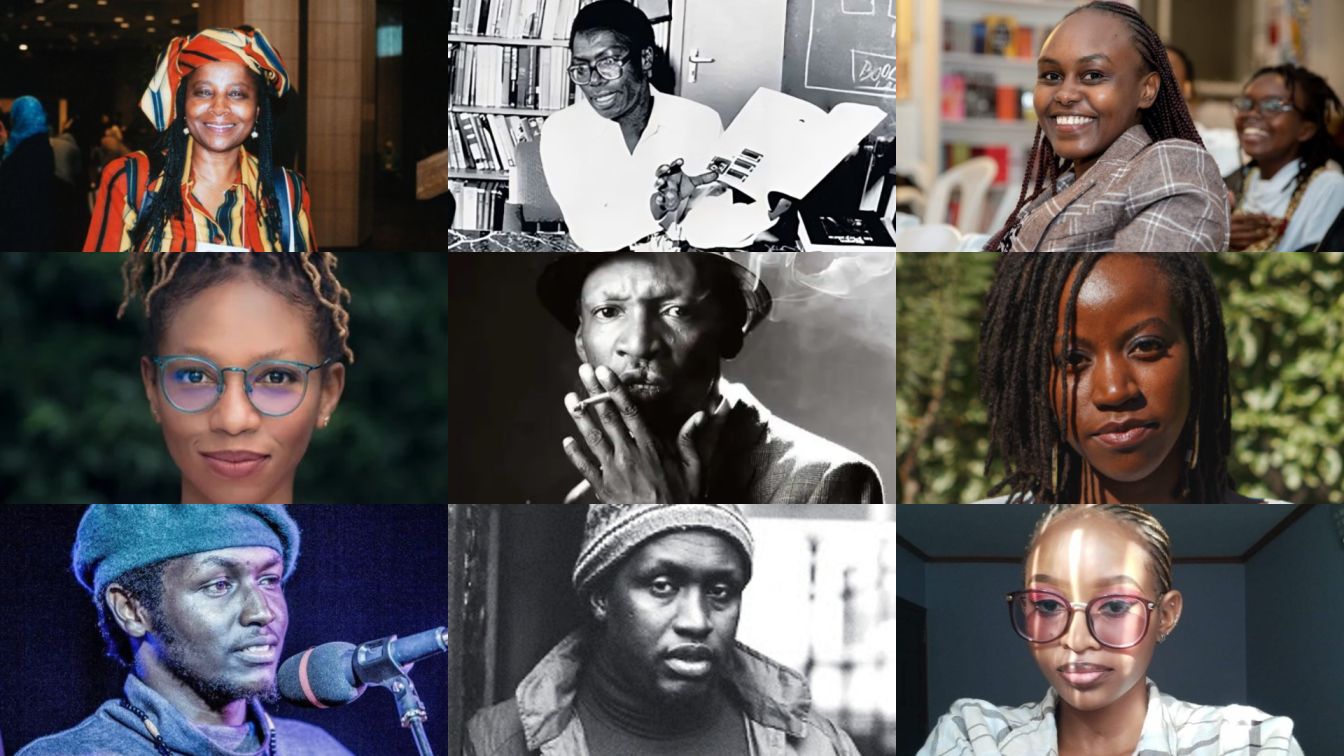


The territory of Kenyan poetry has contracted from the nation to the self, and the contraction is deepening as the country’s poems eventually follow the human being inward, pursuing the last frontier of unexpressed truth.
By Frank Njugi
Sometime in 2024, at an event organised by the Kenyan literary group Qwani, I found myself leaning into a microphone as Dorphanage, a preeminent voice in the Kenyan literary landscape and a luminary of the East African poetic renaissance, delivered Hii Poetry — a piece whose line, “Hii poetry si hobby, hii poetry ni jukumu. Siku moja huyu poet ataishia but hii poetry itadumu”, burrowed into the room and refused to leave. That sentiment, that the poet is mortal but the poem is not, did not originate in Nairobi. It echoes directly from Mutabaruka’s Dis Poem (Shanachie Records, 1986), a Jamaican dub-poetry classic that insists, across decades and oceans, that a poem belongs to no single throat.
The chain of inheritance is itself the argument: art is the one contract between the living and the unborn, the sole currency through which a mortal being purchases a claim on eternity. Of all the art forms available to human beings, none compresses this bargain into a smaller, more devastating space than poetry does, and none is as capable of saying the unsayable with such brevity and such force.
It is against this understanding of poetry as eternal witness that the story of Kenyan verse becomes so charged. The voice of the Kenyan poet has never stood still as it once moved through the forests of the Aberdares, coded and collective, a weapon wrapped in song and today it leans into the microphones of Nairobi’s venues, intimate and individual, but no less urgent. Kenyan poetry, across its history, has functioned as a socio-political mirror, evolving from a collective tool of resistance into a vehicle for individualised expression, yet never losing its fundamental conviction that the poem will outlast the poet.

Historical conviction serves as the ultimate validation of that claim, illustrating how, throughout the 1950s and 1960s, poetry did more than passively endure and functioned as a vital tool for survival. The poetry of Kenya’s liberation struggle was forged in the forests of the Aberdares and on Mount Kenya, passed between guerrilla fighters and village support networks in coded verse, and deployed as intelligence, oaths, spiritual sustenance, and a weapon.
At the heart of this poetry lay a theological conviction about land. In Agĩkũyũ cosmology, ithaka — the earth — is divine inheritance, a gift from God that binds the living to their ancestors and to their descendants. Colonial land alienation had severed the sacred relationship, reducing a people, as the oral tradition anthem framed it, to tenants in their own house. One anthem was Wĩyathi na Ithaka, a rallying cry song of the Mau Mau freedom fighters in colonial Kenya, who united the Gĩkũyũ words for “freedom” and “land” to express the core demands of their armed struggle against British rule. It made this explicit, its lyrics indicating the colonial theft of the fertile highlands with the directness of scripture: To sing the song’s lyrics was to perform a religious and moral reckoning.
The British colonial state, aware of the mobilising power of indigenous assembly, banned traditional gatherings and political organisations. Resistance poets responded with a brilliant act of cultural judo: they took the tools of the coloniser and turned them inside out. Missionary hymns, taught in church to songs of Christian salvation, had their lyrics quietly replaced. A Presbyterian melody praising Jesus was rewritten to praise Jomo Kenyatta or Dedan Kimathi; a hymn about the path to heaven became a chant about taking the mũuma, the oath of unity that bound fighters to the cause. Traditional performance forms — such as the mũthĩrĩgũ and the erithi genres of poetry — functioned simultaneously as both ceremony and archive, holding the community’s trauma and history in their rhythms when no written record was safe to keep.
Perhaps the most elegant feature of this poetry was its linguistic architecture. The colonial police monitored speech, and so resistance literature developed a system of layered metaphor that could pass the inspection of a British administrator standing in a village square while delivering precise strategic intelligence to those with ears to hear. The mũgumo fig tree, to an administrator, was simply a large native tree. To a fighter, it was the unyielding spirit of African sovereignty. A reference to “the clearing of rains” was a weather observation to one listener and an announcement of the British departure to another. “The Shield of Mũmbi” invoked ancient folklore on the surface and active guerrilla defence beneath it. Another Mau Mau anthem Twarĩkanĩire — We Had Agreed — deployed the image of a heavy log being carried across a river, those who dropped it and fled representing, with devastating precision, the Home Guards, the colonial loyalists whose betrayal was the wound that cut deepest.
This poetry did not vanish when independence arrived. It required a literary framework to recognise and legitimise what it had always been. That framework arrived, obliquely, from Uganda: Okot p’Bitek’s Song of Lawino (1966), which used the long oral poem to stage a fierce argument against cultural assimilation and the abandonment of African roots, gave writers across the region both a permission and a model. In Kenya, it was Ngũgĩ wa Thiong’o and Micere Githae Mugo who most deliberately pulled the oral energy, the rhythmic defiance, and the raw political urgency of the forest poems onto the global literary stage, insisting, as the Mau Mau poets had before them, that the poem was not decoration but was testimony and resistance.
****
There is a particular kind of grief that has no name in English, and that is the grief of a dream that arrives and immediately begins to rot. Kenya achieved Independence in 1963, and within a decade, the poets who had inherited the fire of the liberation struggle found themselves writing in mourning. The British administration had departed. What replaced it was, in structural terms, indistinguishable from what it replaced: land grabbed by a new political elite, the Mau Mau veterans left landless and unrewarded, and the ordinary citizen returned to the condition of being tenants.

The post-independence era produced what might be called Kenya’s literature of the betrayed dream. The poets of the Kenyatta and Moi regimes were largely in university corridors, and the danger they faced was not from colonial administrators but from a domestic surveillance state that proved equally ruthless. Under the Nyayo era, political dissent invited arbitrary detention, interrogation in the torture chambers beneath Nyayo House, Nairobi, and years of imprisonment without charge.
The poem, accordingly, put on a disguise. Where Mau Mau verse had used coded metaphor to slip past colonial censors, post-independence poetry buried its politics under layers of academic irony and allegorical abstraction. The crocodile in a poem was just a crocodile until it was the predatory political leader draining the nation’s resources. The drought was just a drought until it was the intellectual and economic stagnation produced by one-party rule.
No figure embodied the cost and the conviction of this era more than Ngũgĩ wa Thiong’o. Already recognised for his novels, Ngũgĩ arrived in the 1970s at a conclusion that was as literary as it was political: that writing in English was itself an act of mental enslavement, a continuation of colonial conquest by cultural means. His pivot to Gĩkũyũ — in poetry, theatre, and fiction — was a declaration of allegiance to the working class that the independence dream had abandoned.
The performances at Kamĩrĩĩthũ Community Education and Cultural Centre brought this poetic philosophy into direct contact with ordinary people. The state’s response was swift and instructive as Ngũgĩ was detained without trial in 1977 and eventually driven into an exile that would last decades. That the government found a community theatre project threatening enough to imprison its author tells you everything about the power it understood art to hold.
Another poet of this era, Jonathan Kariara, worked at a different register, as quieter but elegiac. His poem, “Grass Will Grow”, his most famous work, does not shout about corruption or dictatorship but observes, with a scholar’s precision and a mourner’s sorrow, that structural violence does not disappear when its architects change but simply changes faces. Where the Mau Mau poets thundered, Kariara whispered, and sometimes the whisper carried further.
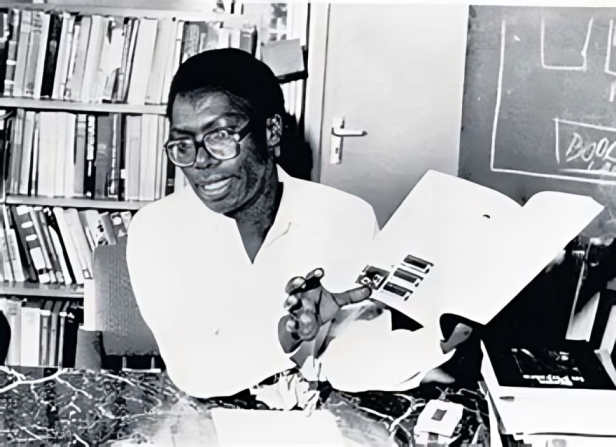
Micere Githae Mugo brought a different pressure: a Marxist-feminist lens that insisted the betrayal of Independence was not only political but also patriarchal. Her poetry argued that no liberation was genuine while women and the poor remained structurally subjugated, and she paid for her arguments with exile in 1982, continuing to write from abroad in verses that fed the underground pro-democracy movement.
That underground found its most urgent form in the Mwakenya movement, an acronym for Muungano wa Wazalendo wa Kenya (Union of Patriotic Kenyans). It was a socialist movement that evolved from the December Twelfth Movement, another underground socialist organisation established by progressive intellectuals and university academics, including figures like Ngũgĩ wa Thiong’o. When Moi, Kenya’s second president, declared Kenya a one-party state in 1982 and criminalised open dissent, poetry did what it had always done when cornered and went to ground.
Mwakenya cells composed raw, uncensored political verse and printed it onto anonymous leaflets, which were dropped in public markets, bus stops, and university lecture halls under cover of darkness, passed hand to hand in complete secrecy. Unlike the polished ironies of the academic journals, the poetry was blunt in speaking directly to the working class. Possession of one of these pamphlets was treated by the state as treason. The gap between that fact and the fact of their continued circulation is perhaps the clearest evidence available that the Mau Mau poets had been right that the poem does not die when the poet is arrested. It continues its rounds.
What separates this era from the one before it is not the courage of its practitioners but the nature of the enemy. The previous poets faced a foreign oppressor whose illegitimacy was, for the community, self-evident. The post-independence poet faced something more psychologically complex: a home-grown authoritarianism that had appropriated the language of liberation. The oppressor now spoke your language, quoted your martyrs, and wore your flag. To write against that required not just bravery but a particular kind of clarity and the ability to look at a feast and name it, precisely and without flinching, as a famine.
****
Every era of Kenyan poetry has had its distribution network. From the forest chant, the subverted hymn, the pamphlets dropped at the bus stop under darkness. What changed at the turn of the millennium was not the urgency of the message but rather the infrastructure through which it travelled. The internet arrived. The mobile phone arrived. The slam stage arrived. And Kenyan poetry, which had spent decades in the university corridors and underground cells of resistance, returned aggressively to the streets and became more deliberately accessible than it had ever been.
The bridge between the post-independence literary underground and the contemporary spoken word movement was built, somewhat unexpectedly, by hip-hop. In the late 1990s to early 2000s, collectives like Kalamashaka and Ukoo Flani Mau Mau — whose very name invoked the forest freedom fighters — were doing in Nairobi innercity estates such as Dandora and Huruma what the Mwakenya cells had done with their pamphlets: producing urgent, uncensored political verse for the people most directly affected by state failure, and they distributed through a medium the establishment had not yet learned to censor. Their verses documented police brutality and extrajudicial killings with the specificity of testimony, not the abstraction of allegory. They did not need a metaphor.
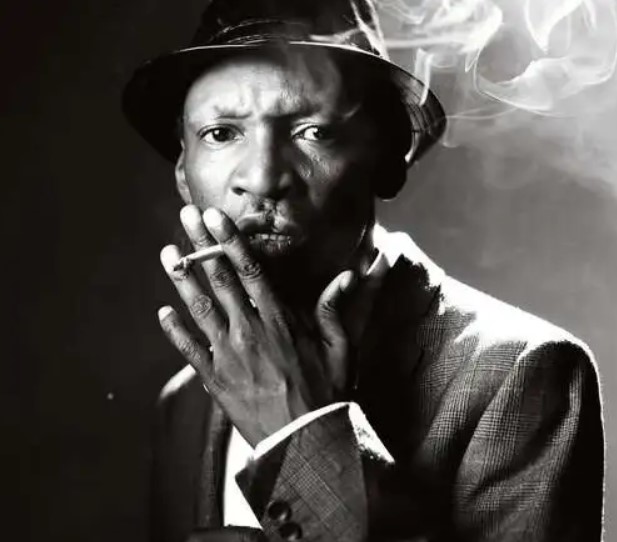
Lyricists like Kitu Sewer pushed the form further, treating the hip-hop verse as a philosophical instrument, his verses rhythmic, densely imagistic, and unambiguously rooted in the lived experience of the urban poor. This lineage runs directly forward to Dorphanage, whose work has continued to evolve the tradition into something that holds within it mental health, economic precarity, digital identity, and the particular psychic weight of surviving in contemporary Nairobi.
Central to this revolution was a linguistic one. Most of the poets of the Nyayo era had written in formal English — a language that, for different reasons, both required a kind of initiation to fully receive. The urban boom poets reached instead for Sheng: the fluid, rapidly evolving creole of Swahili, English, and indigenous languages that had developed organically in Nairobi’s informal settlements as the linguistic signature of a generation that refused to be contained by any single colonial inheritance.
Poetry in Sheng was an epistemological declaration that the knowledge and experience of the street was as valid as anything produced in a lecture hall, and that poetry written in the language people actually spoke was more honest and more powerful than poetry written in the language they were taught to perform. Where the academic poets had used linguistic complexity as armour, the spoken word generation used linguistic fluidity as an open door.
The institutional platforms that enabled this shift deserve more than a footnote. Kwani?, the literary journal and collective founded by Binyavanga Wainaina in 2003, was perhaps the first establishment-adjacent space in Kenya to insist, seriously and in print, that Sheng and urban street voices belonged in the same conversation as formally published poetry. Slam Africa introduced the competitive poetry slam to East Africa in 2008, transforming the poet from a solitary figure hunched over a desk into a performing artist whose craft was measured in real time by a live audience.
Two years earlier, in 2006, Wapi — Words and Pictures, organised by the British Council — had become a monthly underground incubator where hip-hop artists, graffiti writers, and slam poets found each other and discovered what their disciplines shared. These spaces did not create the movement, as the movement was already happening in the streets and the cyphers. But they gave it a stage, and the stage gave it a public.
The performance itself became a formal consideration. Where post-independence poetry was designed to be read slowly and decoded, the spoken word poem is designed to be experienced in the body, in the poet’s vocal inflections and silences, and in the physical theatre of a figure behind a microphone working a room. This is, of course, a return to the rhythmic chanting of the Mau Mau songs, to their defiance dances, and to the deep oral tradition that formal written literature had spent decades trying to contain. The contemporary Kenyan slam poet stands, in some sense, at the confluence of every distribution network— the forest, the pamphlet, the journal, the stage— and synthesises them into something immediate, multilingual, and impossible to ignore.
****
The Mau Mau poet fought for the land beneath their feet. The post-independence poet fought for the integrity of the nation being stolen from them. The slam poet fought for the dignity of the street they lived on. Each era located its battleground in an external geography, from the forest to the state, and then the city. But something has changed in the last fifteen years, as Kenyan poets have done the inward turn: the battleground is now the body itself, the mind, and the private history carried in the bones. The resistance, in 2026, is the act of telling the truth about what it costs to be a person.
This shift is not a retreat from politics. It is a recognition that the political has always been personal, that the state’s failures do not only manifest in land grabs and police brutality but in the depression of a young person in Nairobi who cannot name what is wrong with them because the culture has no language for it, or in the queer Kenyan who must love in hiding in a country which treats their desire as criminal, in the daughter who inherits her mother’s grief and her grandmother’s silence and has to figure out, alone, where the wound began. Confessional poets are doing what every generation before them did, which is bearing witness. They have simply moved the site of that witnessing to the interior.
The trailblazers of this transition worked at the threshold. Blue Mothertongue (Kwani Trust, 2010), Ngwatilo Mawiyoo’s critically acclaimed debut poetry collection, mapped the charged space between structural geography and domestic intimacy, moving through Nairobi and the African diaspora with a poet’s precision, finding in the textures of urban life and coming of age the irreducibly human, and in the irreducibly human, the quietly political.
Clifton Gachagua’s Madman at Kilifi (2013), winner of the first Sillerman Book Prize for African Poetry, broke open what Kenyan poetry could say and how it was permitted to say. His work was surreal, sensual, and fluid; his subject matter included somatic vulnerability with a directness that had no real precedent in the formal Kenyan literary tradition. Where the Nyayo-era poets had required a decoder, Gachagua offered himself: the poems were specific, strange, and inhabited by a poet who refused to disappear behind his own imagery.
Other poets such as Michelle Angwenyi, who was shortlisted for the 2018 Brunel International African Poetry Prize and is the author of the chapbook, “Gray Latitudes”, included in APBF’s New-Generation African Poets: A Chapbook Box Set (Saba), brought cinematic meditations on memory and ecological softness, with some of her poems moving the way time on earth actually moves in half-glimpsed traces.
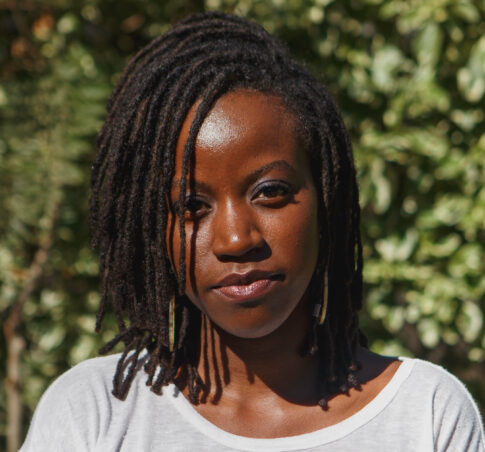
Another such poet, Bethuel Muthee, a member of Maasai Mbili Artists Collective and a member of the collective Naijographia, arrived with a more abrasive instrument, fusing the physical decay of the urban environment with the psychological disintegration of the individual trapped inside it.
The 2020s have deepened this excavation. Naomi Nduta Waweru has emerged as perhaps the most precise practitioner of the contemporary confessional mode, her poems constructing out of bodily imagery an architecture for grief that resists sentimentality while remaining devastatingly tender. In poems like “Spine” and “As Promised”, both in Agbowo, she writes about loss with a clarity that feels almost clinical until it doesn’t, until the precision breaks open into something the reader recognises from their own interior. Her observation that breaking also happens inside us, that a crack can be internal and unreachable, seems to name an experience that Kenyan poetry may not have, until recently, permitted itself to name.

Another confessional poet, Salama Wainaina, works at a different edge, the place where private trauma meets public rot. “Portrait of a Broken Blade” in Zambia’s Ubwali magazine examines familial addiction and child vulnerability with a transparency that is almost unbearable; “Inheritance of Rot” in Brittle Paper sees her trace how a country’s accumulated violence settles into a body and psyche, passing itself forward through generations like a gene. What Wainaina understands, and what distinguishes the best confessional work from mere autobiography, is that the self is not separate from the state. It is the state’s most intimate address.
The platforms through which this poetry circulates have changed accordingly. Literary spaces like Lolwe, Down River Road, and 20.35 Africa have created ecosystems in which this work finds its readers without requiring the gatekeeping of traditional publishing, a democratisation that echoes, in a different key, what Slam Africa and Kwani? did for a previous generation. The poem travels now at the speed of a notification and does what it has always done, which is to tell someone they are not alone in what they are carrying.

All the eras of Kenyan Poetry describe a single unbroken movement, from the forest to the cell, from the cell to the street, from the street to the body. The territory of Kenyan poetry has contracted from the nation, to the city, to the self, and the contraction is a deepening. The country’s poems have eventually followed the human being inward, pursuing the last frontier of unexpressed truth, which has always been the most dangerous and the most necessary territory to map.
The story of Kenyan poetry, at its core, is a story about the shrinking and deepening of a pronoun. The Mau Mau poet sang we — a collective we that was also a weapon, a declaration of shared land, shared blood, and shared grievance. The post-independence poet began to feel the we fracture, to notice that the liberation had been distributed unevenly, and so the voice became more pointed, more ironic, more suspicious of its own solidarity. The slam poet stood on a stage and said I — but an I that still spoke for the street, for the generation the nation had failed. And the confessional poet has turned the I inward entirely, discovering that the last uncharted territory was not the nation, not the city, but the self, and that the body was a political document, that the mind was an archive, that the poem’s final frontier was the truth a single human being had been carrying alone in the dark.
This is what Dorphanage meant, even if he did not mean it in every dimension it has turned out to hold. Hii poetry ni jukumu. Poetry is a duty — not only to the nation or the street or city, not only to the self, but to the full, unbroken chain of testimony that connects the MauMau singers to the young poet uploading a poem on Substack in 2026, certain of nothing except that the poem must be written or performed.
The poet will end. The poetry will not. And somewhere in that gap — between the mortal voice and the immortal work — is where Kenyan literature has always lived, and where it continues, with gathering force, to speak.
Frank Njugi is a writer, poet, and journalist from Naivasha, Kenya. His accolades include a nomination for the 2023 Pushcart Prize and recognition as a runner-up in the 2023 ILS– Fence Fellowship. He has also previously been awarded the Sevhage-Agema Founder’s Prize, the Jay Lit Prize for Non-Fiction, and was shortlisted for the 2025 Rajat Neogy Editorial Fellowship. Njugi is an alumnus of the Nairobi Writing Academy, a 2024 African Writers Trust Residency Fellow, a 2024 and 2025 International Literary Seminar Fellow, and a 2026 Macondo Literary Festival TBI residency fellow. He is also the author of a poetry chapbook, Ujana (INKSPIRED, 2024).