


Yet what survives these intellectual revolutions within workshop culture, I believe, is rarely their philosophical ambition. What survives is a portable lexicon of craft, detachable from the theoretical disputes that originally animated it.
By Felix Eshiet
The Oxford English Dictionary (OED) defines a “workshop” as “a seminar or meeting for concerted discussion, practical work, and skill application in a particular field”. In the literary context, the workshop as used in this essay could mean Creative Writing programmes (MFA and non-degree), poetry retreats, residencies, masterclasses, craft laboratories, editorial fellowships, writers’ conferences and bootcamps, etc.
Every generation believes it has discovered a keener way to read. And what distinguishes literary cultures from political ones is that their dogmas rarely come off as dogmas. They, by the most forgiving account, appear instead as sensitivities and refinements of perception that are developed, almost imperceptibly, rather than argued for, until they seem indistinguishable from intelligence itself.
There is, nowadays, an ease in the mainstreaming of run-of-the-mill, cookie-cutter, nondescript judgments in editorial culture that has acutely bad-dye-leaked into educated readership; too perfunctory, if not admonitory, to be useful. Hypothetically, an educated reader (my poet-critic friend Oluwatunmise Akigbogun calls them practising readers, readers with stamina and credentials) could turn to a phrase like the ending hasn’t earned itself in commenting on a text whose ending he finds unnatural, or say flawed.
If the said text is prideful of its leanings with even the slightest espousal from cultural capital, it becomes a statement with an accuracy relatively difficult to prove because it has long become a diagnosis, not criticism (isn’t literary criticism a form of literary diagnosis? Maybe, maybe not, or criticism is just what it is; criticism).
In psychic terms and to fit it in a frame, it takes semblance to some sort of Freudian language of cognition. One would also barely ask whether the diagnosis belongs to a particular school of thought, even though it’s pretty much easier to just assume it merely exists to pretend-name a condition already present (or even non-existent) in the said text.
Readerly reception is a by-product of expectation, ill-expectations to be precise. Craft being equal, to the safest approximation, there are novels (and their film adaptations) whose endings feel inevitable only because we have expended centuries learning how inevitability should feel in dialogue with plots (and film’s syuzhet) of similar import, not merely genre. For context, Emerald Fennell’s film adaptation of Emily Brontë’s Wuthering Heights (1847) comes in handy here. Whether one calls the $80-million-budget film a gross debauchery of the novel that lapses into bathos, or not, refuses to taint the obviousness that the film shocked a material share of its viewers into disenchantment, a flop on the expectation scale, in every sense of the schema. Before all else is said, racially, the casting is concerning: Brontë’s Heathcliff, the orphan boy from Liverpool, was Afro-Latino, a Lascar; in her words, the character is a “dark-skinned gispy…with a dark face and hair”, Fennell’s a white Australian (played by Jacob Elordi), not to mention the inversion of the secondary characters in so evocative a way it raised a decent screed of white supremacist rhetoric.
Moving on, the villain arc suffers an auteurist revision, with the novel’s leitmotif antagonist role switching from Catherine Earnshaw’s biological brother, Hindley Earnshaw, to her father, Mr. Earnshaw, with Hindley completely cut off from the film’s plot. In the novel, Mr. Earnshaw picks up an orphaned boy on the streets of Liverpool, brings him home and names him after one of his dead sons, but Fennell’s plot makes Catherine name the boy Heathcliff against the backdrop of the backstory that it is in memory of her late brother with the same name. Just as galling as the other misgivings in the film so far quoted, maybe what is worse has to be that the novel’s nested narrative arc is stripped from the film and the genre (in the novel) has been made so profane the plot moves from gothic tragic horror to erotic (melo)drama that a moral sheltering parent who might permit his underage kid to read Wuthering Heights would sink or swim to stop the same kid from seeing the film adaptation of the same novel. The onus of it here is that the film’s ending wasn’t only transmuted from the novel’s; it failed to fit the expectations of a tragic classic of that timbre, plunging it headlong into critical drabbing.
By my reckoning, pending contrary evidence, the history of literature cannot be separated from the history of reading. Courtesy of their progenitorship, we often imagine that movements begin with writers, when it, in fact, begins with readers (audience; the sine qua non). How so? We are (un)fortunately dealing with a dialectical process which perhaps speaks to why literary movements survive only when readers patronise them, no matter how infinitesimal.
It is akin to sheer Keynesian economics where demand stimulates production even in the presence of potenter factors of production. I want to believe it takes a modicum of common sense to come to terms with the axiom that before James Joyce’s Ulysses (1922) could pass as a seminal work, there had to be an invention of the reader for whom Ulysses was intelligible, which makes even more sense when one realizes that some readers, to date, still find the modernist novel not so great—especially as a modern transposition of Homer’s The Odyssey.
The workshop enters this history of reading at a critical moment. No. It is rarely because it keeps inventing new aesthetics, but because it makes the shipping of aesthetics pocket-sized and portable. It follows, then, that the workshop’s most durable innovation might just be epistemological, not pedagogical; that one of its many successes is revising the conditions under which literature is read. Mind you, this is a stronger claim than the hackneyed accusation that the workshop produces homogeneous writing. Put political dogmas and literary commodification aside, social ostracisation and non-workshop collectivist values have been milling out homogeneous writing for God knows how long now, so I don’t think the indictment squares with the facts.
It is, for all I stand for, a claim that holds water only in a limited sense since the workshop, for me, does not primarily condition personal artistic output; it conditions expectations for non-personal artistic output. In her 2011 essay “Are MFA programs ruining American fiction?” Laura Miller said, “It’s true that MFA programs have produced far more competent mediocrities than shining stars, but that’s also true of every other literary ecosystem…Yes, MFA grads with nothing to say are now able to say it more skillfully, but authors were pretty good at being boring before university writing programs came along and would surely go on being boring if every MFA program were wiped off the face of the earth. The programs don’t make them dull, even if they also can’t make them interesting.” By the same logic, I think what the workshop inherits from twentieth-century criticism is only revealing and not indicting.
On reading particularly, the Russian Formalists urged readers to attend to the literariness of literature rather than its biography; at least so is my interpretation leaning more on Boris Eikhenbaum and little of Viktor Shklovsky (The Formal method/Ostranenie). New Critics sought to preserve the autonomy of the text through close reading. Later theorists would dismantle assumptions about stable meaning, exposing interpretation itself as historically contingent. Yet what survives these intellectual revolutions within workshop culture, I believe, is rarely their philosophical ambition. What survives is a portable lexicon of craft, detachable from the theoretical disputes that originally animated it.
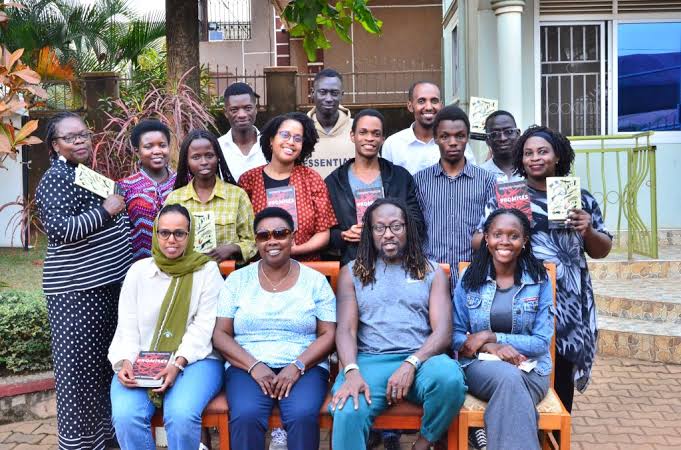
I’ll forego the preliminaries and cut to the chase: to speak of literary pedagogy without foregrounding reading is to misunderstand the very conditions under which writing becomes legible; the road to writing runs through reading. This is so important to me, both as a reader and a writer, that the first sign that I was, perhaps, in for something worth every bit of my time while at the inaugural Jésùyemí Poetry Program by Nigerian poet-critic and Efiko Magazine poetry editor Ernest Jesuyemi was him teaching “The Art of Reading” even before speaking of poetry itself: a bulky week-long syllabus with 7 essays that ran from Ezra Pound, Randall Jarrell, Jane Hoogestrat to Dennis Donoghue, Helen Vendler and Edward Hirsch; 16 poems giving craftsmanship prominence to Geofrey Hill, Andrew Marvell, Marianne Moore, William Carlos William, Paul Celan, Gerard Manley Hopkins, Kay Ryan, Yehudu Amichai, Arturo Riley, Charles Bukowski (not a shocking inclusion for a venomous critic like Ernest), Christian Wiman, Tomas Transtomer, W.S Graham, T. S Eliot, Ishion Hutchinson and the Zambian experimental poet Cheswayo Mphanza for his poem “Notes toward a Biography of Henry Tayali (2020)”.
Perhaps, championing the reading drill was the exercise calling for a categorisation of select poems based on Pound’s classification of poetry; Melopoeia (music), Phanopoeia (imagery) and Logopoeia (intellect) off “How To Read”, then finding eloquence in the same poems based on the polemics from Dennis Donoghue’s “Taking Notes (On Eloquence)”. Pound perhaps may have put Ernest’s readerly aim in perspective when he said: “to tranquillise the low-brow reader, let me say at once that I do not wish to muddle him by making him read more books, but to allow him to read fewer with greater result.”
Another example would be that if one listens carefully to writers speak of revision and self-editing, they often describe the process as discovering what the work “wants”. On editing a fiction manuscript lately, I posed the question to the writer whose self-editing goal tilted towards meeting the manuscript’s “wants.” This might not be entirely deficient but seems to be looking for a problem where there is none, I mean, there could be room for more if what is being scrutinised are “needs”, but they are “wants”, an ornamentation? For what it’s worth, the illusion could be that the phrasing seems self-indulging until one notices how frequently what the work wants corresponds to what contemporary literary culture has preset for quality, especially for younger writers: greater compression at the sentence level, maybe more trust in the image and most importantly less rhetorical certainty, to list a few.
I see no better explanation as to why editorial revision now seems to resemble a pseudo-sophisticated act of cultural translation: that the manuscript is adjusted until it becomes legible within an already existing ecology of value. For a second, one could be tempted to side with Faulkner for having said: “I get mad, I get drunk, I get thrown off horses. I get all sorts of things, but I don’t get edited; I’d rather see the stable boy fuck my wife than get edited”.


This would come off perhaps as one of those junctures where fingers are pointed at capitalism even though this is fundamentally less about censorship and more about conformity. It is something more ordinary and therefore more difficult to perceive. Writers learn, gradually and often unconsciously, the emotional habits of their future readers, not inherit them from present reading culture.
Meanwhile, there is a paradox currently epicentering contemporary literature: never before have so many people been taught to write creatively, and never before has literary culture celebrated plurality with such conviction. Aside from the mushrooming of MFA programs in Europe and America, short-term alternative non-degree creative writing programmes have proliferated across continents, even in Africa where it used to be only a smattering; sheer accessibility perhaps thanks to the vast growth of literary technoculture?
In Nigeria, Kenechi, perhaps inspired by the Chimamanda Ngozi Adichie-led Farafina Trust now Purple Hibiscus Trust Creative Writing Workshop, wrote of the possibility of an uprising of MFA programs in Nigerian Universities. In racial conversations like Junot Diaz’s MFA vs. POC, one can say they have long been an intervention no matter how minute: outside Western-borne magazines leaving free submission windows for BIPOC writers, we can, I believe, now speak to the realisation of representational inclusion since literary magazines the world over now publish voices from Nairobi alongside those from New York and Awka beside London which might never connote true equality but sure does challenge the pre-representational inclusion indifference from just a few decades ago. The rhetoric of the present is one of multiplicity and democratisation.
Be that as it may, reading widely across contemporary literary journals still produces an oddly opposite sensation. The output differs in form by landslide margins, but the expectations surrounding their reception are similar. They arrive from vastly different cultural vulnerabilities while appealing to nearly identical assumptions about subtlety, restraint, revelation, ambiguity, and emotional intelligence. The surface is heterogeneous; the underlying grammar is surprisingly coherent. It is a gamble of expectations that may never appear in plain sight, except for the practising educated reader.
More to the point, the analytical payoff here is that contemporary literature now, more than ever, feels simultaneously adventurous even as it is familiar. The subjects proliferate just as much as the identities multiply, but ultimately the geographies expand and keep expanding. But despite these undeniable differences, there still lies a remarkable stability in the expectations through which difference itself is rendered meaningful. We have become extraordinarily open to new experiences while remaining surprisingly consistent about not the forms but the horizon of expectations through which those experiences ought to arrive. Where is the fun in wanting change but wanting it in familiar ways? Of wanting new wine in old wine skin?
I met my dream poets at the Nick Makoha-led Poetry Retreat by Obsidian Foundation in 2025 and learned a truckload about literature, not merely poetry. With quite an extensive-intensive syllabus, Ernest’s Jésùyemí Poetry Program (JPP) opened my eyes to literary possibilities that transcended poetry as a form. Currently, I’m brimming with hope to learn again from Nick Makoha and, for the first time, Romeo Oriogun as a fellow of the inaugural edition of Lagos International Poetry’s Craft and Development Lab. I do not hold an MFA, but this is to say, I’m a benefactor of the workshop and none of this, however, diminishes the workshop’s achievements. If anything, it suggests that we have underestimated it. We have spent decades asking whether the workshop produces good writers, when the more interesting question may be whether it has produced a new kind of reader—one whose assumptions have become so widely shared that they now pass unnoticed into the practice of writing itself.
Felix Eshiet is a Nigerian writer and Efik-Ibibio poet. He has work in ONLY POEMS, Madrid Review, Efiko, 20.35 Africa, Chestnut Review and Palette Poetry. He is a 2025 Obsidian Foundation fellow.
Cover photo credit: African Writers Trust