


Sef Adeola taps into a tradition well-honed and long maintained, leaving the viewer with no doubt as to the pristineness of whatever work of his they encounter.
By Emmanuel Esomnofu
Patterns have always been a feature in African art. From textile designs to body art, numerous artists have expressed deep aspects of the human condition through the abstract arrangement of patterns.
The contemporary artist Sef Adeola is no different; an assured hand who has obviously trained himself in this delicate art, his work takes inspiration from elements as distant as cave inscriptions and as nearby as the textile art of his native Yoruba people. It is this intentional blend that makes Adeola one of the most distinctive artists of his era, unflinching in his approach to his art and the nearby art forms that spark its existence.
I have known Sef Adeola for five years, where he often worked with digital publications to visualise some of their stories. With his portfolio including magazines like Q Marker and Lolwe, it was quite evident that those who favoured his artwork knew the potential of abstraction.
Rather than the overt, colourful displays familiar amongst his peers, these outfits possibly knew that his artwork gave potential readers a greater complication as they approached the piece. What do these colours represent? Who is that little figure lurking by the side? Would they feature in the story? How relevant is the principal colour being utilised?
These are questions the viewer finds themselves asking after viewing the work of Sef, which are to be treated, sometimes, if not often, as independent artworks themselves. No matter that he’s being commissioned to create them, the peculiar instincts of an artist will always manifest in the end result.
In recent years, two projects have arguably stood out as pristine embodiments of Adeola’s art; these are his work illustrating an issue of the creative outlet, Bata Magazine, and the other is a curated selection of new works for Engaging Borders.

An obvious thematic alliance springs from his collaboration with Bata Magazine, whose central vision is to showcase the richness of Yoruba culture through creative works such as fiction and poetry.
Given Adeola’s artistic background, it’s a fine meeting point between artist and collaborator, as showcased in the depth of the covers he produced. One such work is his cover for Titilayo Matiku’s “Ko Si Enikeni Ti N So”, a riveting piece about the peculiar whims of a child’s life, their openness to just about anything at that point in their existence.
Entirely backdropped by a cluster of pink jewels, the silhouetted figure of a child is the main object of the artwork. He stretches his hands towards an encroaching mosquito, whose deathly lore is familiar amongst many African residents who have fought the malaria virus at least once in their lives.
Of course, there’s little narrative resonance between those gems and the mosquito, but the child transcends that boundary through the welcoming, effervescent quality of his nature. While he assumes the buzzing thing to be a playmate, in reality, there’s a dangerous undertone set by the mosquito. Could it be a commentary on watching children more closely? Could it be a philosophical entry that suggests the inevitability of painful experiences?
“The cause of the pain is irrelevant; all that matters now is the faithfulness of the depiction”, wrote John Berger in an essay on Matthias Grunewald. Likewise, the faithfulness of Adeola’s depiction on “Enikeni” is startling, a focused look that gets the rhetorical mind spinning in all directions.
There’s even more ambiguity in “Ìgbà-ǹ-Bá Jó, Onílù Dágbére Aké”, which is written by Qudus Olanrewaju Ojikutu. A poem on dance, the artwork fittingly captures the mid-action poise of a dancer’s feet. What is most remarkable here isn’t the minuscule masks patterned into the backdrop (which implies the setting as a royal court), but rather it’s the sly form of a human’s face on the billowing hem of the dancer’s gown, just below their knees.
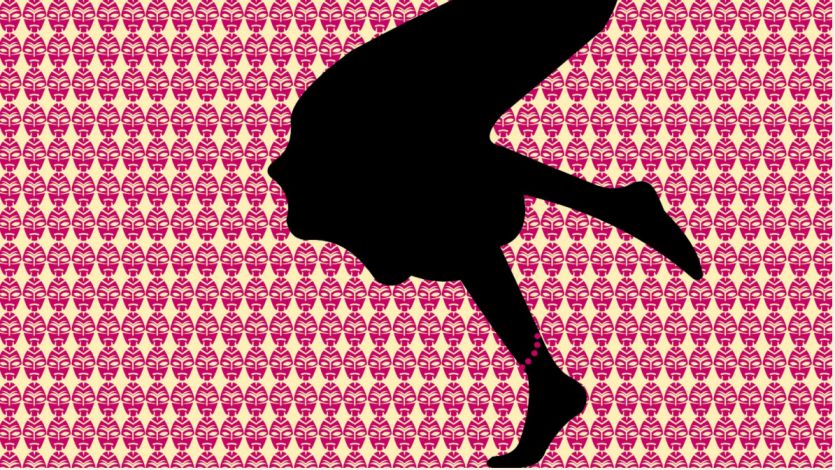
With a sustained gaze, one sees that in an act of sublimity, the artist has replaced the function of dance. Where it was once viewed as an aesthetic activity, one with little real-life consequences, the inclusion of a face gives the act all those implications.


Now there’s no limitation to what the dance could mean, who the dancer could be. Viewed from the Yoruba art influence, there’s also the possibility of Adeola’s dancer being representative of a fantastical element, which wouldn’t be out of place considering how dance (and music) have upheld spiritual functions in traditional art.
Sef Adeola’s work with Engaging Borders is outrightly spiritual in its gaze. There, rosaries and chaplets are a recurring feature, but it’s telling that there’s no child in the human depictions. Religion is an adult construct, whereas experience is the ultimate conduit of a child’s life force.
Yet Adeola ascribes the same revelatory perspective on these characters; “alherin zaman lafiya,” for instance, features a minuscule dove (a Christian image) hovering just on the tip of an outstretched finger. On the wrist, a rosary; beneath the hand, a flower. What do these pairings suggest?
Well, for one, the proximity between religion and nature is apparent. It’s as though the artist situates them within the same functional plane, as motifs intended to guide one to a more fulfilled life. Even when these motifs are suggestive enough, he uses colour tones to amplify the mood, achieving a cinematic register which ultimately enlivens the narrative possibilities. In “fata”, the suggestions are more explicit than in the others, utilising a collection of upheld fists to build Adeola’s trademark patterned background.

However, depicted in the foreground of the piece is the woman the piece is named after (we learn this from her tag). A minuscule van displays the word ‘press’, suggesting freedom, agency, and all the many positive values journalism is supposed to embody, but yet there’s that tag which could have been doubled as a rope, a restriction, a limitation to the fullness of the job.
Today’s world holds a lot of complications and contradictions for the curious mind. With values constantly eroding and shifts in technology sparking ethical conversations, the place of art in illuminating this fog of our collective existence has never been more important.
As earlier implied, it’s possible Sef Adeola doesn’t sit at his desk with these heavy topics brimming on his mind; it’s the instinct of his artistic education which brings them to the fore. Since it’s like African art to be political while furthering aesthetic beauty, he taps into a tradition well-honed and long maintained, leaving the viewer with no doubt as to the pristineness of whatever work of his they encounter.
Emmanuel Esomnofu is a Nigerian writer and culture journalist. He was awarded Best Writer of 2024 by The Republic and was named among the 30 Under 30 Power Players in Nigerian Music by Turntable. He’s working on his debut manuscript.