


Can we say that between the prize and the story and Jamir Nazir, there is something perverse and disrespectful to other writers, because it threatens the soul of literature, writing, and the organic ways we engage with it?
By Chimezie Chika
I
The announcement of the 2026 regional winners of the Commonwealth Writers’ Prize, selected from a record-breaking 7,809 submissions, came with great controversy. It majorly concerns the Caribbean regional winner, the Trinidadian writer Jamir Nazir’s “The Serpent in the Grove”, which is published in Granta Magazine, as is usual with Commonwealth-winning stories. Early readers of the story, led by Nigerian writer Chiemeziem Everest Udochukwu’s first whistleblower comment on X, were quick to point out that the story was questionable and showed signs of having been written by an AI language model.
My interest, when I started reading the winners, was to find which stories would truly move me and affirm my thirst for well-written literature, since, for me, the pleasure of a story comes from its artistry and craft. This is the temperament with which I approached Nazir’s “The Serpent in the Grove”, which the judge for the Caribbean region had described as a story told with “a voice of restraint and quiet authority”—a telling description, to say the least.
“The Serpent in the Grove” tells the fable-like story of a disconnected couple, Vishnu and Sita Mohammed, in a poor farmhouse somewhere in Trinidad and Tobago, who live near a possibly enchanted well. However, the idea of whether it is enchanted or not is never entirely clear. The plot, or what we can make of it, involves an event that caused Sita to fall into the well after a moment of bar-room lust led Vishnu to hatch a plan to kill his wife and marry the object of his lust: a woman named Zoongie.
There are a few sparkly moments in the prose. An example is a description of Vishnu’s relationship with the land, which tells us that “He worked it alone and most days the land worked him back, a quiet quarrel older than his father and his father’s father.” Though within this figurative accomplishment, an expression like“rain in teeth” hardly makes sense.
Another skillful sentence reads: Outside, little Puttie – three years old, sun-dark, bright-eyed – chased a yard fowl through dust, his laughter like water over pebbles. (“laughter like water over pebbles” is a thoroughly good use of a simile, and sounds as though it was drawn from culture-based idioms.) In the same manner, the stretches of prose used to describe Sita are, for the most part, decent:
Sita had been passed like a parcel from kin who were hungry for everything except another mouth; she learned to make herself small, to take the shape of whatever container held her. (The first part of the sentence is better than the second, but still tolerable.)
…
After that, Sita became obstacle by existing. Not for anything she did wrong, but for how exactly she fitted the life that fenced him in: the quiet chores, the patient hands, the unlit lamp. Vishnu began to plan with the patience of a reptile – cold, ancient. He studied how Sita walked the track alone, how no neighbour watched their yard, how the plank over the old well at the acre’s edge lifted on one loose nail.
(This one contains a double segue handled with sufficient skill.)
…
Sita paused. Her life had not given her much, but it had given her sense.
If the language of the entire story had gone along those lines, it would have been significantly different, tolerable at least. But the issues one notices from the first two sentences—“They say the grove still hums at noon. Not the bees’ neat industry or the clean rasp of cutlass on vine, but a belly sound – as if the earth swallows a shout and holds it there.”—are far too many to ignore. To begin with, the plot is inadequate for a story of this nature. The narrative arc is truncated before we can figure out where it’s going: we do not see a sequence of motive, intent, conflict, and resolution. In the last quarter of the story, all pretenses towards narrative crumble into vague expressions that sound remotely poetic but are almost completely disconnected from the at least visible sequence of events earlier in the story.
Disconnected parts are one of the story’s major issues. The characters are sometimes introduced in a slightly abrupt manner (Sita, Zoongie), with no transitive link between the preceding paragraph and the one that introduces them. Beyond that, it’s little more than a mess of words. Pleonasms abound so much in the story that it might be safe to describe the entire story as a typical example of extended pleonasm, replete with bizarre and senseless metaphors, verbose sentence constructions, epistrophic repetition of certain words and phrases, and far too many meaningless expressions and similes running riot in the prose. Here are a few:
Sita returned it and felt as if she’d put down a pan she had no business carrying.
A man who had cleared brush like a conscience
She came over the lip choking a sound the day almost refused. They lay on hot ground, breath scraping sky.
He calls her back with a word his mother once used that grammar can’t carry but love can.
In the hot hush, the grove held its breath and released it – small and entire, like a last stitch drawn through a wound that had finally decided to close.
Coins meant for rice or kerosene slid across the counter and came back white rum hot as apology. One drink opened the chest, two turned fear into courage’s cheap cousin, three steadied the hand enough to write the future in invisible ink.
There is a straightforward lack of style here, which the basics of grammar and composition should teach. Most of the metaphors hang in the air and are not rooted in the phenomena they are describing. Finally, no decent reader of literature would read the number of times “hum” and “hush” are used in the story and proclaim that it represents the virtues of literary excellence. There is also the issue of the story’s flat characterisation, a grievance I will put to bed immediately, having benignly described it as a fable.
The prose was a particularly sore point, for I had spent my years assuming there was a standard for what good writing represents (the absence of which could cause the entire literary ecosystem to crumble). Here are the last two paragraphs (which the writer versified for reasons best known to him):
A story is a well.
It eats sound until somebody throws a rope.
If grace is near and hands hold, something breathing comes up.
Some stories pull buckets of bone.
This one pulled a woman.
The grove remembered.
The house remembered.
The boy remembered.
And now, at noon, when the wind turns kind, the hum sounds less like hunger –
and more like the earth clearing its throat to speak the names of those who came back.
Even if any of these has for some reason become the hallmark of artistry and craft, it will still be hard to defend it on a line-by-line basis. Not much here is convincing; constantly, one is left in head-scratching confusion as to what the prose is conveying. An initial feeling of substance in the sentences, eclipsed by a lack of semantic depth and figurative originality, often makes them simultaneously ring false: too many words justling on the page, but too little is conveyed. By my reckoning, this is, in general, not a very good story. And that is putting it mildly.
II
After reading the story, the next logical curiosity is directed towards its writer. Who is he? What else has he written? The reasoning is that if the story has won such a prize despite my reservations, then there must be viable tracks of literary excellence (no matter how minuscule) in the writer’s life and work, especially given the advanced age implied by the writer’s photograph on the Commonwealth page. My singular vision may eventually agree with something else he had written.
The principal reason for going on Google is the promises of Nazir’s bio on Granta, which reads: “Jamir Nazir is a Trinidadian writer of East Indian heritage whose work explores the cultural intersections of the Caribbean and the Indian diaspora. A prolific poet and author, with books published and others forthcoming, he is particularly known for his love of poetry. His writing draws on the landscapes, histories, and emotional rhythms of Trinidad, where memory, heritage, and identity converge to shape voice and imagination”.
The first page of Google yielded little more than congratulatory messages from some Caribbean publications regarding his winning of the Prize. Nothing else was visible or viable: no stories in magazines, no interviews, no books, no reviews and critical analysis of his works, and no profiles, which is strange for an author of his age. It was not until the third Google page that a Facebook account attributed to his name appeared, with a fair bio that read: “Writer. Want a just and fair society for all, with equality and good governance for my country”. (That account now appears to have been deactivated, perhaps following the AI controversy that has trailed him). As it turns out, there’s another Facebook account dedicated to a book he had authored, which we will come to.

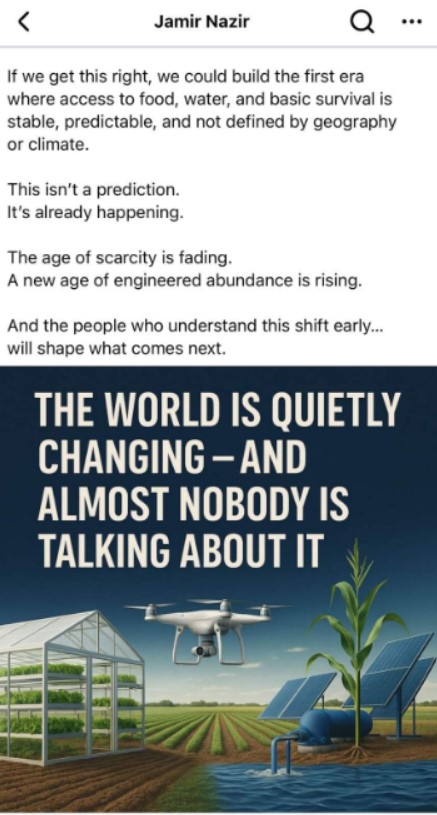
The main Facebook page showed no serious literary precedence. All the man does there is either comment on his country’s politics or post poorly written (possibly AI-generated) poems and articles, sometimes tagged with emojis as bullet points and, in the case of the poems, a note that the titles were generated using Meta AI. On November 16, he posted a suspicious article (which has all the possible AI tells) discussing how technology is changing agriculture and enacting a green revolution. In his now habitual verse-like way, he writes:


This isn’t a prediction.
It’s already happening.
On November 4, he had posted another possibly AI-generated article titled, “The AI Arms Race: It’s Not About Data, It’s an Industrial Energy Race”. In the article, he philosophises that participation in AI requires huge financial investments and worries that poorer people and nations cannot partake in the AI largesse.
He may not have realised the irony of his optimism about the future of AI, for his perspective is vastly different from the concerns of many writers out there whose sense of vocation stands precisely opposite to those of AI advocates like him.
Some of the stilted language we noticed in his Commonwealth story can also be seen everywhere in things he posts on his Facebook page: negative parallelisms (It isn’t this, it’s that; not that, but this), figurative and semantic disharmony, uniform sentence styles, overuse of the rule of three (tripartite adjectives), and an inconsistency of voice that appears consistently. An example of that is that the grammar of his responses to comments under his posts differs markedly from that of the posts themselves.
Another significant inconsistency is about his authorship of books. His Granta bio says he is a prolific writer “with books published”, but I would later discover that he has only two books on Amazon. The books—Night Moon Love: For all those who have loved or dreamed of love (2018) and One a day: Life’s Gems – 366 Original quotes to motivate and inspire (2019)—are a poetry collection filled with similar poems as the ones on his two Facebook pages and a book of quotes whose title contains rather poor typography. The bio for his poetry book is long and verbose, and compared to his Commonwealth bio, its unprofessionalism is telling.
One of his major consistencies is his vocal advocacy for the use of AI. Beyond that, this is a writer who does not behave like a writer. No serious trail of interest in literature or engagement in a recognisable literary community can be found anywhere on his Facebook page.
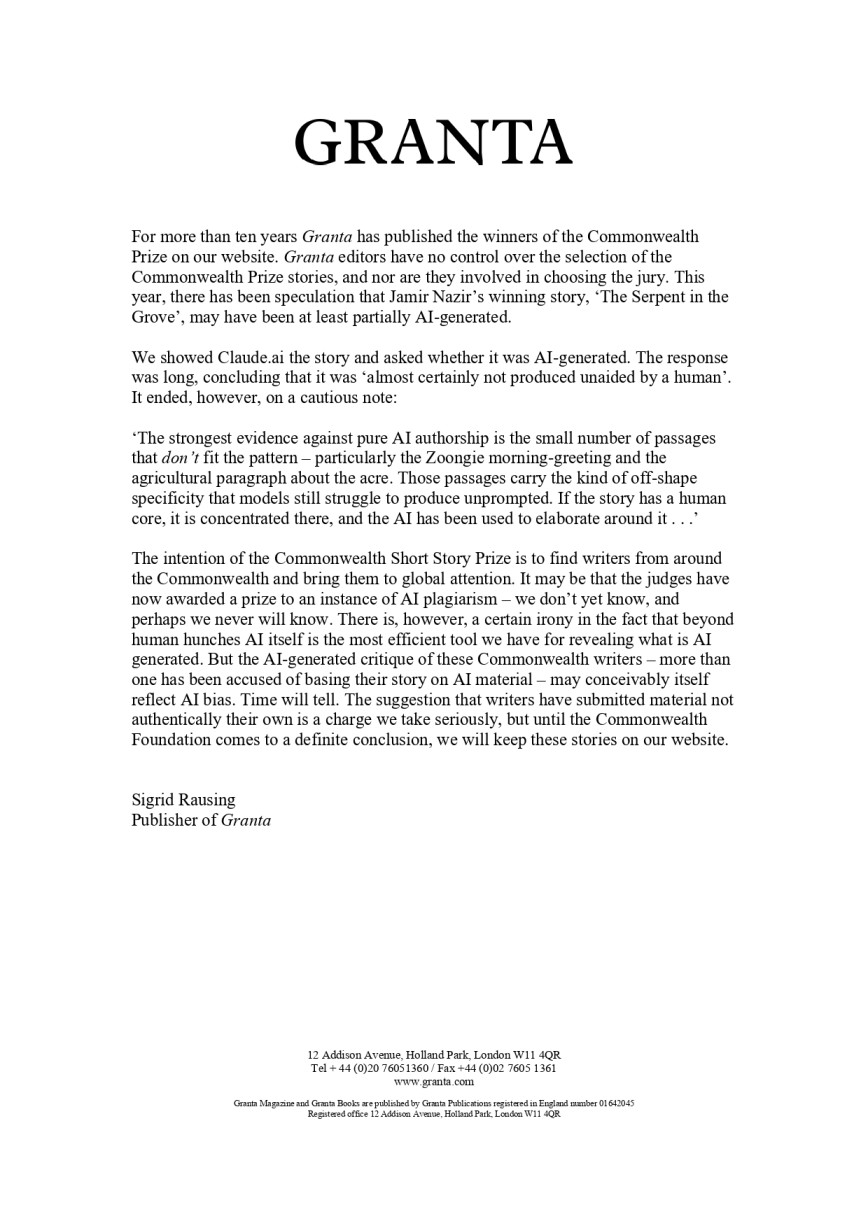
Speculations around his use of AI have dominated conversations since. Early on in the saga, entrepreneur and AI researcher, Nabeel S. Qureshi, flagged Jamir Nazir’s story as “having obvious markers of AI writing”—a sentiment that was echoed across the world. (To compare notes, some of those markers—or frequent signs of AI use—are discussed here.) Responses from Commonwealth and Granta expressed ambiguity about the difficulty of determining the story’s AI origins. In Granta’s response, the magazine’s publisher, Sigrid Rausing, wrote that they asked Claude.ai whether the story was AI-generated—a most problematic action—and ended with saying that until the Commonwealth Foundation makes a decision, the story will remain on their website (They have since appended a note above the story). Further, the Commonwealth said it would continue to operate on a trust principle in the absence of a definitive AI detector but offered no forward-minded assurances on the present issue.
In the days after the start of the saga, Kevin Jared Hosein, Jamir Nazir’s countryman and one of Trinidad’s most prominent writers who has himself previously won the Commonwealth Prize on two occasions, came out on X and expressed disappointment at the Commonwealth Foundation’s response to the AI allegations. Hosein would go on to post further evidence of a recent interaction he had with Nazir in which he asked him the meaning of the phrase, “she made benches become men”, from his Commonwealth story.
There are also speculations that even Jamir Nazir’s Commonwealth author photograph is likely AI-generated. On his Facebook page, the discrepancy between the photo on his Facebook profile and his Commonwealth photo is rather obvious. The second is a clean image of a sagely serious man with a full white beard; the first is none of that. Nazir himself confirmed the photo’s AI origins in another post made by Hosein, in which he also (further in the thread) shares information about Nazir’s writing of AI poems for a certain poetry group in Trinidad.
The entire saga and the evidence around it begin to feel, after a while, as though a confidence trickster had spun a parody, a joke in poor taste. From the point I flagged the story on X, I have constantly insisted that it was first and foremost an extremely badly written piece of fiction. I felt, and still feel, that the fact that the story fails as a piece of literature should’ve been the first thing noticed by Commonwealth readers and judges. If they could not do that, then we have a far more serious problem than any other issue that has been raised regarding the story and its writer. This is why I have one major concern here, with another subordinate concern trailing after it.
First is the writing. The rule of writing, beyond basic principles, is that you can do almost anything so long as there is some sort of coherence, an organising principle, in the story or idea being put forward. That is, its innate aim is achieved, and its parts come together in some way, even if the writer—in the case of avant-garde literature—is trying to upend and deconstruct language, narrative, and ideas.
There is none of these in “The Serpent in the Grove”, which is a difficult read based on not having achieved anything within its simplistic narrative. It is not very easy, on this score, to see how some people can frame the disharmony of the story’s sentences as evincing traits of an experimental narrative or ethnocentric iterations of Caribbean patois.

To wit, if a writer has to separately explain the metaphors he used in a story, regardless of how culture-based they might be, then he has failed. Have we (Africans) forgotten that we all come from postcolonies where the English language is constantly being refashioned to fit our hybrid identities and cultures? We should be able to tell the difference between linguistic sleights of hand and poor pastiche.
Second is AI. AI-savvy people have pointed out that the story has all the hallmarks of AI, including but not limited to those selfsame negative parallelisms, nonsensical metaphors, and the repetition of certain specific words and phrases. The truth is that some of those hallmarks of writing can also appear in good writing; the crucial issue with them (examined through the lens of literary aesthetics) is not their use, but their overuse.
I have recently concluded that while bad writing may not be AI-writing, AI-writing (whatever it may be) is bad writing. For this reason, simply judging a piece of literature firmly on literary merit might result in a corresponding weeding out of AI slop. This is also not exactly fail-proof, which means that we may need to have conversations to reaffirm general belief in the most basic standards of good writing, the details of which still present some complexities.
Considering everything, is “The Serpent in the Grove” deserving of the prize it was awarded? Can we say the writer might have cheated in one way or several ways? Can we say that between the prize and the story and its author, there is something perverse and disrespectful to other writers, because it threatens the soul of literature, writing, and the organic ways we engage with it? Following that, can we also say that what we are witnessing here might be the result of moral and intellectual cowardice?
My involvement in the saga and the initial lambast I received has taught me that courage is one thing sorely missing amongst writers today. Courage is a moral undertaking; the intellectual vigour it gives can lift our literary culture above its drab cronyisms and bandwagonisms. That these vices might be the result of the hive-minded excesses of digital culture is sad.
Chimezie Chika is a staff writer at Afrocritik. His short stories and essays have appeared in or forthcoming from, amongst other places, The Weganda Review, The Republic, The Iowa Review, Terrain.org, Isele Magazine, Lolwe, Fahmidan Journal, Efiko Magazine, Dappled Things, and Channel Magazine. He is the fiction editor of Ngiga Review. His interests range from culture, history, to art, literature, and the environment. You can find him on X @chimeziechika1
Cover photo credit: Inc