

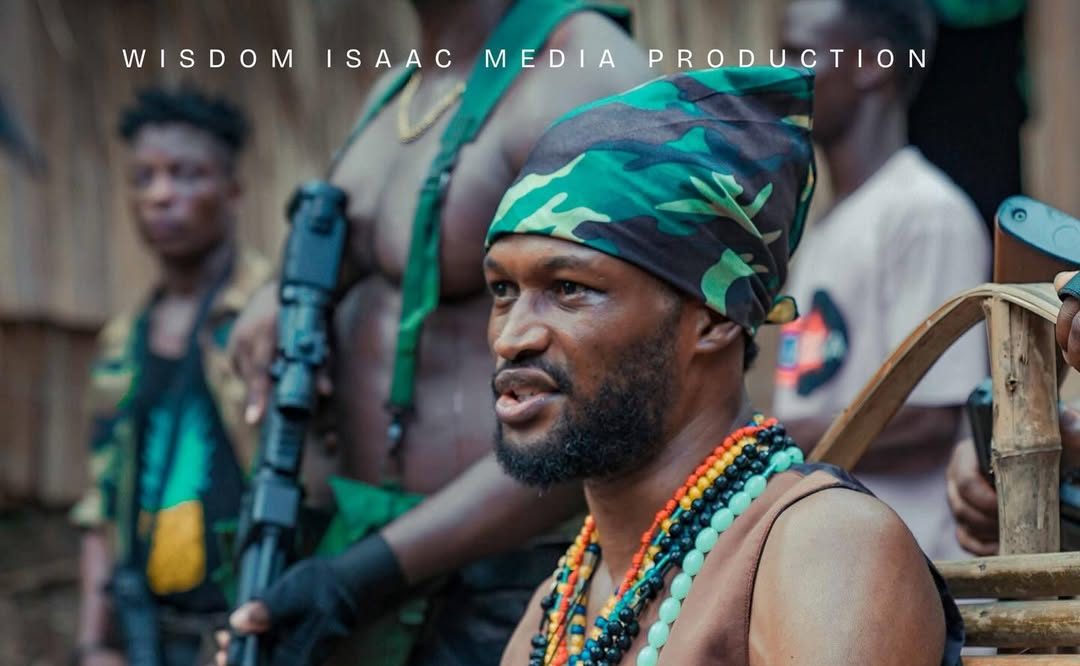

What The Creek ultimately reveals is a tension at the heart of Nollywood’s engagement with politically charged material: the industry’s capacity for ambition routinely outruns its willingness to do the difficult work that ambition demands.
By Joseph Jonathan
There is a line in “Delta Blues”, a poem by Tanure Ojaide, the Delta-born poet who has spent decades writing about oil, water, and erasure, in which he describes his home as suffering from an “immortal pain/ masked in barrels of oil.” The image stays with you because it captures something that statistics and journalism cannot quite reach: the intimacy of the wound, the fact that what is being extracted is not merely oil but something closer to life itself — the ecosystem, the economy, the dignity of communities whose names rarely appear in the contracts signed on their behalf. The Niger Delta is not a location. It is an ongoing argument between the world’s appetite and a people’s right to exist on their own land. Any film that sets itself there inherits that argument, whether it wants to or not.
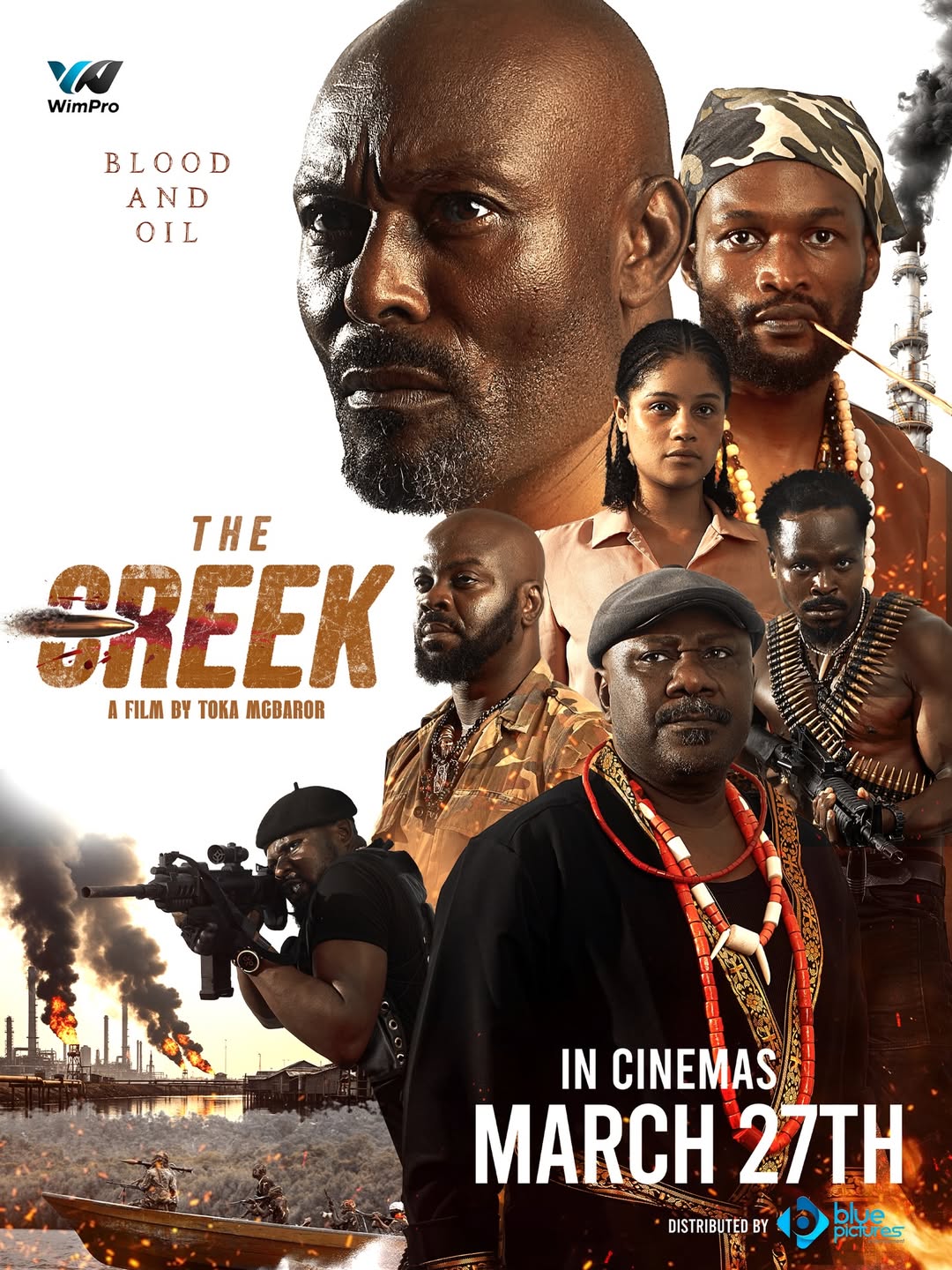
Toka McBaror’s The Creek, written by Emeka Jepherson, wants to. But wanting, as Nigerian cinema has demonstrated with some consistency, is not the same as doing. The film arrives carrying a weight it did not fully prepare to bear, and the gap between what it gestures toward and what it actually achieves is the most instructive thing about it.
Nigerian cinema has returned to the Delta with some regularity over the past decade and a half. Black November (2012), Oloibiri (2016), and Blood Vessel (2023) each represent a distinct moment in that return: distinct in ambition, in aesthetics, in who they imagine sitting in the cinema watching them. Placed against that company, The Creek becomes something more than a film to review. It becomes an occasion to ask whether we, as an industry, have learned anything from all these returns to the same wound. And to ask, more uncomfortably, whether the wound has become so familiar that we have stopped seeing the person it belongs to.
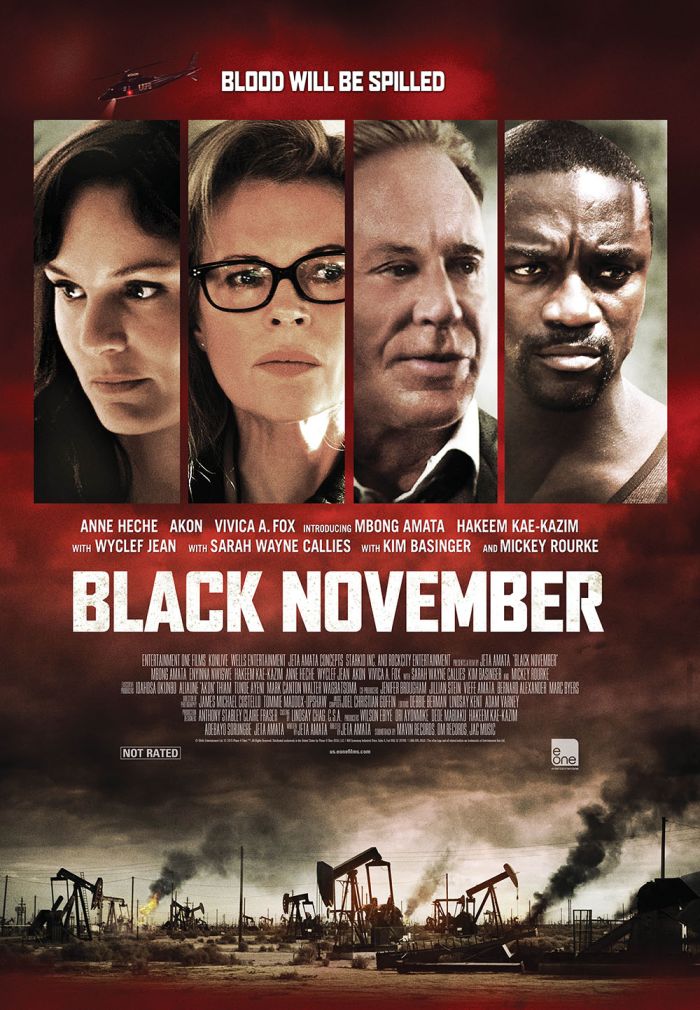
Jeta Amata’s Black November arrived first, loudest, and most self-consciously political. Bankrolled at enormous expense and designed as much as a lobbying instrument as a film — it premiered at the Kennedy Centre, screened at the UN General Assembly, and eventually drew enough American congressional attention that two lawmakers sponsored a joint resolution on Delta oil spills — it was a film with genuine political impact and genuine aesthetic failure, held simultaneously.
Its lead character, the activist Ebiere, played by Mbong Amata, entered the story as a concept more than a person: a young woman whose political consciousness is documented in starchy flashbacks, whose suffering is always in service of the film’s argument rather than her own interiority. She is the Delta’s grief, made female and made legible, then martyred so that the argument can conclude.
The Hollywood names — Mickey Rourke, Kim Basinger, Vivica Fox — were imported not because the story required them but because the filmmakers believed the international audience needed familiar faces to stay engaged long enough to receive the message. What this revealed was the film’s fundamental anxiety: it did not trust that the Niger Delta’s own story, told in its own terms, was sufficient. It needed translation. It needed intermediaries. The result was a film that spoke loudly about a people it could not quite bring itself to fully inhabit.
Curtis Graham’s Oloibiri took a quieter approach, grounding its story in the actual village where Nigeria’s first oil well was drilled in 1956. It worked through interlocking generations: an elder haunted by what he failed to prevent when the oil companies first arrived, and a geology graduate turned militant who embodies the rage that the elder’s regret never permitted itself. What Oloibiri understood that Black November did not is that you do not need Hollywood names to legitimise a Niger Delta story. Olu Jacobs standing in Oloibiri is legitimacy enough.
Yet, the film could not fully commit to its own political argument. It focused its critique so narrowly on foreign oil companies that the Nigerian government’s decades of enabling neglect — the legislation passed and never enforced, the regulatory bodies captured and hollowed out, the political class that negotiated with militant groups for electoral purposes and abandoned them when the amnesty money ran out — barely registered. It offered grief without accountability, an atmosphere without analysis. And like Black November, it treated the women at the edges of its story as peripheral fixtures rather than political actors, which is a curious erasure for a region whose resistance tradition is deeply, measurably female.
Moses Inwang’s Blood Vessel arrived in 2023 with the sharpest survival instincts of the three and arguably the most politically resigned worldview. It did not stage the Delta crisis as an argument directed at power. It staged it as a survival thriller directed at people who already understood they had lost. Six young people flee a community destroyed by oil pollution and military violence, stowing away on a ship bound for South America, only to find a different kind of violence waiting for them at sea.

The political conditions that produced the crisis appear as backstory rather than dramatic engine: the wound is assumed, not re-examined. What the film did, that neither of its predecessors had managed, was to use the Delta’s Ijaw language extensively throughout, including as a streaming subtitle option, insisting that the people of this story speak as themselves rather than through an English filter designed for outside consumption. It was the most commercially successful of the three, reaching millions of viewers on Netflix within its first two weeks.
Yet in some ways it was also the most politically resigned: its young people are not trying to change the Delta. They are trying to escape it. The aspiration the film permits them is not justice but survival, not transformation but flight. That is an honest portrait of what years of dispossession produce in a generation. It is also, quietly, a portrait of defeat.
Before The Creek, two other films deserve acknowledgement, if only because they reveal how much more the Delta contains than any of these productions have thought to reach for. Courage Obayuwana’s Kill Boro (2024) is set in a fictional riverside town in an oil-rich state, and its drama is domestic and intimate — a boy seeking to protect his mother from a brutally abusive father — yet the environment is never merely a backdrop. The gang politics, the ex-militant histories, the particular textures of poverty in a region that produces the nation’s wealth and receives almost none of it: these shape every choice every character makes.
Famous Odion Iraoya’s Onobiren (2026), written by Laju Iren and set partly in the Itsekiri riverine communities of Delta State, uses the Delta as a cultural origin story — the fishing traditions, the river-bound economy, the specific grammar of a community’s life — rather than as a political crisis.
What these films share, and what distinguishes them from the main lineage, is that they use the Delta as a world rather than as an argument. They trust the environment to carry meaning without having to announce it, and the result is that their characters feel shaped by a place rather than positioned within a thesis. The Delta films that have been most fully inhabited are often the ones that arrived there sideways.
Into this lineage steps The Creek, and the first thing to note is that it has inherited the right instincts from all three of its predecessors without quite synthesising them into a coherent vision. It has Black November’s declarative political ambition, Oloibiri’s commitment to local casting and location authenticity and Blood Vessel’s understanding that the Delta’s indigenous languages must be heard on screen. These are not nothing. They represent a genuine accumulation of lessons. Yet the film cannot translate those lessons into dramatic architecture that holds.
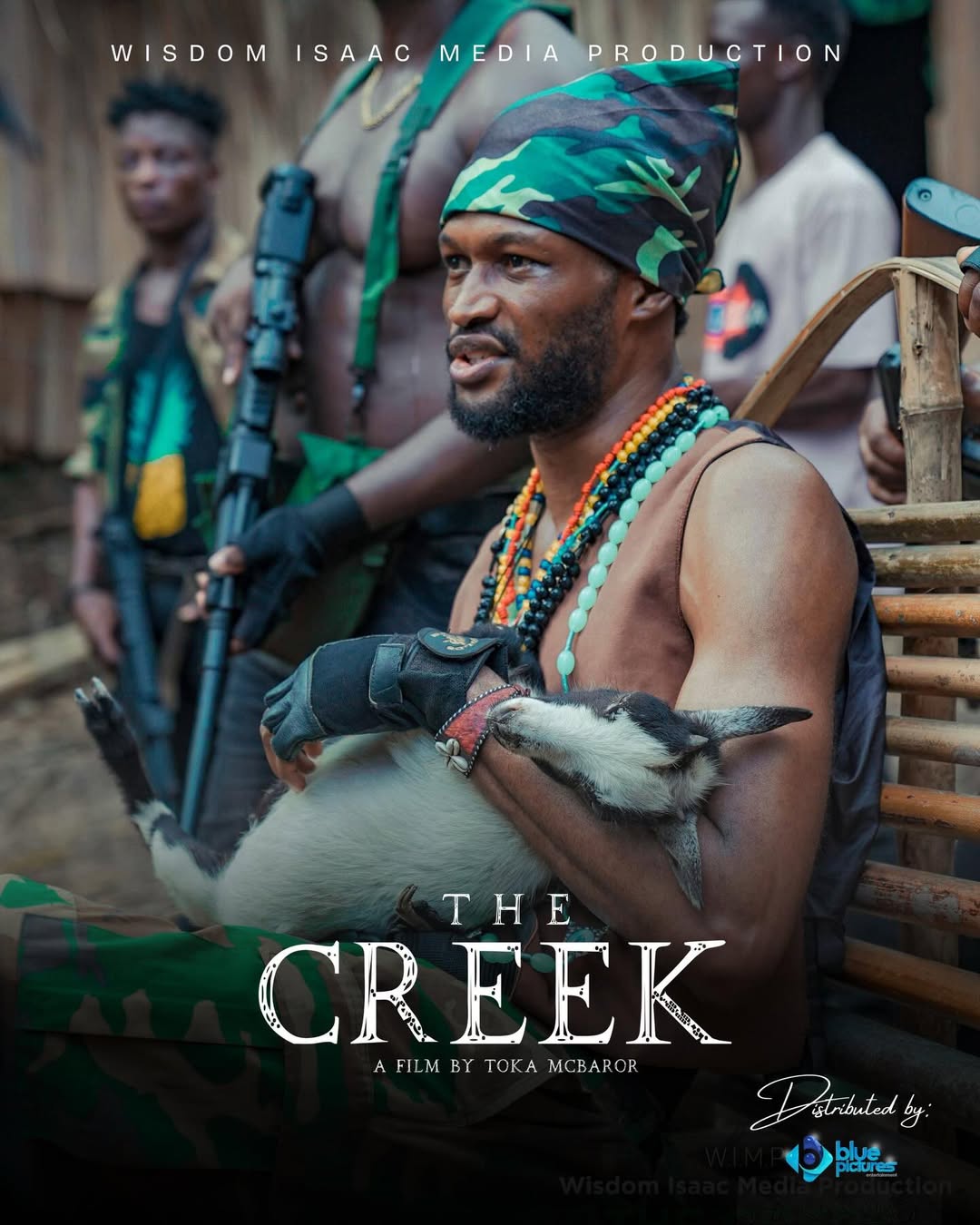
The plot is familiar in outline: a man returns to Nigeria after twenty-five years abroad, is kidnapped along the Delta creeks, and a community must negotiate between loyalty, survival, and the layered violences (corporate, political, militant) that have long defined life in that region. There is a journalist pursuing the story. There is a militancy whose internal fractures mirror the broader fragmentation of the Delta’s resistance movements. There is a cast of community figures caught between complicity and conscience. On paper, this is the infrastructure of a serious film. In execution, it is the infrastructure of a film that cannot decide what it is serious about.
The Niger Delta’s modern crisis has a dateable origin, though its roots go deeper than any single event. When Shell-BP struck oil in Oloibiri in 1956, it initiated a reorganisation of the entire region’s relationship to power, land, and water. Communities that had sustained themselves through fishing and farming for generations found their waterways contaminated, their land appropriated, their political representation subordinated to the interests of a revenue stream they would barely share.
By the time Ken Saro-Wiwa was hanged in 1995, silenced for the crime of making the Ogonis’ case too loudly and too effectively, the Delta had become a metonym for a particular kind of tragedy: the place where the world’s abundance is produced and the local population pays the full cost. The militancy that emerged in the early 2000s, through groups like MEND, was not an aberration. It was a logical response to decades of dispossession, filtered through the desperation of young men for whom the state had made no other provision.
Yet the full story of that militancy, the one these films never quite manage to tell, includes how grievance became weaponised by political actors who used militant groups for electoral violence and discarded them when the amnesty programme ran dry, how the liberatory cause and the predatory economy grew so entangled that separating them became almost impossible. A film that understood this could not settle for fighters who are simply pushed to the brink. It would have to ask who benefits from keeping them there.
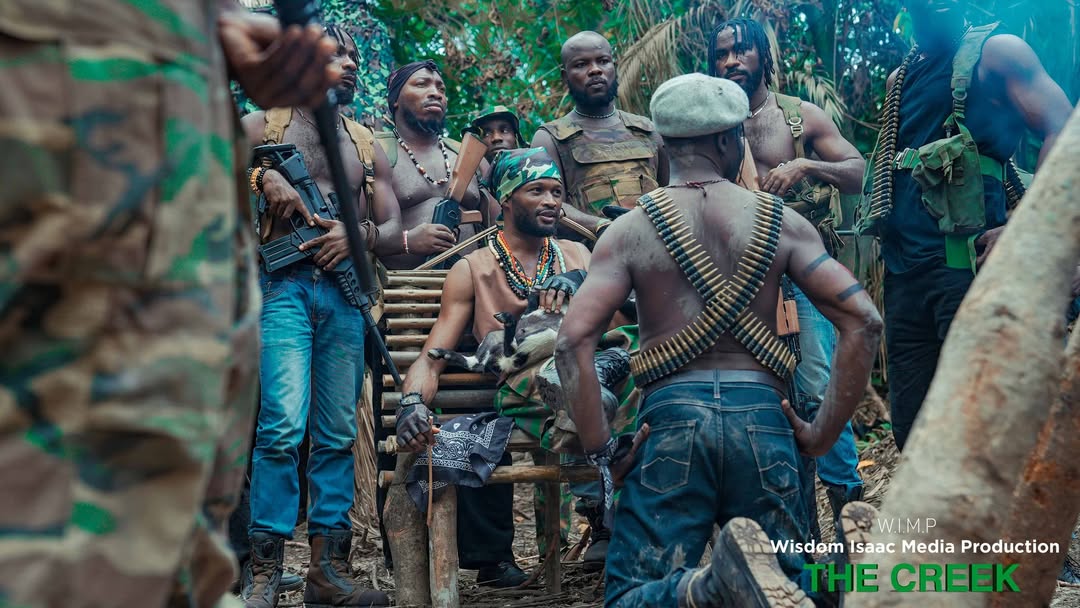
The Creek does not ask that question. The oil exploitation, the environmental degradation, the moral economy of militancy: these are present in the film the way furniture is present in a room, occupying space without being engaged. The militants are introduced, their rivalries sketched, their motivations suggested, yet the writing does not push far enough into the logic of their choices to make them feel like people shaped by a specific history rather than narrative functions filling required roles.
This is the precise failure that haunted Black November (Ebiere as concept rather than character), and it is dispiriting to find The Creek repeating it. Oloibiri at least gave us its militant as a full dramatic argument: a first-class geology graduate who understood the extraction machinery better than anyone and chose to blow it up rather than serve it. That choice carried the weight of the character’s entire life behind it. The Creek’s militants carry only the weight of the scene they are currently in.
The film’s action sequences compound the problem. The waterways of Port Harcourt are genuinely beautiful — the winding creeks, the dense mangroves pressing in from either bank, the quality of light on water in the late afternoon — and the decision to shoot on location gives the film images that carry the documentary truth of a landscape rarely simply seen.
Yet this commitment to location does not extend to the formal execution of the action staged within it. The gunfights lack spatial coherence. Chase sequences lose their geography mid-movement. Violence that should feel dangerous and consequential registers instead as illustrative, something to indicate that conflict is occurring rather than to make the audience feel its stakes. Blood Vessel, working with newer and less experienced performers, showed considerably more spatial intelligence in its action sequences. The Creek had more resources. It has not solved the problem.
What partially redeems the film’s human dimension is Bucci Franklin, who brings to his role a quality the best screen performers share across cultures: the ability to be dangerous without announcing it. His is a performance of compressed energy, of threat held just below the surface, and it gives his scenes a tension the film otherwise struggles to manufacture.
Franklin understands something about the kind of men the Delta has produced, men for whom violence is neither performed nor celebrated but simply available, a resource acquired through necessity, and he plays it without sentimentality or caricature. Sam Dede brings the weight of presence that suggests the richer, more interior film that might have been built around these characters with a more disciplined screenplay.
Jimmy Jean-Louis, whose work elsewhere has demonstrated a capacity for quiet, layered masculinity that African cinema needs more of, is stranded in a role that asks little of him and receives accordingly little in return. His character reacts to the plot rather than shapes it, and the result is a performer of real ability made largely invisible by writing that never decided what to do with him. This is a recurring problem in how Nollywood deploys international talent: the acquisition of a name without a corresponding investment in the role that would justify the acquisition. Black November made the same mistake on a grander scale, and The Creek has not learned from it.
The film’s most structurally revealing decision involves its journalist character. The sibling chemistry between Sunshine Rosman and Kelechi Udegbe (who plays her brother in the film) generates one of the story’s few moments of genuine emotional weight, the specific urgency of someone trying to reach family across the no-man’s-land of militant territory. Yet the script undermines this with a lapse that is not merely credibility-straining but character-destroying: a journalist embedded in Delta conflict who does not recognise the sworn enemy of her own brother.


In the actual Delta, where the journalist community is small, and the stakes of misidentifying a source are measured in lives rather than corrections, this is a disqualifying failure. A reporter who does not know who Fish Bone is, in a story where Fish Bone is the central antagonist and her brother’s mortal enemy, is not a journalist. She is a plot convenience. And she is, like Ebiere before her, like the peripheral mothers in the films that surround this one, ultimately a woman in service of a narrative that does not fully consider what it means to be a woman in this specific landscape, in this specific crisis.
This is a pattern worth naming directly. The Niger Delta’s resistance history is not only male. The 1929 Women’s War (Ogu Umunwanyi) drew on networks that ran deep into the Delta, women organising against colonial taxation and the erosion of their market authority. The Ogoni women who formed human shields around Shell installations in the 1990s. The women’s protests at Chevron facilities in 2002 that drew international attention and forced negotiated agreements.
The female leadership structures within Ijaw, Urhobo, and Itsekiri communities that governed access to waterways and adjudicated resource disputes long before any oil company arrived. These are not footnotes. They are history. Yet across all four of the Delta films examined here, women are consistently peripheral: activists to be martyred, mothers to be mourned, journalists to be rescued. The feminist political tradition that runs through the Delta’s actual history has not registered in its cinema. That absence is not neutral. It is a choice, made repeatedly, whose cumulative effect is to suggest that the Delta’s story belongs only to its men and ultimately leads to a tacit erasure of its women.
The decision to use local language throughout the film, allowing characters to shift between English and their native dialect as the situation demands, is one of The Creek’s most authentically political choices. Language in the Delta is not incidental. The imposition of English as the medium of governance, commerce, and legal argument was itself part of the colonial and post-colonial machinery that marginalised Delta communities.
To hear characters speak their own tongue in a film about their own dispossession is a corrective gesture, quiet but real: an insistence that the people of this story belong to a linguistic culture that precedes and exceeds the structures exploiting them. Blood Vessel pioneered this on a global streaming platform. The Creek extends it in a theatrical context. It is the clearest line of genuine progress in the Delta filmography, and more Nollywood films set in linguistically specific communities should take it this seriously.
What The Creek ultimately reveals is a tension at the heart of Nollywood’s engagement with politically charged material: the industry’s capacity for ambition routinely outruns its willingness to do the difficult work that ambition demands. Filming on location in Port Harcourt with a crew of over five hundred and former militants among the cast is not a small undertaking. The logistics alone represent a genuine commitment. But commitment to production is not the same as commitment to argument.
The Delta’s history does not simply need to be depicted. It needs to be understood; its internal contradictions, its moral complexity, the uncomfortable fact that the militancy which emerged there was a rational response to irrational conditions, that the men with guns in the creeks were produced by the same system the film nominally critiques. A film that understands this cannot settle for action sequences and rescued journalists, for a narrative that introduces its political setting and then treats it as atmosphere.
And then there is the deeper question, the one that sits beneath all four of these films and that none of them has yet thought to ask: why is the oil crisis the only story the Delta gets to tell? The Niger Delta is one of the most historically dense landscapes in West Africa. The Benin Kingdom’s trade networks extended through the Delta centuries before European contact. The Ijo/Ijaw city-states of the seventeenth and eighteenth centuries were sophisticated commercial powers, mediating trade between the interior and the coast. The Ijaw, the Urhobo, the Itsekiri, and the Ogoni each carry cosmologies, legal traditions, and artistic practices of extraordinary depth.
The Delta’s pre-colonial history includes epic wars, complex systems of governance, resistance movements against both internal and external domination and African feminist political traditions that, as noted, predate the oil era by centuries. The Nembe kingdom’s armed resistance against British imperial forces in 1895, when they attacked the Royal Niger Company’s headquarters at Akassa in what became known as the Akassa raid, is a story of organised anti-colonial defiance that no Nigerian film has yet touched. The region’s slave trade resistance movements, the role of water priestesses in Ijaw spiritual and political life, and the epic narratives embedded in Ekine masquerade traditions are materials of the highest dramatic order.
Yet Nigerian cinema returns, again and again, to the oil well. The wound, it seems, is easier to film than the person. And in doing so, these films risk becoming complicit in a second erasure, not of land and water this time, but of history and imagination. To represent the Delta only through its crisis is to suggest, however unintentionally, that the region has no story worth telling from before the rigs arrived. It is to allow extraction to define not just the landscape but the culture’s sense of itself. The oil companies took the oil. The films, in their narrow framing, take something else: the fullness of a civilisation’s past, reduced to the circumstances of its present suffering.
Oloibiri stands today on the site of Nigeria’s first oil well without reliable electricity, without stable running water, without meaningful compensation for the half-century of extraction that powered a country and left it behind. That fact is not a metaphor. It is the ongoing condition that every Niger Delta film inherits when it switches on its cameras. The Creek visits that condition. It does not reckon with it. And in the distance between visiting and reckoning, something keeps getting lost, not just the political argument these films reach for and cannot hold, but the full human world that preceded the argument, and that has never once been given the screen time it deserves.
The film that can finally do justice to both has not yet been made. When it arrives, it will not begin with an oil spill. It will begin much further back, in the part of the story we have not yet dared to tell.
Rating: 1.5/5
Joseph Jonathan is a historian who seeks to understand how film shapes our cultural identity as a people. He believes that history is more about the future than the past. When he’s not writing about film, you can catch him listening to music or discussing politics. He tweets @Chukwu2big