


At two hours and six minutes, Ìwé Àlà is longer than its dramatic content can comfortably sustain.
By Joseph Jonathan
In June 1892, a British military expedition forced its way through the Ijebu Kingdom’s carefully maintained trade borders, breaking a commercial monopoly that the Ijebu people had held with remarkable tenacity for decades. The Ijebu, among the most commercially sophisticated and culturally self-contained of the Yoruba subgroups, had controlled the trade routes between the coast and the interior with a discipline that frustrated both neighbouring kingdoms and colonial ambition alike.
The British expedition that defeated them was not primarily a military campaign. It was a trade policy enforced at gunpoint. Within a year of that defeat, the Awùjalè, the paramount ruler of the Ijebu, had opened the kingdom to missionary activity, colonial administration, and the economic reorganisation that would remake the region. What the Ijebu lost in sovereignty, some of them recovered in education and commerce, becoming among the first Yoruba to embrace Western education and among the most prominent in the professional classes of early colonial Nigeria.
The Ojude Oba festival — which translates, with appropriate simplicity, as “the king’s frontcourt” — exists in the long shadow of that history. Celebrated annually three days after Eid al-Adha, it is an occasion for Ijebu Muslims to pay homage to the Awùjalè, to display the prosperity and cultural pride of their age-grade groups, the Regbe-regbe, and to affirm the specific Ijebu identity that colonial encounter tried and failed to dissolve entirely.
It is one of the most visually spectacular communal events in Nigeria: a procession of horsemanship, coordinated costuming, drumming, and generational pride that has grown, over its century of existence, from a local ceremony of loyalty into a regional celebration of cultural survival. To make a film set against the Ojude Oba is to inherit all of this history, whether or not the screenplay acknowledges it. Ìwé Àlà: An Ojude Oba Story, directed by Adeoluwa Owu and produced by ComeOnNaija, released in Nigerian cinemas on June 12th (Democracy Day), inherits it, and what it does with that inheritance is the central question the film must answer.
The release date deserves a moment’s attention before the film itself. June 12 in Nigeria is not an ordinary public holiday. It is the anniversary of the 1993 presidential election (reportedly the freest in the country’s history, subsequently annulled by the Babangida military regime) and its designation as Democracy Day carries the specific weight of a nation still reckoning with the gap between democratic aspiration and democratic reality. To choose this date for a film about cultural heritage, family legacy, and the things passed between generations that are either honoured or distorted, is to make a statement about what Nigerians choose to celebrate and why. Whether Owu and ComeOnNaija intended this resonance or simply chose a public holiday for commercial reasons, the film sits differently against that backdrop than it would on any other date.
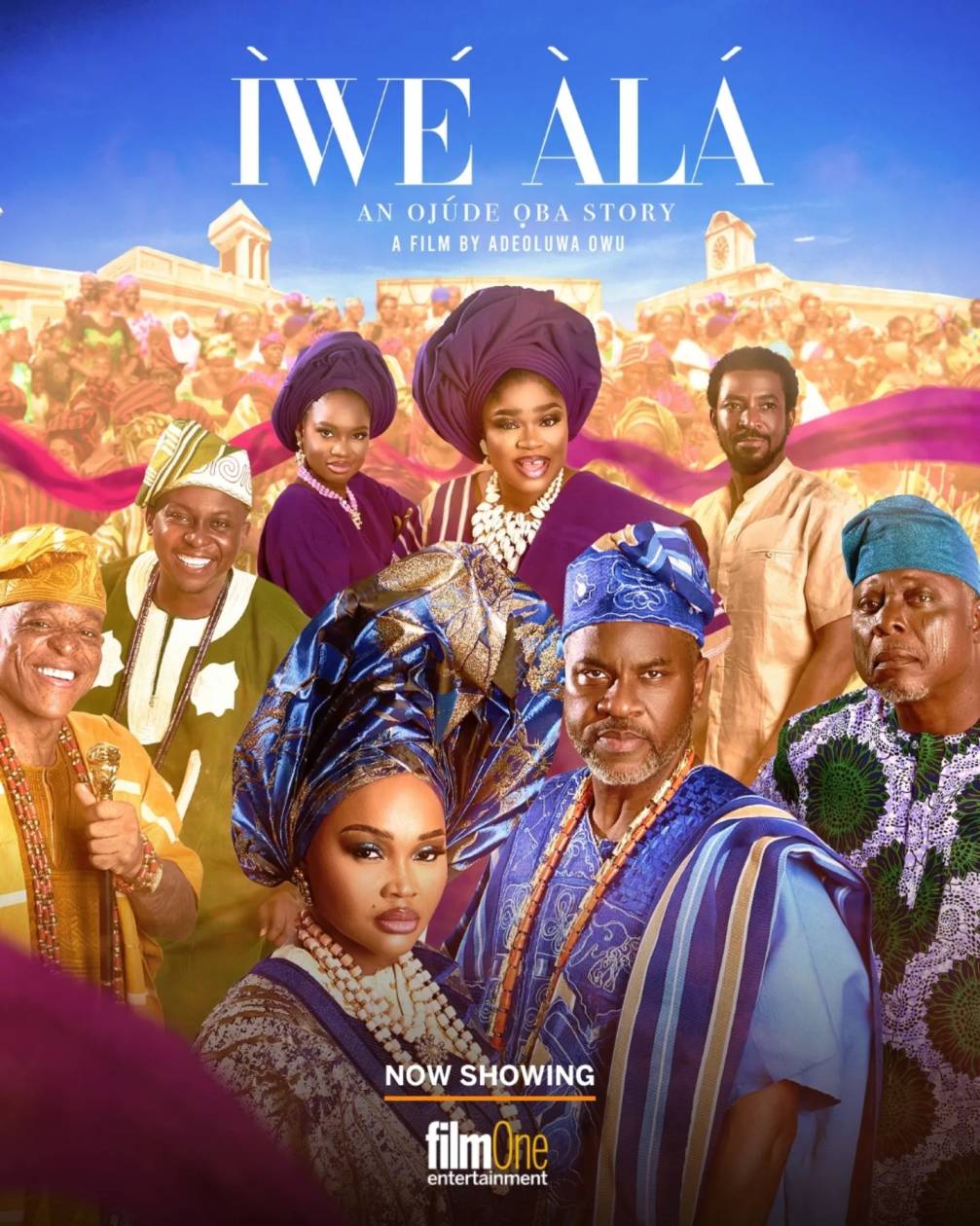
The story the film tells is, at its foundation, a worthy one. Alhaji Ojusote Jimoh (Owobo Ogunde), a master tailor of considerable reputation whose professional crisis, precipitated by his staff’s desertion weeks before the festival, forces him back into contact with the family his stubbornness has gradually alienated. This is the kind of protagonist that Nigerian domestic drama handles with familiarity and, at its best, with genuine emotional intelligence. The Ìwé Àlà of the title, the family’s book of dreams, is the film’s most resonant symbolic object: a document of aspiration passed between generations, its original meaning obscured by time and pride, its emotional consequences unexamined until the crisis of the present moment forces examination. This is good material. It connects the personal to the cultural, the domestic to the historical, the individual’s stubbornness to the broader question of what we do with the legacies we inherit, whether we honour them or merely perform them.
The difficulty is that the film surrounds this material with narrative furniture it cannot fully justify. A love triangle involving Ojusote’s daughter Temidire (Aishat Isiaka), caught between genuine feeling and a wealthier alternative her mother promotes, generates its own small drama but consumes screen time disproportionate to what it contributes. A subplot involving his son Sanya (his scholarship, his desperation, and the act that follows) opens a thread of real consequence and then abandons it before it can close. What happened to the scholarship? What becomes of Sanya after the consequences of his decision catch up with him? The film moves on without answering, which is not ambiguity but incompletion. These are not narrative choices that generate productive uncertainty. They are loose ends that communicate a screenplay stretched beyond its structural discipline.
ComeOnNaija’s previous production, Afamefuna: An Nwa Boi Story (2023), managed the balance between cultural specificity and dramatic coherence with a sureness that made it one of the more accomplished Nigerian films of its year. The comparison is instructive because both films are attempting something similar: to use a specific cultural environment as both setting and argument, to let heritage carry emotional weight rather than simply decorative function.
Afamefuna succeeded because its human drama was proportionate to its cultural canvas; the personal story and the cultural story breathed together, each enlarging the other. Ìwé Àlà struggles with this proportion. The cultural canvas is magnificent. The human drama orbiting it is too dispersed to fill it adequately. The result is a film that is most fully alive in precisely the moments it stops constructing plot and simply records what is in front of the camera.
Those moments are extraordinary. When the Ojude Oba sequences arrive in force: the Regbe-regbe age-grade groups in their coordinated magnificence, the horsemanship displaying the specific pride of a people who have always understood that appearance is not vanity but declaration, the homage to the Awùjalè performed with the ceremonial weight of a tradition a century deep, the film achieves something that no amount of screenplay craft could manufacture.
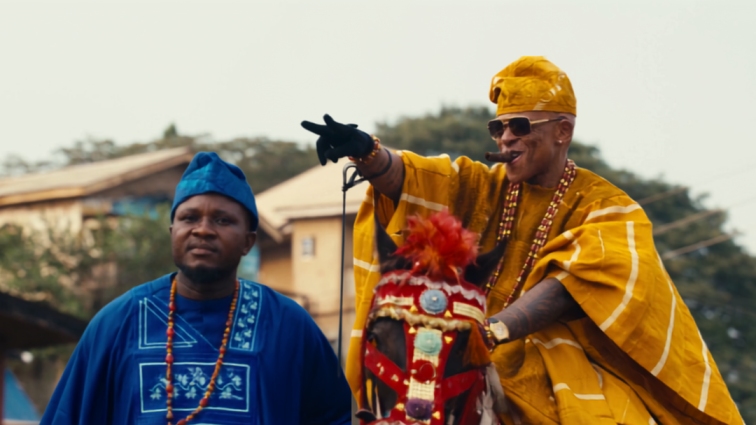
The drone footage gives the festival grounds the scale they deserve, revealing the Ojude Oba not as a background to the story but as a story in itself: a living document of Ijebu identity, an annual act of cultural insistence in a country that has spent most of its post-independence history undervaluing what its communities know about themselves. These sequences suggest that the filmmakers were shooting the actual festival rather than a recreation of it, and that authenticity gives them a texture and energy that the dramatic scenes rarely match. The Ojude Oba is the film’s most compelling presence. It does not need direction. It simply needs to be seen.
Owobo Ogunde as Ojusote carries the dramatic weight of the film with a seriousness that the role demands and the film’s coherence requires. He finds the specific register of a man whose pride has calcified into stubbornness without tipping into the cartoonish, which is the performance’s most important achievement, because a protagonist who cannot generate sympathy alongside his flaws loses the audience before the forgiveness theme can function.


Mercy Aigbe as his wife Abosede operates within the deliberate cadence of Yoruba performance tradition (words weighted and extended, emotion announced rather than implied) in ways that will read differently depending on the audience’s familiarity with that tradition. It is a deeply culturally embedded performing style, and the film makes no apology for it and no concession to audiences outside its tradition. This is, in principle, the correct decision. In practice, it occasionally creates distance between the character’s interior state and the audience’s access to it.
At two hours and six minutes, the film is longer than its dramatic content can comfortably sustain. The structural problem is not simply pacing but positioning: the emotional reckoning that the entire film has been building toward arrives in a runtime that has already spent considerable energy on the subplots orbiting it, and it must work harder to land with full force than it should. This is an editorial problem as much as a writing one; a more disciplined cut would not diminish the film’s cultural ambitions but concentrate them, giving the forgiveness at the story’s heart the unobstructed space it needs to breathe.
There is a version of Ìwé Àlà that fully becomes what its best instincts are reaching toward; a film in which the personal story of a man reckoning with the legacy he is leaving is as magnificent as the cultural story unfolding around him, in which the Ìwé Àlà of the title carries the same emotional weight as the festival that gives it context.
That film is visible inside this one, in flashes and fragments, in the moments where the screenplay loosens its grip, and the Ojude Oba simply is what it is: one of West Africa’s most beautiful communal expressions of identity, survival, and the specific Ijebu insistence on being fully and magnificently themselves. The festival has been celebrating that insistence for over a century. It does not need the film to justify it. What the film needed was a drama equal to it. It has found one that is worthy but uneven, and in the gap between those two things lives the honest measure of what Ìwé Àlà achieves and what it leaves for next time.
Rating: 2.3/5
Joseph Jonathan is a historian who seeks to understand how film shapes our cultural identity as a people. He believes that history is more about the future than the past. When he’s not writing about film, you can catch him listening to music or discussing politics. He tweets @Chukwu2big