

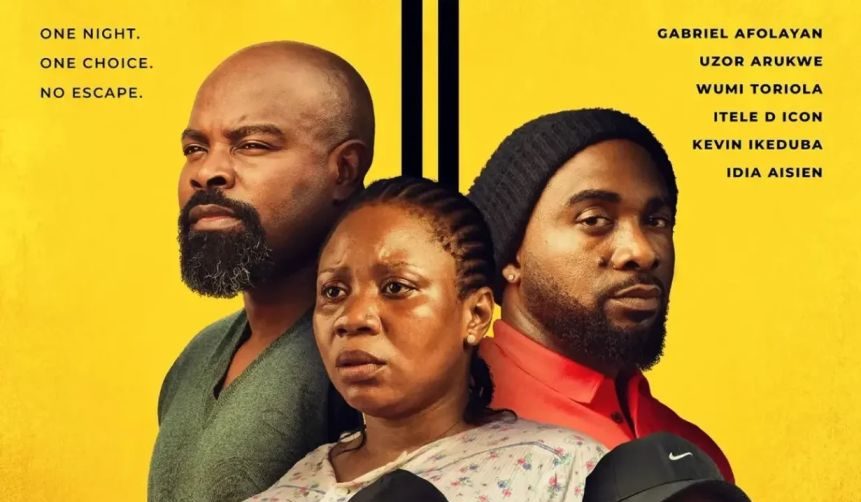

One Gidi Night finds its rhythm when Lagos, the clock and its characters’ desperation converge, but loses its grip when its screenplay leaves some decisions unearned and consequences unresolved.
By Joseph Jonathan
The real-time thriller is one of cinema’s most unforgiving forms. Remove the convenient time jump, the narrative shortcut, and the luxury of allowing characters to recover between major events, and the story has nowhere to hide. Every decision has to feel immediate; every complication has to intensify the one before it. James Abinibi’s One Gidi Night understands this. More importantly, it understands that Lagos is almost perfectly suited to such a story. Whether it delivers on that ambition is a more complicated answer.
Written, directed and produced by Abinibi, the neo-noir thriller follows Ejiro (Gabriel Afolayan), a dispatch rider whose seemingly ordinary night takes a dangerous turn after he becomes entangled in a criminal operation he never agreed to join. With his pregnant wife waiting for him, Ejiro’s attempt to get home becomes a race through a Lagos increasingly hostile to his plans. The premise is simple: compress the story into one night and let the city, the clock and the characters’ decisions generate the tension.
It is a smart choice because Lagos has long provided Nigerian cinema with the raw materials of urban crime stories: congestion, economic desperation, anonymity, informal networks and the constant collision between legitimate survival and illicit opportunity. From older depictions of the city as a place of hustle and social mobility to contemporary crime thrillers that turn its streets into arenas of danger, Lagos has rarely been merely a backdrop. One Gidi Night understands this tradition and pushes it towards a more explicitly neo-noir direction. Here, the city is not simply where the story happens; it helps determine what can happen.
The film’s best formal decision is therefore not merely its real-time structure but the way it connects that structure to movement through Lagos. Sangotedo, Awoyaya, Lakowe and the other locations establish a physical geography for Ejiro’s predicament. Every journey costs time, and every delay creates another opportunity for something to go wrong. Abinibi makes the audience conscious of distance in a way that strengthens the suspense. Ejiro is always trying to get somewhere, but the closer he appears to safety, the more complicated the route becomes.

This is where One Gidi Night comes closest to classic noir. The traditional noir protagonist is rarely trapped by a locked door. He is trapped by circumstances, bad decisions and an environment from which escape becomes increasingly difficult. Abinibi translates that idea into contemporary Lagos, where danger can come from another person, another job, another road or simply the consequences of being in the wrong place at the wrong time.
At its best, the real-time structure makes these pressures cumulative. The audience knows the night has an endpoint, but the uncertainty lies in what Ejiro will have to endure before he reaches it. Abinibi also demonstrates a good instinct for pacing, allowing some moments to breathe before accelerating into the next complication. The cinematography complements this rhythm with wet roads, headlights, shadows and half-lit spaces. Lagos feels restless and difficult to fully read, which is exactly what the film needs.
The on-screen markers establishing time and location are another smart choice. In a story that constantly moves between places and incorporates flashbacks, they prevent disorientation without burdening the dialogue with unnecessary exposition. Some transitions are similarly inventive, particularly when visual elements connect otherwise separate scenes. These choices reveal a filmmaker thinking about the mechanics of storytelling rather than simply moving characters from one plot point to another.
But this is also where the film exposes its limitations. Real-time storytelling leaves very little room for weak character logic. When a character makes a questionable decision, there is no comfortable distance between the decision and its consequences. The audience has to believe that the person would make that choice at that precise moment. One Gidi Night does not always achieve this.
Its escalation is often convincing as circumstance but less convincing as behaviour. Some decisions feel like the screenplay’s requirements rather than the natural consequences of established personalities. Once that happens, suspense changes. Instead of asking, “What is going to happen?” the audience starts asking, “Why would this person do that?” The former creates tension; the latter exposes the machinery underneath it.

The flashbacks help explain how the characters arrived at the night’s circumstances, but they do not always deepen our emotional understanding of them. They provide information where the film sometimes needs emotional pressure. A thriller can explain a character’s motivation without making that motivation feel inevitable.
Gabriel Afolayan does much to bridge that gap. His Ejiro is not an action hero in the conventional sense. He is tired, frightened and increasingly overwhelmed, and Afolayan allows those qualities to register physically. His performance is built around movement and reaction: the hesitation before a decision, the calculation of an escape route, the exhaustion of somebody whose night keeps getting worse. He gives the film a human centre that the screenplay does not always provide.
Uzor Arukwe has perhaps the more technically demanding role, playing twins whose differences need to be communicated without relying solely on appearance. He gives the two characters distinct rhythms and energies, allowing their personalities to register through behaviour. Wumi Toriola, Ibrahim Yekini (Itele D Icon) and the wider ensemble provide solid supporting work, although several characters are constrained by the same structural problem: they exist long enough to serve the plot but not always long enough to become fully developed people.
The police subplot is the clearest example. It is introduced with enough weight to suggest that institutional consequence will become part of the film’s larger moral framework. Yet the thread is eventually left hanging. For a story so invested in choices and consequences, an institutional thread that simply disappears weakens the sense that the night is keeping an account of everything that happens within it.


This is ultimately the contradiction at the centre of One Gidi Night. The film is very good at creating the conditions for tension. It understands its city, its compressed timeline and the visual language required to make darkness feel uncertain. It knows that movement can be suspenseful when every journey costs something. But it does not always sustain that tension because its character logic occasionally falls behind its plotting.
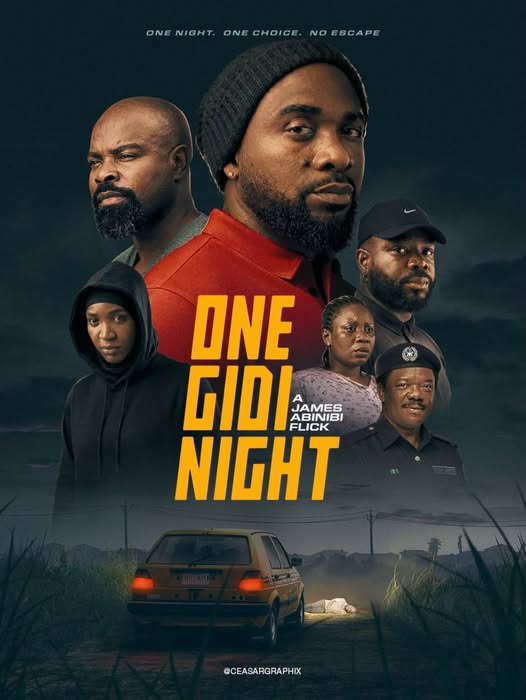
That makes the film more interesting as an exercise in form than as a completely satisfying thriller. Abinibi has clearly thought about what it means to tell a story in real time, and the result contains several genuinely effective pieces of filmmaking. But formal discipline cannot compensate indefinitely for underdeveloped motivations or narrative threads that do not receive proper resolution.
Still, there is something encouraging about the ambition. One Gidi Night recognises that Lagos already contains everything a neo-noir thriller needs. The city is fast, crowded, economically unequal and unpredictable. People are constantly moving towards something—money, safety, opportunity, home—and sometimes those destinations put them on a collision course with one another. Abinibi does not have to manufacture that tension. He only has to give it a deadline. He comes close to doing exactly that.
One Gidi Night finds its rhythm when Lagos, the clock and its characters’ desperation converge, but loses its grip when its screenplay leaves some decisions unearned and consequences unresolved. The result is an atmospheric and formally ambitious thriller whose strongest ideas are sometimes more convincing than its execution.
Rating: 2.9/5
Joseph Jonathan is a historian who seeks to understand how film shapes our cultural identity as a people. He believes that history is more about the future than the past. When he’s not writing about film, you can catch him listening to music or discussing politics. He tweets @Chukwu2big.