



At two hours and three minutes, Love and Life is a long journey without a clear destination; a film that introduces its emotional coordinates early and then spends its considerable runtime circling them rather than pressing into them.
By Joseph Jonathan
There is a particular kind of film that arrives carrying more goodwill than it has earned, built on the strength of its cast, its intentions, and the cultural appetite for stories about women navigating life’s harder passages with their friendships intact. Nigerian cinema has always had an audience for this kind of film, and that audience is not wrong to want it. At its best, the female friendship story is one of the most emotionally intelligent forms available to drama: it lets us explore love, loss, ambition, and identity through a lens mainstream Nigerian storytelling has historically underserved.
When the cast assembled to tell that story includes Rita Dominic, Nse Ikpe-Etim, and Michelle Dede — three of the most accomplished performers the industry has produced — the goodwill accumulates further still. The tragedy of Love and Life, written by Brenda Ogbukaa-Garuba and directed by Reuben Reng, is not that it squanders this goodwill entirely. It is that it squanders it so consistently, and so unnecessarily, across a runtime of two hours and three minutes that feels considerably longer than it is.
Being the second film in the First Features Project, its setup is promising in the way that setups sometimes are: clean in outline, with sufficient emotional architecture to support a film of real weight. Abike (Rita Dominic) is eight months into widowhood, locked in her room, paralysed by a grief that the film initially renders with genuine sensitivity.
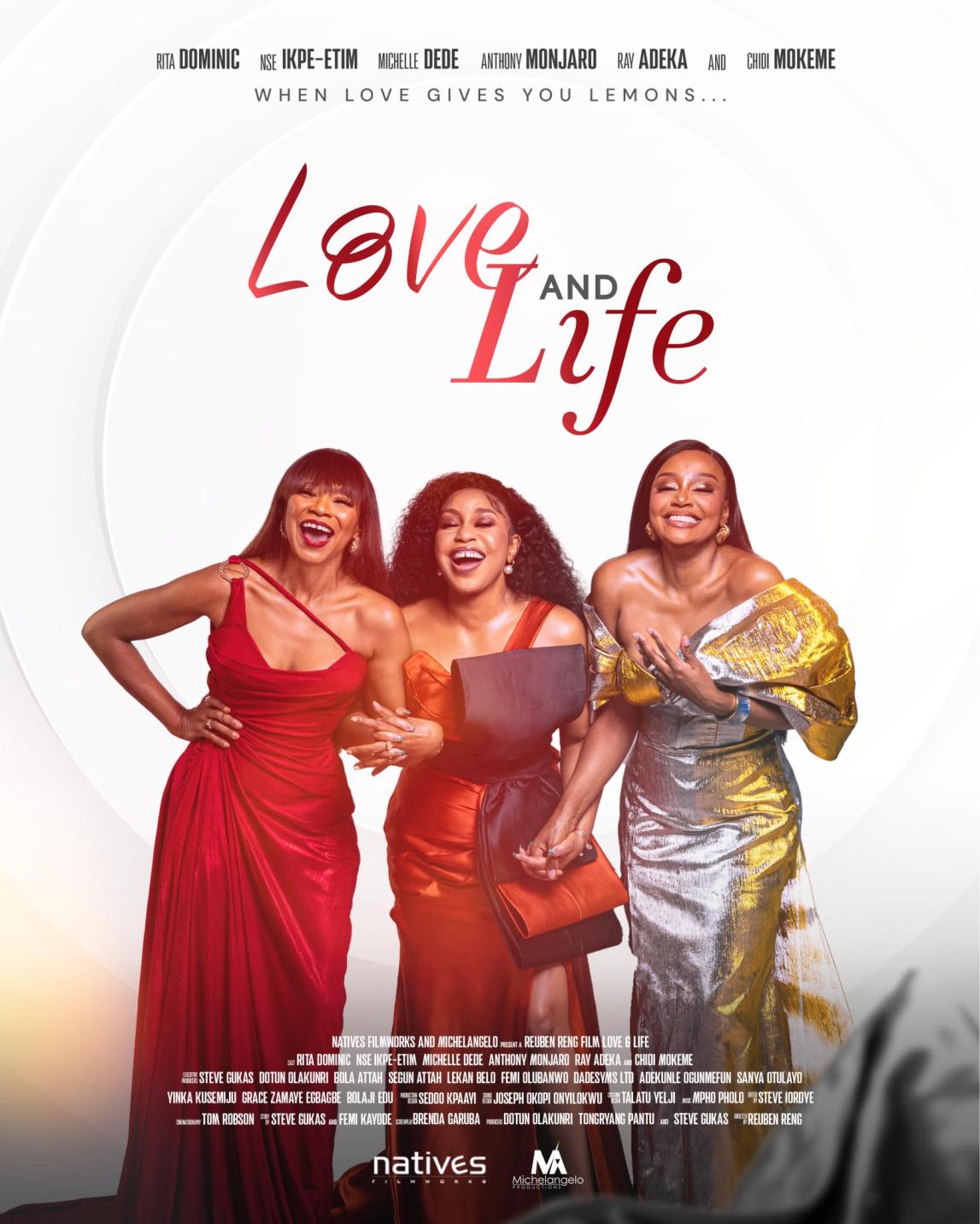
Her friends Ivy (Michelle Dede) and Osas (Nse Ikpe-Etim) orbit her, each carrying their own domestic turbulence: Ivy’s marriage to Dekunle (Chidi Mokeme) has gone cold in ways that the film takes its time identifying, and Osas’ relationship with her younger boyfriend Dante (Ray Adeka) is corroded by a distrust she cannot fully suppress. Three women, three kinds of romantic crisis, one sustaining friendship. The structure is familiar but not inherently weak. The weakness is in what the film does with it.
What it does, primarily, is take wrong turn after wrong turn on the way to an ending it has not earned. The dramatic problems accumulate rather than resolve, and the accumulation has a specific quality: it feels less like a story losing its way than like a story that was never entirely sure where it was going. Conflicts that should build toward genuine confrontation are resolved with a swiftness that borders on dismissal: Abike’s grief, which is the film’s most emotionally substantial material, is periodically subordinated to the romantic complications of the other two women in ways that dilute rather than deepen the ensemble’s emotional logic.
The stakes, when they arrive, are communicated with insufficient force, and the resolution of several plot threads triggers not satisfaction but a kind of bewildered disbelief, the specific discomfort of watching a film conclude that its own preceding events have not prepared it to reach.
The screenplay’s most instructive failure is its treatment of the men. Dekunle, whose emotional withdrawal from his marriage is meant to generate one of the film’s central tensions, is written and performed (Mokeme operating at a register of flat disengagement that serves neither character nor film) as a figure of such thin motivation that his eventual behaviour carries no dramatic weight.
When the revelation of what has been happening in this marriage finally arrives, the film expects a response from the audience that it has not sufficiently earned through the construction of the relationship preceding it.
The men in Love and Life exist primarily as catalysts for the women’s emotional experiences rather than as people with their own interior lives, which is a legitimate storytelling choice only when the women’s experiences are rendered with the depth that the choice demands. Here, the women are also underwritten, not in their performances, which are the film’s consistent strength, but in the material the screenplay provides them.

Abike’s late husband Tyrone, played by Bassey Ekpo in portrait form and in brief flashbacks, achieves something quietly remarkable: a presence that registers in his absence, a gravity felt most fully through Abike’s relationship with his memory. That the most emotionally convincing male presence in the film is a dead man appearing only in photographs and recollection is less a tribute to the casting than an inadvertent indictment of the screenplay’s treatment of every living male character.
What saves Love and Life from complete failure (and the saving is real, if insufficient) is the performances of its three leads, who consistently do more with the material than the material deserves. Dominic anchors the film with an emotional seriousness that keeps Abike’s grief legible and affecting even when the screenplay rushes past it toward plot mechanics.
There are moments, particularly in the film’s group therapy sequence and in the quieter scenes where Abike speaks to photographs of her husband, where Dominic achieves the specific register of a woman reconstructing herself after devastation, and these moments are the film’s best. Ikpe-Etim as Osas brings a comic energy that provides genuine relief without tipping into caricature, and her timing in the film’s lighter scenes is precisely calibrated.
Dede’s doe-eyed warmth makes Ivy sympathetic in ways the screenplay does not always support. Together, the three women generate a chemistry that occasionally convinces you of a friendship that the film has not quite taken the time to build on the page.


The film’s formal limitations compound its narrative ones. The camera, for much of the runtime, maintains a distance from its subjects that is neither stylistically motivated nor emotionally useful; a static observational posture that might suit a different kind of drama but works actively against a film whose subject is the interior lives of women under emotional pressure.

Cinema communicates interiority through proximity, through the selective attention of a camera that moves with its characters’ consciousness rather than simply recording their exteriors. Love and Life is largely content to record exteriors, which means that the grief and desire and frustration it is depicting remain at one remove from the audience, visible but not felt.
The few moments of camera movement suggest that the formal vocabulary was available and understood; the choice not to deploy it more consistently is the film’s most significant directorial missed opportunity.
At two hours and three minutes, Love and Life is a long journey without a clear destination; a film that introduces its emotional coordinates early and then spends its considerable runtime circling them rather than pressing into them.
The destination it eventually reaches is not the wrong one, exactly, but it is one the film has not travelled far enough to deserve. Nigerian cinema has proven, in recent years, that it is capable of sophisticated, emotionally honest portrayals of women navigating love and loss on their own terms. Love and Life wants to be part of that conversation. It does not yet have enough to say.
Rating: 2.3/5
*Love and Life was released on Prime Video on December 29 2023, as the second film in the First Features Project slate.
Joseph Jonathan is a historian who seeks to understand how film shapes our cultural identity as a people. He believes that history is more about the future than the past. When he’s not writing about film, you can catch him listening to music or discussing politics. He tweets @Chukwu2big.