
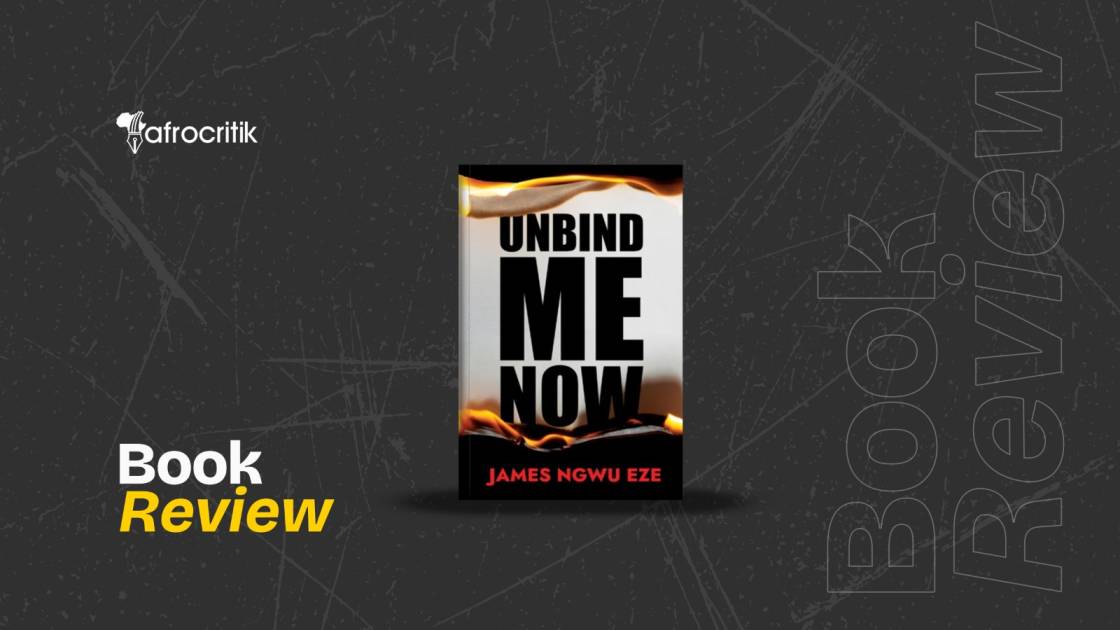

And truly, the poetry in Unbind Me Now is angry, filled with outrage and umbrage, or at least performs it (no matter what, anger and its adjacent feelings are a good spring for great politically conscious poetry).
By Chimezie Chika
Somewhere in the middle of Unbind Me Now, James Ngwu Eze’s collection of poetry, which was on the 2026 Nigeria Prize for Literature shortlist, “The Voice of the Streets” begins:
my poetry belongs to the streets—
to the itinerant traders with broken voices,
to tooting horns that shatter our sleep at dawn.
At which point I began to wonder how many verses in this book are telling us what the poet’s poetry is about. A roll call would be too tedious, but a couple of examples will suffice.
The poem, “burning verses”: “my verses wear thorns—/sharp edges that slice/like an axe at the root of lies”.
The poem, “i speak fire”: “mine is the breath of fire—/a covenant that burns”.
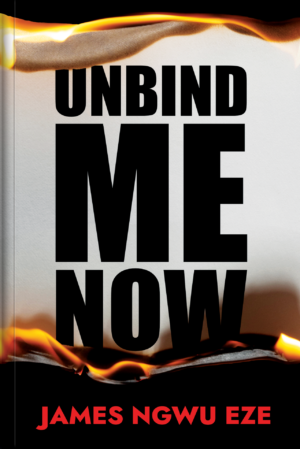
I am not very comfortable with this literalised, lip-heavy iconoclasm; this need to send us a frequent reminder within poems of what one’s poetry is about. For one thing, it takes away the critic’s job. The poet has become a connoisseur who tells us, without subtlety, how to read his poetry as he is writing it. If we are being asked to consign this poetry to Spoken Word, something truly engineered for street activism, perhaps we should simply try to find its elements in the collection.
And truly, the poetry in Unbind Me Now is angry, filled with outrage and umbrage, or at least performs it (no matter what, anger and its adjacent feelings are a good spring for great politically conscious poetry). The poems here speak frequently on the political and security issues that have plagued this country.
There are many poems dedicated to vituperating Boko Haram and other insurgents of northeastern Nigeria, Bandits, Unknown Gunmen, and even George Floyd and the race issues that created BLM activism. In “burnt bibles”, for instance, we read about what some people have tagged a Christian genocide in the Northeast and the Middle Belt (another poem in the book references Trump’s involvement in the saga), a targeting orchestrated by the same Islamic insurgents:
burnt bibles, broken altars,
pews spattered with blood,
Shrieks of dying infants
and mothers forced into labour—
In a later verse, we get the inevitable Leah Sharibu reference:
O searing cry
of pastors slain before their altars;
of young Leah embracing bondage
in return for her faith.

Leah was a much bigger presence in Why Does God Need a Gun?, another book on the Nigeria Prize shortlist (which won the prize), as she has been in a number of poems I have seen in certain places. Ms. Sharibu has become a victim of not just Islamic insurgency but also of the holy anger of Nigerian poems. This kind of poetry can call her name, but they must also not forget that they have the canvas to do more than call names.

And still, the poetry continues to insist upon what it wants to be seen as doing. In the titular poem, it is “the aggrieved sun” that “casts a blurry gaze/through clouds of injustice”. And it is important to note again that poetry dedicated to injustice is a noble one; one only asks that it expresses a high consciousness of the technical and intellectual demands of poetry.
To that end, Unbind Me Now attempts a grand design. Within this design, it attempts elemental sequences going from fire to earth to water; it projects biblical burning bush images and ecological images of a tender and grieving earth, amongst others, by which it attempts to show us a nation on fire, a country that needs saving, etc.
There is many a recourse to nature here, some lyricism and rhythm. There are echoes of Okigbo without any of his power of symbolism and prophecy; and some prosodic chants in “litany of resistance” and “our chants have grown teeth”). There are echoes of Kofi Awoonor, Clark, and Senghor, but they are all botched by reckless inattention.
Elsewhere, the rhythm in the first lines of the poem, “my roof is on fire”, nearly reminded me of Masizi Kunene’s “To the Soldier Hero”. And of course it is nothing like the latter, not in subject or sheer power. One poem, “apocalypse”, only grazes that power ever so slightly. By the poem, “Crossroads”, we get a caper on Shakespeare’s Julius Ceasar, which would perhaps have added something Clarkesque herewith had the book’s grand design worked:
fellow countrymen and women, lend me your ears:
our dance of madness swirls in the market square.
Why didn’t it work? It’s hard to tell. The difficulty of this poetry is clearly not due to deliberate formal difficulty. What is it then? Purpose? Certainly not, for the purpose was explained in the preface. Imagination? Perhaps. The difficulty here, hard as it is to pinpoint, might still reside in the purpose; or more specifically, in the role this poetry has been given. It is a role that asks us to turn a blind eye to all else and see only righteous iconoclasm.
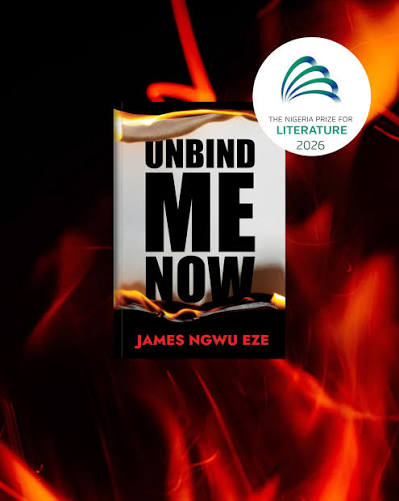
One of the many frustrations of this book is its monotony of images, of phrases, words, flow. Apart from the individual poem titles, it can be hard to tell one poem from the other over a span of 150 pages. The verses in Unbind Me Now coerce us to think in one direction, and we must respect that.
On 8th October 2026, the Nobel Committee announced Canadian poet and classicist Anne Carson as the winner of the 2026 Nobel Prize in Literature. She brought to poetry an intellectual understanding and a willingness to experiment with the mythological foundations of Western culture. It seems to me that the true breadth and power of Nigerian poetry, which has produced someone of Wole Soyinka’s standing, who brought great intellect and purpose to the reinvention of the mythological foundations of Yoruba and African culture, may not have been well represented where such representation matters, through proper ụgwọ ọrụ—the incorrigible merit mechanism.
We should ourselves ask then: How do poets think? How should poets think? A poet should have understanding (from experience and intellect), that is one. A poet should possess honesty, and an honesty of purpose and feeling. And when poetry draws from an ancient foundation, or an existing mythos, it possesses something for all time. But somehow, there is a kind of poetry that insists it must be read for its subject matter, not for its inventiveness, technique, and skill. Such poetry might well be given a category: for the sake of the streets, the common man, or for all kinds of activism.
Chimezie Chika is a staff writer at Afrocritik. His short stories and essays have appeared in or forthcoming from, amongst other places, The Iowa Review, Dappled Things, Channel Magazine, Terrain.org, Lolwe, Isele Magazine, Efiko Magazine. He is the fiction editor of Ngiga Review. His interests range from culture, history, to art, literature, and the environment. You can find him on X @chimeziechika1