



“I wanted Church Girl and Other Short Stories to make readers feel seen. Many people endure ordeals they feel unable to articulate, unaware that others share those exact struggles. This collection is a way of saying: Yes, this painful reality exists, but you can overcome it” – Merit Gogo-fyneface.
By Chimezie Chika
Merit Gogo-fyneface is a lawyer and writer whose works explore contemporary life, identity, and cultural complexity through fiction. She is the author of Church Girl and Other Short Stories, a Christian-themed collection of stories, and two previously published novellas. Her writing frequently returns to the themes of love, faith, identity, and urban experience. Merit is also the founder of Sarima City Magazine, an online publication dedicated to storytelling, creative expression, and positive lifestyle commentary.
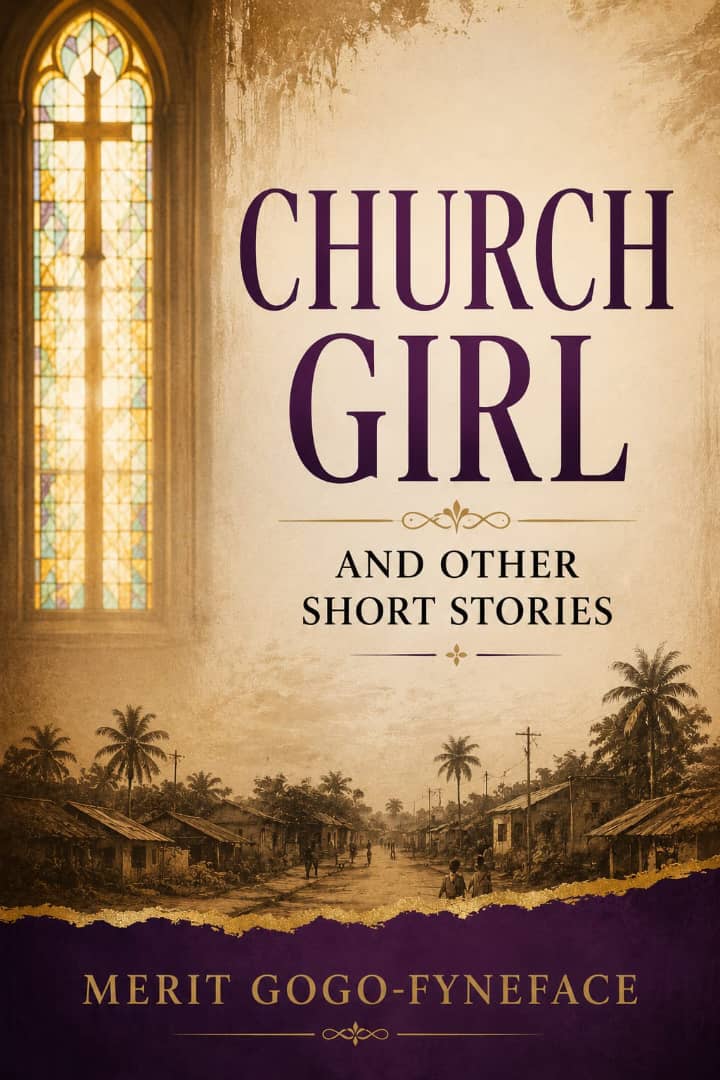
Church Girl and Other Short Stories, an example of Nigerian Christian fiction, collects seven stories which dwell on the travails of Christian women. The stomping ground of the stories is mostly marriages and relationships, and the themes are right up the alley of Christian fiction: love, romance, faith, patience, and belief in God.
In this interview, she discusses Church Girl, Christianity, and her writing process.
How did you start writing?
I began writing at twelve. I had a couple of poems and short stories, and I even started creating my own magazine with formatted sections inside a mini notebook. After writing a piece for an English assignment, my teacher, who was amazed by the story, asked, “Is this a true-life story? Keep it up.” It was entirely from my imagination, and that was the moment I realised these stories and poems had real value.
I kept writing, publishing my first novella in 2012, and eventually went on to establish the Sarima Magazine and Sarima City in 2021. Writing for me began as a personal form of self-expression and then grew into a lifelong pursuit.
What books or influences have shaped you as a writer? What is your defining literary influence?
Since I enjoy foreign legal thrillers, African fiction has been my primary influence. Stories deeply rooted in our realities, culture, struggles, and everyday experiences. Books like The Beggars’ Strike and The Joys of Motherhood resonated with me deeply.
If I had to pinpoint a single defining influence, the works of Buchi Emecheta stand out. As a literature student years ago, I remember actively arguing with some of her concepts and central themes. Yet, regardless of my personal stance on those ideas, I found her narrative style and voice extraordinarily compelling.

What inspired your collection, Church Girl and Other Short Stories?
I wanted Church Girl and Other Short Stories to make readers feel seen. Many people endure ordeals they feel unable to articulate, unaware that others share those exact struggles. This collection is a way of saying: Yes, this painful reality exists, but you can overcome it.
Furthermore, within religious spaces, sometimes we tend to see only the good in people, hoping our positivity will be mirrored. Unfortunately, some individuals exploit that trust, leaving people on an unimaginably broken path. Awareness equips you to protect yourself, so I designed Church Girl as a bank of knowledge. I view writing as an educational tool to showcase complex, unspoken experiences and broaden the reader’s perspective beyond their own worldview.
What difficulties did you encounter while writing this book?
Handling sensitive, easily misunderstood themes was a delicate task. Additionally, because Church Girl and Other Short Stories explores diverse scenarios, I had to ensure each entry maintained its distinct voice while keeping the overall collection cohesive as a single body of work.
Which story in the collection was the hardest to write, and which was the easiest? Why?
“Church Girl” was the most challenging. I chose to tell it in an unconventional epistolary format while keeping the narrative direct and balanced. The main hurdle was preserving its spiritual essence—finding the exact intersection between what I felt spiritually compelled to communicate and how to deliver it effectively as literary fiction.
In “Deliverance”, the narrative addresses serious spiritual themes. Were you criticising aspects of institutional Christianity, and what was your main objective?
“Deliverance” explores what happens when people weaponise religion without truly understanding faith or God. The story grew from my observation of how faith can become distorted by fear, cultural bias, ignorance, and desperation.


In the story, Bright is a child struggling academically. Rather than addressing his educational needs, the adults around him attribute his performance to spiritual affliction that must be beaten out of him, framing the abuse as a “deliverance”. I was not asserting that Christianity itself is inherently violent or problematic. Rather, I wanted readers to distinguish between serving God in truth and engaging in harmful actions disguised as spiritual intervention.
In the titular story, “Church Girl”, Daberechi repeatedly emphasises prayer while advising a friend on marriage. What role does prayer play in choosing a partner, and can it single-handedly save a marriage?
Prayer plays a pivotal role alongside self-awareness, observation, and an understanding of one’s purpose before entering a union. When you truly understand yourself and what you need, your prayers become much more focused.
However, prayer cannot serve as a substitute for the practical work a marriage demands. As Daberechi suggests, prayer isn’t merely asking God to transform someone into your ideal partner; it is asking for the wisdom to see a person for who they truly are—and the courage to accept that reality, even if it isn’t the answer you desire.
Of all the stories, “Redemption” and “Heaven’s Gate” tackle themes often identified as feminist. Do you align with feminism, and where do faith and social justice intersect for you?
I don’t explicitly identify as a feminist; my focus is on fairness, justice, human dignity, and upholding fundamental rights.
With “Redemption” and “Heaven’s Gate”, I wanted to examine experiences that people either conceal or struggle to process. Some carry heavy emotional burdens in isolation, while others remain completely unaware of the hardships around them. These stories are meant to act as eye-openers—creating a shared space of empathy, fairness, and mutual understanding regardless of labels.
What are your goals and future plans for Church Girl and Other Stories?
My goal is for readers to extract meaningful lessons and fresh perspectives from every story. Looking forward, I am excited that these characters’ journeys haven’t fully concluded. I plan to develop a sequel that expands on several storylines and characters introduced in this volume. While this collection stands complete on its own, there is still much more of the story left to tell.
Chimezie Chika is a staff writer at Afrocritik. His short stories and essays have appeared in or forthcoming from, amongst other places, The Iowa Review, Dappled Things, Channel Magazine, Terrain.org, Lolwe, Isele Magazine, Efiko Magazine. He is the fiction editor of Ngiga Review. His interests range from culture, history, to art, literature, and the environment. You can find him on X @chimeziechika1