


In terms of quality, it might be one of the Caine Prize’s stronger shortlists in recent times, alongside the 2024 shortlist.
By Chimezie Chika
The Caine Prize for African Writing, the most prestigious award for African short stories, has returned in 2026 with a remarkable shortlist of five stories after what might be called a hiatus last year. The Caine Prize is a career-making literary prize that has been awarded to a long line of important African writers—including Leila Aboulela, Binyavanga Wainaina, Helon Habila, Yvonne Owuor, EC Osondu, NoViolet Bulawayo, Tope Folarin, Namwali Serpell, Nneka Leslie Arimah, and others—who have gone on to have stellar careers.
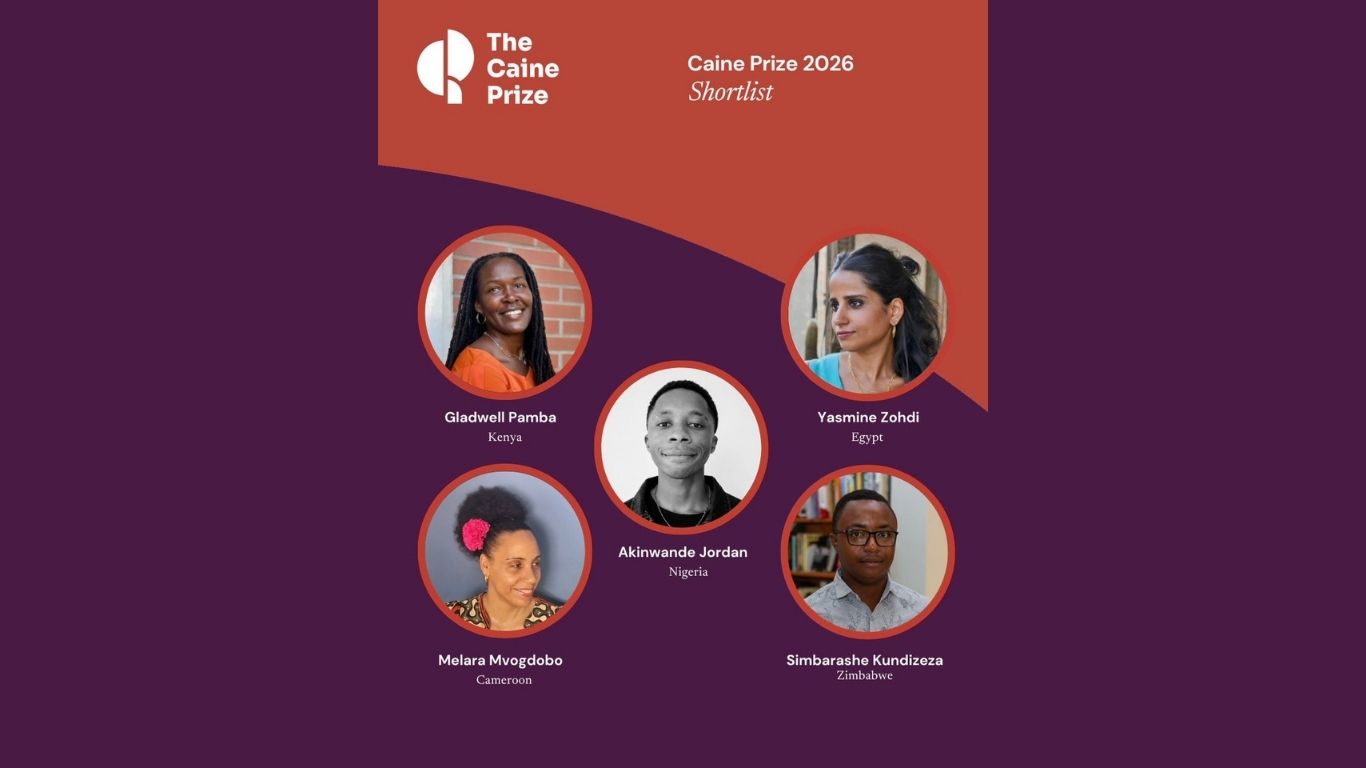
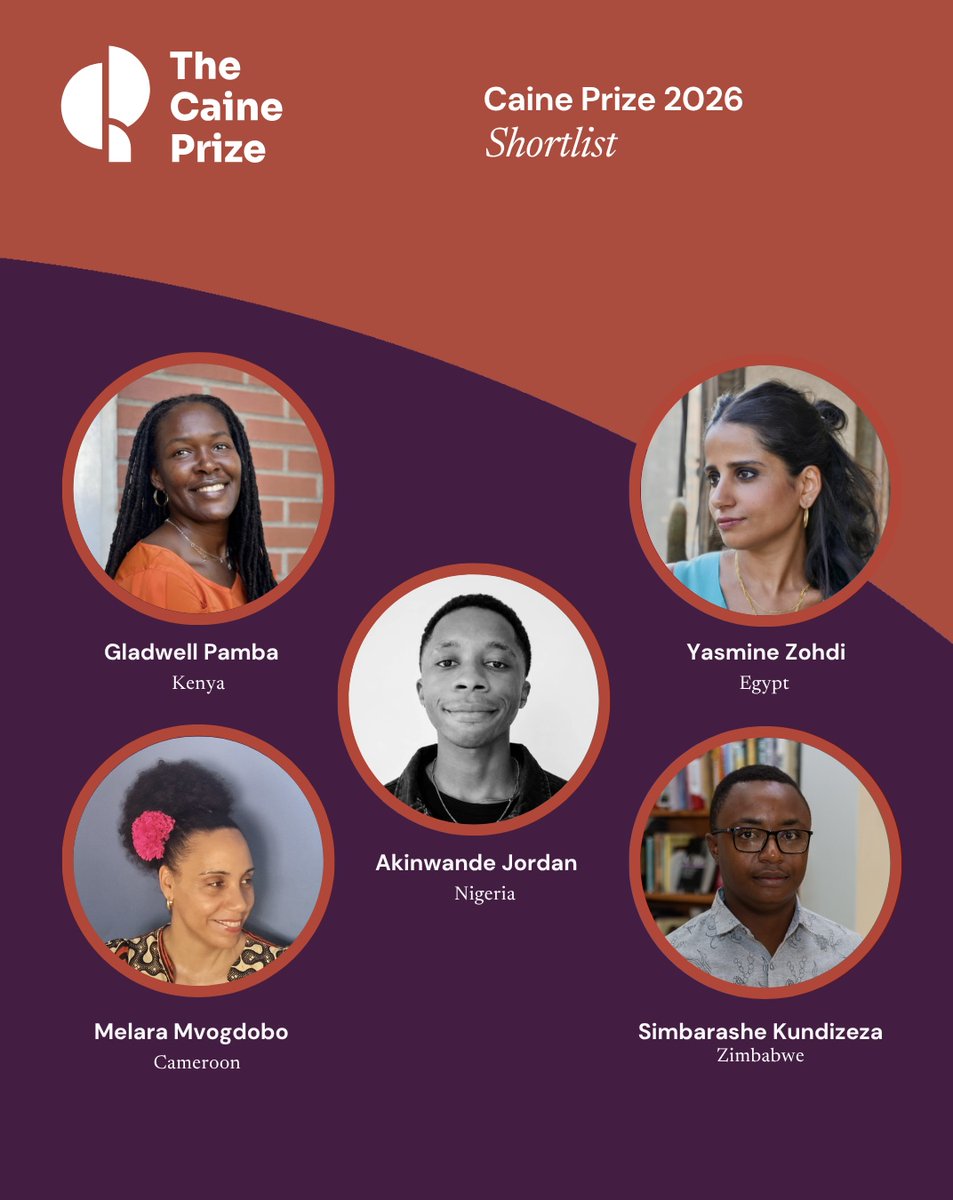
This year’s shortlist is one of the most democratic in the history of the prize. Each of the five shortlisted stories has been chosen to represent one of Africa’s five regions. North Africa is represented by Egyptian Yasmine Zohdi’s “The Absence of Stains”; South Africa is represented by Zimbabwean Simbarashe Kundizeza’s “The Blue Fighter”; West Africa is represented by Nigerian Akinwande Jordan’s “So Long It’s Starting to Look Like Eternity”; East Africa is represented by Kenyan Gladwell Pamba’s “The Last Shop”; and Central Africa is represented by Cameroonian Melara Mvogdobo’s “Dieu Merci”.
It is additionally gratifying to note that the Caine Prize now nominates stories from non-Anglophone Africa. This year, they featured a story from Francophone Cameroon. As recently as 2023, the prize was awarded to Senegalese writer couple, Mame Bougouma Diene and Woppa Diallo for their story, “A Soul of Small Places”. This is significant for a prize that has been perennially dominated by Anglophones from inception; something African translators must take note of.
This year’s shortlist, however, is significant in other ways. In terms of quality, it might be one of the Caine Prize’s stronger shortlists in recent times, alongside the 2024 shortlist. In terms of themes, they are variations on the subject of family. Family here can be an unlikely friendship, something contrived to attain legal status in a European country, confusion and indecision amidst infidelity, choosing love over family strictures, and making a firm decision against a family’s dwindling fortunes. In all or almost all the stories, female characters are making decisions that affect their lives or that of their families.
The plot of the first story, Gladwell Pamba’s “The Last Shop”, can best be described as stutterer boy meeting a traumatised coffin-making philosopher. The coffin-maker is a female ex-convict who has endured a hard life and seems to have acquired much wisdom from it: one such being that death is merely a peaceful transition, a mercy for the old. The stuttering boy, as one would expect, lacks confidence and gets bullied in school.
He thinks his talent is singing, but the coffin can see clearly that it is drawing, making art. As their relationship develops, the coffin maker helps the boy gain confidence and becomes the caring, attentive family he knows. But despite the young boy’s dependence on the coffin-maker’s seeming control on life, the latter is a woman thoroughly traumatised by her past.
“The Last Shop” is a straightforward story. Nothing jumps out here. Our interest is held down by the character of the coffin maker, around whom a certain mythic aura emanates. This mythic quality is present in the story’s collective consciousness, leading up to the final tragedy.
Dismay is perhaps the prevailing emotion a reader might find themselves dealing with while reading Melara Mvogdobo’s “Dieu Merci”. In a nutshell, it is the story of a Cameroonian woman whose mother brings her to Europe by the way of a fake marriage to a Congolese philanderer who has the Swiss citizenship they covet, which he himself got by the way of an earlier fake marriage to a white Swiss woman. The mother pays this man a monthly salary to keep being married to her daughter until she couldn’t pay anymore, and subsequently tells her daughter to find her own way. Acting on this, the daughter ends up with both a baby and an unconventional job in Geneva’s red-light district.
For Africans, is this surprising to read? That would depend on their knowledge of immigration stories. Many strange things happen in the African diaspora; many desperate things are done to gain citizenship in these places. In the story, Switzerland, DRC, and Cameroon can be viewed as stand-ins; the characters could be given other African nationalities, and the story would still be true.
“Dieu Merci” is a non-linear narrative. It is not clear how this has helped the story. While its flexible first person aligns with the story’s style, the story seems a little too erratic. One can say that the subject matter is the only thing interesting about it.
Nigerian writer Akinwande Jordan’s “So Long Now It’s Starting to Look Like Eternity” is the only story I read twice. On first reading alone, one immediately sees that it is a brilliant, glittering piece of art. It’s extremely skilful writing, conveyed by a direct prose that seems cleanly hewn out of stone, if you get what I mean.
The story it tells is riveting. A mathematics professor discovers his wife’s infidelity and does not know what to do about it. Having spent his life studying and cultivating mathematical formulas and formulaic mannerisms, his lukewarm reaction to the affair becomes the opening for the anatomy of a cold marriage. His wife is a professor of English literature herself, and her affair partner is a lecturer in sociology: emotional awareness meets human understanding — is it?
In short, it’s a story about ivory tower affairs—a common denominator for those who are well-acquainted with that sphere. What makes this story remarkable is the manner in which it is written. It does something wonderful with time, looping in and out of it. The writer understands psychology; he knows things and is not shy about letting us know. Above all, he pays attention to language.
Here’s how he would have written what I just wrote: This was how the sentences flowed. Their quality mattered. Their precision mattered.
For instance, look at how the writer turned beaten paths into new roads: “The words sat in the air between them. They had weight. They had mass. They occupied space.”
Writing can’t get more impressive than this.
But skill is also about knowing how to be judicious with patterns, wherever they appear, and the lack of variation to that effect is perhaps the problem here: many of the sentences are so precise, their types and styles so uniform, their cadence loitering in the same places. Overuse them, and they begin to obscure meaning.
One reader may be forgiven for missing it, but as the pattern becomes plainer, it may begin to grate for other readers; which then brings up the question of why such an accomplished writer can be so repetitive. When the professor’s wife first gives the alibi of “I don’t know”, we relate her response directly to an inner emotional turmoil. But after not a few repetitions of the same, we are not so sure anymore that the character is true to character.
Jordan’s “So Long Now It’s Starting to Look Like Eternity” succeeds at almost everything except the way it handles human emotion. To use its own style: the emotions are too precise, too calculated, too algorithmic—this rigidity matters.
All this is to say that the most flawless story here is “The Absence of Stains” by the Egyptian writer, Yasmine Zohdi. It is the slow-burn story of Miriam, a young woman from a typical Egyptian household who is in a relationship with a young filmmaker. It begins with the aftermath of their lovemaking, setting the tone of the central concern: the girl’s need to shake off the mores around girlhood, marriage, and virginity that exist in her family and doubtless in Egyptian society.



In such a society, it comes to a point where you begin to judge yourself more than society judges you. But our protagonist here is a fighter who is ultimately ready to take risks to secure her independence. It is the story of a girl breaking free of the moral strictures of family and society.
The story’s title points to the central question of sexuality and morality. Who does virginity mean more to, the girl or her family/society? What does virginity entail, a physical state or an emotional one? Some of these questions are highlighted in the story with subtlety and nuance. In one instance, after Miriam’s cousin, Dina, is attacked, Dina’s mother seems more interested in whether Dina’s purity is still intact than in the trauma she has suffered.
“The Absence of Stains” is written in simple, direct language, and the narrative movement is novelistic. Perhaps this is why we feel the characters and their struggles move and develop throughout the story, even within the short canvas of a short story. Much of Zohdi’s writing is reminiscent of Mahfouz’s Cairo Trilogy.
And finally, there is Simbarashe Kundizeza’s “The Blue Fighter”, which is the story of a man who quits his job to face his obsession with creating aquariums. He believes the idea is genius, but his comfortable family begins to suffer for it, progressively sinking into penury.
This plot has the spark of greatness in the hands of a true master, but this is not what we got here. The story read instead like an oft-told morality tale. That is, everyone has heard or read a version of it somewhere. But the commonness of stories is not what makes them significant; it is their telling that does. A piece is worthwhile because of the writing, not solely because of the subject matter.
What is new here then? Perhaps, it’s that the man’s obsession is making a business out of building aquariums, or that the story is narrated by his reminiscing grown son who sounds, to some extent, like a composite of the narrators of previous Caine stories, Okwri Odour’s “My Father’s Head” and Joshua Chizoma’s “Collector of Memories”. This means the narrator’s voice is interesting but also a little sentimental.
There is no reason why a contemplative story like this wouldn’t have read better, but it doesn’t. What sticks out most here is the dialogue. It has a certain artifice worsened by a propensity toward aphorisms.
For the life of me, I don’t know why we kept getting the following: “Sometimes love means bringing someone back to earth”, “Everyone should be allowed to keep one dream, Tinashe. Even if it’s a small one”, “Being strong doesn’t mean he’s happy. But he lives. That’s something.”
Aspire to Maguire, in other words. Yet, it’s not a bad story if we can read it with far less knowledge.
Having read through this year’s shortlist, I am almost reluctant, this time, to offer a prediction. I have a feeling I will not be as successful as I have been in times past. Nonetheless, for their mastery of narrative, I will place my inflated naira on Jordan’s “So Long It’s Starting To Look Like Eternity” or Zohdi’s “The Absence of Stain”.
Chimezie Chika is a staff writer at Afrocritik. His short stories and essays have appeared in or forthcoming from, amongst other places, The Iowa Review, Dappled Things, Channel Magazine, Terrain.org, Lolwe, Isele Magazine, Efiko Magazine. He is the fiction editor of Ngiga Review. His interests range from culture, history, to art, literature, and the environment. You can find him on X @chimeziechika1