

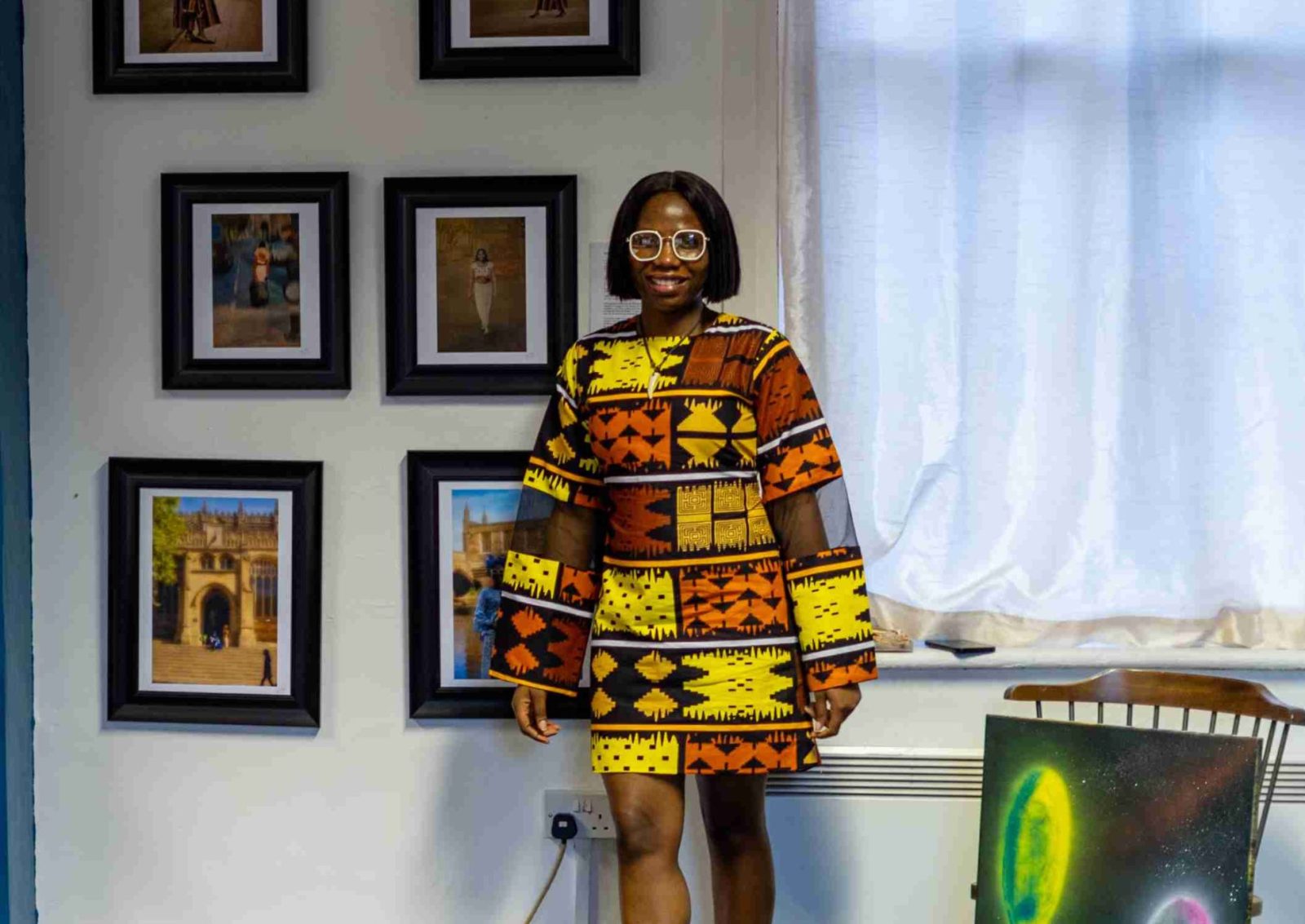

Since beginning her photographic practice in 2017, Esther Adeola Seriki has continued to move between conceptual portraiture, fine art, and all kinds of mixed media photography.
By Chimezie Chika
I
The triptych of photographs begins beyond its subject. What we are seeing is the final iteration of its construction. We know this through a number of pointers, as we do with all art in this mode: through their compositional style, through the correspondence of their visual metaphors, and through their conceptuality. The first of the three series of pictures here features a distinctly maternal woman in àṣọ òkè, the second series is of a young woman in mudukare, and the third series returns to the first woman, who this time is wearing a lace outfit.
This is Nigerian fine art photographer Esther Adeola Seriki’s presentation, “Core & Course: Who I Am!”, subtitled “A Triptych in Three Movements”. The work’s first public appearance was in 2023 when it won first place nationally (in Nigeria) in Wiki Loves Earth, a photography competition run by the Wikimedia Foundation, and later placed 8th globally in the special nomination category on Human Rights and Environment.
The HRE special category is an international segment of the competition run in partnership with the United Nations Office of the High Commissioner for Human Rights, which drew over 8500 submissions in that year. The competition, as a whole, is astoundingly huge; a 13-man international jury of photographers, artists, critics, and industry experts has to sift through 61,700 submissions from 3,300 participants from 50 countries to select the top 10 finalists. Remarkably, Seriki also placed 7th nationally when she contested again two years later in 2025.
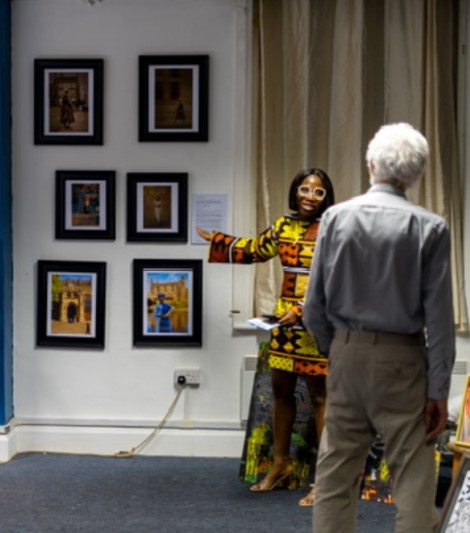
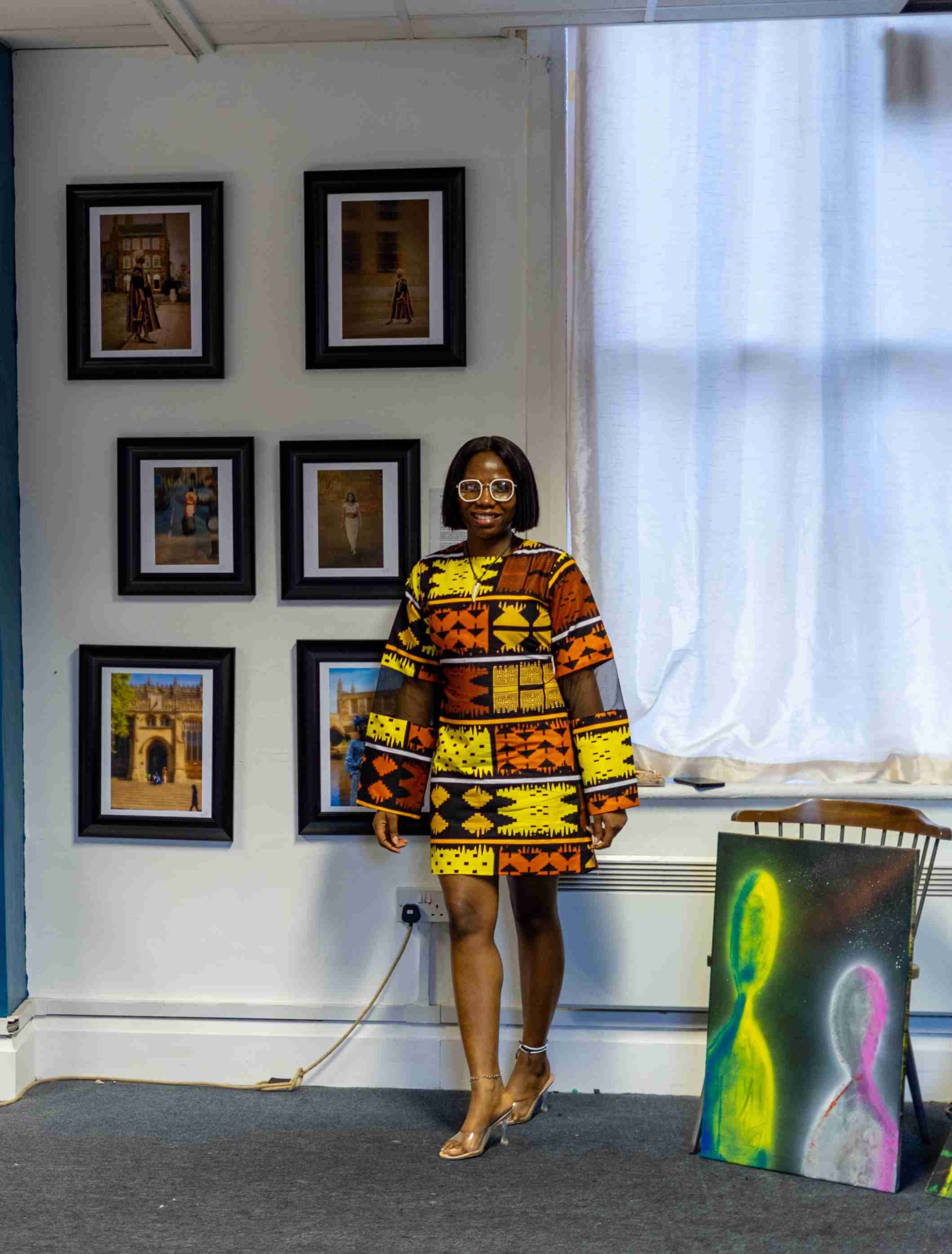
“Core & Course” has been most recently exhibited at the Westgate Studios in Wakefield, the UK city where Seriki and her family are based. The exhibition is part of Artwalk Wakefield, the city’s bi-monthly celebration of arts, heritage and culture—the last two being recurrent themes in Seriki’s work. It brings her work full circle by capturing the essence of the young photographer’s journey as an artist and immigrant. A cursory glance through her work would show a trail of themes around diasporic identity and the transmission of cultural memory. Her work often juxtaposes the body as a vehicle of belonging, as a carrier of generational and cultural continuity. Often, in her work, we are shown this through the images of children and offspring.
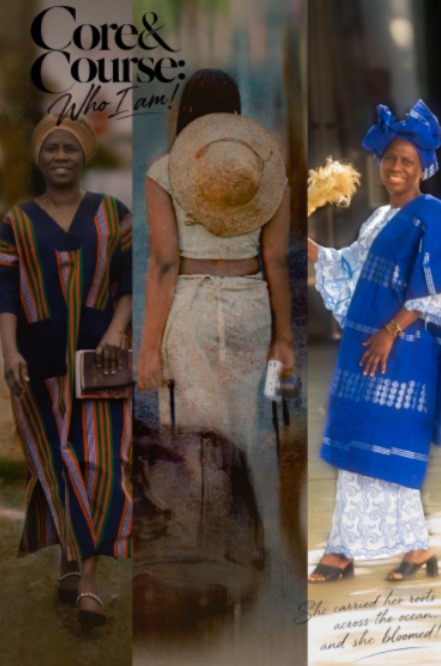
Beyond its visual lustre, “Core & Course: Who I Am!” Is a deeply autobiographical work. It’s three movements—as the artist herself frames it—that bracket two related women of vastly different ages, Seriki and her mother, in a complex dialogue across generations. In each movement of the work, the artist invites us to look at the core of her personhood, family values, and the course and direction she is taking to pursue the goals that grew out of those selfsame values.
The first movement, which has a rather trite title, Cultural Echoes in Motion, contains two featured photographs of a woman in àṣọ òkè (referenced earlier in this piece). The subject, we now learn, is Seriki’s mother. In the first photo of the movement, Seriki’s mother is standing in profile against the looming presence of a Georgian building somewhere in Wakefield and, apart from her garment, she is also holding an African print wrapper.
We cannot see much from the background, but we can make out signs of a city street. In the second photo, Seriki’s mother is captured walking through Wakefield. The blur of everything around her would suggest that the walk is brisk, but we particularly notice, as Seriki points out in her exhibition notes, that she is carrying a large bible. The wrapper and Bible suggest where the woman is coming from and where she appears to be heading; it suggests a rich heritage and culture tempered by a personal devotion to the Christian faith.
If the photographer has carefully curated objects that reveal her mother’s history and identity, she extends that to herself in the next movement, titled Who Am I?, which is a couple of self-portraits, the first of which pictures her from the back in a Fulani mudukare outfit, with one hand holding a camera and the other pulling a suitcase. The second photograph highlights Seriki from the front this time. In this iteration of her, she is standing in front of a red bus on a street with cars, though Seriki’s characteristic light-blur effect makes it difficult to decipher little else. It is a picture of a young woman in bloom.
Both photographs, if the pattern already established is anything to go by, show us the core of Seriki’s personality: a Nigerian photographer who has travelled to the United Kingdom to pursue her dreams. While it is not clear if Seriki has some Fulani heritage, we can interpret her wearing of that garment as an acknowledgement of the peripatetic necessity that warranted her migration. It seems also to be an acknowledgement of and desire for continuous artistic movement and mutation. It is, in essence, a desire for growth.
The last movement, Where We Were Held, containing a corresponding couple of photographs, is again focused on Seriki’s mother. This time the older woman is wearing a white-and-blue Nigerian lace attire, whilst carrying a traditional horsetail fan. In the first photo, she is standing in front of what looks like a river, with a baroque-looking building in the immediate background.
In the second one, she is sitting at the head of the entrance staircase of that building, between two flower pots, still carrying her fan. The signs of influence or affluence are unmistakable, for lace and a horsetail fan signify wealth or power back in Nigeria. In her exhibition notes, Seriki writes that at the point the photo was taken in Wakefield, her mother had five years of belonging behind her. We also learn that the building is the Wakefield Cathedral which, having “watched over this family’s arrival now [sic] stands witness to something quieter and more profound . . . [this is] a document of what a community can do when it opens itself up to people who have come from far away.” Seriki’s “Core & Course: Who I Am!” is, in simple terms, a chronicle of family, cultural values, immigration aftermath, and dream-building.


II
As a photographer, Seriki’s growth is still ongoing. Nothing in her life and work thus far suggests that an endpoint is nigh. With the medium of photography, she remains a nomad. Since beginning her photographic practice in 2017, she has continued to move between conceptual portraiture, fine art, and all kinds of mixed media photography.
While growing up in Nigeria, where she was born and raised, Seriki became steeped in the rich visual and ceremonial life of her people. The young, impressionable girl would become inured to the daily performance of age-old rituals of belonging and heritage held within her family and community for generations.
Little wonder then that this greatly influenced her work. In form, Seriki’s work can be best described as photographic impressionism. She has learnt to merge photography and one of the most remarkable movements in visual art history into something truly engaging. It is clear that she takes the conceptualisation and construction of her images seriously. Each of her photographs, in the final form, achieves a kinship with the locus of many famous Impressionist paintings.
If we look more closely at the photographs in “Core & Course”—in the first movement where her mother is walking, in the second where Seriki is in the motion of departure, in the third in which her mother stands behind the river in front of Wakefield Cathedral—we find that the correspondence these photographs share is Seriki’s particular application of filter and editing to achieve the impressionistic effect, giving them a certain dated quality.
One of the photographs in “Everyday Grace”, her exhibition at the London Photo Show, is evidence of Seriki’s undeniable promise. It is of a busy winding street in an English city, possibly Wakefield. There are a lot of people. People walking, shopping; people in groups, people talking: shopkeepers, vendors. In the foreground, a man is cycling past on a bicycle; he is wearing a black hoodie and an orange backpack, his eyes looking straight ahead. Even here, we get a sense of light, of fleeting time, of frozen motion, of illuminated beauty. The sense of a heritage, old and unending.
Seriki’s talent cannot be doubted. One hopes she would double down on following the greats of her craft: the ones who know how to watch with the eyes and mind, how to notice the sublime and the ordinary, one within and without the other, through the lens of a camera and through ideas they hatch about what they see. Seriki must understand the artistic demands of image-making; she must pay attention to subjects that are worthwhile, that hold the potential for the sublime. Yet, if the small lights shining in her work presently are an intimation of a future rendezvous with greatness, one hopes Seriki’s journey never ends. That rendezvous can only come with uncommon dedication to the craft.
Chimezie Chika is a staff writer at Afrocritik. His short stories and essays have appeared in or forthcoming from, amongst other places, The Iowa Review, Dappled Things, Channel Magazine, Terrain.org, Lolwe, Isele Magazine, Efiko Magazine. He is the fiction editor of Ngiga Review. His interests range from culture, history, to art, literature, and the environment. You can find him on X @chimeziechika1